
How to Clean a Garage Floor: The Complete Guide to Oil Stains, Tire Marks & Concrete Restoration (2026)
This post contains affiliate links. We may earn a commission if you purchase through these links.
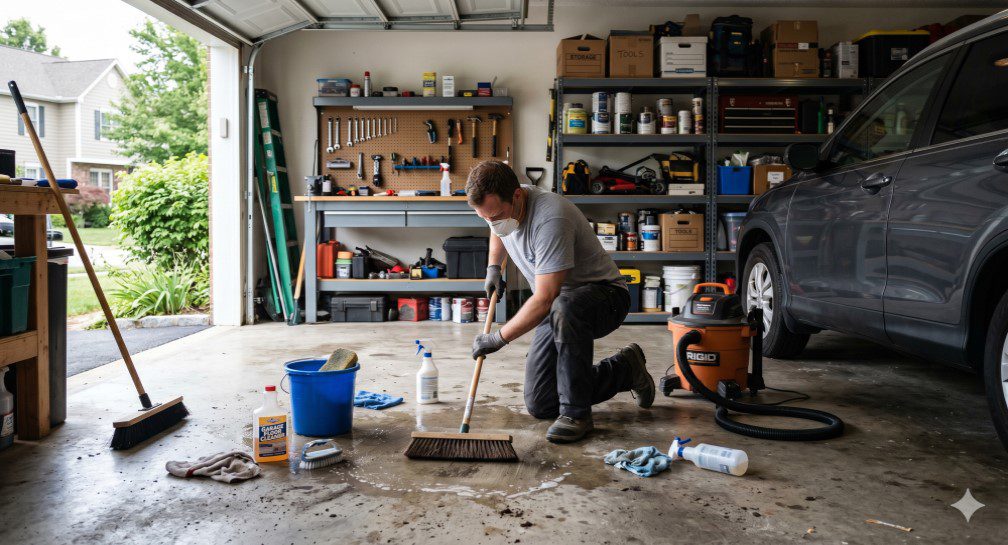
The “Pressure Washer Mistake”: You rent a pressure washer, point it at your garage floor, and spend two hours blasting every square inch. The floor looks a little better wet. Then it dries. The oil stains are still there. The tire marks are still there. You’ve just wasted two hours and $50 because you cleaned the surface without treating the stain.
Garage floor cleaning is chemistry, not just power. A pressure washer removes loose dirt and debris. It does almost nothing to polymerized oil stains, tire marks, or concrete efflorescence — because those stains are either chemically bonded to the concrete or driven deep into its pores.
This guide explains the chemistry, matches the right chemical to each stain type, and gives you a step-by-step process on how to clean a garage floor perfectly.
Understanding Concrete: Why Your Floor Stains So Easily
Concrete is porous — full of microscopic capillaries that absorb liquids by capillary action. When oil drips onto concrete, it doesn’t just sit on the surface. It wicks downward through the concrete matrix, driven by gravity and absorption. The deeper it goes, the harder it is to remove.
Polymerization is the other enemy. Fresh oil is relatively easy to clean. But motor oil exposed to heat (from a hot engine) and UV light (from sunlight through the garage door) begins to polymerize — essentially curing like a varnish and bonding chemically to the concrete. Old, dark oil stains are largely polymerized and require alkaline degreasers (not just soap and water) to break the bond.
Concrete porosity scale: New concrete is highly porous. Sealed or epoxy-coated concrete is much less porous — which is exactly why sealed floors are dramatically easier to clean. Unsealed concrete is essentially a sponge on your garage floor.
If your concrete is clean but still bare and porous, now is the time to seal it. Read our Best Garage Flooring 2026 guide for the best protective coatings.
Stain Type Identification Guide
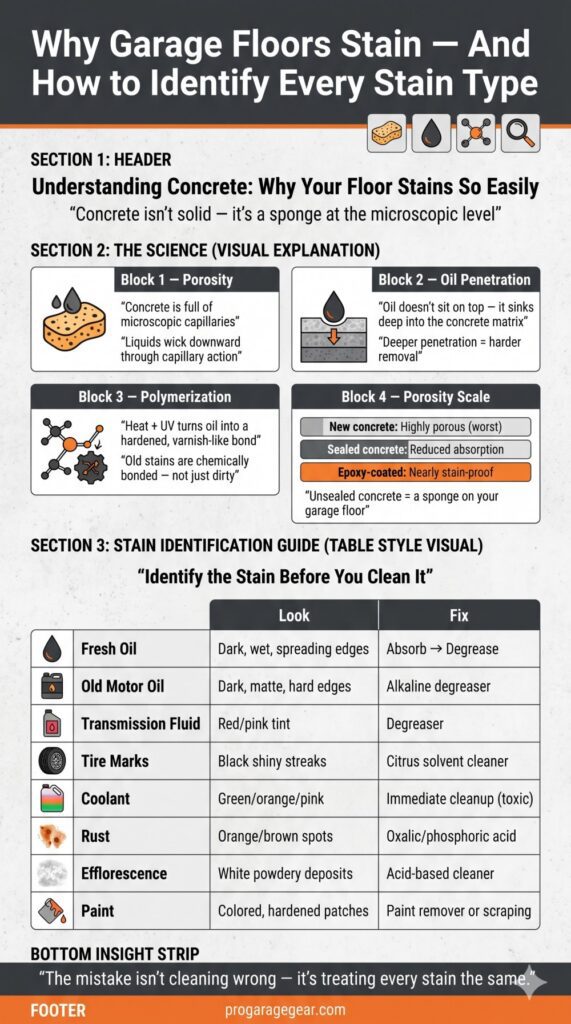
Before you choose a cleaning method, identify what you’re dealing with:
| Stain Type | Visual Characteristics | Cleaning Method |
|---|---|---|
| Fresh oil (< 24 hours) | Dark, wet-looking, spreads at edges | Absorb first, then degrease |
| Old motor oil (polymerized) | Dark brown/black, hard edges, matte finish | Alkaline degreaser + agitation |
| Transmission/power steering fluid | Red or pink tint | Same as motor oil, degrease |
| Tire marks (rubber transfer) | Black streaks, often shiny | Citrus degreaser or solvent cleaner |
| Coolant/antifreeze | Green, orange, or pink, sweet smell | Soak immediately — hazardous to animals |
| Rust stains | Orange/brown, often under corroded items | Oxalic acid or phosphoric acid cleaner |
| Efflorescence (white mineral deposits) | White, powdery, crystalline | Diluted muriatic acid or phosphoric acid |
| Paint | Hard, colored, often chipped | Paint stripper or mechanical removal |
The 6-Step Garage Floor Cleaning Process
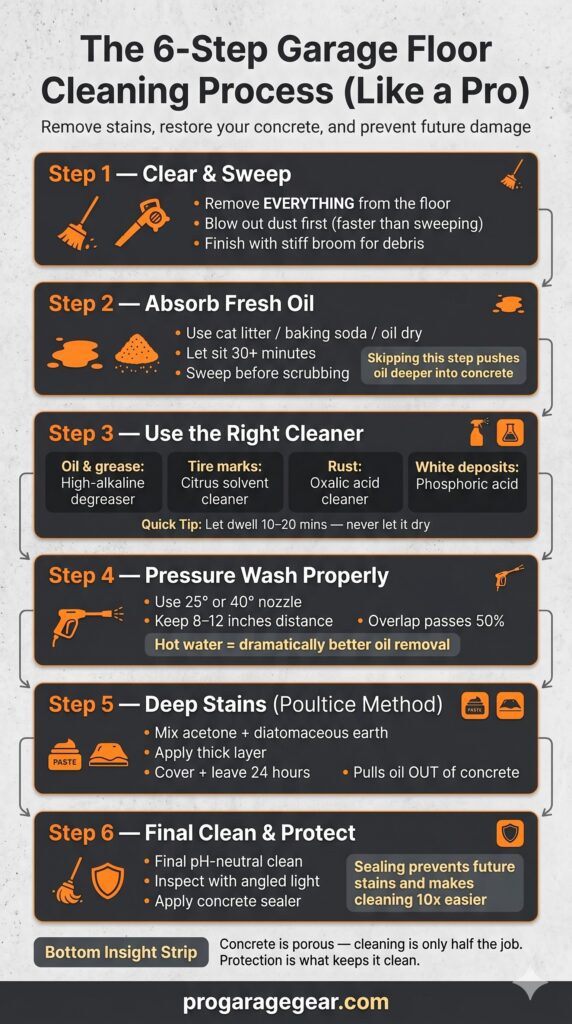
Step 1: Remove Everything from the Floor
You cannot clean a floor covered in stuff. Remove all vehicles, tools, furniture, and items. Sweep the entire floor with a stiff broom to remove loose debris, sand, and grit. A leaf blower used on the garage floor is faster and more thorough than sweeping — use it first, then collect with a broom.
Step 2: Deal With Fresh Oil Immediately
Fresh oil (less than 24 hours) can be largely removed before it penetrates deep:
- Pour cat litter, baking soda, or commercial oil dry on the fresh spill. These are absorbent materials that wick oil back out of the surface pores.
- Let sit for 30 minutes minimum (longer for thicker spills).
- Sweep up and discard in a sealed bag (oil-soaked cat litter is hazardous waste in many jurisdictions — check local disposal rules).
- Apply degreaser to the remaining stain (Step 3).
The #1 mistake: People skip the absorption step and go straight to scrubbing, which pushes the oil deeper into the concrete instead of removing it.
Step 3: Apply the Right Degreaser
For motor oil, grease, and fluid stains: Use a high-alkalinity concrete degreaser (pH 12–14). Products like Zep Driveway and Concrete Cleaner, Purple Power Degreaser, or Krud Kutter are effective and widely available.
Application process:
- Apply undiluted to the stain
- Let dwell for 10–20 minutes (do not let it dry)
- Work in with a stiff-bristle brush — not a nylon brush, which won’t provide enough agitation. A wire-bristle brush on concrete damages the surface over time; a polypropylene bristle brush is the right tool.
- Rinse with hot water (hot water cuts grease better than cold)
- Repeat for severe or old stains
For tire marks (rubber transfer): Use a citrus-based solvent degreaser (Simple Green Pro HD, or dedicated tire mark cleaner). Rubber transfers are not oil-based — they’re hydrocarbon polymer residues. An alkaline degreaser has limited effect. Citrus-solvent formulations dissolve rubber residue more effectively.
🛒 Check Price on Amazon →For rust stains: Use oxalic acid-based concrete cleaner (available as “wood brightener” or concrete rust remover). Apply, let dwell 15 minutes, agitate, rinse. Do not use on newly sealed concrete — the acid can etch the sealant.
🛒 Check Price on Amazon →For efflorescence (white mineral deposits): Use a phosphoric acid-based concrete cleaner (diluted 1:10 with water for light deposits, 1:5 for heavy). Apply, let dwell 5–10 minutes — efflorescence dissolves on contact with acid. Rinse thoroughly. Neutralize with baking soda solution afterward.
⚠️ Safety warning: Always wear nitrile gloves, eye protection, and old clothing when working with concrete degreasers and acid-based cleaners. Work with the garage door open — ventilation is non-negotiable.
Cleaning chemicals and vehicle exhaust in enclosed garages create serious air quality risks. Read our Attached Garage Health Risks guide before working with chemical cleaners.
Step 4: Pressure Wash or Hot-Water Rinse
After degreasers have been agitated, rinse thoroughly with a pressure washer or garden hose at full pressure. Start at the far end of the garage and work toward the door, pushing dirty water out.
Pressure washer tips for concrete:
- Use a 25-degree (green) or 40-degree (white) nozzle — 0-degree (red) nozzles will damage concrete surfaces over time
- Keep the nozzle 8–12″ from the surface
- Overlap passes by 50% for consistent cleaning
- Work in sections, not random patterns
For oil stains, hot water rinses are significantly more effective than cold. If you have access to a hot water source, use it.
If you’re considering a pressure washer for ongoing garage maintenance, see our Best Wall Mount Pressure Washer guide for permanent setups that make this task easy.
Step 5: Address Remaining Stains with the “Poultice Method”
For old, set motor oil stains that didn’t fully respond to Steps 2–4, use the poultice method — the most effective technique for drawing oil out of concrete.
Poultice recipe:
- Mix one cup of acetone (nail polish remover) with 2 cups of diatomaceous earth (or fuller’s earth) to create a paste the consistency of peanut butter
- Apply a 1/4″ thick layer over the stain, extending 1″ beyond the stain edge
- Cover with plastic sheeting and tape the edges to prevent evaporation
- Let sit for 24 hours
- Remove the dried poultice and dispose
- Repeat if necessary
The poultice works by capillary action in reverse — the diatomaceous earth is more porous than the concrete, and the acetone solvent carrier causes the oil to migrate from the concrete into the poultice paste.
Step 6: Final Clean and Optional Sealing
After all stains are treated and the floor has fully dried (24–48 hours minimum):
- Do a final sweep and mop with a pH-neutral concrete cleaner
- Inspect under bright light (use a work light angled across the floor — raking light reveals surface texture and remaining stains)
- Apply concrete sealer or floor coating for long-term protection
The best long-term solution: A penetrating concrete sealer ($40–$80 for a 2-car garage) fills the surface pores and dramatically reduces future stain absorption. Applied after a thorough clean, it makes every future cleanup 10 times faster.
♻️ Responsible Cleanup: Safe Disposal and Environmental Protection
This is the section most garage floor cleaning guides skip entirely — which is exactly why including it makes this guide more trustworthy, more complete, and frankly more responsible.
The Legal Reality: Pouring oil-saturated rinsewater, acid-based cleaners, or chemical degreasers down your driveway and into the storm drain is illegal in all 50 U.S. states under the Clean Water Act. Storm drains go directly to waterways — not to a treatment plant. A single cleanup of a heavily oil-stained garage floor can release enough hydrocarbon contamination to affect local water quality.
Responsible Disposal: Step-by-Step
For Oil-Contaminated Waste (cat litter, rags, poultice material):
- Place in a sealed plastic bag or metal container with a lid
- Do not put in regular trash in most jurisdictions
- Find your local disposal site at: Earth911.com — enter “motor oil” and your zip code for the nearest certified drop-off
- Many AutoZone, O’Reilly, and Advance Auto Parts stores accept small quantities of oil-saturated materials for free
For Degreaser Rinse Water:
- Allow most of the water to evaporate from the surface before rinsing
- Do not flush high-concentration degreaser directly to storm drain
- Dilute thoroughly with at least 10:1 water before allowing surface runoff
- Where possible, rinse into a floor drain connected to the municipal sewer system (not a storm drain — check which type your garage drain connects to)
For Acid-Based Cleaners (oxalic acid, phosphoric acid, muriatic acid):
⚠️ This step is mandatory before rinsing. Acid must be neutralized before it contacts any drain or soil.
Acid Neutralization Protocol:
- After the acid has done its work, sprinkle baking soda liberally across the treated area (1 cup per 4 sq. ft.)
- You will see fizzing — this is the acid reacting with the sodium bicarbonate and being neutralized
- When fizzing stops completely, the acid is neutralized
- Now it is safe to rinse with water
- Test the rinse water with a pH test strip (pool test strips work) — target pH 6–8 before allowing runoff
For Paint Thinner, Solvents, and Acetone:
- Never rinse solvents with water — this spreads contamination
- Collect in an approved hazardous waste container
- Dispose at your local Household Hazardous Waste (HHW) facility
- Find yours at: EPA.gov/recycle → “Household Hazardous Waste”
For Antifreeze Spills: Antifreeze (ethylene glycol) is acutely toxic to animals and children. It has a sweet smell that attracts pets who then consume a lethal quantity.
- Absorb with cat litter or sand immediately — do not hose off
- Dispose as hazardous waste
- Flush the area with large quantities of water only after the liquid is fully absorbed and removed
The “Which Drain” Question
Many homeowners don’t know which type of drain their garage connects to. Here’s how to find out:
- Floor drain in the garage: Usually connects to the municipal sanitary sewer. This drain is acceptable for diluted cleaning products but NOT for high concentrations of oil, acid, or solvents.
- Driveway drain or curb outlet: This is almost always a storm drain. Treat it as if it connects directly to a river, because functionally — it does.
- Unknown: Contact your local water utility. They can tell you exactly what your drains connect to. This is a free call and takes 5 minutes.
The Bottom Line on Disposal: Doing the right thing here costs you nothing extra — just a few extra minutes. Earth911.com and the EPA’s HHW locator are free. Certified drop-offs are free. The environmental consequence of not doing it is not free — and neither is the potential fine.
Ongoing Maintenance: Preventing Stains Before They Start
Oil drip mat under vehicles: A simple absorbent mat under your parked vehicle’s engine bay catches drips before they hit the concrete. Change when saturated.
Floor coating: Epoxy, polyurea, or polyaspartic floor coatings create a non-porous surface that’s impervious to oil, chemicals, and tire marks. The investment pays off in every single cleanup for the next 10–20 years.
“Clean as you go” rule: Wipe fresh spills within 30 minutes. This is the single most effective maintenance habit in any garage. Fresh spills clean in 2 minutes. Polymerized stains take 2 hours.
Shop vacs are essential for wet spills and post-cleaning debris. See the Best Shop Vacs of 2025 for models with wet pickup capability.
Will bleach clean an oil stain?
No. Bleach is an oxidizer — it reacts with organic matter and produces color-change (which is why it whitens fabric). Motor oil is a hydrocarbon, and bleach does not break the hydrocarbon bonds. It may lighten the stain slightly but won’t remove it. Use alkaline degreasers for oil.
How do I remove old antifreeze stains?
Antifreeze (ethylene glycol) stains are water-soluble when fresh, but older stains can leave a colored residue. Clean with a degreaser and hot water. More critically: antifreeze is attractive and toxic to pets. Clean it up immediately when spilled and flush the area thoroughly.
Can I use muriatic acid to clean my garage floor?
Muriatic acid is effective for heavy mineral deposits and as a concrete etching preparation before coating. But it’s aggressive — it damages concrete if left too long, produces dangerous fumes, and must be neutralized after use. Use phosphoric acid-based cleaners first; they’re safer and effective for most residential cleaning tasks.
How long does concrete need to dry after cleaning before sealing?
Minimum 24 hours in moderate conditions (65–75°F, low humidity). In cold or humid conditions, wait 48–72 hours. Sealing or coating wet concrete traps moisture beneath the coating, causing delamination (peeling) within weeks.
FAQs
Q: A:
Q: A:
Q: A:
Q: A:
The Bottom Line
Your garage floor is the foundation of your workspace. A dirty, stained floor isn’t just an eyesore — it’s a slip hazard, it masks cracks and damage, and it sets the tone for the entire garage. A clean floor makes every project cleaner, safer, and more enjoyable.
Treat the chemistry. Match the cleaner to the stain. Use the poultice for old oil. And once clean, protect it so cleaning next time takes 20 minutes instead of 4 hours.
Your garage floor can look like new. It just needs the right approach.