
Best Battery Trickle Chargers & Maintainers for Garage Storage 2026: Why “Trickle” Can Kill Your Battery
Affiliate Disclosure: Pro Garage Gear earns from qualifying Amazon purchases at no extra cost to you.
The “Dead Classic” Discovery: You pull the cover off your classic car after a 6-month winter storage. You get in. You turn the key. Click. Nothing. The battery is dead — fully discharged, sulfated, and ruined. You go to the auto parts store and pay $180 for a replacement. This happens every spring to thousands of car, motorcycle, boat, and RV owners — and it’s completely preventable with a device that costs $25–$80 and draws less power than a night light.
But here’s what most buyers get wrong: not all battery chargers protect batteries during storage. A traditional “trickle charger” applies a constant low current — and if left connected for weeks, it overcharges and damages the battery it was supposed to protect. What you actually need is a smart battery maintainer — a device with battery management intelligence that monitors voltage and stops charging when the battery is full.
This distinction costs people hundreds of dollars every year in ruined batteries.
Trickle Charger vs. Smart Maintainer: The Critical Difference
| Feature | Traditional Trickle Charger | Smart Battery Maintainer |
|---|---|---|
| Output type | Constant low amperage | Pulsed / float-mode adaptive |
| Monitors battery state? | No | Yes |
| Safe for months of storage? | No — overcharges over time | Yes — designed for indefinite connection |
| Handles sulfated batteries? | No | Yes (most have desulfation mode) |
| Multiple battery types? | Usually one type | Usually AGM, Gel, Calcium, Standard |
| Price range | $10–$30 | $25–$150 |
The chemistry of overcharging: When a fully charged 12V battery is continuously charged at even a low rate, electrolysis accelerates — water splits from the electrolyte and escapes as hydrogen and oxygen gas. The electrolyte level drops. The plates dry out. Sulfate crystals form permanently. A battery in this state loses 20–40% of its capacity after one overcharge cycle and deteriorates exponentially with each subsequent cycle.
A smart maintainer prevents this entirely through multi-stage charging logic.
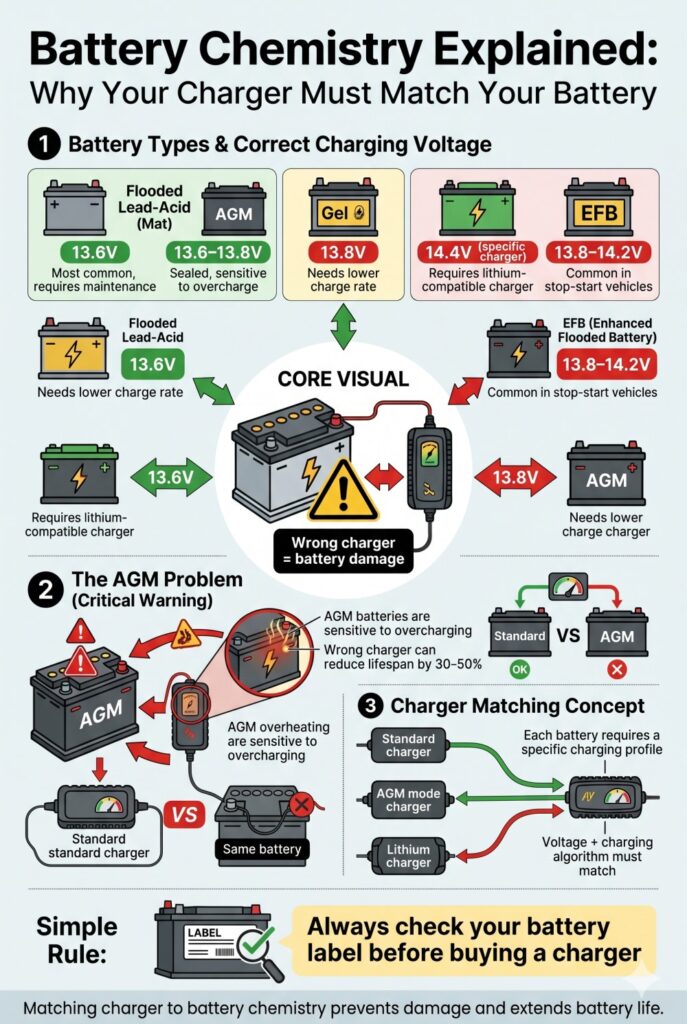
Understanding Battery Chemistry: Why Your Charger Must Match Your Battery
Not all 12V batteries are the same. Using the wrong charger profile damages the battery:
| Battery Type | Charging Voltage (Float) | Notes |
|---|---|---|
| Flooded Lead-Acid (standard) | 13.6V | Most common; requires maintenance access |
| AGM (Absorbed Glass Mat) | 13.6–13.8V | Sealed; more sensitive to overcharge |
| Gel | 13.8V | Sensitive; requires lower charge rate |
| Lithium (LiFePO4) | 14.4V specific | Requires lithium-specific charger |
| EFB (Enhanced Flooded Battery) | 13.8–14.2V | Common in modern stop-start vehicles |
The AGM problem: Modern vehicles increasingly use AGM batteries for their superior performance in stop-start systems. AGM batteries are significantly more sensitive to overcharging than standard lead-acid — a charger that works perfectly on a standard battery will reduce an AGM battery’s life by 30–50% if it doesn’t have an AGM-specific charging profile.
Check your vehicle’s battery label before buying any charger.
2026 Rankings: Best Battery Trickle Charger & Maintainers for Garage Storage
🥇 #1 — NOCO GENIUS5 5-Amp Smart Charger (Best All-Around)
Compatibility: 6V and 12V; Flooded, AGM, Gel, Lithium Output: 5 amps (4 charging modes) Storage Mode: Yes — float maintenance indefinitely Desulfation Mode: Yes Weatherproof: IP65
The NOCO GENIUS5 is the benchmark smart maintainer because it handles more battery types and situations than any competitor in its price range. The 5-amp output fast-charges a dead battery (100Ah to 80% in ~16 hours) while the intelligent storage mode safely maintains a full battery indefinitely.
The standout feature: thermal compensation. The charger adjusts its charging voltage based on ambient temperature — a detail that matters enormously in garages that see 20°F in January and 100°F in July. Most cheap maintainers apply the same voltage regardless of temperature, which means they overcharge in warm conditions.
The IP65 weatherproof rating means it survives the humidity, dust, and temperature swings of a working garage indefinitely.
🥈 #2 — Battery Tender Plus 12V, 1.25 Amp (Best for Classic Cars / Long-Term Storage)
Compatibility: 12V flooded and sealed lead-acid Output: 1.25 amps Storage Mode: Yes — float mode Desulfation Mode: No Warranty: 5 years
The Battery Tender Plus is the original smart battery maintainer — the benchmark against which all others are measured — and it’s earned that position through 20+ years of reliable service in millions of garages. The 1.25-amp output is gentler than the NOCO, making it the preferred choice for long-term winter storage of classic cars and motorcycles.
It’s not the most sophisticated charger available, but for its core purpose — keeping a classic car battery healthy over a 5-month storage period — it has a track record that newer chargers haven’t had time to earn.
🥉 #3 — CTEK MXS 5.0 12V Battery Charger (Best for European/Modern Vehicles)
Compatibility: 12V; all lead-acid chemistries including calcium Output: 5 amps (8-step charging) Storage Mode: Yes — reconditioning mode included Desulfation Mode: Yes (aggressive reclamation mode) Certifications: Multiple European OEM approvals (BMW, Porsche, Volvo specify CTEK)
CTEK is the charger recommended by European automakers and is the OEM-specified maintainer for several premium brands. The 8-step charging algorithm includes a dedicated reconditioning mode that attempts to recover deeply discharged batteries through controlled desulfation pulses — often recovering batteries that a standard charger would declare dead.
For owners of modern European vehicles (which almost universally use AGM or EFB batteries), CTEK’s calibrated charging profiles are the safest option.
The Complete Product Comparison Table
| Charger | Voltage | Amps | Battery Types | Desulfation | IP Rating | Best For | Amazon |
|---|---|---|---|---|---|---|---|
| NOCO GENIUS5 | 6V/12V | 5A | Flooded/AGM/Gel/Li | Yes | IP65 | All-around best | View → |
| Battery Tender Plus | 12V | 1.25A | Flooded/Sealed | No | IP — | Long-term storage | View → |
| CTEK MXS 5.0 | 12V | 5A | All lead-acid | Yes | IP44 | European vehicles | View → |
| NOCO GENIUS1 | 6V/12V | 1A | Flooded/AGM/Gel/Li | Yes | IP65 | Motorcycles/ATV | View → |
| NOCO GENIUS10 | 6V/12V/24V | 10A | Flooded/AGM/Gel/Li | Yes | IP65 | Trucks/RVs/Boats | View → |
Garage Storage Best Practices: Beyond the Charger
Disconnect the negative terminal before long storage: Modern vehicles draw 20–80 milliamps in “parasitic” standby loads (alarm, computer memory, clock). Over 3 months, this fully discharges even a new battery. Disconnect the negative terminal and maintain with a tender.
Check electrolyte levels before storage (flooded batteries only): Sealed AGM and gel batteries require no electrolyte maintenance. Flooded batteries should have cells topped with distilled water (never tap water — mineral content attacks the plates) before storage.
Temperature and storage location matter: A battery stored at 32°F discharges 2–3x faster than one stored at 60°F. If possible, bring the battery indoors during extreme cold storage. A maintained battery at 60°F in your garage significantly outlasts one sitting at 10°F with no maintainer.
🔬 Finding Your Battery Killer: The 3-Step Parasitic Draw Test
You’ve installed the maintainer. You disconnect it in spring. The battery dies again by July — even though the car is being driven regularly. The maintainer was doing its job. The real problem is a parasitic draw — a component in your vehicle that’s draining the battery when the car is off, faster than normal driving can recharge it.
Modern vehicles have 20–80 milliamp standby draws (alarm, clock, computer memory). A parasitic draw fault is anything above 50 milliamps — a stuck relay, a faulty module, or a dome light that doesn’t turn off fully. At 500mA of parasitic draw, a 60Ah battery goes fully flat in 5 days.
Here’s how to find it before replacing another battery.
The 3-Step Parasitic Draw Test
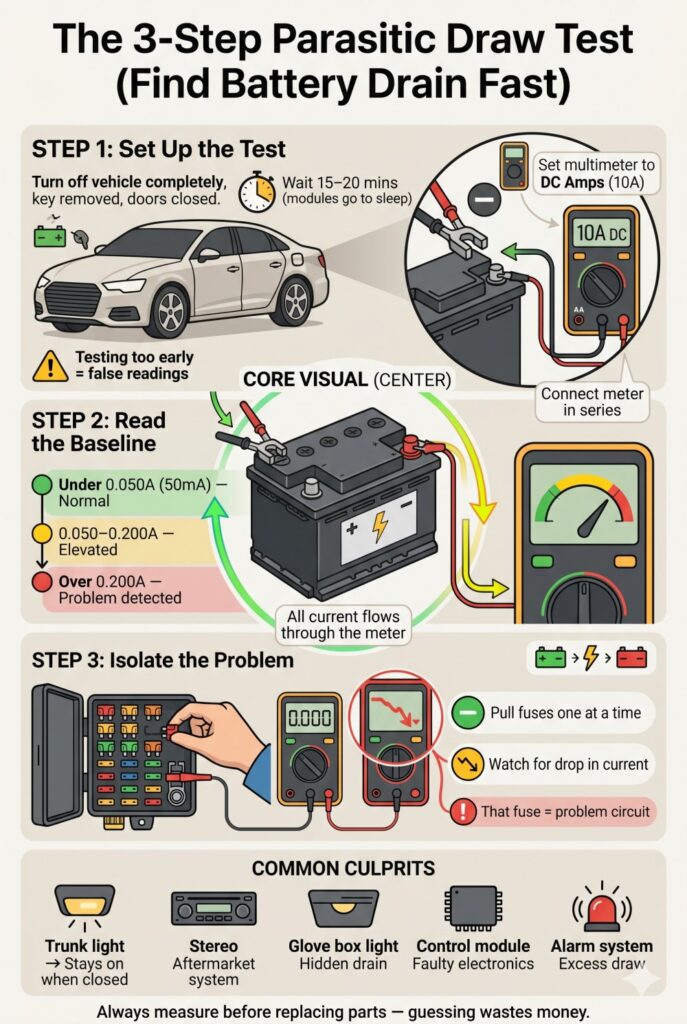
What you need: A digital multimeter with a 10-amp DC current setting.
➡️ Shop Digital Multimeter on Amazon
Step 1 — Set Up the Test:
- Turn off the vehicle completely. Remove the key. Close all doors.
- Wait 15–20 minutes — modern vehicle modules need time to “go to sleep.” Testing too early gives false high readings from modules still active.
- Set your multimeter to DC Amps (10A range).
- Disconnect the negative battery terminal.
- Connect the multimeter in series: one probe to the negative terminal, one probe to the negative battery cable. The circuit is now: battery → multimeter → vehicle. All parasitic loads now flow through your meter.
Step 2 — Read the Baseline: Your meter now shows the total parasitic draw.
- Under 50 milliamps (0.050A): Normal. Your battery drain is not from a parasitic draw fault.
- 50–200 milliamps: Elevated. Should be investigated, especially if you’re seeing weekly discharge.
- Over 200 milliamps: Definite parasitic draw fault. Something is staying active when the car is off.
Step 3 — Isolate the Circuit: If you find elevated draw: go to your fuse box (both under-hood and cabin fusebox). Pull fuses one at a time while watching the meter. When pulling a fuse causes the reading to drop significantly — that circuit is your culprit. Cross-reference the fuse label in your owner’s manual to identify which system the circuit controls.
Common culprits: Trunk light (won’t turn off with lid slightly ajar), aftermarket stereo, faulty BCM (Body Control Module), alarm system drawing in excess of spec, glove box light.
🔧 The “Complete Battery Maintenance Kit” Bundle
Rather than just a maintainer, recommend pairing these three items for a complete garage battery health station:
| Item | Purpose | Amazon |
|---|---|---|
| NOCO GENIUS5 Smart Maintainer | Smart charging and storage maintenance | Check Price → |
| Digital Multimeter (auto-ranging) | Parasitic draw testing + voltage checks | Check Price → |
| Battery Terminal Cleaner Brush | Removes oxidation from terminals before connecting | Check Price → |
| Battery Terminal Protector Spray | Prevents future corrosion on terminals | Check Price → |
| Battery Load Tester | Tests battery under load (not just voltage) | Check Price → |
The Full Kit Cost: ~$80–$120 total. The cost of a dead battery replacement: $80–$200. The cost of a tow: $75–$150. The kit pays for itself the first time it either prevents a replacement or helps you diagnose a parasitic draw before it kills another battery.
Can I leave a smart maintainer connected all year?
Yes — that’s exactly what they’re designed for. In float mode, a quality smart maintainer draws almost no power and keeps the battery at peak charge indefinitely.
My battery is completely dead. Will a maintainer recover it?
Possibly, if it has a desulfation mode (NOCO and CTEK do). However, batteries discharged below 10.5V for extended periods often have permanent plate damage that no charger can reverse. The desulfation mode is more effective on batteries that went flat recently than on ones stored dead for a full winter.
Can I use a car battery maintainer on a motorcycle battery?
Use a charger designed for your battery’s capacity. The NOCO GENIUS1 (1 amp) is designed for small batteries (motorcycles, ATVs, powersports). The GENIUS5 at 5 amps can be used on motorcycles but may be unnecessarily fast for their smaller batteries.
The Bottom Line
For most garage storage scenarios in 2026, the NOCO GENIUS5 is the correct choice — it handles every battery chemistry, charges intelligently in all temperatures, and maintains indefinitely without overcharging. If you’re storing a classic car specifically and want the most conservative, proven option: the Battery Tender Plus has 20 years of verified track record.
A $40 maintainer has prevented more dead batteries than all the roadside assistance calls combined. Plug it in before the first frost and forget about it until spring.