
Best Garage Shelving 2026: The Tote Depth Rule, the Weight Stack Limit, and the 6 Systems That Actually Hold What You Put in Them
By Pro Garage Gear Team Last Updated: July 2026
Disclosure: This post contains affiliate links. As an Amazon Associate, we earn from qualifying purchases. This helps us keep the lights on in the shop!
Best Garage Shelving ideas – The Shelf Too Shallow to Use: The most common garage shelving purchase mistake costs nothing to prevent and is discovered only after the shelving is assembled, anchored to the wall, and the first load of storage totes is placed on it.
The standard large storage tote — the HDX 27-gallon model sold at Home Depot, the Sterilite 30-gallon, the Costco Kirkland — is 22 inches deep front to back. The standard wire shelving unit sold for garage use is 18 inches deep. The tote extends 4 inches past the front edge of the shelf. The shelf cannot hold the tote safely in any stable configuration, the tote overhangs and tips forward under load, and the garage owner now has $200 worth of shelving that physically cannot hold the totes that were sitting on the garage floor before it was installed.
This single measurement incompatibility — shelf depth versus tote depth — is responsible for more returned garage shelving than any product defect. It is also never mentioned in any of the “15 genius shelving ideas” articles that dominate this keyword. Those articles tell you which shelving looks good. This guide tells you which shelving works — and the three measurements you need to take before purchasing any system.
Three Measurements to Take Before Purchasing Any Shelving
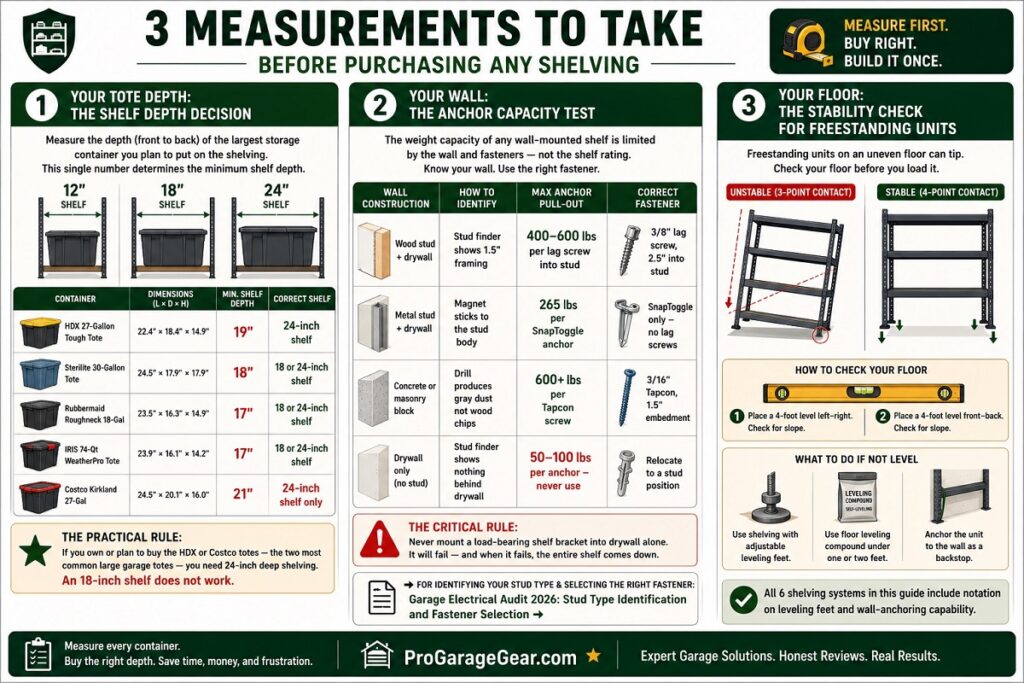
Measurement 1 — Your Tote Depth: The Shelf Depth Decision
Measure the depth (front to back) of the largest storage container you plan to put on the shelving. This single number determines the minimum shelf depth for your installation.
Standard shelf depths in the residential shelving market are 12 inches, 18 inches, and 24 inches. Most wire shelving units are sold in 18-inch depth. Most heavy-duty steel shelving units offer 18 or 24-inch options. Here is how common storage containers map to these depths:
| Container | Dimensions (L × D × H) | Min. Shelf Depth | Correct Shelf |
|---|---|---|---|
| HDX 27-Gallon Tough Tote | 22.4″ × 18.4″ × 14.9″ | 19 inches | 24-inch shelf |
| Sterilite 30-Gallon Tote | 24.5″ × 17.9″ × 17.9″ | 18 inches | 18 or 24-inch shelf |
| Rubbermaid Roughneck 18-Gal | 23.5″ × 16.3″ × 14.9″ | 17 inches | 18 or 24-inch shelf |
| IRIS 74-Qt WeatherPro Tote | 23.9″ × 16.1″ × 14.2″ | 17 inches | 18 or 24-inch shelf |
| Costco Kirkland 27-Gal | 24.5″ × 20.1″ × 16.0″ | 21 inches | 24-inch shelf only |
The practical rule: If you own or plan to buy the HDX or Costco totes — the two most commonly purchased large garage totes at big-box stores — you need 24-inch deep shelving. An 18-inch shelf does not work. Verify the depth of every container that will go on the shelves before selecting a shelf depth.
Measurement 2 — Your Wall: The Anchor Capacity Test
Every wall-mounted shelving system — brackets, French cleats, track systems — transfers its load to the wall through fasteners. The weight capacity of any wall-mounted shelf is not the shelf’s own rating: it is the lower of the shelf rating and the fastener capacity into your specific wall material.
The three common garage wall constructions and their anchor capacity:
| Wall Construction | How to Identify | Maximum Anchor Pull-Out | Correct Fastener |
|---|---|---|---|
| Wood stud + drywall | Stud finder shows 1.5″ framing | 400–600 lbs per lag screw into stud | 3/8″ lag screw, 2.5″ into stud |
| Metal stud + drywall | Magnet sticks to the stud body | 265 lbs per SnapToggle anchor | SnapToggle only — no lag screws |
| Concrete or masonry block | Drill produces gray dust not wood chips | 600+ lbs per Tapcon screw | 3/16″ Tapcon, 1.5″ embedment |
| Drywall only (no stud) | Stud finder shows nothing behind drywall | 50–100 lbs per anchor — never use | Relocate to a stud position |
The critical rule: Never mount a load-bearing shelf bracket into drywall alone. The 50–100 lb pull-out resistance of a drywall anchor is reached and exceeded by a single shelf loaded with paint cans, tool sets, or storage totes. Drywall-only mounting fails at the anchor under sustained load — and when it fails, the entire shelf system comes down simultaneously.
➡️ For identifying your stud type and selecting the correct fastener: Garage Electrical Audit 2026: Stud Type Identification and Fastener Selection →
Measurement 3 — Your Floor: The Stability Check for Freestanding Units
Freestanding shelving units stand on four feet. If the garage floor has a slope, a crack, or a low spot under one foot, the unit stands on three feet — the diagonal from the high corner to the low corner. A 6-foot tall steel shelving unit with 600 lbs of load distributed across five shelves becomes significantly top-heavy when standing on three feet. The stability condition changes from four-point balanced support to three-point unstable configuration.
Before purchasing a freestanding unit, place a 4-foot level on the floor in the planned installation location along both the left-right axis and the front-back axis. Any measurement showing more than 1/4-inch slope across 4 feet requires either: adjustable leveling feet on the shelving unit (specified in the product data), a floor levelling compound under one or two feet, or wall-anchoring the unit as a backstop even if it is a “freestanding” design.
All six shelving systems ranked in this guide include a notation on whether leveling feet are included and whether the unit can be anchored to the wall as a safety measure.
The Zone Architecture: Where to Put Each Shelf
The most efficient garage shelving layout is not about filling every wall — it is about matching access frequency to shelf height so the things used most often require the least effort to retrieve and return.
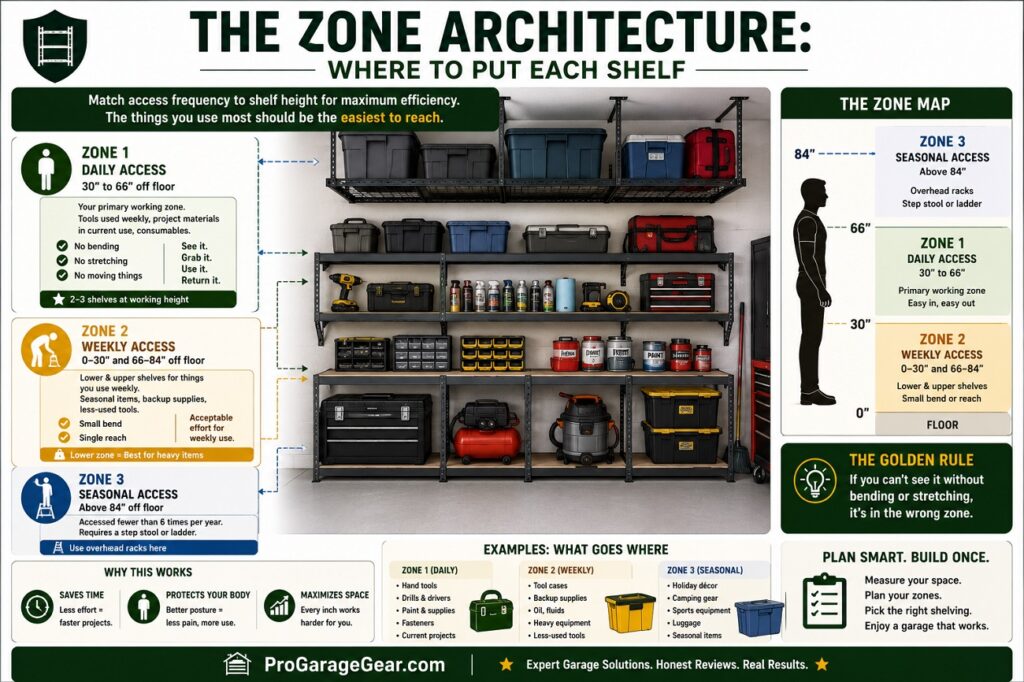
Zone 1 — Daily Access (Waist to Eye Height: 30 to 66 inches off floor)
This zone is your primary working zone. Tools used weekly, project materials in current use, consumables like paint, fasteners, and lubricants. Every item in Zone 1 should be retrievable and returnable without bending, reaching overhead, or moving anything else. If you cannot see the item without crouching or stretching, it is in the wrong zone. Zone 1 shelving is typically 2–3 shelves of wall-mounted or freestanding shelving at working height.
Zone 2 — Weekly Access (Below Waist and Above Eye: 0–30 inches and 66–84 inches)
The lower shelves below waist height and the upper shelves between eye level and comfortable reach. Seasonal project materials, backup consumables, less-used tools. Requires a small bend or a single reach — acceptable for weekly access, inconvenient for daily. Lower Zone 2 (floor level) is the correct location for heavy items: toolboxes, equipment, concrete blocks. Gravity works in your favour — heavy things that are hard to lift high are easy to slide from a low shelf.
Zone 3 — Seasonal Access (Above 84 inches — overhead)
Holiday decorations, camping gear, seasonal sports equipment, anything accessed fewer than 6 times per year. Requires a step stool or ladder. In this zone, overhead rack systems outperform wall-mounted shelving because they span the ceiling rather than consuming wall space that Zone 1 and Zone 2 systems need.
➡️ For overhead rack systems specifically: Best Overhead Garage Storage Racks 2026: Joist Load Ratings and Safe Installation →
The Deflection Problem: When a Shelf Needs a Centre Support
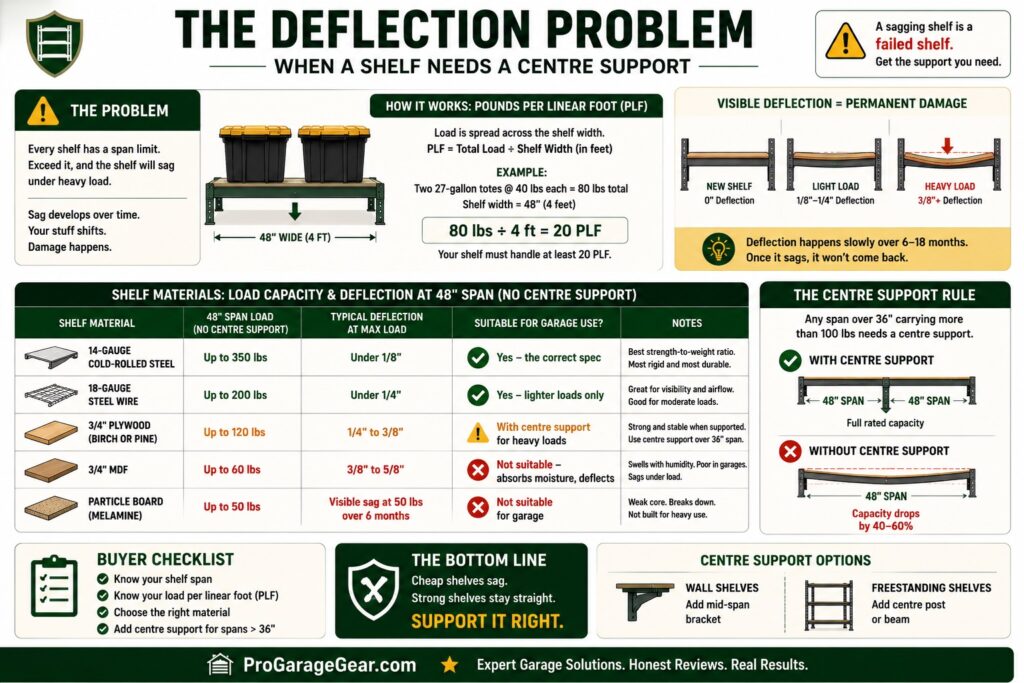
Shelf deflection — the visible sag that develops under a sustained heavy load — is the structural failure mode that buyers least anticipate and shelving manufacturers least discuss. Every shelf has a span limit beyond which the shelf material begins to deflect visibly under a given load. Exceeding this span under typical garage load conditions produces a permanently bowed shelf within 6–18 months.
The relevant specification is pounds per linear foot (PLF) of load relative to the shelf’s span. For a 48-inch wide shelf carrying two 27-gallon totes at 40 lbs each (80 lbs total): the load per linear foot is 80 ÷ 4 = 20 PLF. A 14-gauge steel shelf at 48 inches of span handles this easily with less than 1/4-inch deflection. A particle-board or MDF shelf at the same span under the same load deflects measurably within months.
| Shelf Material | 48″ Span Load (no centre support) | Typical Deflection at Max Load | Suitable for Garage Use? |
|---|---|---|---|
| 14-gauge cold-rolled steel | Up to 350 lbs | Under 1/8″ | ✅ Yes — the correct spec |
| 18-gauge steel wire | Up to 200 lbs | Under 1/4″ | ✅ Yes — lighter loads only |
| 3/4″ plywood (birch or pine) | Up to 120 lbs | 1/4″ to 3/8″ | ⚠️ With centre support for heavy loads |
| 3/4″ MDF | Up to 60 lbs | 3/8″ to 5/8″ | ❌ Not suitable — absorbs moisture, deflects |
| Particle board (melamine) | Up to 50 lbs | Visible sag at 50 lbs over 6 months | ❌ Not suitable for garage |
The centre support rule: Any span over 36 inches carrying more than 100 lbs should have a centre support — either a mid-span bracket for wall-mounted systems or a centre post for freestanding units. The rated shelf capacity in product listings assumes a single mid-span centre support for spans over 36 inches — remove that support and the effective capacity drops by 40–60%.
2026 Rankings: The 6 Best Garage Shelving Systems
🥇 #1 — Edsal UR-241872 Heavy-Duty Steel Shelving (Best Overall Freestanding)
Why it earns #1: The Edsal UR-241872 is the industrial standard for serious garage freestanding shelving — the system that commercial warehouses, auto parts stores, and professional shops use. Five 14-gauge steel shelves at 4,000 lbs total rated capacity, adjustable shelf heights in 1.5-inch increments, and a 24-inch depth that accommodates every common storage tote without overhang. No assembly tools required — all connections are boltless, using interlocking steel clips that assemble in 30 minutes and disassemble without leaving wall damage.
The Data
- Shelf depth: 24 inches — correct for all large storage totes ✅
- Shelf width: 72 inches (6 feet)
- Total height: 72 inches
- Shelf count: 5 shelves (adjustable spacing)
- Total weight capacity: 4,000 lbs (800 lbs per shelf)
- Shelf material: 14-gauge cold-rolled steel
- Frame material: 1.25-inch steel tube, powder coated
- Leveling feet: Yes — adjustable 1 inch
- Wall anchorage: Optional — bracket included for anti-tip anchoring
- Assembly: Boltless — no tools required
The 800 lbs per shelf specification reality: This is the rated capacity under evenly distributed load. In practice a full shelf of 27-gallon totes at 40 lbs each — 9 totes per shelf at 24-inch depth and 72-inch width — reaches 360 lbs per shelf. The Edsal handles this with significant safety margin. The configuration that approaches the limit: engine blocks, cast iron tooling, or concrete products stored on a single shelf concentrated at one position rather than distributed.
The one installation step that every Edsal owner should do: After assembly, use the included anti-tip bracket to anchor the top rear of the unit to the wall stud behind it. The bracket takes 5 minutes to install. A fully loaded 6-foot steel shelving unit at 4,000 lbs is stable on level ground — but on a slightly sloped garage floor, or if a child climbs the shelves, or if a car bumps it during parking: the anchor prevents a catastrophic topple that no freestanding unit can prevent on its own.
🛒 Check Price on Amazon — Edsal UR-241872 Heavy-Duty Steel Shelving →
🥈 #2 — Gladiator GARS774DEG Wall-Mounted Shelving System (Best Wall-Mount)
Why it earns #2: The Gladiator wall-mount system uses a horizontal steel rail anchored to wall studs, from which individual shelf brackets hang and lock in any position across the rail. This track-based architecture means shelves are repositionable without re-drilling — the entire shelf configuration can be changed by unlocking brackets and sliding them to new positions. For a garage where storage needs evolve seasonally, this flexibility is worth the higher price versus fixed-position bracket systems.
The Data
- Shelf depth: 24 inches ✅
- Rail length: 77 inches (fits between standard stud spacing)
- Weight capacity: 200 lbs per shelf
- Adjustability: 3-inch increments across the full rail length
- Shelf material: 16-gauge steel with reinforced edge lip
- Mounting: Wall studs — 3/8″ lag screws into wood studs required
- Finish: Hammertone powder coat — resists chips and rust
- Compatible accessories: Gladiator GearWall hooks, baskets, and bins
The installation sequence that matters: Level the horizontal rail before drilling. A rail that is off-level by even 1/4 inch produces visibly tilted shelves that tip toward the low end under load. Use a 4-foot level across the full rail length, mark both stud positions, confirm the marks are at the same height, then drill. Five minutes with a level prevents an installation that looks wrong for the life of the shelving.
🛒 Check Price on Amazon — Gladiator GARS774DEG Wall-Mount Shelving System →
🥉 #3 — Muscle Rack UR361884PB5P-SV (Best Value Freestanding)
Why it earns #3: The Muscle Rack delivers 18-gauge steel construction, 5 adjustable shelves, and 2,000 lbs total capacity at the lowest cost per pound of rated capacity in the freestanding category. For a garage where the primary storage need is organised rather than heavy — plastic totes, sporting goods, seasonal bins — the Muscle Rack provides correct function at half the cost of the Edsal.
The Data
- Shelf depth: 18 inches — suits Sterilite 30-gal and Rubbermaid Roughneck; not HDX 27-gal or Costco totes ⚠️
- Shelf width: 36 inches
- Total height: 84 inches (7 feet)
- Shelf count: 5
- Total weight capacity: 2,000 lbs (400 lbs per shelf)
- Shelf material: 18-gauge steel
- Leveling feet: Yes — adjustable
- Assembly: Boltless
The 18-inch depth trade-off: Confirm your tote depth before ordering. If you own HDX 27-gallon or Costco Kirkland totes, this shelf depth does not work — order the Edsal at 24 inches instead. If your totes are Sterilite 30-gallon or Rubbermaid Roughneck: the Muscle Rack’s 18-inch depth accommodates them correctly.
🛒 Check Price on Amazon — Muscle Rack UR361884PB5P-SV Freestanding Shelving →
⭐ Best Modular Track System — Rubbermaid FastTrack Garage Storage (Most Flexible)
The Rubbermaid FastTrack uses a horizontal steel rail anchored to studs, on which dozens of compatible accessories — shelves, hooks, baskets, bike holders, cord winders, and sports racks — clip and slide freely. The single rail accommodates every storage type simultaneously: a shelf section for totes, a hook section for bikes, a basket section for balls, and a cord section for extension cords, all on one continuous wall system.
The FastTrack is the correct system for a garage where storage needs are genuinely mixed — tools, bikes, sports, seasonal, automotive — and where the storage configuration needs to change over time without re-drilling. Every accessory slides off and repositions in seconds. No other system in this guide matches this reconfigurability.
The Data
- Rail length options: 20″, 36″, 48″, 60″ — connect multiple rails end-to-end
- Weight capacity per anchor: 175 lbs per 20″ section into studs
- Compatible accessories: 40+ items including shelves, bike hooks, sports racks
- Mounting: Wood stud required — 3/8″ screws included
- Shelf depth (FastTrack shelf add-on): 16 inches
The key limitation to know before buying: The FastTrack rail must hit a stud at least every 40 inches to maintain its load rating. Stud spacing in residential construction is typically 16 inches on-centre — the rail will hit studs at 16, 32, and 48 inches. For a 60-inch rail section, the two end anchors and the centre anchor all hit studs correctly. Where garage wall layouts put studs at non-standard spacing, verify stud positions with a stud finder before purchasing rail lengths.
🛒 Check Price on Amazon — Rubbermaid FastTrack Garage Storage Rail System →
⭐ Best for Small Garages — Fleximounts 2-Pack Wall Shelves (Double Stacked, No Floor Space)
A one-car or small two-car garage where every square foot of floor space matters cannot afford the footprint of a freestanding shelving unit. The Fleximounts wall shelf mounts directly to studs at any height, has zero floor footprint, and in a 2-pack configuration provides two stacked shelves — typically one at Zone 1 height and one at Zone 2 overhead — covering both access levels with one purchase.
The Data
- Shelf depth: 12 inches — correct for smaller bins and individual tool items; not for large totes
- Shelf length: 36 or 48 inches
- Weight capacity per shelf: 220 lbs
- Floor footprint: Zero
- Mounting: Wood stud with included hardware
- Height adjustability: Fixed once installed — position carefully
- Finish: Powder-coated steel
The stud location planning step for the 2-pack: Both shelves in the pair must anchor to the same studs — upper and lower brackets share the stud positions. Before ordering, locate your studs and measure the stud-to-stud span at the planned wall section. If your studs are at 16-inch spacing and your planned wall section is 48 inches wide, you have studs at 16, 32, and 48 inches — three anchor points per shelf. If your section lands between studs, the shelf length does not match your stud layout and you need to shift position or choose a different length.
🛒 Check Price on Amazon — Fleximounts 2-Pack Wall Shelves (Small Garage) →
⭐ Best DIY Option — French Cleat System (Most Adaptable Long-Term)
A French cleat is a 45-degree bevelled strip of plywood anchored horizontally to wall studs. Any shelf, bracket, hook, or holder with a matching 45-degree bevel on its back edge hangs on the cleat and can be repositioned anywhere along the cleat’s length by simply lifting and sliding. The system costs $50–$100 in materials for a full wall versus $200–$600 for commercial track systems — and it is infinitely reconfigurable without any new hardware.
The specification for a structurally sound French cleat: 3/4-inch birch plywood ripped at exactly 45 degrees on a table saw. Each cleat strip anchored with 3-inch screws into every stud it crosses — at a minimum every 16 inches. A cleat anchored only at two points across a 48-inch span will rack sideways under load at the unsupported centre. A cleat anchored into four studs across the same span holds rigidly under any residential garage load.
This is the correct solution for: Anyone comfortable with a table saw, anyone who wants to build custom shelf configurations that no commercial system offers, and anyone whose storage needs change frequently enough that the flexibility of infinite repositionability justifies a half-day of initial installation work.
🛒 Check Price on Amazon — 3/4″ Birch Plywood for French Cleat System →
🛒 Check Price on Amazon — French Cleat Hook and Bracket Set →
Complete Comparison Table
| System | Type | Depth | Capacity | Floor Space | Adjustable | Best For | Amazon |
|---|---|---|---|---|---|---|---|
| Edsal UR-241872 | Freestanding | 24″ ✅ | 800 lbs/shelf | Yes | Yes (1.5″ incr.) | Heavy loads, large totes | Shop → |
| Gladiator GARS774DEG | Wall-mount rail | 24″ ✅ | 200 lbs/shelf | None | Yes (slides) | Reposition without drilling | Shop → |
| Muscle Rack UR361884 | Freestanding | 18″ ⚠️ | 400 lbs/shelf | Yes | Yes (1.5″ incr.) | Budget / lighter loads | Shop → |
| Rubbermaid FastTrack | Modular track | 16″ ⚠️ | 175 lbs/section | None | Yes (slides freely) | Mixed storage — bikes, tools, sports | Shop → |
| Fleximounts 2-Pack | Fixed wall shelf | 12″ ⚠️ | 220 lbs/shelf | None | No | Small garages, floor space recovery | Shop → |
| French Cleat (DIY) | DIY wall system | Custom | Custom | None | Fully custom | Table saw users, custom configurations | Shop → |
The Container Strategy: Getting the Bin and Shelf Decision Right Together
The most functional garage shelving system is designed around the containers that will go on it — not selected first and fitted with containers later. The two decisions (shelf depth and container size) should be made simultaneously, because the wrong sequence produces the shelf-too-shallow problem described in the opening of this guide.
The three-step container strategy:
- Decide what you will store. Heavy items (engine parts, tools, car care products) need rigid totes. Light bulky items (sleeping bags, holiday decorations) can use soft-sided bags or open wire baskets. Uniformly-shaped items (paint cans, spray bottles) can go on open shelves without containers.
- Select the container for each category. Buy one of each container type, measure its depth, and record the maximum depth across all containers.
- Select the shelf depth to match. The shelf depth must equal or exceed the maximum container depth. If you own containers of different depths, either standardise on one container family or select the shelf depth to match the largest.
The container standardisation benefit: Every container being the same brand, size, and depth means every shelf can hold the same number of containers in the same configuration. Standardised containers stack vertically, label consistently, and transfer between shelves without reconfiguration. The one-time cost of replacing mismatched containers with a consistent set pays back in organisation quality and usability immediately.
🛒 Check Price on Amazon — HDX 27-Gallon Tough Totes (Set) →
🛒 Check Price on Amazon — Sterilite 30-Gallon Totes (Set) →
➡️ For the complete garage organisation zone system: Best Garage Power Tool Organizers 2026: The 3-Zone Framework →
➡️ For the 30-day sequenced approach to setting up all garage storage systems: The DIY Garage Makeover 30-Day Plan: The Correct Installation Sequence →
Frequently Asked Questions
How much weight can a wall-mounted garage shelf hold?
The weight limit of any wall-mounted shelf is the lower of two numbers: the shelf’s own rated capacity and the anchor pull-out resistance in your specific wall. A shelf rated at 500 lbs mounted with drywall anchors into drywall alone has an effective limit of 80–100 lbs — the anchor fails long before the shelf does. The same shelf mounted with 3/8-inch lag screws into wood studs develops 400–600 lbs of pull-out resistance per fastener — the shelf’s own rating becomes the limiting factor. Always anchor into studs. The shelf rating is meaningless without the correct anchor specification.
What is the best shelf depth for a garage?
24 inches is the correct depth for any garage where large storage totes are the primary stored item. 18 inches works for medium totes (Sterilite 30-gallon, Rubbermaid Roughneck) and tool storage. 12 inches is suitable only for small items, individual tools, and spray cans. The single most useful pre-purchase action is measuring the depth of the totes you already own — the shelf depth must match or exceed that measurement, or the totes will overhang the front edge and become unsafe.
Can I install garage shelving into metal studs?
Yes, with the correct fastener. Standard lag screws are not appropriate for metal studs — they have insufficient thread engagement in the thin steel flanges of metal stud framing. Use SnapToggle TOGGLER anchors rated at 265 lbs pull-out per anchor. These expand behind the drywall independently of the stud type. For heavy garage shelving in a metal stud garage: verify the stud gauge (20-gauge vs 25-gauge), confirm SnapToggle sizing, and avoid exceeding 150 lbs per anchor point even with correctly installed toggles.
Do freestanding shelving units need to be anchored to the wall?
Technically no — they are designed to be freestanding. Practically yes for any garage where the shelves carry significant load, children may be present, or vehicles park in proximity to the shelving. A fully loaded 6-foot tall freestanding unit at 2,000+ lbs has a high centre of gravity and a narrow base footprint. Contact from a vehicle bumper, a child climbing the shelves, or seismic activity can produce a forward-toppling failure that no freestanding base prevents. An anti-tip bracket anchored to the wall stud behind the unit costs five minutes to install and eliminates this risk category permanently.
How many shelves do I need for a standard 2-car garage?
A useful starting estimate: one 6-foot wide, 5-shelf freestanding unit per car bay for general household overflow storage. For a garage with active workshop use, sports equipment, and seasonal storage simultaneously: two freestanding units plus a modular wall track system on a third wall covers most households. The Zone Architecture framework above provides a more precise method — map what you store, assign each category to a zone, calculate the linear shelf feet each category needs at the correct depth, and size your shelving system from that calculation rather than from a generic recommendation.
The Bottom Line: Measure Before You Buy
Every shelving purchase decision in this guide traces back to three measurements: tote depth, wall construction, and floor levelness. Get those three numbers before ordering and the purchase decision becomes straightforward. Skip them and the most common outcomes are a shelf that does not accommodate the totes you already own, anchors that fail under expected load, or a freestanding unit that rocks on an uneven floor.
For heavy load capacity and large tote compatibility: Edsal UR-241872 at 24-inch depth. For wall-mount flexibility without permanent positions: Gladiator track system. For small garages where floor space is the constraint: Fleximounts 2-pack. For mixed storage including bikes and sports: Rubbermaid FastTrack. For full custom adaptability and a table saw in the shop: French cleat.
Measure the totes first. Everything else follows.
Affiliate Disclosure: Pro Garage Gear earns from qualifying Amazon purchases at no extra cost to you. Weight capacity specifications are manufacturer-stated distributed load ratings. Anchor pull-out values are approximate and vary with concrete or wood species and installation technique.