
Best Garage Workbenches 2026: The Shake Test, the Vise Overhang Rule, and the 7 Benches That Pass Both
By Pro Garage Gear Team Updated July 2026
Disclosure: This post contains affiliate links. As an Amazon Associate, we earn from qualifying purchases. We recommend workbenches that are solid enough to mount a vise on, not wobbly card tables.
The “Kitchen Table” vs. The Command Center.
Best Garage Workbenches – You can have the best impact driver, the sharpest chisels, and the brightest lights, but if you are working on a wobbly folding table—or worse, hunching over on the concrete floor—your projects will suffer. And so will your lower back.
The workbench is not just a table. It is the Command Center of your shop. It is where you clean carburetors, solder wires, glue wood, and plan your next move.
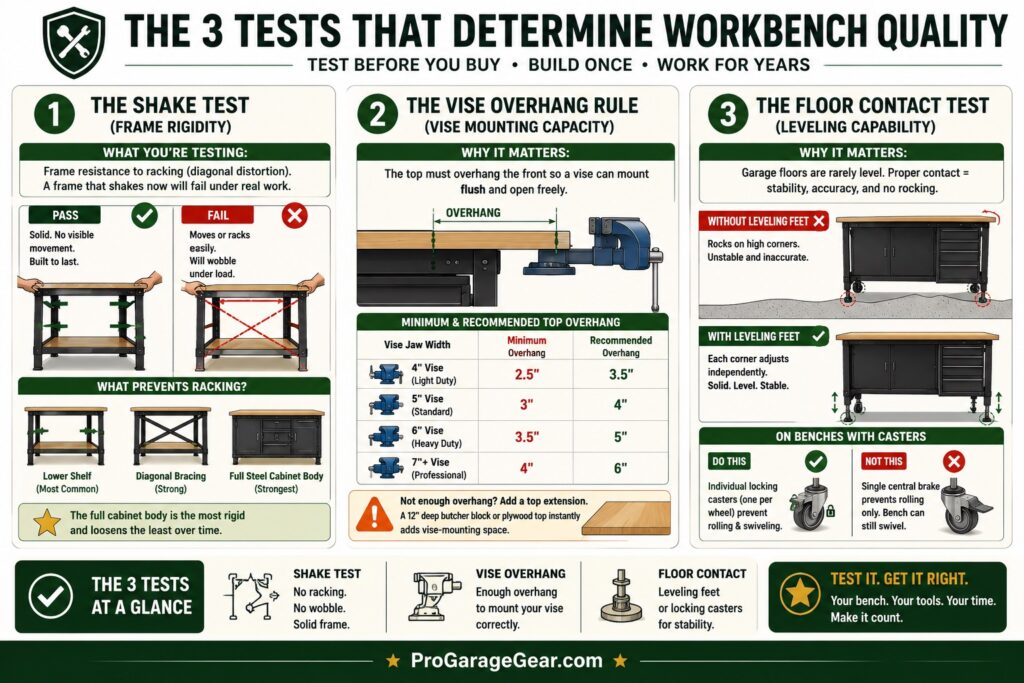
The Shake Test: Before you buy any garage workbench, apply this evaluation. Clamp a piece of scrap wood to the front edge of the bench. Set an electric sander on top and switch it on. Now walk to the far corner of the bench and push the corner firmly — not a tap, a sustained push — at a diagonal.
If the bench moves across the floor, the legs are too narrow or the base frame too light. If the bench shakes but stays in place, the cross-bracing is insufficient and the frame is flexing under load. If the coffee cup you set on the far corner spills, the top is deflecting under the concentrated load of the sander. If none of these things happen — the bench passes the Shake Test and is worth considering.
Most garage workbenches fail this test. Not because they are dishonestly marketed, but because manufacturers optimise for what photographs well — a wide top, integrated pegboard, clean painted finish — rather than what matters functionally: frame rigidity, top surface durability, and the structural details that determine whether the bench serves you for 20 years or deteriorates into an expensive storage surface within 24 months.
This guide introduces three tests that separate functional workbenches from photogenic ones, ranks the seven best garage workbenches of 2026 across every use case and budget, and covers the installation and configuration details that most buyers discover only after the bench arrives
The Three Tests That Actually Determine Workbench Quality
Test 1 — The Shake Test (Frame Rigidity)
Described above. What you are evaluating: the frame’s resistance to racking — the diagonal distortion that occurs when lateral force is applied. A frame that racks under hand pressure will rack significantly worse under the sustained vibration of power tool use, the leverage of a mounted vise, and the shock loading of hammering on the top surface.
The structural feature that prevents racking is cross-bracing — either a horizontal lower shelf (the most common), diagonal bracing between the legs, or the cabinet-style approach where a full steel cabinet body provides the rigidity. Of these, the full steel cabinet body is the most rigid per unit weight and the most resistant to loosening over time because the rigidity comes from welded sheet metal rather than bolted connections that can work loose.
Test 2 — The Vise Overhang Rule (Vise Mounting Capacity)
This is the most commonly discovered gap in workbench purchasing — and it is discovered universally after the bench is assembled and the buyer goes to mount their bench vise.
A bench vise mounts by clamping to the underside of the workbench top with a mounting plate and two to four bolts. For the vise jaws to sit flush with the front edge of the top and open freely, the top must overhang the front face of the cabinet or leg frame by a minimum distance:
| Vise Jaw Width | Minimum Top Overhang Required | Recommended Overhang |
|---|---|---|
| 4-inch vise (light duty) | 2.5 inches | 3.5 inches |
| 5-inch vise (standard) | 3 inches | 4 inches |
| 6-inch vise (heavy duty) | 3.5 inches | 5 inches |
| 7-inch+ vise (professional) | 4 inches | 6 inches |
Before purchasing a workbench, measure the overhang specification in the product listing — it is almost never included in the headline specs and requires reading the dimensional diagram in the product images. For cabinet-style benches with drawers, the drawer cabinet itself determines the overhang — the top typically extends the same distance in front of the cabinet face as the drawer handles protrude, which on many models is 2 inches or less. This eliminates vise mounting on those models without a custom top extension.
If a bench does not specify overhang in its listing: add a butcher block or plywood top extension after purchase. A 12-inch deep, 1.75-inch thick hardwood slab secured to the existing top with pocket screws adds 12 inches of vise-mountable surface to any bench.
🛒 Check Price on Amazon — 5-Inch Quick-Release Bench Vise →
Test 3 — The Floor Contact Test (Leveling Capability)
Garage concrete floors are not level. Settlement, pour variation, and slab control joints mean that across a typical 20×20 foot garage floor, the elevation varies by 1/4 to 3/4 of an inch. A bench with four fixed welded feet placed on this surface will rock on the highest diagonal — exactly like a table at a restaurant with an uneven floor, but with 200 lbs of tools on top.
The correct feature: threaded leveling feet — adjustable steel feet with a lock nut that allows each corner to be independently raised or lowered until the bench sits stable and level on the actual floor surface. This eliminates rocking and ensures the top surface is level for any precision work.
On benches with casters: verify the casters have individual wheel locks rather than a single foot brake. A single central brake prevents rolling but does not prevent swivelling — the bench can twist under vise load even with the brake engaged. Four individual locking casters (one per wheel) provide genuine positional stability.
The Workbench Surface Decision: What Goes on Top
The top surface is the most personal choice in workbench selection because it directly reflects the work you do most. Getting this right on the initial purchase prevents a surface replacement project within 2–3 years.
Solid Hardwood / Butcher Block
The professional standard for general DIY, woodworking, and assembly work. Solid hardwood at 1.5–1.75 inches thickness absorbs vibration (important for hammering and chiselling), accepts screw anchors for bench dogs and hold-down clamps, can be refinished when scarred, and looks professional in any shop environment.
The maintenance reality that sellers understate: a hardwood bench top in a garage needs annual treatment with raw linseed oil or mineral oil to prevent checking (surface cracking) as humidity cycles seasonally. Untreated hardwood in an unheated garage that cycles between 20°F and 90°F will develop visible surface checks within 2–3 winters. This is maintenance, not a defect — it is the correct expectation for wood in an uncontrolled environment.
Stainless Steel
Correct for automotive mechanics and engine builders where oil, coolant, and solvent contact is routine. Wipes completely clean. Never absorbs fluids. Will not check, warp, or require refinishing.
The acoustic trade-off: metal tools set on a steel top generate a ringing impact noise that is significantly louder than on a wood surface. In a workshop environment where hearing protection is not routinely worn, this matters. A rubber anti-fatigue mat on the steel surface when working with small parts resolves both the noise and the tool-rolling problem simultaneously.
MDF and Particle Board
Never the correct choice for a garage workbench, regardless of price. MDF absorbs moisture from ambient air — not just from direct liquid spills — and swells progressively over time in a garage environment that cycles between humidity extremes. The swelling is not visible until the top has distorted beyond flat. A garage that runs 40% relative humidity in summer and 70% in winter will destroy an MDF top within 2–3 years. The only legitimate use for MDF in a garage shop is as a temporary sacrificial surface on top of a solid wood or steel top — as something deliberately expendable.
➡️ For humidity control that protects all wood surfaces in the garage: Best Garage Dehumidifiers 2026: The Humidity Number That Stops MDF from Warping →
The Top 3 Workbenches for 2025
🥇 #1 — Seville Classics UltraHD Adjustable Workbench (Best Overall)
Why it earns #1: The Seville Classics UltraHD is the benchmark against which every other mid-range garage workbench is evaluated. It combines a solid 1.5-inch hardwood butcher block top — the correct material for a working surface — with a heavy-gauge steel frame, height adjustment that covers the full ergonomic range, and ball-bearing drawer slides on every drawer. No competing bench at this price point offers all four of these features simultaneously.
The Data
- Top surface: 1.5-inch solid hardwood (oak or beech depending on production run)
- Height range: 28.5 to 43.5 inches — covers from seated work to standing vise height
- Weight capacity: 1,000 lbs evenly distributed
- Frame material: 18-gauge powder-coated steel
- Drawer slides: 100-lb rated ball-bearing full-extension
- Casters: 3-inch polyurethane, two locking (front wheels)
- Top overhang: 3.5 inches front — accommodates up to 5-inch bench vise
- Electrical: No integrated power strip — requires aftermarket addition
- Dimensions: 46W × 24D inches top surface
The height mechanism matters: The UltraHD uses a threaded rod height adjustment — a hand crank at the side raises and lowers the frame. This is slower than a pneumatic or electric lift but more reliable long-term because there are no seals, valves, or motors to fail. In a garage environment where mechanisms are exposed to temperature cycling and humidity variation, the simplest height adjustment mechanism is the most durable.
The honest limitation: The casters lock only on the two front wheels. Under sustained vise use — where lateral force is applied to one side of the bench repeatedly — the bench can creep slightly. If permanent positioning is the priority, remove the casters and fit the threaded leveling feet (included) for rock-solid positional stability.
🛒 Check Price on Amazon — Seville Classics UltraHD Adjustable Workbench →
🥈 #2 — Husky 52-Inch Solid Wood Top Workbench (Best Value)
Why it earns #2: The Husky 52-inch delivers a larger working surface than the Seville Classics at a comparable or lower price point, with the same solid hardwood top specification and a fixed-height steel frame that is noticeably more rigid than the adjustable-height designs because there are no moving components in the frame structure. For a buyer whose work is primarily at a consistent height — or whose ergonomic needs are met by the bench’s fixed height of 34 inches — the Husky 52 is the correct value specification.
The Data
- Top surface: 1.75-inch solid hardwood (thicker than Seville Classics)
- Height: Fixed at 34 inches — standard counter height
- Weight capacity: 2,000 lbs — double the adjustable model
- Frame: Heavy-gauge welded steel base
- Drawers: 9 drawers, ball-bearing slides
- Top overhang: 2.75 inches — accommodates 4-inch vise; tight for 5-inch
- Dimensions: 52W × 24D inches
The 1.75-inch top specification: The thicker hardwood top is the Husky’s most significant advantage over competing benches. At 1.75 inches, the top provides more thread engagement for bench dog holes, more material for hold-down clamp tracks, and more resistance to surface deflection under concentrated loads — the difference between a 1.5 and 1.75-inch top is measurable when hand-planing a long board or chiselling mortises.
🛒 Check Price on Amazon — Husky 52-Inch Solid Wood Top Workbench →
🥉 #3 — Gladiator GAWB04BWEG Adjustable Hardwood Workbench (Best Heavy-Duty)
Why it earns #3: The Gladiator is the correct specification for any application where the bench vise is the primary tool and the loads it must resist exceed what a standard residential workbench handles. Rated to 3,000 lbs, built on a welded square-tube steel base, with a 1.75-inch hardwood top and a lifetime warranty on the frame. This is a bench that anchors to the wall and floor and becomes a permanent fixture in the garage.
The Data
- Top surface: 1.75-inch solid hardwood
- Height range: 32.5 to 36.5 inches adjustable
- Weight capacity: 3,000 lbs — highest in the residential category
- Frame: 1.5-inch square-tube welded steel — the heaviest gauge construction at this price point
- Drawers: None — slab bench with lower shelf only
- Top overhang: 4 inches front — accommodates up to 6-inch vise
- Warranty: Lifetime on frame
Who this is specifically for: The absence of drawers is a feature, not a limitation, for the heavy-duty mechanical work this bench is designed for. Every drawer in a workbench beneath the top represents a cavity that fills with metal shavings, oil residue, and dropped fasteners from the work above. A clean slab bench with a lower shelf for toolboxes is the professional mechanic’s preference for exactly this reason. The toolboxes stay on wheels — easy to roll out and access — while the bench top and lower shelf handle static storage and the vise work.
🛒 Check Price on Amazon — Gladiator GAWB04BWEG Heavy-Duty Workbench →
⭐ Best Space-Saver — Fleximounts WB107 Wall-Mounted Folding Workbench
For any garage where parking a vehicle nightly prevents a permanent floor-based bench, the Fleximounts WB107 is the most credible wall-mount folding solution available. It deploys in 5 seconds, locks in horizontal position with steel leg brackets rated to 400 lbs, and folds flat against the wall to 3.5 inches of wall projection when stowed. The working surface is solid enough for the majority of light-to-medium DIY tasks — assembly, wiring, painting, and basic hand tool work.
The Critical Installation Detail
The WB107 must be mounted into wood studs — not drywall anchors, not metal studs. The mounting rail that carries the hinge requires 3.5-inch lag bolts driven into wood stud members at each bolt position. In a garage with metal stud framing, this bench requires either wood blocking installed between the metal studs first or an alternative mounting approach using steel stud-rated toggle anchors.
Wall stud position determines bench position — it is not adjustable. Before ordering, locate your studs at the planned mounting height and confirm the stud spacing allows the bracket mounting holes to align. Standard 16-inch OC stud spacing typically works for most mounting widths.
➡️ For stud location and anchor type identification before installation: The Garage Electrical Audit: Stud Type and Anchor Selection Guide →
🛒 Check Price on Amazon — Fleximounts WB107 Wall-Mounted Folding Workbench →
⭐ Best for Electronics and Precision — WORKPRO 48-Inch Workbench with Power Strip
The WORKPRO 48-inch stands apart from the other benches in this guide by the inclusion of an integrated 4-outlet power strip with USB ports mounted directly to the bench frame. For electronics assembly, small appliance repair, and any work requiring multiple powered tools simultaneously, this eliminates the extension cord routing that is a genuine safety and convenience problem on standard benches.
The Data
- Top surface: 0.75-inch MDF with PVC laminate — the one acceptable application for composite top in a workbench, because the PVC laminate provides a sealed moisture barrier
- Height: Fixed at 33.5 inches
- Weight capacity: 500 lbs
- Power: Integrated 4-outlet power strip + 2 USB ports on bench frame
- Top overhang: 2 inches — not suitable for vise mounting without top extension
The MDF caveat for this application: The PVC laminate surface on this bench changes the MDF recommendation made earlier in this guide. A PVC laminate top seals the MDF substrate from moisture contact at the working surface. The concern with unlaminated MDF is direct liquid absorption — the laminate prevents this. The limitations that remain: the laminate does not prevent moisture ingress at the edges and cut ends, the surface cannot be refinished if deeply scratched through the laminate, and the composite construction has lower vise load capacity than solid wood.
🛒 Check Price on Amazon — WORKPRO 48-Inch Workbench with Integrated Power Strip →
⭐ Best Portable — Stanley FatMax Portable Folding Workbench
The Stanley FatMax solves the problem the other benches in this guide do not address: project work in locations other than the garage. It folds to suitcase dimensions, weighs 21 lbs, and sets up in 30 seconds. The clamping top — two halves that open and close via a crank mechanism — holds irregular workpieces (pipe, angled stock, curved surfaces) that cannot be held in a standard vise. This is the bench you take to the driveway when working on a vehicle, to the back yard for a building project, or to a job site.
The Data
- Top surface: Two-part MDF composite top with clamp function
- Clamping capacity: Opens from 0 to 13.4 inches — holds pipe, angled stock, curved parts
- Height: Two height settings: 31.5 and 24 inches
- Weight capacity: 550 lbs
- Weight: 21 lbs — portable by one person
The FatMax is not a replacement for a permanent garage workbench — it is a complement to one. The combination of a permanent Seville Classics or Husky bench plus a Stanley FatMax for portable and clamping applications covers every workholding scenario a residential garage shop encounters.
🛒 Check Price on Amazon — Stanley FatMax Portable Folding Workbench →
⭐ Best Budget — Olympia Tools 84-187 (Under $150)
For a first garage workbench where the primary requirement is a dedicated work surface at the correct height and the budget does not support a premium investment, the Olympia Tools 84-187 delivers the correct specification at the lowest price in the category. Steel frame, 500-lb capacity, adjustable height from 28 to 36 inches, and a clean powder-coat finish that holds up in a garage environment. It will not pass the Shake Test under heavy vise load — the cross-bracing is adequate for hand tool work but not for sustained power tool vibration. For light assembly, wiring, and general DIY: it is a legitimate entry point.
🛒 Check Price on Amazon — Olympia Tools 84-187 Budget Workbench →
Complete Comparison Table
| Model | Top Surface | Height | Weight Cap. | Vise Overhang | Drawer Slides | Best For | Amazon |
|---|---|---|---|---|---|---|---|
| Seville UltraHD | 1.5″ hardwood | Adjustable 28.5–43.5″ | 1,000 lbs | 3.5″ ✅ | Ball-bearing | Best overall adjustable | Shop → |
| Husky 52″ | 1.75″ hardwood | Fixed 34″ | 2,000 lbs | 2.75″ ⚠️ | Ball-bearing | Best value fixed-height | Shop → |
| Gladiator GAWB04 | 1.75″ hardwood | Adjustable 32.5–36.5″ | 3,000 lbs | 4″ ✅ | N/A (no drawers) | Best heavy-duty / vise work | Shop → |
| Fleximounts WB107 | Solid wood | Fixed wall-mount | 400 lbs | Variable by config | N/A | Space-saving / parking garage | Shop → |
| WORKPRO 48″ | PVC laminate | Fixed 33.5″ | 500 lbs | 2″ ❌ (vise ext. needed) | Ball-bearing | Electronics / powered work | Shop → |
| Stanley FatMax | MDF composite | Two-pos: 24 or 31.5″ | 550 lbs | N/A (clamp top) | N/A | Portable / clamping odd shapes | Shop → |
| Olympia 84-187 | MDF composite | Adjustable 28–36″ | 500 lbs | 2″ ❌ | Plain steel | Budget / light assembly | Shop → |
The Essential Workbench Accessories
Bench Vise — The Most Important Addition
A workbench without a vise is a table. The vise transforms the bench from a surface into a workholding system. For a general DIY garage bench, a 5-inch quick-release vise with a swivel base covers 95% of use cases. The swivel base allows the vise to rotate to hold workpieces at angles that the fixed jaw position cannot — this is particularly useful for sawing and chiselling tasks where the cut line needs to be vertical regardless of the workpiece orientation.
🛒 Check Price on Amazon — 5-Inch Quick-Release Swivel Bench Vise →
Power Strip — Wall of Power at the Bench Surface
Running extension cords from the wall to the bench for each project session is the small friction that accumulates into significant inconvenience. A metal-body power strip mounted directly to the bench frame side provides consistent power access at the work surface with no cords on the floor. Metal body is the correct specification for a garage environment — plastic power strip housings degrade under temperature cycling and UV exposure within 2–3 years.
🛒 Check Price on Amazon — Heavy-Duty Metal Power Strip (Bench Mount) →
Hardwood Top Conditioner — Annual Maintenance for Wood Tops
Raw linseed oil or food-grade mineral oil applied to a hardwood top once per year prevents the seasonal checking that degrades untreated wood in unheated garages. Apply with a cloth, allow to soak for 20 minutes, wipe off excess. The top will darken slightly with each annual application and develop a patina that actually strengthens the surface against minor fluid penetration.
🛒 Check Price on Amazon — Raw Linseed Oil (Annual Hardwood Top Treatment) →
➡️ For workbench lighting that eliminates the shadow directly over the work surface: Best Garage Workbench Lighting 2026: Fix the Shadow That’s Ruining Your Work →
➡️ For the tool wall system to install above the workbench: Best Garage Power Tool Organizers 2026: The 3-Zone System →
The Uneven Floor Problem and How to Solve It Before Assembly
The most common post-assembly complaint for every workbench is rocking on the garage floor. The solution is not to shim the bench after assembly — it is to map the floor before assembly and select the correct foot hardware.
The two-minute floor mapping method: Fill a spray bottle with water and spray a 6-inch wide line across the garage floor in the area where the bench will sit. Observe where the water pools after 60 seconds. The pooling point is the low spot. The bench will rock across the diagonal from the high corner to the low corner — the corner diagonally opposite the low spot contacts the floor last and therefore rocks.
With this information: position the bench so the low spot falls under one leg rather than between two legs. A low spot under a leg is stabilised by the leveling foot — a low spot between two legs creates an unsupported span that rocks.
On benches where the casters can be replaced with leveling feet: always make this change for a permanent installation. Level feet lower the centre of gravity, increase positional stability under vise load, and prevent the slow migration that occurs when caster wheels are not fully locked over time.
➡️ For full garage floor preparation including levelling low spots: How to Epoxy a Garage Floor: Levelling Low Spots Before Coating →
The Ergonomics Framework: Setting the Correct Height for Every Task
A fixed-height workbench set at the wrong height for your body creates sustained postural stress that accumulates across every project session. Back pain from an incorrectly set bench height is one of the most preventable occupational health issues in workshop environments and one of the most commonly attributed causes of reduced garage workshop use over time.
The Elbow Rule — Your Personal Bench Height Formula
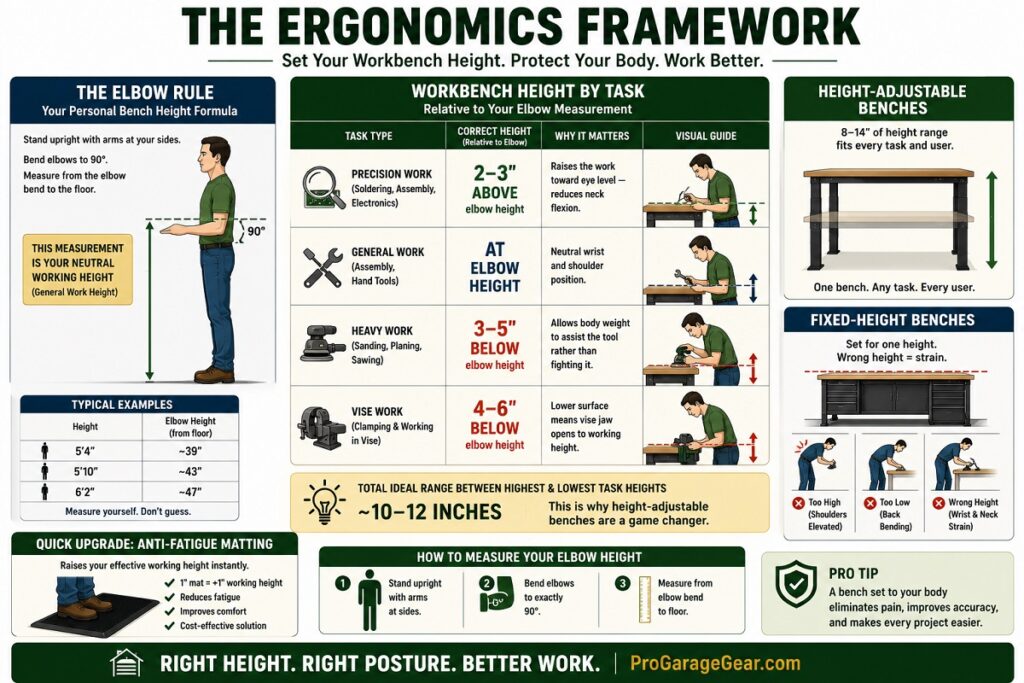
Stand upright with your arms hanging naturally at your sides. Bend your elbows to exactly 90 degrees. Measure from the bend of your elbow to the floor. This measurement is your neutral working height — the height at which your hands rest without shoulder elevation or trunk bending.
From this baseline, the correct bench height varies by task type:
| Task Type | Correct Height Relative to Elbow Measurement | Why |
|---|---|---|
| Precision work (soldering, assembly, electronics) | 2–3 inches ABOVE elbow height | Raises the work toward eye level — reduces neck flexion |
| General workbench tasks (assembly, hand tools) | At elbow height | Neutral wrist and shoulder position |
| Heavy work (sanding, planing, sawing) | 3–5 inches BELOW elbow height | Allows body weight to assist the tool rather than fighting it |
| Vise work (clamping and working workpiece in vise) | 4–6 inches BELOW elbow height | Lower surface means vise jaw opens to working height |
The range between precision work height and vise work height for a typical 5-foot-10-inch person is approximately 10–12 inches of total range requirement. This is precisely why height-adjustable workbenches — which typically offer 8–14 inches of height range — represent such a meaningful ergonomic upgrade over fixed-height benches.
If you own a fixed-height bench currently: anti-fatigue matting under your feet raises your effective working height without modifying the bench. A 1-inch anti-fatigue mat raises your elbow height by 1 inch. For precision work that currently requires bending: the mat adjustment is cheaper and faster than a new bench.
🛒 Check Price on Amazon — 3/4″ Anti-Fatigue Workbench Mat →
The Drawer Slide Quality Test: Why the Hidden Component Determines Longevity
Drawer slides are the most consistently underspecified component in workbench marketing material. The product listing shows the exterior finish and the top surface. The drawer slides determine whether the drawers still operate smoothly with 30 lbs of sockets in them after three years of daily use — or whether they grind, sag, and require two hands to open.
Ball-bearing slides use recirculating steel balls in a raceway that eliminate metal-on-metal contact between the slide elements. They operate smoothly under full load throughout their service life, support true full-extension opening, and maintain smooth operation when loaded with the weight of a complete socket set or wrench collection.
Plain steel slides (also called friction slides or epoxy slides) have painted or epoxy-coated steel riding directly against steel. They operate smoothly when empty and new. Under load and over time, the surfaces wear through the coating, introduce galling, and create the grinding resistance that characterises cheap tool cabinet drawers after 18 months of use.
The specification to look for: “100-lb rated ball-bearing drawer slides” or “full-extension ball-bearing slides.” This specification at 100-lb per slide rating is the industry minimum for genuine workshop use. Below this rating, the slides are sized for household furniture applications, not tool weight.
Frequently Asked Questions
What is the standard height for a garage workbench?
There is no universal standard — the correct height is specific to the primary user’s body dimensions and the task type, as described in the Elbow Rule section above. However, 34 inches is the most common fixed height for residential workbenches because it matches the height of standard kitchen countertops — a reasonable approximation of a comfortable standing work height for a person of average height (5-foot-8 to 5-foot-10). For anyone significantly taller or shorter, or for applications involving vise work, this standard height will not be ergonomically correct and an adjustable bench is the better choice.
How much weight can a garage workbench actually hold?
The weight capacity listed in workbench specifications is always an evenly distributed load across the full top surface — not a concentrated load at one point. A bench rated at 1,000 lbs distributed capacity may fail at 150 lbs concentrated at a 4-inch diameter area (such as the foot of a press or the anvil face of a vise under load). For applications involving concentrated loads — a bench grinder, a drill press, a mounted vise — the relevant specification is the frame’s resistance to point loading, which is a function of the frame gauge and the number of contact points between the top and the frame, not the listed capacity.
How deep should a garage workbench be?
The standard depth of 24 inches represents the reach limit of most adults — the maximum working depth where all points on the bench surface are reachable without leaning forward. Beyond 24 inches, the back of the bench becomes storage rather than work surface. For benches against a wall: 24 inches is always correct. For island benches accessible from both sides: 32–36 inches doubles the effective work surface. For benches with overhead cabinets or pegboard directly above: confirm the cabinet depth does not reduce the effective working depth below 18 inches at the front edge.
Is particle board or MDF safe for a workbench top?
Only if the surface is fully sealed with a waterproof laminate, epoxy coating, or sheet metal overlay. Unsealed MDF or particle board will absorb moisture from the air in a garage environment over seasonal humidity cycles and progressively deform. A PVC laminate top seals the substrate adequately for light-duty use. For any application involving liquid contact, mechanical work, or vise mounting: solid hardwood or stainless steel is the correct specification and the composite tops represent a maintenance liability.
Can I build a workbench instead of buying one?
Yes, and for many specific applications a built bench is superior to any purchased option because it can be dimensioned precisely for the available space, the ceiling height, the user’s height, and the specific work it will perform. The minimum DIY bench specification that outperforms most purchased benches: 4×4 legs, 2×4 stretchers and cross-bracing, 1.75-inch hardwood plywood top (not MDF). Total material cost: $150–$250 depending on material pricing. Total build time: 4–6 hours. The limitation is that a built bench requires accurate cutting, the correct fasteners, and comfort with basic woodworking — none of which should be assumed.
Final VerdictThe Bottom Line
The workbench is the foundation of every project that happens in the garage. A bench that rocks absorbs energy into the frame instead of the work. A bench set at the wrong height absorbs energy into the user’s back instead of the work. A bench without enough top overhang for a vise mount forces compromised workholding for every clamping task.
Run the three tests before purchase. Apply the Elbow Rule before setting height. Verify the vise overhang before ordering. And once installed: treat the hardwood top annually, mount power at the bench surface, and add the lighting directly overhead that makes the bench as functional at 9 PM in November as it is at noon in July.
The bench you outfit correctly in a weekend serves you without friction for a decade. The bench you set up quickly and work around for inconveniences costs you small amounts of time and quality on every subsequent project, indefinitely.
Affiliate Disclosure: Pro Garage Gear earns from qualifying Amazon purchases at no extra cost to you. Weight capacity specifications are manufacturer-stated distributed load ratings. Always verify vise mounting compatibility with your specific bench dimensions before purchasing a vise.