
The Complete Garage Upgrade Cost Guide 2026: What Each System Actually Costs (DIY vs. Contractor)
Affiliate Disclosure: Pro Garage Gear participates in the Amazon Services LLC Associates Program. We earn from qualifying purchases at no extra cost to you. No manufacturer has paid for placement in this guide.
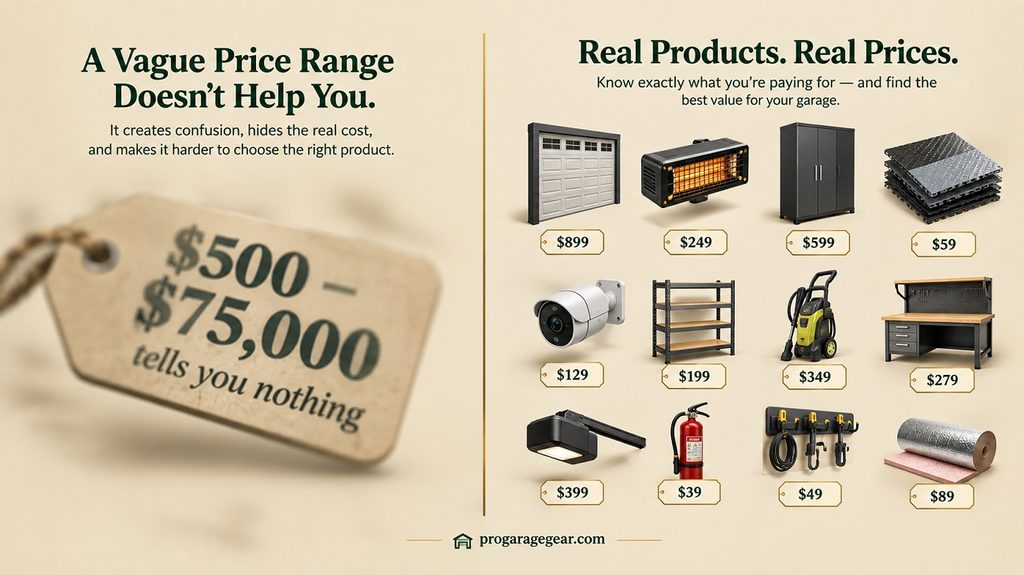
Garage Upgrade Cost – The Number That Doesn’t Actually Help You: Search “garage renovation cost” and every result gives you some version of the same answer — a range so wide it borders on meaningless. “$500 to $75,000.” “$7,000 to $30,000.” “$18,000 to $28,000.” These numbers are technically accurate and functionally useless, because a full living-space conversion with plumbing and HVAC and a $2,000 cabinet system share the same headline range, and nothing in that number tells you which end applies to what you’re actually planning to do.
Almost nobody wants “a garage remodel” as a single undifferentiated project. They want to know what a new insulated door costs. What a real car lift costs, and what it costs to prep the slab for one. What a cabinet wall costs at the tier they actually need, not the cheapest option or the showroom option. This guide breaks the garage down into its actual component systems — the same systems this site has spent months researching and pricing individually — and gives you a real number for each, at real product tiers, sourced from the specific reviews that back each figure up.
Then it does something no contractor-cost guide does: it totals up what a complete, thorough, DIY garage upgrade actually costs across every major system — and compares that number against what the same scope costs hired out.
Before starting any system in this guide: a stud finder, an outlet tester, and a laser distance measurer are the three tools that come up across almost every project here — confirming stud locations for anchoring, checking whether an existing outlet is actually wired correctly before relying on it, and measuring accurately for flooring, slatwall, and cabinet runs.
🛒 Check Price on Amazon — Franklin ProSensor Stud Finder →
🛒 Check Price on Amazon — 3-Light Outlet Circuit Tester →
🛒 Check Price on Amazon — Laser Distance Measurer →
The System-by-System Cost Breakdown
Each row below reflects real DIY product pricing at three tiers — budget, mid-range, and premium — based on the specific products and calculators in this site’s dedicated guide for that system. Click through to the full guide for the complete buying analysis behind each number.
A note on these figures: these are planning-level estimates based on the product tiers reviewed in each dedicated guide, not fixed prices — actual costs shift with retailer pricing, regional labor rates for anything requiring professional installation, and which specific products you choose within each tier. Use the numbers here to scope your budget realistically, then confirm current pricing in the full guide for whatever you’re actually buying.
The DIY Stack Total: What a Complete Garage Upgrade Actually Costs
Every contractor-cost guide quotes a “mid-range garage remodel” somewhere in the $18,000-$28,000 range for a standard 2-car garage — full insulation, drywall, improved lighting, a modest heat option, and an upgraded door, professionally installed. That number assumes a contractor doing everything, including plenty of labor for tasks a reasonably capable homeowner can do independently.
Here’s what the equivalent scope looks like stacked from the mid-range DIY column above — insulated door and seals, a real heater, four storage cabinets, one slatwall wall, floor tiles, and a smart opener:
| Item | Mid-Range DIY Cost |
|---|---|
| Door insulation + seals | ~$275 |
| Heating | ~$450 |
| 4 storage cabinets | ~$4,000 |
| 1 slatwall wall | ~$450 |
| Floor tiles (DIY) | ~$900 |
| Smart opener | ~$200 |
| Total | ~$6,275 |
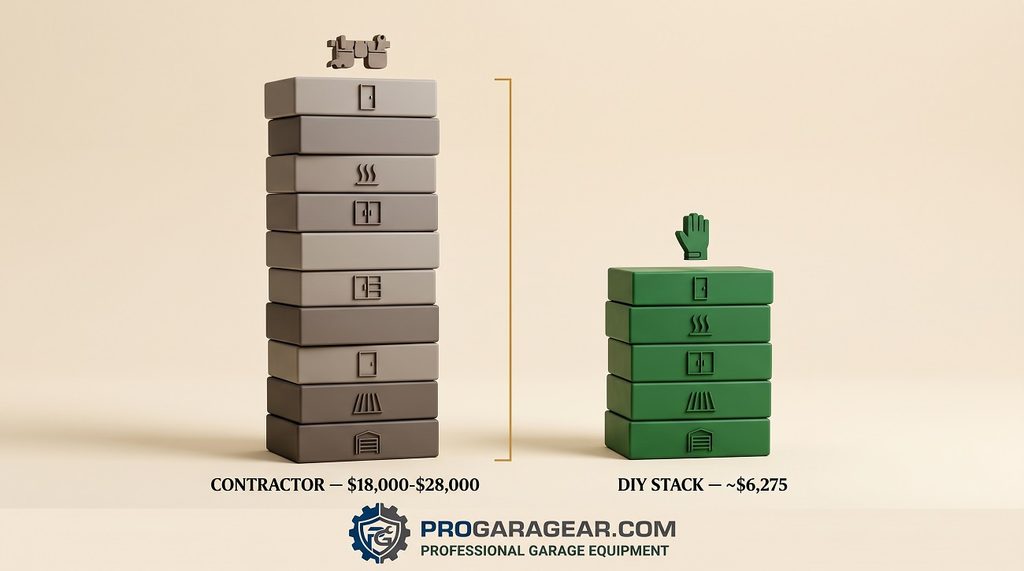
That’s roughly a quarter to a third of the professionally-installed mid-range figure for comparable scope — the gap is almost entirely labor, which is consistent with industry reporting that labor accounts for roughly 40-50% of a typical garage remodel’s total cost. DIY doesn’t eliminate that cost, it eliminates paying someone else for it — which is exactly the trade-off this site’s guides are built to help you make correctly, system by system.
What DIY Can’t (or Shouldn’t) Replace
Several systems in the table above have a real ceiling on how far DIY reasonably extends — not because the products are hard to install, but because specific portions of the work genuinely require licensed trade work for safety and code compliance reasons already covered in depth elsewhere on this site.
| System | What’s DIY-Safe | What Needs a Pro |
|---|---|---|
| Utility Sink | The sink itself, faucet connection | New drain/vent runs — P-trap venting is a real code requirement, not a suggestion |
| Car Lift | Assembly, slab qualification checks | Dedicated 220V/240V electrical circuit for most 2-post lifts |
| Mini-Split Heating | DIY-kit models (MrCool) can be self-installed | A dedicated 240V circuit for the unit, if one doesn’t exist |
| Full Epoxy Floor Coating | Small DIY kits for light-duty use | Professional-grade moisture testing and diamond-grinding for a garage that sees daily heavy vehicle traffic |
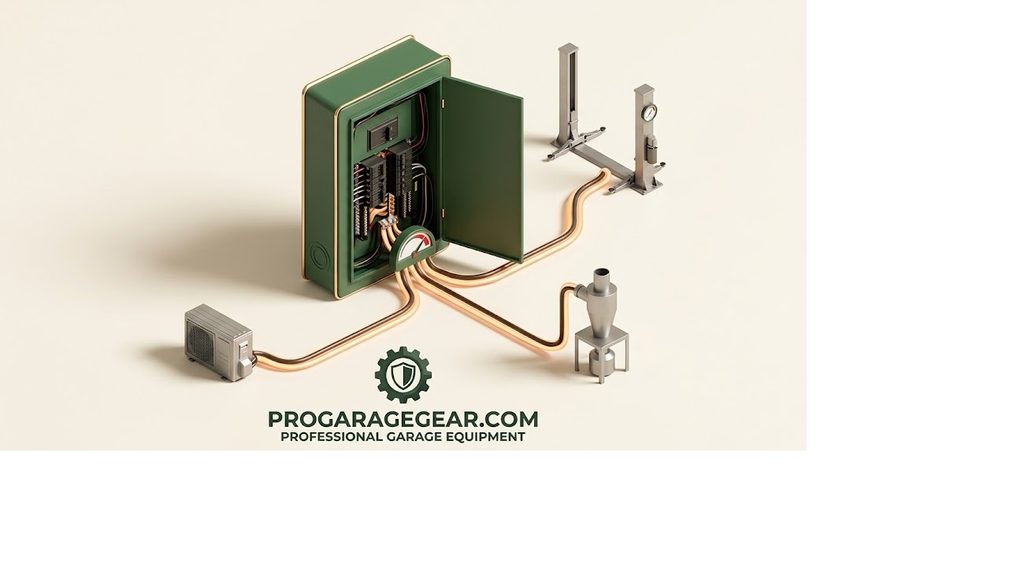
One risk specific to selecting several systems from this guide at once: a 240V mini-split heater, a 2-post car lift, and a full cyclone dust collection system each have their own circuit requirement covered in their dedicated guides — but nothing in any single guide tells you whether your garage’s electrical service can actually support all of them running as part of the same project.
If your garage is on a shared 15A or 30A circuit with no dedicated sub-panel, stacking multiple 240V, high-draw systems can mean a $1,500-$2,500 electrical service or sub-panel upgrade is a prerequisite before any of that equipment gets powered on — a cost that belongs in your budget from the start if you’re planning more than one major electrical system from this guide, not something to discover after the equipment arrives.
The honest budgeting approach: DIY everything in the “what’s DIY-safe” column, and price a licensed electrician or plumber specifically for the narrow scope in the “needs a pro” column rather than either avoiding the upgrade entirely or paying full contractor rates for the whole project.
➡️ For the full electrical planning framework used across every system on this site that needs a dedicated circuit: Garage Electrical Audit 2026 →
The Cost Nobody Budgets For: Permits
The trade-labor costs in the table above are only part of what “needs a pro” actually costs — permit and inspection fees sit on top of that labor as a separate line item, and they’re required for exactly the systems most likely to need an electrician or plumber in the first place.
| Work Type | Typical Permit Cost | Applies To |
|---|---|---|
| Electrical (new circuit) | $50-$200 | Car lift 240V circuit, mini-split circuit, new sub-panel work |
| Plumbing (new drain/vent) | $50-$300 | Utility sink with no existing drain stub-out |
| Structural (if applicable) | $100-$300+ | Anything altering the garage’s structure, not typically triggered by the systems in this guide |
Why this matters beyond the fee itself: unpermitted electrical or plumbing work can affect homeowner’s insurance coverage if it’s later found to be the cause of a loss, and it can surface as a problem at resale — a buyer’s inspector or the closing process itself can flag unpermitted modifications. The permit fee is small relative to the risk of skipping it. Check with your local building department before starting any work that adds a new circuit or a new drain line — requirements and costs vary by jurisdiction.
➡️ For the full electrical planning and circuit-load framework this applies to: Garage Electrical Audit 2026 →
The Garage Upgrade Budget Builder
Check off the systems you’re planning to upgrade and select a tier for each to build a running total, compared against the professional-remodel benchmark for equivalent scope.
💰 Garage Upgrade Budget Builder
💰 Garage Upgrade Budget Builder
Select what you’re upgrading and at what tier — get a real running total.
* Estimates based on the tier pricing above. Excludes labor for any portion that requires a licensed electrician or plumber — see “What DIY Can’t Replace” above. Always confirm current pricing in each system’s full guide before purchasing.
Frequently Asked Questions
Is it actually cheaper to DIY a garage upgrade than hire a contractor?
Usually significantly, for anything that doesn't require licensed electrical or plumbing work — see the DIY Stack Total section above, which shows roughly a quarter to a third of comparable contractor-installed pricing for the same scope. The gap is almost entirely labor cost, which industry data puts at roughly 40-50% of a typical garage remodel's total. DIY doesn't make labor disappear — you're supplying it yourself — but for anyone comfortable with basic tools and willing to follow the installation guidance in each system's dedicated guide, the savings are real and substantial.
What garage upgrade gives the best return for the money?
Based on the cost breakdown above, door insulation and seals deliver the highest ratio of impact to cost — a few hundred dollars for a meaningful comfort and energy improvement, with a documented payback period under a year in our dedicated insulation guide. Storage systems (cabinets, slatwall) deliver the most visible transformation per dollar for anyone whose primary goal is organization rather than climate control or workshop capability.
How much should I budget for permits and professional labor even in a mostly-DIY project?
It depends entirely on which systems from the "What DIY Can't Replace" table above are part of your plan. A project limited to insulation, storage, flooring, and lighting typically needs no permits or professional labor at all. Adding a car lift, a mini-split heater, or a new utility sink drain each typically requires a dedicated electrical circuit or plumbing work — budget $150-$500 per trade visit for that narrow scope, separate from the DIY total for everything else.
Do these DIY totals include the cost of tools I don't already own?
No — these figures reflect the flooring, cabinets, fixtures, and equipment themselves, not tools needed to install them. Most of the systems in this guide require only basic hand tools most homeowners already have; a few (car lift installation, floor coating prep) benefit from specific tools covered in each system's dedicated guide, which are generally inexpensive enough not to meaningfully change the totals above.
One more thing worth budgeting for separately from tools: consumable hardware — structural screws, electrical wire and conduit, PEX or drain fittings, sealants, and wall anchors — isn't included in the system totals above either, and it adds up faster than most people expect across a multi-system project. A reasonable planning buffer is an extra 10% on top of your total, roughly $300-$800 depending on project scope, to cover fasteners and small hardware that don't show up in any single product's price tag but are required to actually install it.
A reasonable starting kit for the consumables buffer above: a structural screw assortment, a set of heavy-duty wall anchors, and basic conduit fittings covers the hardware most of the systems in this guide need at some point.
🛒 Check Price on Amazon — Structural Screw & Heavy-Duty Anchor Assortment →
The Bottom Line
"How much does a garage remodel cost" is the wrong question if what you actually want to know is what upgrading your storage, your floor, or your heating specifically costs. Break the project into its real component systems, price each at the tier that matches what you actually need — not the cheapest option or the showroom option — and you'll end up with a number that's both more accurate and, for anyone willing to do the work themselves, meaningfully lower than any contractor-remodel figure you'll find quoted elsewhere.
* Total includes a 10% consumables/hardware buffer (fasteners, wiring, sealants, etc. not priced into any single product). Excludes permit fees and labor for any portion that requires a licensed electrician or plumber — see "What DIY Can't Replace" and the Permit section above. Always confirm current pricing in each system's full guide before purchasing.
Affiliate Disclosure: Pro Garage Gear earns from qualifying Amazon purchases at no extra cost to you. Cost figures are planning-level estimates based on the product tiers reviewed in each dedicated guide and general market data for professional installation; actual costs vary by retailer, region, and specific product selection. Always confirm current pricing before purchasing.