
The State of the American Garage 2026: What the Data Actually Shows
Note: Pro Garage Gear participates in the Amazon Services LLC Associates Program. This particular guide is a data reference rather than a product roundup, so affiliate links are minimal and limited to directly relevant guides linked below.
State of the American Garage – The Problem With Most “Garage Statistics” Pages: Search for garage statistics and you’ll find the same handful of numbers recycled across dozens of sites — often without a source, sometimes without even a publication year. A stat that started as a 2015 press release from one storage-organization company gets cited in 2026 content as if it were current data. This page exists to fix that: every figure below is traced to its original source — U.S. Census Bureau, NAHB, Department of Energy, or a named industry survey — with the actual publication date disclosed, not just the year it happens to be re-cited.
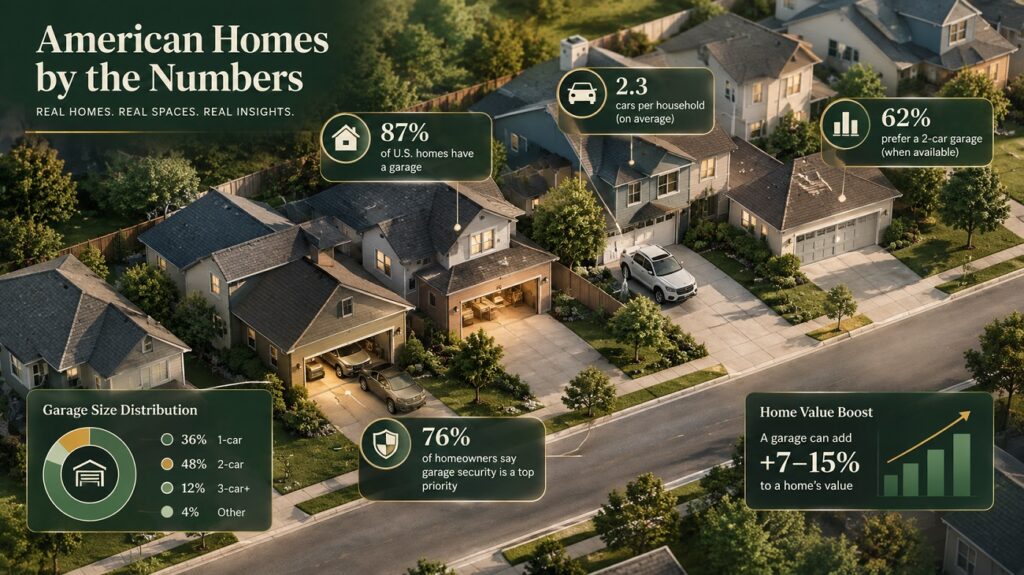
Quick Facts: The Numbers Worth Citing
How to cite this page: if you’re referencing these figures elsewhere, please link back to this page as your source — we’ve done the work of tracing each number to its origin so you don’t have to, and a link back helps us keep this page updated with the latest available data.
How Many Garages Exist, and How Big Are They
About two-thirds of U.S. housing units have a garage or carport: 66% as of 2021, according to the Department of Energy’s analysis of American Housing Survey data (DOE Fact of the Week #1268). The American Housing Survey is sponsored by HUD and conducted by the Census Bureau; DOE’s Vehicle Technologies Office analyzes it because home garages matter for EV charging. DOE’s count covers houses and apartments but excludes co-ops and condominiums. The national number also hides a wide regional spread: 80% in the Pacific states versus 53% in the Middle Atlantic, where urban density and older housing stock leave more households without off-street parking.
Ownership matters even more than region. In DOE’s analysis of the 2015 survey, 78% of owner-occupied units had a garage or carport versus 37% of rentals (DOE Fact #958), and its 2017 release showed a similar gap, 81% versus 39% (DOE Fact #1058). Newer homes skew higher as well: 74% of units under two years old had a garage or carport in that 2017 release. DOE’s most recent release (2021 data) reports only the overall share, so the owner and renter figures here come from the years when they were published rather than being projected forward.
You will often see the total quoted as “82 million garages.” That number is widely repeated, including by Stanley Black & Decker’s chief marketing officer in the 2022 CRAFTSMAN press release, but we could not trace it to a primary government dataset, and versions of it have circulated for roughly a decade (one widely shared version compares it to worldwide car production in 2013). Other published estimates differ. Treat it as a rough order of magnitude, not a precise count.
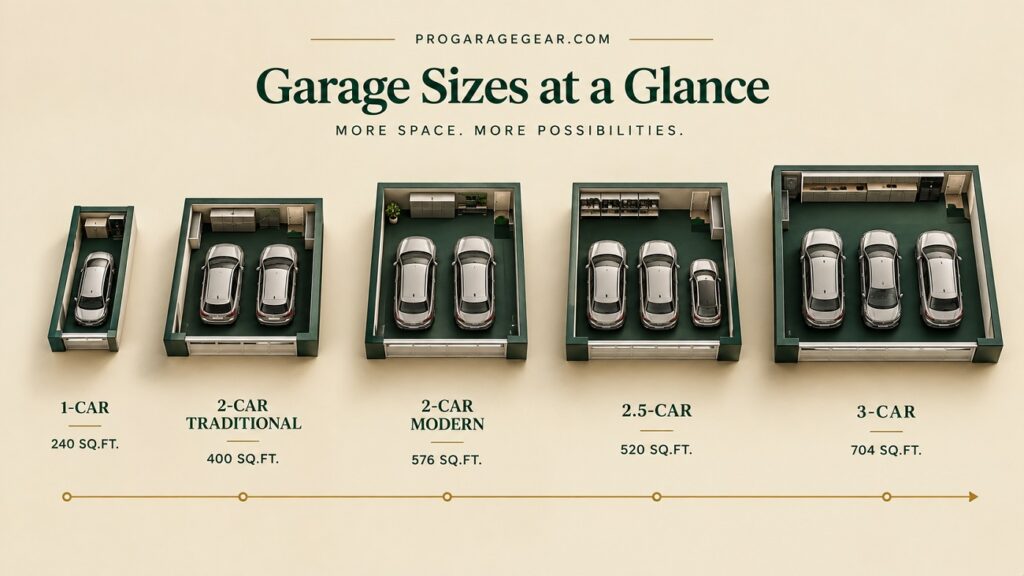
Garage sizes have grown alongside home sizes, though not uniformly. The traditional 20×20-foot (400 sq.ft) two-car garage is still common in older housing stock, but newer construction increasingly favors 22×22 or 24×24-foot footprints (up to 576 sq.ft) — a shift builders attribute to the growth in average vehicle size, particularly SUVs and trucks, over the past two decades. Standard one-car garages run roughly 12×20 feet (240 sq.ft), and three-car garages typically measure around 32×22 feet (704 sq.ft).
| Garage Type | Typical Dimensions | Square Footage |
|---|---|---|
| 1-car | 12×20 ft | 240 sq.ft |
| 2-car (traditional) | 20×20 ft | 400 sq.ft |
| 2-car (modern) | 24×24 ft | 576 sq.ft |
| 2.5-car | 26×20 ft | 520 sq.ft |
| 3-car | 32×22 ft | 704 sq.ft |
The Garage Footprint & Capacity Profile Generator
Select your garage’s footprint and your own ceiling height to get a usable-volume estimate and a ready-to-use citation for referencing this page’s data elsewhere.
📐 Garage Footprint & Capacity Profile Generator
Get your garage’s usable volume and a ready citation for this page’s data.
The Clutter Reality
The statistic that gets cited most often in garage-organization content — that roughly a third of garages are too cluttered to park a vehicle — traces back to a 2022 CRAFTSMAN-commissioned survey conducted by Atomik Research (2,004 U.S. adults, ±2 percentage point margin of error). It’s worth knowing that origin, because the figure continues to circulate in 2026 content as if freshly measured; it’s a real, methodologically disclosed survey result, just not brand-new data.
Multiple other surveys over the years — from Gladiator GarageWorks, Garage Living, and various home-organization studies — have found comparable figures in the 20-36% range depending on survey wording and year, which suggests the underlying pattern (a meaningful share of American garages can’t fit a car) is a durable trend rather than a one-time finding, even if no single number should be treated as a precise current measurement.
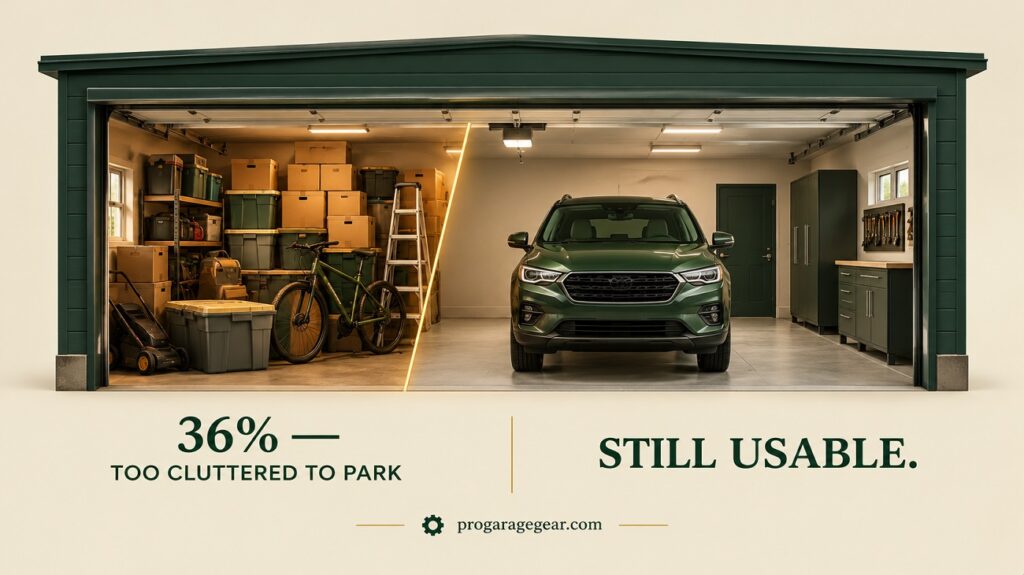
The same 2022 survey found 62% of respondents named the garage their most cluttered room in the house — ahead of the basement, the attic, and closets — and that 53% of homeowners use their garage as an active DIY or workshop space, rising to 62% among millennial respondents specifically.
➡️ If clutter is the problem you’re solving for: Best Garage Cabinet Systems 2026 → and Best Garage Shelving 2026 →
What Garages Are Actually Used For
The garage’s function has shifted well beyond its original purpose. Multiple surveys converge on a similar picture: a meaningful share of garage owners — estimates range roughly 20-36% depending on the specific survey and year — cannot park a vehicle inside due to how the space is actually used. A frequently cited academic-adjacent finding from UCLA researchers studying Los Angeles households found that 75% of families studied used their garage exclusively for storage rather than parking, though this figure is specific to that regional study and shouldn’t be generalized as a national number without that caveat.
Beyond storage, garages increasingly serve as multi-purpose space: hobby and craft areas, automotive workspaces, and — a genuinely growing category — home gyms and fitness spaces, alongside the more traditional workshop and tool-storage functions this site covers in depth.
➡️ For the home gym use case specifically: Best Garage Gym Flooring 2026 →
The 2026 Shift: EV Charging and Smart Systems
Two trends are reshaping how garages get built and upgraded going into 2026, backed by both adoption data and real estate market signals.
EV Charging Infrastructure
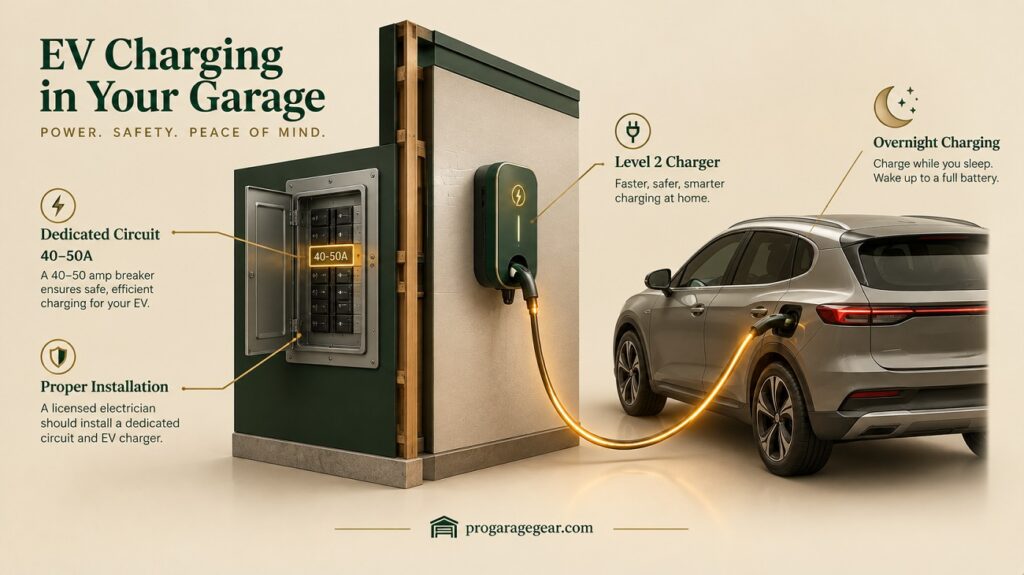
The U.S. Department of Energy reports that more than 80% of electric vehicle charging happens at home rather than at public stations — which puts the garage at the center of EV infrastructure planning for a growing share of households. Realtor.com data found that home listings mentioning EV charging stations appeared significantly more often in 2025 than the year before, suggesting the feature is becoming a real factor in home marketing, not just a niche amenity.
Typical Level 2 home charger installation costs range roughly $800-$2,000 for a straightforward job with adequate existing electrical capacity, climbing higher when a panel upgrade or a long wiring run to a detached garage is required — pricing varies meaningfully across sources and installers, so treat any single quoted range as a starting point rather than a firm number for your specific situation.
A note on the federal tax credit: the Section 30C federal credit (up to 30% of installation cost, capped at $1,000, in eligible census tracts) has been widely referenced through mid-2026 content, but multiple sources report a June 30, 2026 expiration with unclear guidance on what — if anything — remains available afterward. If you’re planning an installation, confirm current eligibility directly through the IRS or a licensed installer rather than relying on this or any other article’s stated terms, since this is exactly the kind of incentive that changes with little notice.
The capacity question most cost estimates skip: a Level 2 home charger typically requires a dedicated 40A or 50A 240V circuit. Homes on an older 100A (or, in some cases, 60A) main electrical panel can run into real capacity constraints once that load is added on top of existing HVAC, water heating, and general household draw — sometimes requiring a load-management device or a full panel upgrade before the charger can be safely installed, on top of the installation cost itself. This is the same underlying concern already covered on this site regarding stacking multiple high-draw 240V systems in one garage.
➡️ For the full electrical capacity planning framework: Garage Electrical Audit 2026 → and The Complete Garage Upgrade Cost Guide 2026 →
Smart Garage Systems
Smart opener and connected-security adoption continues to climb as part of the broader “garage as a system, not a single product” shift several industry trend reports describe for 2026 — app-controlled openers, motion-triggered cameras, and integrated lighting increasingly sold and installed as one coordinated setup rather than separate purchases.
➡️ For the current smart garage product landscape: Best Smart Garage Door Openers 2026 → and Best Garage Security Cameras 2026 →
Safety Data
The garage carries real, quantifiable safety risk that’s often overlooked relative to other rooms in a house. Fire safety industry estimates put garage-originating house fires at over 6,000 incidents annually in the U.S. — a figure that reflects the combination of stored flammable materials (fuel, solvents, paint), electrical equipment, and vehicles all sharing one space, often with less fire-separation attention than the code requirements applied to living spaces.
The code requirement behind that fire statistic: residential building code (International Residential Code, sections governing garage-to-dwelling separation) requires a fire-rated boundary between an attached garage and living space — commonly 5/8″ Type X fire-rated drywall on the garage side of any shared wall or ceiling, plus a self-closing, solid-core door at the entry point between the two spaces.
This isn’t a detail worth ignoring during a DIY upgrade: cutting into a shared wall to run cabinet mounting hardware, electrical conduit for an EV charger, or new plumbing can breach that fire separation if the penetration isn’t properly sealed and fire-rated material isn’t restored around it. Confirm with a local inspector or contractor before penetrating any wall shared with living space, regardless of how minor the modification seems.
➡️ For the specific carbon monoxide and ventilation risks covered in depth elsewhere on this site: Attached Garage Health Risks: CO, Benzene, and Ventilation →
What This Means If You’re Planning a Garage Upgrade
The data above points to a consistent pattern: garages are used for far more than parking in most American households, the majority of owners are dissatisfied with how organized their garage currently is, and the systems people are adding — EV charging, smart security, dedicated workshop and gym space — are increasingly planned as part of one coordinated upgrade rather than piecemeal purchases.
➡️ For a full breakdown of what each of these upgrades actually costs, system by system: The Complete Garage Upgrade Cost Guide 2026 →
Sources
- U.S. Department of Energy, Vehicle Technologies Office, Fact of the Week #1268: “As of 2021, Two-Thirds of U.S. Housing Units Had a Garage or Carport” (American Housing Survey data; includes regional breakdown)
- U.S. Department of Energy, Fact #958: “Sixty-Three Percent of All Housing Units Have a Garage or Carport” (2015 AHS data, owner-occupied vs. rental breakdown)
- U.S. Department of Energy, Fact of the Week #1058: “Two-Thirds of All Housing Units Had a Garage or Carport in 2017” (new-construction and owner/rental breakdown)
- The American Housing Survey itself is sponsored by the U.S. Department of Housing and Urban Development and conducted by the U.S. Census Bureau; the DOE pages above are analyses of its data.
- National Association of Home Builders, Eye on Housing: quarterly new single-family home size data, sourced from Census Quarterly Starts and Completions by Purpose and Design
- CRAFTSMAN (Stanley Black & Decker) / Atomik Research survey, 2022: garage clutter, usage, and DIY statistics (2,004 U.S. adults surveyed). The “82 million garages” figure is quoted in the same release.
- Argonne National Laboratory (U.S. Department of Energy): EV charging infrastructure and home-charging statistics
- GarageDaily.com, reporting Realtor.com listing-frequency data: EV charging station mentions in home listings
- Industry-compiled fire safety statistics: garage-originating residential fire incidence (aggregated estimate, not a single primary government dataset)
This page is reviewed and updated periodically as new data becomes available. Last reviewed: 2026. If you notice a figure that needs updating or have a more current source for any statistic above, we welcome corrections.
This page is reviewed and updated periodically as new data becomes available. Last reviewed: 2026. If you notice a figure that needs updating or have a more current source for any statistic above, we welcome corrections.
Pro Garage Gear participates in the Amazon Services LLC Associates Program; any product links on this site follow standard affiliate disclosure practices, though this particular page is primarily a data reference rather than a product guide.