
Best Garage Utility Sinks 2026: The Plumbing Nobody Explains (P-Trap, Venting, and the Freeze Risk No One Mentions)
Affiliate Disclosure: Pro Garage Gear participates in the Amazon Services LLC Associates Program. We earn from qualifying purchases at no extra cost to you. No manufacturer has paid for placement in this guide.
What “Easy Installation” Actually Skips: Nearly every garage utility sink buying guide describes installation the same way — “simply connect to your existing drain and faucet.” That sentence is doing an enormous amount of unexplained work. What drain? Connected how? A sink basin is the easy part of this purchase. The plumbing behind the wall is where a genuinely simple project turns into a slow-draining sink, a sewer-gas smell nobody can trace, or a cracked pipe after the first hard freeze — and not one buying guide we found addresses any of it.
This isn’t a criticism of the sinks themselves — the products reviewed across this category are generally reasonable. It’s that the entire category of content treats plumbing connection as an afterthought, when it’s the actual determinant of whether the sink works correctly for years or becomes a recurring problem within months.
This guide covers what every other garage sink article skips — the P-trap and venting requirements that determine whether your drain actually works, the trap seal evaporation problem specific to infrequently-used fixtures like garage sinks, and the freeze risk that applies to garage plumbing more than almost anywhere else in a house — before ranking the best garage utility sinks for 2026.
The Drain Connection Reality: P-Trap, Venting, and Slope
A sink drain isn’t just a pipe running to a hole in the wall or floor. Three things have to be correct for it to function safely and reliably, and “connect to your existing drain” glosses over all three.
The P-Trap Is Not Optional
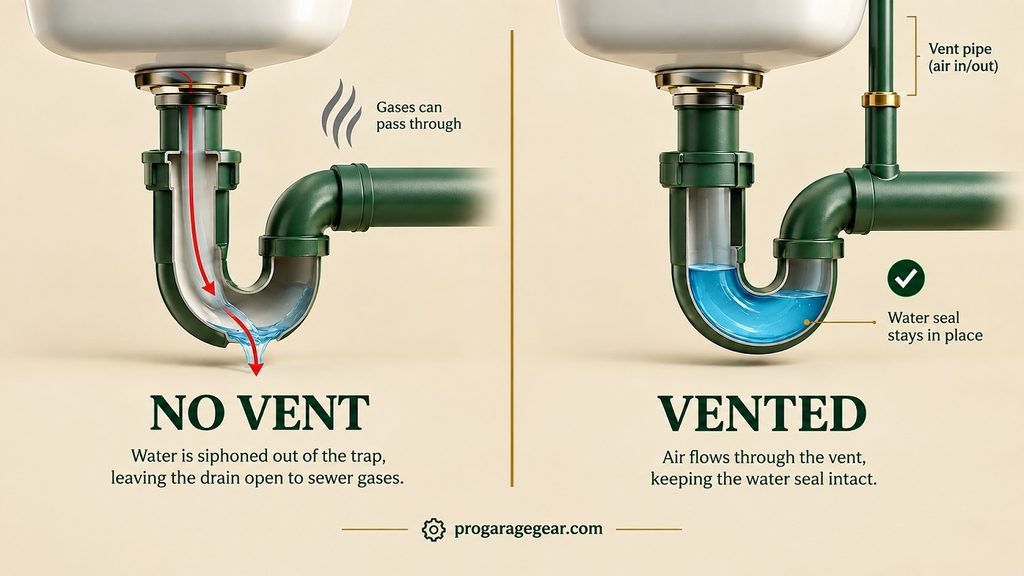
Every sink drain requires a P-trap — the curved section of pipe directly beneath the drain that holds a small amount of standing water at all times. That water seal is what blocks sewer gas from coming up through the drain into your garage. A sink plumbed without a proper P-trap, or with a trap installed incorrectly, creates a direct path for sewer gas into an occupied space — this is a functional requirement, not a nicety, and it’s required by plumbing code (most US jurisdictions follow the International Plumbing Code or a close local variant) for exactly this reason.
Venting Prevents the Trap From Failing on Its Own
A P-trap needs a vent — a pipe connected to the drain line, on the other side of the trap from the sink, that runs to open air (usually up through the roof). Without a vent, water draining out of the sink can create a siphoning effect strong enough to pull the water seal out of the trap itself as it drains — the exact water seal that’s blocking sewer gas. A trap without adequate venting can lose its seal the very first time you drain a full basin, which defeats the purpose of having a trap at all.
What this means practically: if you’re adding a sink to a garage with no existing drain stub-out, “easy installation” only applies to the sink itself. The drain and vent connection is a real plumbing task — tying into an existing vent stack correctly, or in some cases installing an air admittance valve (a code-accepted mechanical vent alternative in many jurisdictions) where running a full vent to the roof isn’t practical. This is worth a licensed plumber’s involvement even if you’re comfortable with the rest of the install, both for code compliance and because a poorly vented drain is a problem that shows up as a mystery smell weeks later, not an obvious failure on install day.
One limitation specific to AAVs in a garage: an air admittance valve works via a mechanical diaphragm that opens under vacuum to admit air and closes by gravity otherwise. In a genuinely cold, unheated location, condensation on that diaphragm can freeze it stiff — leaving the valve either stuck open (allowing sewer gas through when it shouldn’t) or stuck closed (allowing the same siphoning problem the valve exists to prevent).
Manufacturer installation instructions for AAVs commonly specify a conditioned space or a location above the garage’s expected freeze line for exactly this reason. If your garage is unheated or detached in a cold climate, factor this into whether an AAV or a full roof vent is the more reliable choice — this is exactly the kind of detail worth raising with the plumber handling this portion of the install.
Drain Slope: The Detail That Determines Whether It Clogs
Horizontal drain runs need a minimum slope — commonly 1/4 inch of fall per foot of horizontal run — to work correctly. Too little slope and water moves too slowly, leaving solids behind that accumulate into clogs over time. Too much slope and water outruns the solids it’s supposed to carry, leaving residue stuck in the pipe for the same reason. Getting this right on a new drain run is a plumbing detail, not a sink-installation detail — another reason the drain connection deserves more attention than the sink itself typically gets in buying guides.
The Trap Seal Evaporation Problem
A P-trap’s water seal isn’t permanent — it can evaporate over time if the sink isn’t used regularly. A kitchen sink used multiple times daily never has this problem. A garage utility sink, used occasionally for washing tools or rinsing paint brushes, is exactly the kind of fixture where weeks can pass between uses — long enough for the trap seal to evaporate, at which point the same sewer-gas risk the trap exists to prevent returns, even though the plumbing itself is installed correctly.
The fix: run water down the drain for a few seconds every few weeks if the sink isn’t in regular use — enough to refill the trap. For a sink that will genuinely sit unused for extended stretches, a trap primer (a small device that automatically introduces a small amount of water into the trap periodically) is a more reliable solution than remembering to do it manually.
🛒 Check Price on Amazon — Automatic Trap Primer Valve →
The Freeze Risk Nobody Mentions
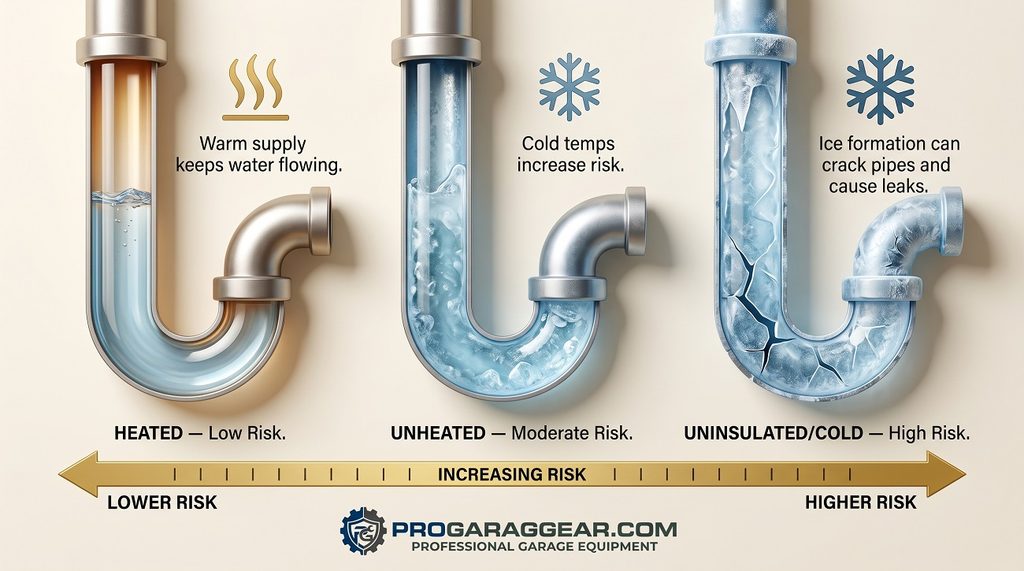
A garage is frequently the least insulated, least heated room in a house with a water line running to it — and every plumbing fixture in that garage inherits that risk. This connects directly to the freeze physics already covered in our winterizing guide: PVC water lines fail at 32°F sustained, because water expands roughly 9% as it freezes and a rigid pipe has nowhere for that expansion to go but outward.
A utility sink’s supply lines and P-trap are both vulnerable to this — the trap specifically because it’s designed to hold standing water at all times, which means it always has water present to freeze, even when the sink hasn’t been used recently.
| Garage Type | Freeze Risk to Sink Plumbing | Recommendation |
|---|---|---|
| Heated, insulated garage | Low | Standard installation is fine |
| Attached, unheated, insulated door | Moderate — depends on regional winter lows | Insulate exposed supply lines; consider a heat cable for the coldest weeks |
| Detached or uninsulated garage, cold climate | High | Heat cable on exposed lines strongly recommended; consider a shutoff valve to drain the line during extended hard freezes |
➡️ For the full freeze-point physics behind this — including why a fully-drained line is safer than a running-but-unheated one — see our winterizing guide: Winterizing Your Garage 2026: The Freeze Point Reference Table →
Pair both, not just one: heat cable protects against active freezing, but a foam insulation sleeve over the same pipe run reduces how hard the cable has to work and adds a layer of protection if power is ever interrupted during a storm.
🛒 Check Price on Amazon — Foam Pipe Insulation Sleeve →
🛒 Check Price on Amazon — Pipe Heat Cable (Freeze Protection) →
Material and Chemical Resistance: What a Garage Actually Puts Down the Drain
A kitchen sink handles food residue and dish soap. A garage sink handles paint thinner, brake cleaner, motor oil, and — if you’re mixing concrete patch nearby — occasionally muriatic acid splash. Material selection matters more here than in almost any other sink application in the house.
One more thing worth adding at the drain itself: a removable strainer basket catches paint chips, drywall mud, and general debris before it reaches the trap and drain line — cheap insurance against exactly the kind of buildup that causes slow drains over time.
🛒 Check Price on Amazon — Stainless Steel Sink Strainer / Sediment Basket →
What the Sink Can Handle Isn’t the Same as What’s Legal to Pour Down It
The chemical resistance table above answers a materials question: what will damage the sink itself. It doesn’t answer a separate, more important question: what’s actually legal to put down that drain at all.
Pouring used motor oil, solvents, paint thinner, or other automotive chemicals into a residential drain — sanitary sewer or septic — is prohibited under local plumbing and environmental codes in essentially every US jurisdiction, regardless of how well the sink material tolerates brief contact. Doing so can damage a septic system’s biological treatment process, contaminate groundwater, and expose a homeowner to real fines under local sewer ordinances and state environmental regulations.
The practical rule: a chemical-resistant sink is for rinsing brushes, hands, and equipment that have had chemical contact — not for disposing of the chemicals themselves. Used motor oil, solvents, and similar waste need to go to a household hazardous waste collection site or an auto parts store that accepts used oil, never down the drain.
The Hose Left in a Bucket: A Backflow Risk Worth Knowing About
Garage utility sinks are frequently paired with a hose-threaded faucet for filling buckets or rinsing equipment. If that hose is left submerged in a bucket of soapy water, fertilizer, or any chemical-laden liquid, a sudden drop in municipal water pressure elsewhere on the line can back-siphon that liquid directly into the supply line — and from there, potentially into the rest of the house’s drinking water.
The fix: a hose bibb vacuum breaker (also called an atmospheric vacuum breaker or anti-siphon valve) on any faucet with hose threads. This is a small, inexpensive device that allows water to flow out normally but closes to prevent flow back in the other direction. Many jurisdictions require these by code on exactly this kind of connection — check yours, and install one regardless even if it isn’t strictly mandated where you live.
🛒 Check Price on Amazon — Hose Bibb Vacuum Breaker (Anti-Siphon Valve) →
➡️ For the full chemical resistance data this table draws on, tested against the same automotive and garage chemicals: Best Garage Floor Mats & Tiles 2026: Chemical Resistance →
Weight and Support: What the Sink Needs From the Wall or Floor
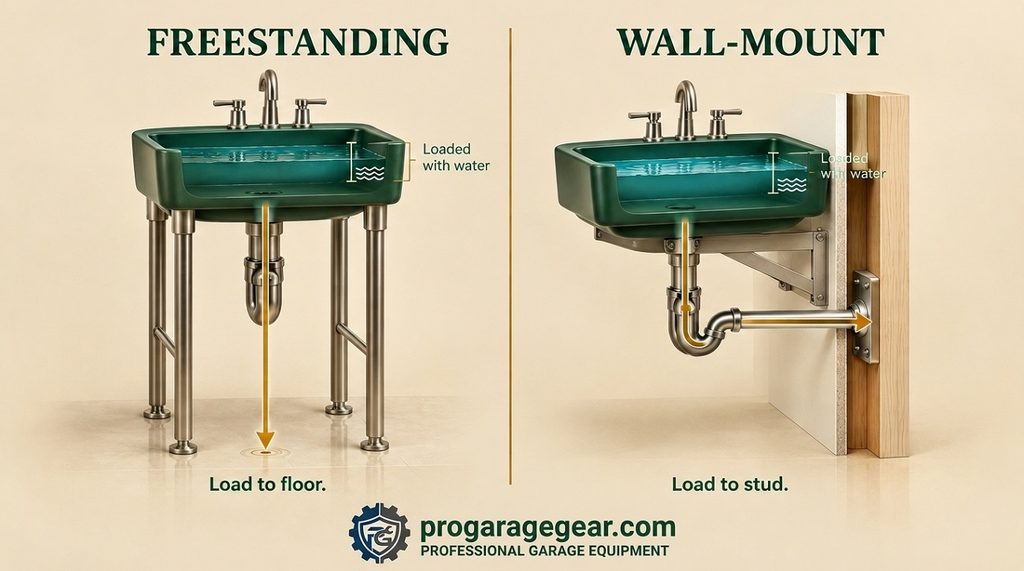
A utility sink full of water and tools is heavier than it looks empty — a large basin holds several gallons, and water alone weighs roughly 8.3 lbs per gallon before anything else is in it. Freestanding sinks with their own legs carry this load to the floor directly and don’t need special wall support. Wall-mounted sinks are a different story: they transfer that full loaded weight to whatever the mounting bracket is anchored into.
➡️ For the stud-spacing and anchor-capacity framework this site uses across every wall-mounted storage guide, equally applicable here: Best Garage Shelving 2026: The Anchor Capacity Test →
The practical rule: never mount a wall-hung utility sink into drywall alone — anchor directly into studs, and confirm the mounting bracket’s rated capacity accounts for a fully loaded basin, not just the sink’s empty weight.
2026 Rankings: The Best Garage Utility Sinks
🥇 Best Overall — Stainless Steel Freestanding with Adjustable Legs
Why it earns #1: A 304 stainless steel freestanding sink with adjustable-height legs covers the widest range of garage use cases correctly — durable, reasonably chemical-resistant with prompt rinsing, and freestanding legs mean no wall anchor load calculation needed. Adjustable legs also solve the same uneven-garage-floor problem covered elsewhere on this site for cabinets and workbenches.
The Data
- Material: 304 stainless steel
- Basin depth: Typically 10-12 inches — enough to contain splash from scrubbing and soaking
- Support: Freestanding, adjustable-height legs
- Faucet: Standard 4-inch centerset compatible
🛒 Check Price on Amazon — Stainless Steel Freestanding Utility Sink →
🥈 Best for Chemical Exposure — Polypropylene Freestanding Sink
Why it earns #2: For a garage where paint cleanup, solvent use, or automotive chemical exposure is a regular occurrence rather than occasional, polypropylene’s chemical resistance genuinely outperforms stainless steel — no finish to dull, no risk of etching from acid splash.
🛒 Check Price on Amazon — Polypropylene Freestanding Utility Sink →
🥉 Best Space-Saver — Wall-Mount Corner Sink
Why it earns #3: For a garage where floor space is the binding constraint, a wall-mounted corner sink recovers floor area a freestanding basin can’t. Correctly installed per the Weight and Support section above, it’s a legitimate choice — just confirm stud anchoring before assuming a standard drywall mount will hold.
🛒 Check Price on Amazon — Wall-Mount Corner Utility Sink →
⭐ Best for Laundry Integration — Sink with Washboard and Standpipe Compatibility
For a garage that doubles as a laundry space, a sink with an integrated washboard and standard standpipe compatibility lets you tie into an existing laundry drain line rather than running an entirely new one — a meaningfully simpler installation than adding a standalone drain connection from scratch.
🛒 Check Price on Amazon — Utility Sink with Washboard (Laundry Standpipe Compatible) →
Complete Comparison Table
The Sink Install Readiness Calculator
Answer a few questions about your garage’s existing setup to see what your installation actually requires before you buy.
🚰 Sink Install Readiness Calculator
🚰 Sink Install Readiness Calculator
Find out what your installation actually needs before you buy.
* General guidance based on common plumbing code principles — always confirm requirements with a licensed plumber and your local jurisdiction’s specific code before installation.
Frequently Asked Questions
Do I need a permit to install a utility sink in my garage?
In most US jurisdictions, yes — adding a new plumbing fixture, especially one requiring a new drain and vent connection, typically requires a permit under local plumbing code. Tying into an existing, already-permitted drain line (like a laundry standpipe) may have different requirements than running entirely new plumbing. Check with your local building department before starting; unpermitted plumbing work can create issues at resale and may not be covered by homeowner’s insurance if it causes water damage.
Why does my garage sink smell like sewer gas even though it drains fine?
This is almost always the trap seal evaporation problem covered above — the P-trap’s water seal has evaporated from infrequent use, even though the drain itself works correctly when you do use the sink. Run water down the drain for a few seconds to refill the trap; if the smell returns quickly and repeatedly, a trap primer is the more permanent fix for a sink that sits unused for extended periods.
Can I install a utility sink without professional help?
The sink itself — mounting, faucet connection — is genuinely DIY-accessible for most comfortable homeowners. The drain and vent connection is where the line to “call a plumber” should be drawn if you don’t have existing, confirmed-correct infrastructure to tie into — see the Install Readiness Calculator above. Getting the trap, vent, and slope wrong doesn’t usually fail immediately; it shows up weeks or months later as a smell, a slow drain, or in the worst case a code violation discovered at resale.
What’s the best sink material for a garage that also does automotive work?
Polypropylene or PE, per the Material and Chemical Resistance section above — genuinely superior resistance to brake cleaner, motor oil, and solvents compared to stainless steel or enamel, with no finish to dull or etch from chemical contact. Stainless steel remains a solid general-purpose choice if chemical exposure is occasional rather than routine.
Will my garage sink freeze in winter?
Depends heavily on your garage type and climate — see the Freeze Risk table above. A heated, insulated garage carries low risk. An unheated or detached garage in a cold climate carries real risk to both the supply lines and the P-trap itself, since the trap always holds standing water. Heat cable on exposed lines and, for the most extreme cases, a shutoff valve to drain the line during hard freezes are both worth considering — see our winterizing guide for the full freeze-point physics.
The Bottom Line
The sink basin is the easy 10% of this project. The plumbing behind it — a correctly sized and sloped drain, a properly vented trap, and freeze protection appropriate to your garage’s climate — is the 90% that determines whether the installation actually works for years or becomes a recurring problem. Confirm your drain and vent situation before you buy anything, budget for a plumber on that portion if you don’t have existing infrastructure to tie into, and match the sink material to what you’re actually going to put down the drain.
Affiliate Disclosure: Pro Garage Gear earns from qualifying Amazon purchases at no extra cost to you. Plumbing code requirements vary by jurisdiction — always confirm specific requirements with a licensed plumber and your local building department before installation.