Best Garage Tool Chests 2026: Husky vs. Craftsman vs. Milwaukee (The Steel Gauge Test)
This post contains affiliate links. We may earn a commission if you purchase through these links, at no extra cost to you.
The “Roller Rattle” Warning: You open your brand-new tool chest. You push it across your garage floor. It wobbles. The drawer slides snag. The lock clicks but doesn’t hold firm. You just spent $400 on a glorified metal filing cabinet. We’ve seen it happen dozens of times — and the manufacturers are counting on you not knowing what to look for before you buy.
In 2026, the garage tool chest market is flooded with units that look industrial but are built from steel so thin it flexes when you load it. This guide exists to fix that problem.
We’re going to cut through the marketing noise, explain the one number that matters more than brand name or color, and rank the best garage tool chests you can actually trust.
The Only Specification That Matters: Steel Gauge
Before we name a single product, you need to understand steel gauge — because this is where manufacturers quietly cut corners.
Here’s the counterintuitive truth: a lower gauge number = thicker steel.
| Steel Gauge | Thickness (inches) | What It Means |
|---|---|---|
| 18-gauge | 0.0478″ | Professional grade. Resists denting. |
| 20-gauge | 0.0359″ | Mid-range. Acceptable for light use. |
| 22-gauge | 0.0299″ | Consumer grade. Dents with a knuckle rap. |
| 24-gauge | 0.0239″ | Thin. Found in cheap “big box” units. |
The problem? Most manufacturers don’t advertise their gauge on the product page. They lead with lumen-equivalent marketing — “1,200 lb. capacity!” — without telling you that capacity assumes all drawers are uniformly loaded and the chest is sitting perfectly still on a flat surface.
The Knuckle Test: Rap your knuckle on the side of any tool chest before buying. If it sounds hollow and tinny — like an empty soup can — you’re holding 22 or 24-gauge steel. A solid, low-pitched thud means 18 or 20-gauge. Do this test before you ever read the spec sheet.
🔊 The Steel Gauge Sound Chart: Train Your Ear Before You Shop
Most people can’t visualize what 18-gauge vs. 24-gauge steel feels like. But you can hear the difference — and once you know what to listen for, you can test any chest in any store in under 10 seconds.
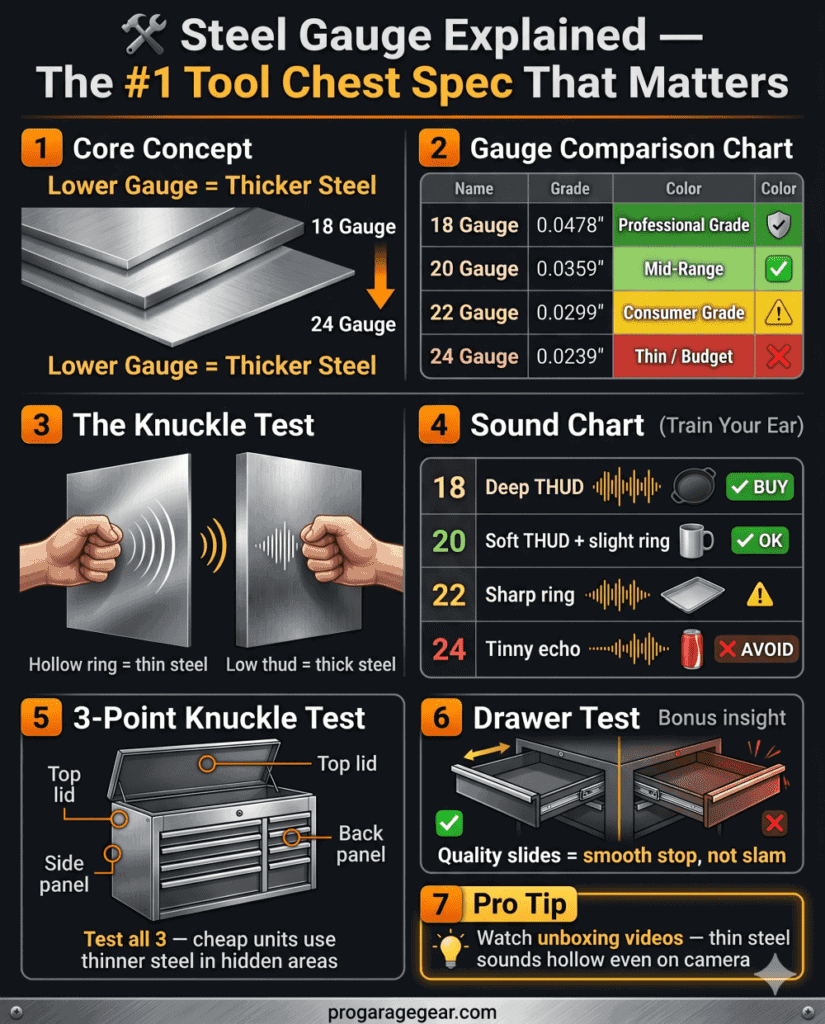
Here’s exactly what each gauge sounds like:
| Steel Gauge | Sound Profile | Real-World Comparison | Action |
|---|---|---|---|
| 18-gauge | Deep, short, low-pitched “thud” | Like tapping a cast iron skillet | ✅ Buy |
| 20-gauge | Moderate pitch, slight ring | Like tapping a thick ceramic mug | ✅ Acceptable |
| 22-gauge | Higher pitch, noticeable ring that lingers | Like tapping a sheet pan | ⚠️ Caution |
| 24-gauge | Hollow, high, tin-can resonance — ring travels | Like tapping an empty aluminum can | ❌ Avoid |
The 3-Point Knuckle Test: Rap your knuckle on three locations — the side panel, the back wall, and the top lid. Cheap units use different gauges in different locations (they spend more on the visible side panels, less on the back and lid). A premium chest sounds consistent across all three points. A budget chest will sound noticeably thinner on the back.
The Drawer Pull Test: After the knuckle test, pull a drawer open quickly and let go. A quality ball-bearing slide decelerates smoothly — the drawer slows and stops without slamming. A cheap slide lets the drawer freewheel and slam shut. You’ve just tested two specs without reading a single sheet.
Pro Tip: If you’re buying online, search YouTube for “[model name] unboxing” and listen to how the drawers sound when the reviewer opens them. Thin steel resonates even through camera audio. This 60-second YouTube trick has saved us from recommending three different tool chests that looked great in photos.
Before you choose your chest, make sure your garage storage system is planned correctly. Read our 15 Genius Garage Shelving Ideas to see how a tool chest fits into a complete organization strategy.
What to Look for Beyond Steel Gauge
1. Ball-Bearing Drawer Slides
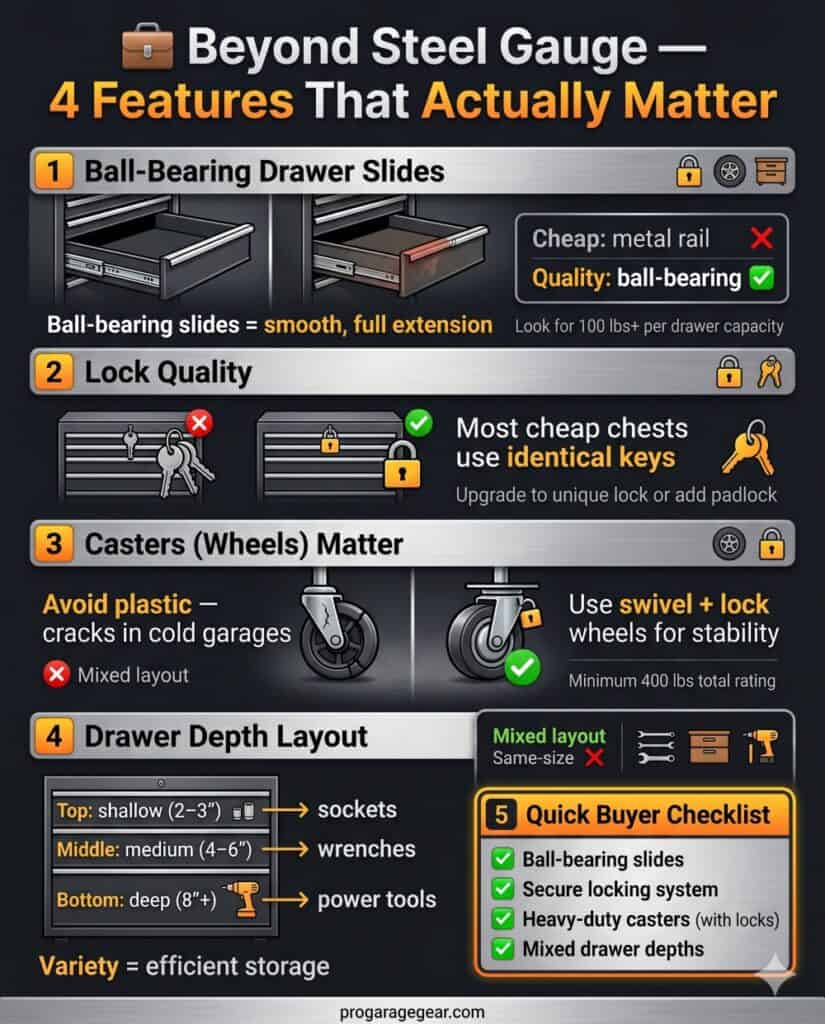
The cheap option is a simple metal runner. Ball-bearing slides allow full extension (you can pull the drawer all the way out without it tipping) and hold weight properly. Look for units rated at 100 lbs. per drawer minimum on the main cabinet.
2. Lock Quality
Most consumer chest locks are keyed-alike across the entire product line — meaning your neighbor’s key opens your chest. Look for unique key tumbler systems on higher-end units, or add an aftermarket padlock to the hasp.
3. Caster Rating and Type
Cheap plastic casters crack in cold garages. Look for polyurethane casters rated for at least 400 lbs. total (not per caster). Swivel-and-lock casters are essential so the chest doesn’t roll while you’re yanking on a stuck socket.
4. Drawer Depth Variation
A good chest has a mix: shallow drawers (2″–3″) for sockets and bits, mid drawers (4″–6″) for wrenches, and deep drawers (8″+) for power tools and extension cords. A chest with all the same drawer depth is inefficient regardless of how large it is.
The 2026 Garage Tool Chest Rankings
🥇 #1 — Milwaukee 46″ High-Capacity Cabinet (18-Gauge)
Best for: Serious DIYers and professional mechanics who want a chest that lasts 20 years.
Milwaukee’s flagship rolling cabinet is built to a standard most brands call “overkill” — which is exactly what you want.
The Data:
- Steel: 18-gauge throughout (verified by independent reviewers)
- Drawers: 15 drawers with 100 lb. ball-bearing rated slides
- Capacity: 3,000 lbs. total
- Casters: 6″ polyurethane, 1,400 lb. rated
- Lock: Single-key, unique tumbler system
What makes it stand out: The full-extension ball-bearing slides mean you can pull a drawer completely out without it falling — critical when you’re holding a heavy wrench set with one hand. The 18-gauge construction means you can sit on this chest, lean tools against it, and load every drawer to capacity without a single flex or rattle.
The honest downside: It’s expensive. If you’re a weekend DIYer doing oil changes and basic maintenance, you do not need this chest. But if you’re building engines, doing bodywork, or this is your livelihood — buy it once and never buy again.

🥈 #2 — Husky 52″ Mobile Workbench (20-Gauge with Solid Oak Top)
Best for: Homeowners who want both storage and a work surface in one unit.
Husky’s 52″ mobile workbench pulls double duty as a tool chest and a workbench, which makes it one of the best values in the garage storage market.
The Data:
- Steel: 20-gauge (strong enough for 95% of homeowners)
- Drawers: 9 drawers with 100 lb. ball-bearing slides
- Bonus: Solid wood top surface (actual hardwood, not MDF)
- Power: Built-in 2-outlet power strip + 2 USB ports
- Casters: Locking, rated for full-load mobility
What makes it stand out: The wood top turns this unit into a full workstation. You can mount a vise directly to it, use it as an assembly table, and still roll it to wherever you’re working. The power strip integration means your battery charger and lamp live on the chest instead of running a cord across the floor.
The honest downside: 20-gauge means the sides will dent if you’re rough with it. Keep this in mind if your garage is a high-traffic workspace with vehicles moving around it.
If you want to combine a tool chest with a true workbench setup, see our full comparison in Best Adjustable Garage Workbenches 2026.

🥉 #3 — Craftsman 2000 Series 26″ Tool Chest + Cabinet Combo
Best for: Budget-conscious buyers who still want a name-brand unit with a real warranty.
Craftsman’s 2000 Series is the benchmark of the value segment. It’s not the thickest steel you can buy, but Craftsman’s quality control and lifetime hand tool warranty make it far more trustworthy than no-name equivalents.
The Data:
- Steel: 21-gauge (thinner than Husky and Milwaukee, but not cheap)
- Drawers: 13 total (chest + cabinet combo)
- Slides: Ball-bearing, 100 lb. rated
- Lock: Single-key system
- Warranty: Lifetime on hand tools, 1 year on the chest itself
What makes it stand out: Value. The combo unit gives you overhead and floor storage in a matching set for a fraction of the Milwaukee price. For the homeowner with basic tools — socket sets, wrenches, screwdrivers — this is genuinely enough chest.
The honest downside: The 21-gauge steel is noticeably lighter than the Milwaukee or Husky units. It won’t survive a serious commercial workshop, but for a residential garage, it holds up well if you don’t overload it.

Also Recommended
DEWALT 52″ Mobile Work Center — Outstanding for those who already use DeWalt power tools and want matching storage. Similar quality to Husky’s 52″ at a comparable price point.
Gladiator Ready-to-Assemble Cabinet — The best option if you want modular storage that expands over time. Not a traditional rolling chest, but great for garages where floor space is fixed.
The “Shadow Test” for Drawer Quality
Here’s a test you can do in-store before buying: pull a drawer out halfway and look at how it moves. A quality ball-bearing slide moves silently, smoothly, and without any left-right play. Now push the drawer in quickly and let go. A quality drawer decelerates gently. A cheap slide will slam shut or bounce back open. You’ve just tested the slide quality without reading a single spec sheet.
Tool Chest Sizing Guide: What Size Do You Actually Need?
| Garage Type | Tools Owned | Recommended Size |
|---|---|---|
| Weekend hobbyist | Basic socket/wrench set | 26″–30″ top chest only |
| Active DIYer | 2–4 full tool sets | 41″–46″ combo unit |
| Serious mechanic | Professional tool inventory | 52″–72″ full station |
The Space Trap: Measure your garage wall before you buy. Allow for the chest to open drawers fully (add 24″–30″ of clearance in front) and to access the back of the drawer. Many garages look like they can fit a large chest — until you actually try to use it.
If your garage is already tight on space, read our Slatwall vs. Pegboard guide — wall-mounted tool storage can free up the floor space needed for a proper rolling chest.
Should I buy a tool chest or a tool cabinet?
chest sits on top (portable, smaller). A cabinet sits on the floor (larger, rolling). Most serious setups combine both — the cabinet on the bottom, the chest on top — which is called a “combo” unit.
Are Harbor Freight tool chests worth buying?
Harbor Freight’s US General Series 2 (not the base model) is legitimately good for the price. It’s 18-gauge on most models and the slides are genuine ball-bearing. If budget is tight, it’s a better buy than an equivalent-priced no-name chest from Amazon.
How much weight should I expect to put in a tool chest?
A full set of hand tools (sockets, wrenches, screwdrivers, pliers) typically weighs 150–300 lbs. Power tools add significant weight. Buy a chest rated for at least double what you plan to put in it — weight ratings are tested under ideal conditions, not real-world use.
Can I bolt my tool chest to the wall for security?
Yes, and you should. Most quality chests have mounting holes in the back for this purpose. Use lag bolts into studs, not just drywall anchors
The Bottom Line
The best garage tool chest for most homeowners in 2026 is the Husky 52″ Mobile Workbench — it’s built well enough to last a decade, doubles as a work surface, and hits a price point that doesn’t require financing.
If you’re a serious mechanic who works on cars daily, spend the extra money on the Milwaukee 46″ High-Capacity Cabinet. You’ll use it for 20 years. The math works out.
If budget is tight, the Craftsman 2000 Series combo gets the job done without embarrassing you. Just don’t overload it.
Now stop letting your tools live in a red plastic tote on the floor. Your tools deserve a real home — and so does your garage.