Best Garage Air Compressors 2026: Pancake vs. Twin-Stack (The CFM Truth Nobody Tells You)
This post contains affiliate links. We may earn a commission if you purchase through these links, at no extra cost to you.
The “Nailgun Stutter” Problem: You’re halfway through framing a workshop shelf. Every third nail fires at half-power, or doesn’t fire at all. Your air gun splutters. You wait. You wait some more. Then it fires — right when you’ve moved on. Your nail goes in crooked, and your trim is ruined. This isn’t a nailgun problem. This is a compressor problem. And it comes down to one number that 90% of buyers completely ignore.
That number is CFM — Cubic Feet per Minute — and it’s more important than PSI, tank size, or horsepower. This guide explains why, and then gives you the best garage air compressors for every type of job in 2026.
PSI vs. CFM: Why You’ve Been Misled
Walk into any hardware store and you’ll see air compressors marketed by two numbers: horsepower and peak PSI. Neither of these tells you what you actually need to know.
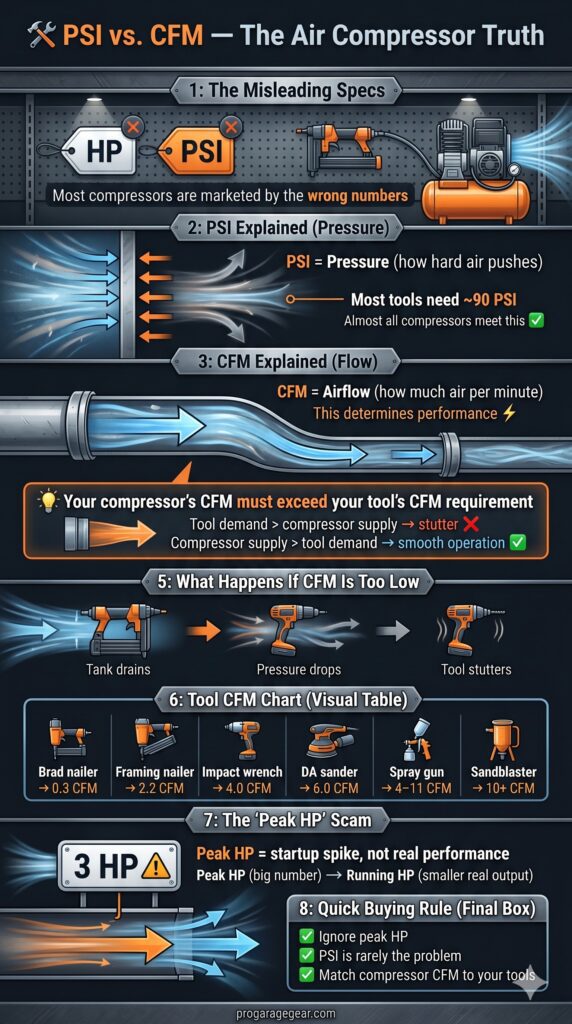
PSI (Pounds per Square Inch) measures pressure — how hard the air pushes. Most tools need 90 PSI to operate. Almost every compressor on the market exceeds that, so PSI rarely limits performance.
CFM (Cubic Feet per Minute) measures flow — how much air the compressor delivers per minute. This is the number that determines whether your tools perform consistently or stutter, stall, and leave you waiting.
The Real Rule: Your compressor’s CFM rating must exceed your tool’s CFM requirement. If it doesn’t, the tank depletes faster than the compressor can refill it. That’s why your nailgun stutters.
| Tool | CFM Required @ 90 PSI |
|---|---|
| Brad nailer | 0.3 CFM |
| Framing nailer | 2.2 CFM |
| Impact wrench (1/2″) | 4.0 CFM |
| DA sander (orbital) | 6.0 CFM |
| Paint spray gun | 4.0–11.0 CFM |
| Sandblaster | 10.0+ CFM |
The “Peak HP” Scam: Many compressors advertise “peak horsepower” — a measurement taken at the moment of startup when the motor draws maximum current. Running horsepower is always lower. A compressor advertised as “3 HP” may only deliver 1.5 HP under sustained operation. Always look for running HP or rated HP, not peak.
🔧 Air Compressor CFM Matcher
Select every tool you plan to use. We’ll calculate your total CFM demand and recommend the exact compressor size — including the 1.5x safety buffer.
Pancake vs. Twin-Stack vs. Belt-Drive: Which Tank Style is Right for You?
Pancake Compressors
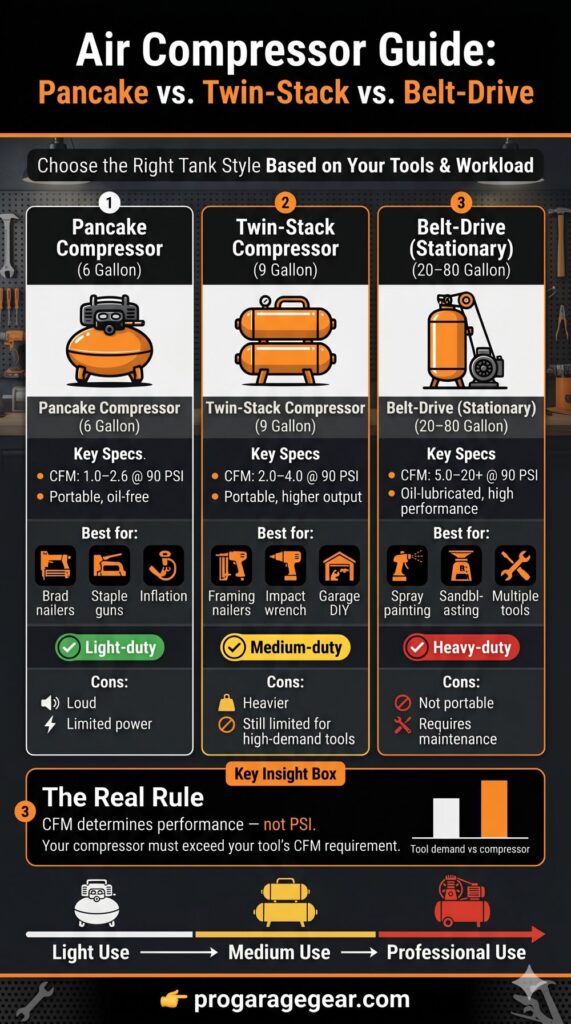
What they are: Single flat circular tank, usually 6 gallons. CFM range: 1.0–2.6 CFM @ 90 PSI Best for: Brad nailers, staple guns, inflation, small jobs Pros: Portable, oil-free, no maintenance Cons: Runs more frequently (small tank), louder, limited to light tools
The pancake compressor is the right tool for trim carpenters, weekend DIYers doing nailing and inflation tasks, and anyone who needs portability above all else. The moment you add a DA sander, impact wrench, or sandblaster, you'll outrun it immediately.
Twin-Stack Compressors
What they are: Two tanks stacked horizontally, usually 4.5 gallons each (9 gal. total). CFM range: 2.0–4.0 CFM @ 90 PSI Best for: Framing nailers, impact wrenches, light finishing Pros: Better CFM than pancake, still oil-free and portable Cons: Heavier than pancake, louder than belt-drive, still limited for high-demand tools
The twin-stack is the sweet spot for most garage DIYers. It handles the majority of air tools without needing the bulk and complexity of a stationary unit.
Vertical/Horizontal Stationary (Belt-Drive)
What they are: Large-tank compressors (20–80 gallons) with belt-driven, oil-lubricated pumps. CFM range: 5.0–20+ CFM @ 90 PSI Best for: Spray painting, sandblasting, running multiple tools simultaneously Pros: Quieter (belt absorbs vibration), highest CFM, longest pump life Cons: Not portable, requires oil changes, more expensive
If you plan to spray paint cars, run two air tools at once, or sandblast, a stationary belt-drive unit is the only viable option. The investment is larger, but a quality belt-drive compressor will outlast direct-drive units by decades.
A high-CFM compressor often requires a dedicated 20-amp circuit. Make sure your garage wiring is ready — read our Garage Electrical Load Guide 2026 before you buy a stationary unit.
2026 Rankings: Best Garage Air Compressors
🥇 #1 — California Air Tools 20-Gallon Ultra-Quiet (Best All-Around)
Noise Level: 70 dB (quieter than a normal conversation) CFM: 6.40 @ 40 PSI / 5.30 @ 90 PSI Tank: 20 gallons Motor: 2.0 HP (running, oil-free) Voltage: 110V (standard outlet)
This is the benchmark compressor for serious home garages in 2026. The 20-gallon tank means it runs less frequently — critical if you're doing sustained work like painting or using a DA sander. The 70 dB noise rating is dramatically quieter than the 90–100 dB typical of most consumer compressors. You can actually hold a conversation next to this unit.
The oil-free pump eliminates maintenance — no oil changes, no oil mist in your air lines. The 110V requirement means you don't need a special outlet.
The one caveat: At 5.30 CFM @ 90 PSI, it will sustain most tools but will still run frequently with a continuous-use tool like a large spray gun. For automotive painting, consider stepping up to a belt-drive with 8+ CFM.

🥈 #2 — DEWALT 15-Gallon 200 PSI Quiet Compressor (Best for Portability + Power Balance)
Noise Level: 78 dB CFM: 5.0 @ 90 PSI Tank: 15 gallons Motor: 1.6 HP (rated) Voltage: 110V
DeWalt's 15-gallon quiet unit hits the balance point between portability and real-world performance better than almost anything in its class. It's lighter than the California Air Tools unit, still delivers 5.0 CFM, and DeWalt's reliability track record in garage tools is second to none.
The 200 PSI max tank pressure is higher than many competitors — which means the tank holds more stored air and the compressor runs less often. This is a smarter design than simply making the tank larger.

🥉 #3 — BOSTITCH BTFP02012 6-Gallon Pancake (Best Budget Pick)
Noise Level: 90 dB CFM: 2.6 @ 90 PSI Tank: 6 gallons Motor: 0.8 HP (running) Voltage: 110V
For nailing, stapling, and inflation, this is the best-value air compressor on the market. It weighs 29 lbs., fits in the back of a truck, and is oil-free with zero maintenance. The 2.6 CFM @ 90 PSI handles brad nailers and framing nailers well. It will not sustain a DA sander or spray gun — don't try. For what it's designed to do, the Bostitch pancake is bulletproof.
Also Ranked
Makita MAC2400 Big Bore Twin-Stack — The best twin-stack available. At 4.2 CFM @ 90 PSI with a 4.2-gallon twin tank, it handles impact wrenches and framing guns without sweating. Oil-lubricated for longer pump life.
Ingersoll Rand 20-Gallon Garage Mate (Belt-Drive) — The best stationary unit for automotive work and painting. At 5.7 CFM @ 100 PSI (belt-drive, oil-lubricated), this unit is built to run 8 hours a day. The belt-drive design means it runs quieter and cooler than direct-drive units of similar output.
🔊 The Garage Noise Scale: What Those Decibel Numbers Actually Mean
Every air compressor spec sheet lists a decibel (dB) rating. Almost no buyer knows what those numbers mean in real life. Here's the translation:
First, the physics reality: Decibels are logarithmic. A 10 dB increase is perceived as roughly twice as loud to the human ear. The difference between 70 dB and 80 dB isn't 14% louder — it's approximately two times louder. This makes the decibel gap between our top picks genuinely dramatic, not just cosmetically different.
The Garage Compressor Noise Scale
| dB Rating | Real-World Sound Equivalent | Heard From 10 Feet Away | Can You Hold a Conversation? |
|---|---|---|---|
| 60 dB | Normal conversation, quiet dishwasher | Barely noticeable | Easily |
| 65 dB | Office environment, moderate AC unit | Noticeable but not intrusive | Yes |
| 70 dB | California Air Tools 20-gal — the quiet benchmark | Like a washing machine | Yes, without raising voice |
| 75 dB | Some quiet twin-stack units | Like a busy restaurant | Yes, but you notice it |
| 78 dB | DeWalt 15-gallon quiet unit | Like a loud TV | Possible, but louder voice needed |
| 85 dB | Most consumer pancake compressors | Like a food blender running | Difficult without shouting |
| 90 dB | BOSTITCH Pancake, most budget units | Like a gas lawnmower | Not really |
| 95 dB | Older oil-lubricated direct-drive units | Like a running chainsaw (nearby) | No |
| 100 dB | Older piston compressors at startup | Like standing next to a running motorcycle | Absolutely not |
OSHA Permissible Exposure Limit: 90 dB for 8 hours, 100 dB for 2 hours, 110 dB for 30 minutes. At 95+ dB, hearing protection is not optional during sustained operation.
Noise Comparison: Our Top 3 Picks Head-to-Head
California Air Tools 20-Gallon (70 dB): Imagine working in your garage with a washing machine running in the next room. You can listen to a podcast. You can have a phone conversation without going outside. Your spouse watching TV in the house next to the garage won't hear it at all. This is the only compressor class appropriate for garages beneath living spaces or in attached garages with thin walls.
DeWalt 15-Gallon Quiet (78 dB): Picture a busy restaurant kitchen — you hear it clearly, but it's background noise, not intrusive foreground noise. You'll raise your voice slightly on a phone call. Your neighbors won't complain. Inside an attached garage, people in the home above will notice a slight background hum during the compressor's on-cycle.
BOSTITCH Pancake (90 dB): The on-cycle sounds like a gas lawnmower running 15 feet away. You will stop your conversation every time the motor kicks on. In a single-car garage, this is tolerable. In an attached garage beneath a bedroom — run it only during daylight hours. Ear protection is genuinely recommended for extended work sessions.
The "Neighbor Test": If your garage shares a wall with a neighbor's bedroom or living space (common in townhouses and zero-lot-line homes), anything above 75 dB becomes a genuine courtesy issue. The 20-dB premium for the California Air Tools unit is the cost of not ruining a neighbor relationship.
The "Night Owl" Consideration: If you work on projects in the evening (after 8 pm), the 70 dB quiet compressor category isn't just considerate — it's the difference between getting to work and waking everyone up.
Does Running Position Affect Noise?
Yes — significantly.
- Placing the compressor on a rubber isolation pad (anti-vibration pad, $15–$20) reduces transmitted vibration noise by 3–5 dB
- Placing it in a corner amplifies sound (corner bass loading) — center of the wall is quieter
- Placing it on a wooden shelf vs. concrete floor reduces transmitted resonance noise
- A plywood "doghouse" enclosure with sound-deadening foam can reduce perceived noise by 8–12 dB for stationary installations — search "compressor sound enclosure DIY" for design plans
Moisture and Air Quality: The Filter You Must Not Skip
Compressed air contains moisture — and that moisture wreaks havoc on air tools, shortens their lifespan, and ruins paint jobs.
You need, at minimum:
- An in-line moisture separator (between the compressor and your main line)
- A coalescing filter if you're painting or using pneumatic sanders
- An auto-drain valve on the tank if you use the compressor regularly (prevents tank rust from water accumulation)
The "Morning Drain" habit: Every time you're done using your compressor, open the drain valve at the bottom of the tank and let the water out. Neglecting this accelerates tank corrosion and will destroy your compressor in 3–5 years instead of 15+.
Air quality in your garage goes beyond your compressor. For dust, fumes, and overall air safety, see our Best Garage Air Filtration Systems guide.
Sizing Guide: What CFM Do You Actually Need?
| Your Main Use Case | Minimum CFM Needed | Recommended Tank |
|---|---|---|
| Inflation, nailing | 2.0 CFM | 6 gal. pancake |
| Impact wrench, framing | 4.0 CFM | 15 gal. |
| Orbital sander, painting | 6.0+ CFM | 20 gal. |
| Sandblasting, production | 10.0+ CFM | 30–60 gal. belt-drive |
The 1.5x Rule: Buy a compressor that delivers at least 1.5x the CFM your most demanding tool requires. If your DA sander needs 6.0 CFM, buy a compressor that delivers at least 9.0 CFM. This accounts for duty cycle limits and means the compressor is never running at max capacity.
Do I need 220V for a garage air compressor?
Most compressors under 3 HP run on standard 110V outlets. Larger stationary units (3 HP+) typically require a dedicated 220V circuit. Check your compressor's specs before plugging in
How often should I change the oil in a belt-drive compressor?
Most manufacturers recommend every 200–500 hours of use. Check your manual. Using the wrong oil (especially automotive oil) will shorten pump life significantly — use compressor-specific synthetic oil.
Can I run two air tools at once?
Only if your compressor's total CFM exceeds the combined CFM of both tools. Add up the CFM requirements of everything you plan to run simultaneously and buy accordingly.
Is a 6-gallon compressor good enough for home use?
For nailing, stapling, and blowing dust — yes, absolutely. For impact wrenches, sanders, or spray painting — no. Be honest about what tools you plan to use.
The Bottom Line
For most home garage owners in 2026, the California Air Tools 20-Gallon is the right answer. It's quiet enough to use without hearing protection, powerful enough for nearly every home DIY task, and reliable enough that you won't be buying another one for 15 years.
If budget is tight and your needs are limited to nailing and inflation, the BOSTITCH Pancake is flawless for its purpose.
If you're painting cars or running continuous tools, invest in the Ingersoll Rand Garage Mate — and set up your garage electrical properly first.
A great compressor makes every air tool you own perform better. Stop suffering through a stuttering nailgun.