Best Garage Parking Aids 2026: Lasers vs. Mats (Stop The “Bump”)
By Pro Garage Gear Team | August 2026
This post contains affiliate links. We may earn a commission if you purchase through these links.
The “6-Inch” Error: Modern SUVs barely fit in standard 20×20 garages. You often have less than 6 inches of clearance between your bumper and the Workbench. One slip of the foot, and you have a cracked drywall or a $2,000 bumper repair.
You have the clean floor. You have the smart opener. Now, the final step is ensuring you don’t crash your car into your new setup. This is where your garage parking aids is vital.
For decades, the “Tennis Ball on a String” was the go-to solution. But in a finished garage, a dirty yellow ball hanging from the ceiling looks trashy (and eventually the string snaps).
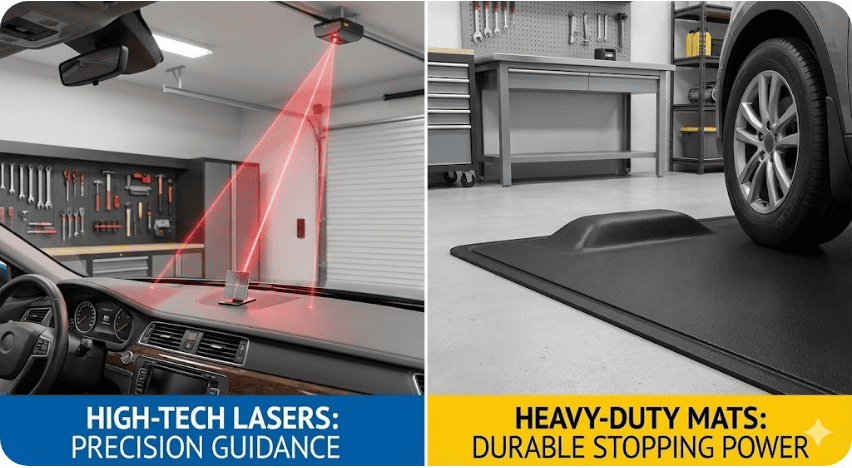
In 2026, the best Garage Parking Aids fall into two categories: High-Tech Lasers or Heavy-Duty Mats.
We tested the top options to see which one actually works—and which ones are just battery-eating toys.
🏆 The Options: Tech vs. Tactile
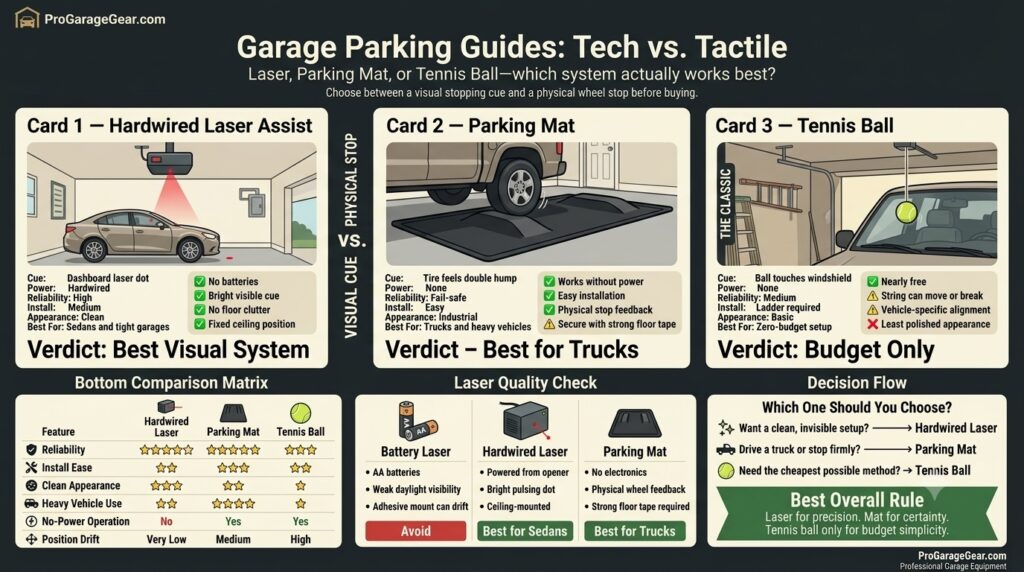
Before you buy, decide: Do you want a visual cue (Laser) or a physical stop (Mat)?
| Feature | Chamberlain Laser Assist (The "Tech") | Maxsa Park Right Mat (The "Physical") | Tennis Ball (The "Classic") |
| Concept | Red dot hits your dashboard. | Tire hits a "double hump" bump. | Ball hits your windshield. |
| Power Source | Hardwired (No Batteries) | None (Gravity) | None |
| Reliability | High (If hardwired) | 100% Fail-Safe | Medium (String breaks) |
| Aesthetic | Clean / Invisible | Industrial | "Trashy" |
| Install Difficulty | Medium (Wiring/Mounting) | Low (Tape to floor) | Medium (Ladder work) |
| Best For | Tight workspaces / Tech lovers | Heavy trucks / "Lead foot" drivers | $0 Budget |
| Link | Check Price on Amazon | Check Price on Amazon | Check Price on Amazon |
| Failure Mode | Battery Laser (The Toy) | Hardwired Laser (The Pro) | Parking Mat (The Block) |
| Power Source | AA Batteries (Die in 6 months) | Garage Motor (Infinite) | Gravity (Infinite) |
| Drift Risk | High (Sticky tape fails) | Zero (Screwed to ceiling) | Medium (Needs Tape) |
| Daylight Visibility | Low (Weak Red Dot) | High (Bright Pulsing Dot) | N/A (Tactile) |
| "Wife Acceptance" | Low (Ugly box on ceiling) | High (Invisible integration) | Medium (Black mat on floor) |
| Analyst Verdict | Avoid (Unreliable) | Best for Sedans | Best for Trucks |
| Link | Check Price on Amazon | Check Price on Amazon |
Chamberlain G975LM Laser Assist
- Why We Picked It: Zero Batteries (Wires directly into opener).
- Best Feature: "Pulsing" Red Dot (Easier to see than static beams).
- Install Time: 15 Minutes (2 Wires + 1 Screw).
- Compatibility: Works with almost all Chamberlain/LiftMaster units.
Safe Transaction via Amazon.com
1. The "Tech" Pick: Chamberlain G975LM Laser Assist
If you have a Chamberlain or LiftMaster opener, this is the only laser you should buy.
Why It Wins:
- The "Battery Trap" Solution: Most cheap lasers on Amazon run on AA batteries. They eat batteries every 3-6 months. When the battery dies, you don't realize it until you crash into the wall.
- The Hardwire Advantage: The Chamberlain G975LM wires directly into the safety sensor terminals on your garage motor.
- The Result: It has infinite power. It automatically turns on when the door opens and turns off after you park. You never have to change a battery.
If You Own a Genie or Other Brand Opener
The G975LM is built specifically for Chamberlain and LiftMaster safety sensor terminals — if you went with the Genie SilentMax 1200 from our smart opener guide, this specific laser is not a confirmed match. Genie sells its own compatible laser parking accessory designed for their terminal layout — search for a Genie-branded parking laser rather than assuming the Chamberlain unit will wire in correctly. Wiring a mismatched accessory into safety sensor terminals isn't just a compatibility failure — it risks disabling the safety reversal sensors themselves, which is a genuine safety issue, not just an inconvenience. If you're unsure which terminals your specific motor uses, check the model's wiring diagram before attempting to connect any third-party accessory.
Before you connect anything: unplug the opener from power before wiring the laser into the safety sensor terminals. This is standard practice for any low-voltage terminal work on the unit and takes the guesswork out of whether you're working on a live circuit.
The Setup:
You mount it on the ceiling near the motor. It shoots a bright red beam down. You park your car perfectly once, then aim the laser dot at a specific landmark on your dashboard (like a speaker grill or a specific vent). Next time, you just drive until the dot hits the spot.
👁️ CRITICAL SAFETY WARNING: Mounting Position
Do NOT mount the laser at eye level.
Lasers are safe for tires/dashboards, but can damage retinas.
The Rule: Mount the unit high on the ceiling (near the opener motor) and aim it down at the dashboard. Never aim it horizontally where it could hit a child in the back seat.
2. The "Physical" Pick: Maxsa Park Right Mat
If you drive a heavy truck or want a physical "hard stop," lasers are too subtle. You need a mat.
How It Works:
The Maxsa Park Right uses a "Double Hump" design.
- Hump 1 (The Warning): You feel a small bump. This tells you "Slow down, you are close."
- Hump 2 (The Stop): A larger, taller block stops the tire.
- The Benefit: It works in the dark, it works if the power is out, and it requires zero electronics.
Who Needs This?
If you have a "lead foot" or often park distracted (kids in the car), the physical feedback of the mat is safer than looking for a laser dot.

⚠️ The "Sliding Mat" Fix (The Gorilla Tape Rule)
This is the #1 complaint in every negative review: "I hit the mat and it slid across the floor."
The Physics of Failure:
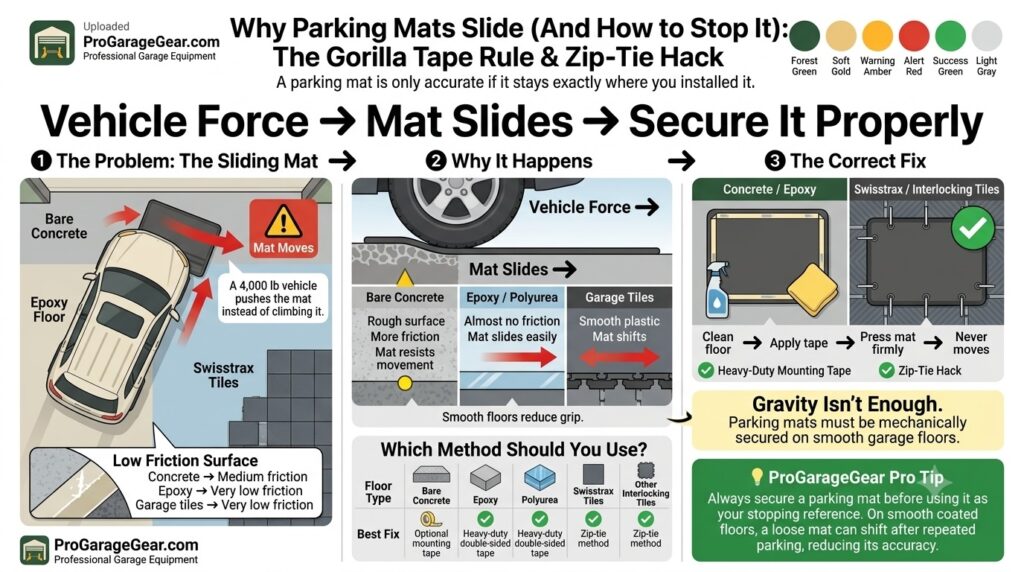
Garage floors are slick—especially if you have Epoxy or Swisstrax. A cold rubber mat has zero grip against cold plastic or concrete. When a 4,000lb SUV hits it, the mat becomes a sled.
The Mandatory Fix:
You must secure the mat. Gravity is not enough.
- For Concrete/Epoxy: Buy a roll of Double-Sided Gorilla Tape (Heavy Duty Mounting Tape). Clean the floor with rubbing alcohol first, then tape the entire perimeter of the mat.
- For Swisstrax Tiles: Do not use tape (it will pull the tile up when you remove it).
- The Method: Use Heavy Duty Zip-Ties. Drill two small holes in the flange of the mat and zip-tie it directly to the ribs of the Swisstrax tile. It will never move.
⚠️ Physics Note: The Epoxy Slide On bare concrete, rubber mats stay put due to friction. On Epoxy or Polyurea, the surface is as smooth as glass. When a 4,000 lb car hits the "speed bump" of the mat, the tire pushes the mat forward instead of climbing over it.
The Fix:
- For Epoxy: Use heavy-duty double-sided Gorilla Tape.
- For Tiles: Use the "Zip-Tie Hack" (pictured above).
🛑 Safety Warning: Laser Eye Hazard
If you choose the Laser guide, refer to the "Mounting Height Rule" mentioned earlier
The Risk:
Lasers are cool, but they are bright. If you mount the laser too low or at a sharp angle pointing toward the back of the garage, it can shine directly into the eyes of children sitting in the rear seats as you pull in.
🚧 The "Tennis Ball" Alternative (And Why to Skip It)
We have to mention it. Yes, you can hang a tennis ball from the ceiling.
The Pros: It’s free.
The Cons:
- Visual Clutter: It ruins the look of your finished garage.
- The "Entanglement": If you have an SUV with a roof rack or a roof box, the string often gets caught in the rack when you back out, ripping the string down or tangling.
- The Sensor: It interferes with the motion sensors of some smart garage hubs.
Verdict: If you just spent $3,000 on cabinets and flooring, don't cheap out $20 on a tennis ball. Get the laser.
Frequently Asked Questions
Do parking mats work on epoxy floors?
Not without help. Most rubber mats will slide on smooth epoxy or plastic tiles when a 4,000 lb car hits them. You MUST secure the mat using heavy-duty double-sided tape (for epoxy) or zip-ties (for Swisstrax tiles) to prevent movement
Are garage parking lasers safe for eyes?
Yes, they are generally Class 2 lasers (low power). However, to be safe, mount the laser unit high on the ceiling near the garage door opener, pointing downward at the dashboard. Never mount it at eye level pointing towards the driver's face.
Can I use a tennis ball instead?
You can, but it is outdated. Tennis balls look cluttered ("trashy") in a finished garage, and the string often snaps or gets tangled in roof racks. A hardwired laser is a cleaner, permanent solution that increases the resale value of the home.
Will the Chamberlain laser work with my Genie or other brand opener?
Not confirmed — the G975LM is designed for Chamberlain and LiftMaster safety sensor terminals specifically. If you have a Genie opener (including the SilentMax 1200 recommended in our smart opener guide), look for a Genie-branded parking laser accessory instead of assuming this one will wire in correctly. For other brands, check the manufacturer's own accessory line first, or fall back to the Maxsa Park Right mat, which works identically regardless of opener brand since it's a purely physical/tactile solution with no wiring involved.
Final Verdict: Which One?
- For the "Smart Garage" Owner: Get the Chamberlain G975LM Laser. Since you likely already have a Chamberlain motor, the direct-wire integration makes it a "set it and forget it" solution with zero battery anxiety.
- For the "Heavy Duty" User: Get the Maxsa Park Right Mat. If you are parking a truck or just want the physical reassurance of a bump, this is the safest bet—provided you tape it down.
The Chamberlain Laser is designed to plug directly into the B6753T opener we reviewed.
Parking perfectly ensures you leave exactly enough room to walk around the front of the car with your 50ft hose.
If you have Swisstrax tiles, you cannot tape the mat down. Use our zip-tie method described above.