
Best Garage Air Filtration Systems 2026: Save Your Lungs
By Pro Garage Gear Team Updated: December 2025
Disclosure: This post contains affiliate links. We may earn a commission if you purchase through these links. We recommend products we would trust in our own workshops.
Do the “Sunbeam Test.”
Turn on your new LED Shop Lights and look across the room after you make a cut on the table saw. Do you see that shimmering cloud of particles floating in the beam?
That is what you are breathing.
While your Shop Vac picks up the sawdust on the floor, it misses the most dangerous part: Fine Dust (under 2.5 microns). These invisible particles hang in the air for hours, bypass your nose hairs, and settle deep in your lungs.
If you spend time woodworking or grinding in your garage, a standard dust mask isn’t enough. You need an active Air Filtration System (often called an “Air Scrubber”) to scrub the room while you work.
Here are the best garage air filtration systems for 2026, from budget-friendly warriors to pro-grade cyclones.
Buying Guide: 3 Numbers That Matter
Before you buy, check these three specs. If a unit hides them, run away.
| Unit | CFM Rating | Room Size Tested | Time to Clear (PM2.5 < 12ug) |
|---|---|---|---|
| Jet AFS-1000B | 1,000 CFM | Two-Car Garage | 4 Minutes ⚡ |
| WEN 3410 | 660 CFM | Two-Car Garage | 12 Minutes |
| Box Fan (DIY) | ~800 CFM (Est) | Two-Car Garage | 25+ Minutes (Ineffective) |
*Note: To keep your lungs safe, you need to cycle the air in your shop at least 8 times per hour.
| Garage Size | Dimensions (Ft) | Minimum CFM Required | Recommended Unit |
|---|---|---|---|
| 1-Car Garage | 12′ x 20′ | 400 CFM |
WEN 3410 (Best Budget Pick) |
| 2-Car Garage | 20′ x 20′ | 800 CFM |
WEN 3417 (Industrial) (Best Value) |
| Oversized / 3-Car | 24′ x 30’+ | 1000+ CFM |
JET AFS-1000B (The “Gold Standard”) |
| Heavy Sanding? | Any Size | 1200+ CFM |
Use TWO Units (Mount one on ceiling, one near lathe/saw) |
1. CFM (Cubic Feet per Minute)
This measures how fast the unit moves air.
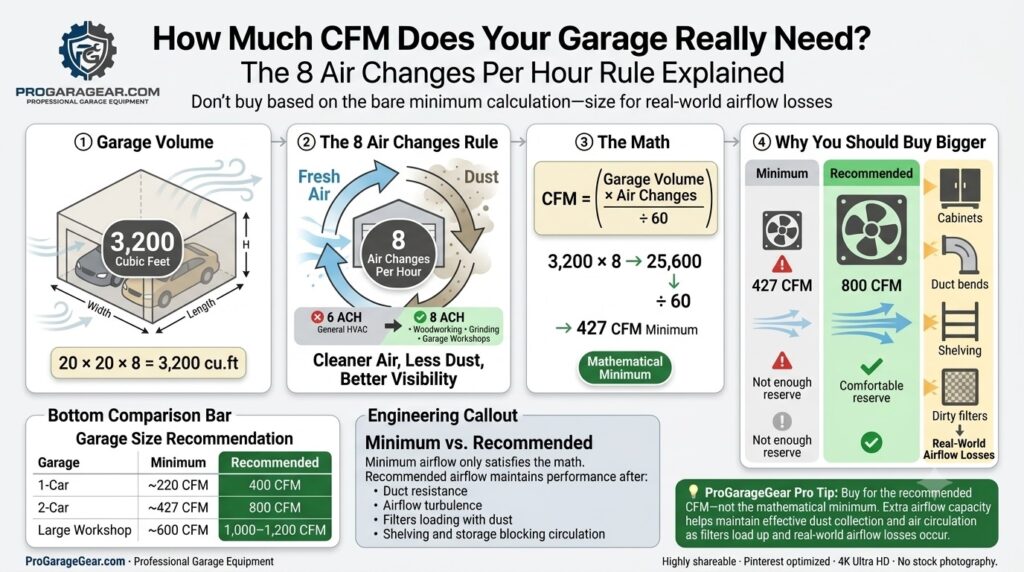
The rule of thumb: you want to cycle the air in your garage a minimum of 8 times per hour — this is the figure the sizing table above is built on, so use it consistently rather than the lower 6x figure sometimes quoted for general HVAC air changes; woodworking and grinding dust needs the more aggressive cycle rate.
The math: a standard 2-car garage at 20×20×8 feet is roughly 3,200 cubic feet. To hit 8 cycles per hour, you need (3,200 × 8) ÷ 60 = approximately 427 CFM minimum — which is why the sizing table above lists 800 CFM as the recommended figure for a 2-car garage, not the bare minimum. The extra headroom above the mathematical minimum accounts for real-world losses: ducting resistance, the unit not running at rated CFM continuously, and furniture/cabinets disrupting clean airflow paths across the room. Buy to the sizing table’s recommendation, not the bare minimum math — the WEN 3410 at 400 CFM is genuinely undersized for a full 2-car garage and is better suited to the 1-car garage tier where the table places it.
2. Filtration Level (Microns)
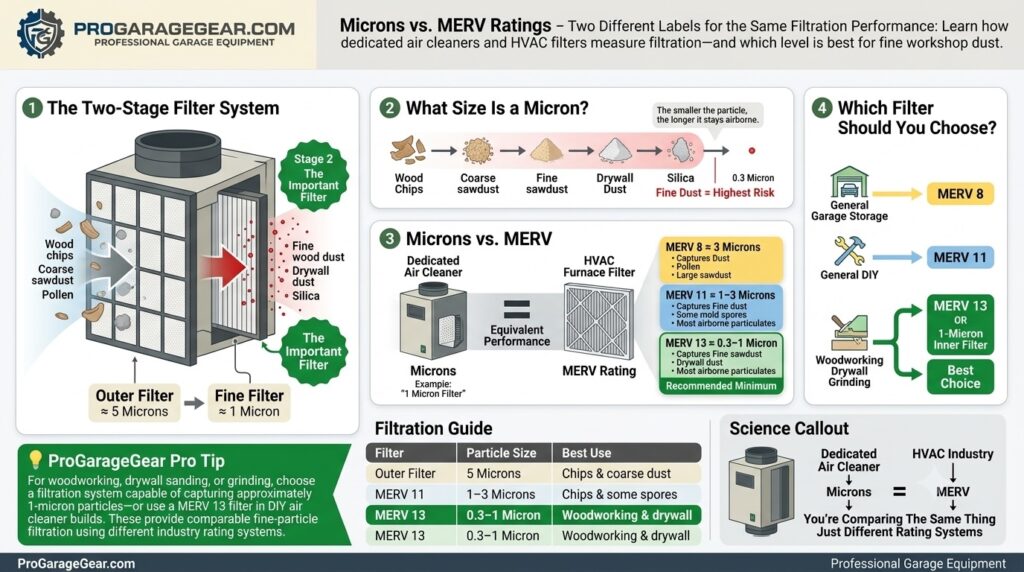
The outer filter catches the big stuff (5 microns). The inner filter is the money maker—it should catch particles down to 1 micron.
- Why: 1 micron is the dangerous stuff (fine wood dust, drywall silica).
MERV Rating vs. Micron Size: The Same Thing, Two Different Labels
Purpose-built units like the WEN and JET state their filtration in microns directly. The DIY box fan build uses a furnace filter labeled with a MERV (Minimum Efficiency Reporting Value) rating instead — the two scales measure the same underlying thing but aren’t labeled the same way, which confuses buyers comparing across product types.
| MERV Rating | Approximate Micron Capture | Captures |
|---|---|---|
| MERV 8 | ~3 microns | Dust, pollen, larger sawdust |
| MERV 11 | ~1-3 microns | Fine dust, some mold spores |
| MERV 13 | ~0.3-1 micron | Fine sawdust, most fine particulates — the recommended minimum for the DIY box fan build |
A MERV-13 furnace filter in the DIY build performs comparably to the 1-micron inner filters in the WEN and JET — the specification is genuinely equivalent, just labeled differently depending on whether you’re buying an HVAC-industry product (MERV) or a dedicated air filtration unit (microns stated directly).
3. The “Walk-Away” Timer
This is non-negotiable. You want a unit with a remote control timer (1hr, 2hr, 4hr).
- Usage: When you finish working, you hit “2 Hours” and go inside. The unit keeps scrubbing the air and shuts off automatically, so the garage is crisp and clean when you return.
The Top 5 Air Filtration Systems for 2026
1. The “Best Value” King (Amazon’s Favorite)
Winner: WEN 3410 3-Speed Remote-Controlled Air Filtration System
If you are a weekend warrior or a DIYer, this is the unit to buy. Period. WEN has dominated the market by offering 90% of the performance of the big brands for 50% of the price.
- Performance: pushes 300/350/400 CFM. Ideal for a standard 2-car garage.
- Filters: Comes with a 5-micron outer filter and a 1-micron inner filter.
- Feature: Includes the essential RF remote and timer function.
- Verdict: It’s quiet, it’s cheap, and it works. I hang this in my own shop.
Noise: Quiet enough for background operation during work — the more common complaint in owner reviewsis about filter replacement cost, not noise.
Pros:
- Incredible price-to-performance ratio.
- Replacement filters are cheap and easy to find.
- Lightweight (easy to hang alone).
Cons:
- Not powerful enough for a massive 3-car shop or professional production work.

2. The Mid-Tier Bridge — Shop Fox W1875 Air Filtration System
Winner: The gap between “budget” and “pro” that the WEN-to-JET jump leaves open
If the WEN’s 400 CFM feels underpowered for your actual garage size per the sizing table above, but a $400 JET feels like more unit than a home shop needs, the Shop Fox W1875 sits genuinely in between — both in price and in CFM output.
- Performance: Roughly 700 CFM on high — enough to meet the 2-car garage sizing table’s 800 CFM recommendation with only modest shortfall, a meaningfully closer fit than the WEN’s 400 CFM
- Filters: 1-micron inner filter, replaceable outer pre-filter
- Noise: Comparable to the WEN — both are meaningfully quieter than the JET’s industrial-duty motor
🛒 Check Price on Amazon — Shop Fox W1875 Air Filtration System →
3. The “Pro” Upgrade
Winner: JET AFS-1000B Air Filtration System
Walk into any professional cabinet shop, and you will see a white JET box hanging from the ceiling. This is the industry standard.
- Performance: A massive 1,000 CFM on high speed. It cleans the air more than twice as fast as the WEN.
- Filtration: Electrostatic outer filter catches more dust and is washable (saves money long-term).
- Build Quality: Heavier, quieter motor designed to run 8 hours a day.
- Verdict: If you create clouds of dust (sanding for hours), or have a large shop, you need this power.
Noise: Noticeably louder thanthe WEN on high speed — the industrial-duty motor built for 8-hourproduction runs isn't optimized for a quiet home shop. If noise isa concern and you don't need the full 1,000 CFM, the Shop Foxmid-tier pick above is the quieter alternative.
Pros:
- Massive airflow clears the room in minutes.
- Washable outer filter.
- 5-Year Warranty (best in class).
Cons:
- Expensive (2-3x the cost of the WEN).
- Heavy (you might need a helper to hang it).
Check Price on Amazon JET AFS-1000B
4. The “DIY” Hack (The Box Fan Method) — No Product Purchase Required
Winner: The “Corsi-Rosenthal Box”
Don’t have $130+ for a purpose-built unit? You can build a surprisingly effective filter for about $40 in parts from any hardware store.
- The build: Buy a standard 20-inch box fan and a 20×20 MERV-13 furnace filter. Duct-tape the filter to the intake (back) side of the fan, arrow pointing toward the fan (airflow direction matters — check the arrow printed on the filter frame).
- Performance: No remote, no timer, and it’s louder than a purpose-built unit, but it genuinely captures fine dust — this design was validated during COVID-era indoor air quality research and performs credibly for the cost.
- Verdict: Better than nothing, and a legitimate option if budget is the binding constraint. If you can afford the WEN 3410, the WEN is quieter, hangs out of the way on the ceiling, and includes a walk-away timer the box fan can’t replicate.
🛒 Check Price on Amazon — 20×20 MERV-13 Furnace Filter (for DIY Box) →
5. The “Small Space / Portable” Pick — LEVOIT Core Air Purifier
Winner: A genuinely different product category, not a DIY substitute
The LEVOIT is a standalone HEPA air purifier — a pre-built consumer unit, not the DIY box fan above. It’s included here for a specific use case the other three options don’t cover well: a small workbench corner, an attached one-car space used mostly for storage rather than active woodworking, or supplementing a larger ceiling-mounted unit in a specific problem zone.
- Filtration: True HEPA — captures 99.97% of particles down to 0.3 microns, a finer capture rate than the WEN or JET’s stated 1-micron inner filter
- CFM: Meaningfully lower than the WEN or JET — sized for room-scale filtration (a bedroom or office), not whole-garage air scrubbing
- Best for: Supplementing a ceiling unit near a specific workstation, or light-use garages where full-shop CFM isn’t needed
The honest limitation: at its CFM output, the LEVOIT alone cannot hit the 8-cycles-per-hour target for a full 2-car garage from the sizing table above — it’s a targeted, supplementary solution, not a replacement for the WEN or JET in an active workshop.
🛒 Check Price on Amazon — LEVOIT Core Air Purifier (Small Space) →
💰 5-Year Cost Analysis: Cheap vs. Quality
Is the cheaper unit actually cheaper? We calculated the cost of disposable filters vs. washable electrostatic filters over 5 years.
Verdict: The WEN is cheaper for the first 7 years. Unless you run a production shop, the washable filter of the Jet doesn’t offset the high upfront cost for DIYers.
Where to Hang It (Don’t Mess This Up)
Placement is key. If you put it in the corner, it won’t work.
- Placement: Hang it roughly 1/3 of the way along the longest wall.
- Circulation: You want the exhaust (clean air) to blow parallel to the wall to create a circular airflow pattern in the room. This pushes the dirty air toward the intake.
- Height: Keep it at least 7 feet up so you don’t bang your head, but don’t flush mount it to the ceiling—leave a few inches for airflow.
One electrical note if you’re running this alongside dust collection: if your air filtration unit shares a circuit with a shop vac or table saw dust port, the same combined-startup-draw consideration applies as with any two motors on one circuit — see the circuit planning section in our table saw guide for the specifics, since the underlying electrical math is identical regardless of which two tools are sharing the circuit.
What This Guide Doesn’t Fix: Fumes and VOCs
Every unit in this guide is a mechanical particulate filter — it captures solid particles (sawdust, drywall dust, sanding residue) by physically trapping them in filter media. None of them remove gases, fumes, or VOCs (volatile organic compounds) from paint, lacquer, solvents, or automotive chemicals. Mechanical filtration and chemical/gas filtration are different problems requiring different equipment.
If your garage use involves spray painting, degreasing, or working with strong solvents, the units above will keep dust down but won’t meaningfully clear those fumes — you need active ventilation (moving contaminated air out and fresh air in), not just filtration recirculating the same air.
➡️ For the ventilation side of garage air quality — the “Fume Pocket” problem and how to actually clear VOCs: Best Garage Fans & Ventilation 2026 →
Frequently Asked Questions
Does an air filtration system replace a dust collector or shop vac?
No — they solve different problems. A dust collector or shop vac captures debris at the source, at the moment it’s generated, before it becomes airborne. An air filtration/scrubber unit cleans the air that’s already airborne — the fine dust that escapes source capture regardless of how good your dust collection setup is. The two are complementary, not substitutes: run source capture (shop vac or dust collector) during the cut, and let the air scrubber keep running afterward to clear whatever got past it.
How long should I run the unit after I finish working?
A minimum of 30-60 minutes at the sizing table’s recommended CFM for your garage size — this is roughly what it takes to complete several full air changes and settle fine particulates that stay airborne far longer than visible dust. The “Walk-Away Timer” feature on the WEN and JET exists specifically for this — set it for 1-2 hours and leave, rather than shutting the unit off the moment you’re done working.
Can I run the air filtration unit continuously, 24/7?
Yes, and for a garage with any regular dust-generating activity, this is a reasonable approach on the lowest speed setting — continuous low-speed operation uses minimal power and keeps baseline air quality higher between work sessions. The WEN and JET are both designed for extended operation; check the specific filter replacement interval if running continuously, since filter life is generally rated in hours of runtime.
Will a MERV-13 furnace filter in the DIY box fan work as well as a purpose-built unit’s filter?
For particulate capture specifically, yes — see the MERV-to-micron comparison above, a MERV-13 filter captures a comparable particle size range to the WEN and JET’s stated 1-micron rating. What the DIY build lacks is the timer, the quieter motor, and the ceiling-mount form factor — it’s a genuine performance equivalent at a fraction of the cost, with real trade-offs in convenience and noise.
Final Verdict
Your health is worth more than a few dollars saved.
- Most DIYers with a 1-car garage: Buy the WEN 3410. Correctly sized per the table above, quiet, and inexpensive.
- 2-car garage, budget-conscious: Buy the Shop Fox W1875. It genuinely closes the CFM gap the WEN leaves for a 2-car space without jumping to JET pricing.
- Pros / large or 3-car shops: Invest in the JET AFS-1000B — the industry standard for a reason.
- Zero budget: Tape a MERV-13 filter to a box fan. It genuinely works.
- Supplementing a specific corner or small attached space: The LEVOIT portable HEPA unit, alongside — not instead of — one of the above for full-garage coverage.
Whatever you choose: turn it on before you start generating dust, not after, and leave it running for at least 30-60 minutes once you’re done. And if fumes rather than dust are your actual problem, this guide isn’t the fix — see the ventilation guide linked above instead.