Best Portable Generators for Home & Garage 2026: The “Clean Power” Problem That Destroys Electronics
Affiliate Disclosure: Pro Garage Gear earns from qualifying Amazon purchases at no extra cost to you.
The Generator Mistake That Destroys Electronics: Your power goes out. You fire up the generator. You plug in the refrigerator, some lamps, and your laptop. Three days later when power returns, your laptop won’t turn on. The generator’s voltage spikes and dirty power — common in conventional generators — have damaged the sensitive electronics inside.
This scenario plays out in every major storm season. It is entirely preventable. The solution comes down to one fundamental choice made before you buy: conventional generator vs. inverter generator. Most people choose based on price and wattage. They should be choosing based on what they’re powering.
This guide explains the technology difference, tells you exactly which type you need, and ranks the best portable generators for home and garage use in 2026.
⚡ Power Outage Generator Sizing Tool
Select every appliance you need to power during an outage. We calculate your exact wattage requirement, identify if you have sensitive electronics requiring clean power, and recommend the right generator.
| Appliance | Running W | Start W |
|---|
* Wattage figures are typical estimates. Check your appliance nameplates for exact values. Generator placement: never run indoors or in garage — minimum 20 ft. from any door, window, or vent. Pro Garage Gear earns from qualifying Amazon purchases.
Conventional vs. Inverter: The Technology That Determines What You Can Power
Conventional Generators
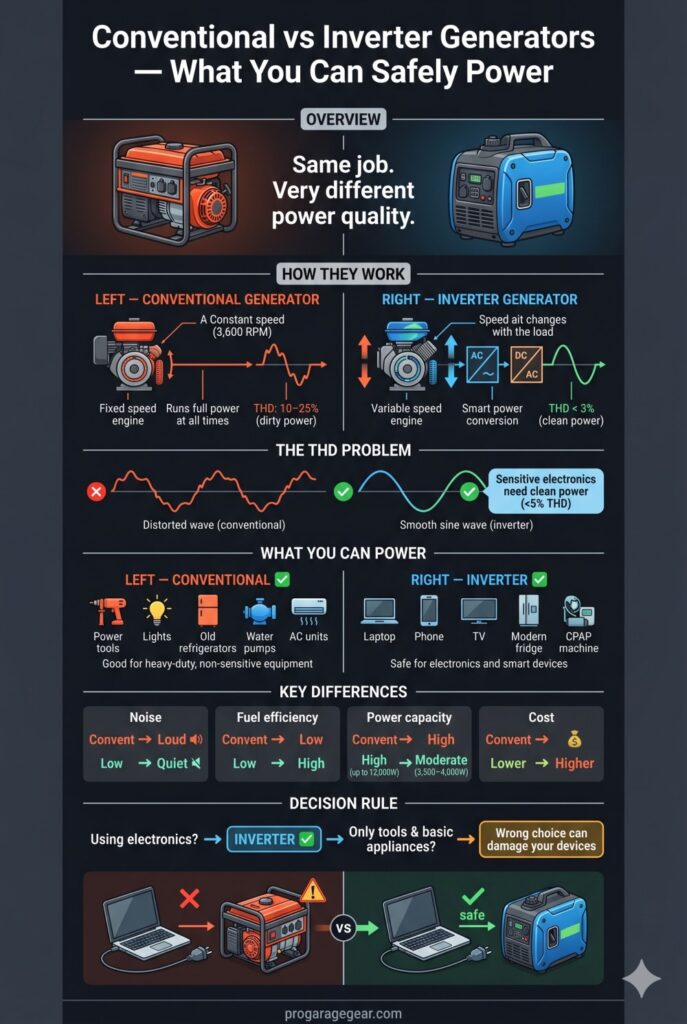
How they work: A gasoline engine runs at a fixed speed (3,600 RPM in the US for 60 Hz power) regardless of load. When your load is light (one lamp), the engine still runs at full speed. When your load is heavy (multiple appliances), the engine stays at full speed. The power output is relatively stable but contains voltage harmonics and THD (Total Harmonic Distortion) of 10–25%.
The THD problem: Sensitive electronics (laptops, TVs, phones, variable-speed appliance motors, modern refrigerators with electronic controls) require clean power with THD below 5%. At 15–25% THD, these devices experience reduced lifespan, corrupted data, and in some cases immediate damage.
What they’re good for: Power tools, lights, refrigerators (older models without electronic controls), sump pumps, water heaters, window AC units. Applications where clean power isn’t critical.
Advantage: Lower cost per watt than inverter generators.
Inverter Generators
How they work: The engine speed varies with load — at light loads, it slows down; at heavy loads, it speeds up. The generated AC power is converted to DC, then inverted back to AC at precise 60 Hz with THD below 3%. The result is power quality equivalent to (and sometimes cleaner than) utility grid power.
Why this matters: Your laptop, phone charger, LED TV, modern refrigerator, CPAP machine, and any device with a microprocessor can be safely run from an inverter generator.
Advantages: Clean power for electronics, quieter operation (engine speed varies), more fuel-efficient at partial load, lighter and more portable, parallel capability (two units running together for doubled output).
Disadvantage: Higher cost per watt than conventional. Maximum wattage is lower (most consumer inverter generators top out at 3,500–4,000W vs. 7,500–12,000W for conventional units).
The decision rule: If you’re powering electronics (laptop, TV, phone charger, modern refrigerator, medical equipment) — inverter generator. If you’re running only power tools and basic appliances — conventional is acceptable.
Key Specifications Explained
Running Watts vs. Starting Watts
Every generator shows two wattage numbers. Running watts is the sustained power output. Starting watts (or surge watts) is the brief higher power available for starting motors (refrigerators, AC units, power tools with inductive motors). Always size by running watts for your needs, with starting watts as the buffer for motor-starting loads.
| Appliance | Running Watts | Starting Watts |
|---|---|---|
| Refrigerator (modern) | 150–400W | 600–1,200W |
| Window AC (5,000 BTU) | 500W | 1,500W |
| Sump pump (1/2 HP) | 750W | 2,000W |
| Electric furnace fan | 800W | 2,400W |
| Laptop + phone charger | 100W | 100W (no surge) |
| LED lights (10 bulbs) | 60W | 60W |
Sizing calculation: Add up the running watts of everything you plan to run simultaneously. Add the highest single starting wattage to that total. The result is your minimum generator requirement.
Noise Level (Decibels)
Conventional generators: 65–75 dB at 23 feet (like a running lawnmower). Inverter generators: 50–60 dB at 23 feet (like a normal conversation). If your generator will be running during nighttime hours or near neighbors, the inverter’s noise advantage is significant.
Run Time at 25% Load
Most generators are rated at 25% of rated load — a realistic partial-load scenario. This metric tells you how long the generator runs on a single tank of gas. At 50% or 100% load, run time drops proportionally.
2026 Rankings: Best Portable Generators for Home & Garage
🥇 #1 — Honda EU2200i Inverter Generator (Best Overall — Home Electronics + Garage Tools)
Why it earns #1: Honda’s EU2200i is the benchmark portable inverter generator. At 2,200W starting / 1,800W running, it handles the essential home electronics and key appliances during an outage — refrigerator, lights, phone charging, laptop, fans — simultaneously. The THD is below 3%, making it safe for every sensitive electronic device you own.
The data:
- Running watts: 1,800W
- Starting watts: 2,200W
- THD: <3% (safe for all electronics)
- Noise: 48–57 dB (quieter than a normal conversation at full load)
- Run time: 8.1 hours at 25% load on 0.95 gallons
- Weight: 47.4 lbs.
- Parallel capable: Yes (run two EU2200i units together for 4,400W combined)
- Fuel: Gasoline
Honest downside: Premium price. The Honda brand carries a significant cost premium over Chinese-manufactured inverter generators with similar specs. However, Honda’s service network, parts availability, and verified long-term reliability record justify the premium for most buyers.
🛒 Check Price on Amazon — Honda EU2200i Inverter Generator →🥈 #2 — Champion 3500W Dual Fuel Inverter Generator (Best Value Inverter — Power + Electronics)
Why it earns #2: Champion’s dual-fuel inverter runs on either gasoline or propane — a critical advantage for extended outages when gas stations are closed. The 3,500W starting / 3,100W running output handles everything the Honda does, plus a window AC unit, simultaneously.
The data:
- Running watts: 3,100W (gas) / 2,790W (propane)
- Starting watts: 3,500W / 3,150W (propane)
- THD: <3%
- Noise: 58 dB at 23 feet
- Run time: 7.5 hours (gas) at 25% load
- Dual fuel: Gasoline or propane
- Weight: 95.7 lbs. (significantly heavier than the Honda)
- Parallel capable: Yes
Why dual fuel matters: In a major hurricane or winter storm, local gas stations can be closed for days. A propane-capable generator allows you to stock propane (which stores indefinitely) rather than stockpiling gasoline (which degrades in 3–6 months without stabilizer).
🛒 Check Price on Amazon — Champion 3500W Dual Fuel Inverter →🥉 #3 — WEN 56380i 3800W Inverter Generator (Best Budget Inverter)
Why it earns #3: WEN delivers a genuine inverter generator with <3% THD at the lowest price point in the category. The 3,800W starting / 3,400W running output makes it the most capable budget inverter available, and WEN’s service network and warranty are better than many Chinese alternatives.
The data:
- Running watts: 3,400W
- Starting watts: 3,800W
- THD: <3%
- Noise: 57 dB at 23 feet
- Run time: 8.5 hours at 50% load
- Weight: 99.2 lbs.
- Parallel capable: Yes
Honest downside: Heavier than comparably powered Honda units and the build quality (materials, finish, control panel feel) is noticeably lower. Functionally equivalent for most uses, but the Honda will likely outlast it by a significant margin in long-term heavy use.
🛒 Check Price on Amazon — WEN 56380i Budget Inverter Generator →Also Recommended
Jackery Explorer 2000 Plus (Solar/Battery Generator): For areas where noise ordinances or HOA rules prohibit gas generators, the Jackery 2000 Plus is a lithium-battery power station with 2,000W output and expandable solar charging. Zero noise, zero fumes, zero fuel. Handles electronics, phone charging, lights, and CPAP machines for 1–2 days without recharging. Recharges from solar panels in 4–6 hours.
🛒 Check Price on Amazon — Jackery 2000 Plus Battery Generator →The Complete Generator Comparison Table
| Generator | Type | Running W | THD | Noise | Fuel | Parallel | Amazon |
|---|---|---|---|---|---|---|---|
| Honda EU2200i | Inverter | 1,800W | <3% | 48 dB | Gas | Yes | Shop → |
| Champion 3500W Dual | Inverter | 3,100W | <3% | 58 dB | Gas/Propane | Yes | Shop → |
| WEN 56380i | Inverter | 3,400W | <3% | 57 dB | Gas | Yes | Shop → |
| Jackery 2000 Plus | Battery | 2,000W | Clean | 0 dB | Solar/AC | N/A | Shop → |
| DuroStar DS4000S | Conventional | 3,300W | 10–15% | 69 dB | Gas | No | Shop → |
Critical Safety Rules (Non-Negotiable)
Never run a generator indoors — ever. This includes the garage, attached or detached. Generators produce carbon monoxide that accumulates rapidly in enclosed spaces. CO is odorless, colorless, and lethal. Position the generator at least 20 feet from any door, window, or vent.
Attached Garage Health Risks: CO dangers from generators
Never backfeed your home electrical panel. Plugging a generator into a dryer outlet to “power the house” is called backfeeding. It energizes the utility lines outside your home, which can electrocute utility workers restoring power on what they believe is a de-energized line. It also bypasses your home’s safety protections. Use a professionally installed transfer switch or interlock kit.
Use generator-rated extension cords. Standard household extension cords are not rated for generator output. Use 10–12 gauge cords rated for outdoor use and for the wattage you’re drawing.
Store fuel safely. Gasoline in your garage is a fire risk. Use approved fuel containers, store away from heat sources, and add fuel stabilizer if storing more than 30 days.
Best Garage Fire Extinguishers 2026: Fuel storage safety
⚡ The Bonded vs. Floating Neutral Problem: Why Your Generator May Trip Every GFCI
This is the technical detail that separates a frustrating generator experience from a seamless one — and almost no review site covers it.
When you connect a portable generator to your home’s electrical system through a transfer switch or interlock kit, the generator’s internal wiring configuration (how its neutral wire is handled) must match what your home’s electrical system expects. Get this wrong and your GFCI outlets trip immediately, your transfer switch may not function correctly, and in some cases you create a shock hazard.
Bonded Neutral vs. Floating Neutral: The Difference
Bonded Neutral Generator: The neutral wire is physically connected (bonded) to the generator’s frame/ground inside the generator. This is the correct configuration for a standalone generator powering extension cords and individual appliances directly. It is also required by NEC code for generators used without a transfer switch.
Floating Neutral Generator: The neutral wire is NOT connected to the generator’s frame. The neutral “floats” relative to ground. This is the correct configuration for a generator connected to a home transfer switch, because the home’s electrical panel provides the neutral-to-ground bond. Two neutral-to-ground bonds in the same system create a ground loop that trips GFCIs and can cause equipment damage.
| Generator Use Case | Correct Configuration | Why |
|---|---|---|
| Extension cords only (no transfer switch) | Bonded Neutral | NEC 250.34 requires bonding for standalone use |
| Connected to home via transfer switch | Floating Neutral | Home panel provides the bond; dual bonding trips GFCIs |
| Powering RV via adapter | Floating Neutral | RV has its own bonding system |
How to Check Your Generator’s Neutral Configuration
With a multimeter: Set your meter to AC voltage. With the generator running and no load connected:
- Probe 1 on the neutral slot of the outlet
- Probe 2 on the green ground screw of the outlet
Reading = 0V: Floating neutral (no voltage difference between neutral and ground — they’re isolated) Reading = 1–5V: Bonded neutral (slight voltage difference due to the internal bond)
🛒 Check Price on Amazon — Digital Multimeter →Transfer Switch Compatibility Quick Reference:
| Generator | Neutral Type | Transfer Switch Compatible? |
|---|---|---|
| Honda EU2200i | Floating | Yes — directly compatible |
| Champion 3500W Dual | Floating | Yes |
| WEN 56380i | Floating | Yes |
| Most job-site conventional generators | Bonded | Requires bonding plug removal (electrician) |
| DuroStar/DuroMax models | Usually Bonded | Check manual — model-specific |
If your bonded-neutral generator needs to connect to a transfer switch: A licensed electrician can remove or bypass the internal bonding strap inside the generator. This is a 30-minute job for a knowledgeable electrician. Do not attempt it yourself — incorrect neutral configuration creates electrocution risk for utility workers during power restoration.
🔧 The Generator Maintenance & Protection Bundle
A generator that doesn’t start when you need it is worse than no generator. The #1 cause of generator failure is stale fuel gumming the carburetor during storage. The #2 cause is running the generator until the oil runs dry.
Fuel Stabilizer: Add to every tank when storing the generator for more than 30 days. Run the engine for 5 minutes after adding to circulate treated fuel through the carburetor.
🛒 Check Price on Amazon — STA-BIL Fuel Stabilizer →Generator Cover: A fitted cover prevents moisture, dust, and rodents from reaching the carburetor during storage. Rodents nesting in stored generators and chewing fuel lines is more common than most owners realize.
🛒 Check Price on Amazon — Portable Generator Cover →10-Gauge Outdoor Extension Cord: Running appliances from a generator through a 14-gauge or 16-gauge household extension cord causes voltage drop that can damage the connected appliances and overheat the cord. Use a minimum 10-gauge, 25-foot outdoor-rated cord for generator use.
🛒 Check Price on Amazon — 10-Gauge Generator Extension Cord →The Generator Owner’s Pro Bundle: Honda EU2200i + Fuel Stabilizer + Generator Cover + 10-Gauge Cord = a system that starts every time you need it and protects your $1,100 investment during the 11 months per year it sits in your garage.
How many watts do I actually need?
Add the running watts of everything you need simultaneously. Typical “essential circuits” home outage: refrigerator (200W) + lights (100W) + phone charging (30W) + TV (100W) = 430W running. Add refrigerator starting surge (800W) = 1,230W minimum. A 2,000W inverter handles this with margin.
Can I run a central air conditioner on a portable generator?
Only with a large conventional generator (7,500–10,000W). Central AC requires 3,500–5,000W running and 10,000–15,000W starting. Portable inverter generators cannot support central AC. Window units (up to 5,000 BTU) can run on larger inverter generators (3,500W+).
What’s the shelf life of gasoline for generator use?
Fresh gasoline without stabilizer: 3–6 months. With fuel stabilizer (Sta-Bil or equivalent): 12–24 months. Run the generator monthly (or at least quarterly) to circulate treated fuel and prevent carburetor gumming — the #1 cause of generator failure when needed.
Is a whole-home standby generator worth it?
For areas with frequent outages (more than 2–3 per year exceeding 24 hours), a standby generator ($3,000–$10,000 installed) pays for itself in prevented food loss, hotel costs, and business interruption over 5–7 years. For occasional outages, a $500–$1,200 portable inverter is almost always the better economic choice
The Bottom Line
If you power only a garage and need it for tools: the WEN 56380i budget inverter handles any power tool combination and costs half the Honda. If you power your home electronics, medical equipment, and essential appliances: the Honda EU2200i is the correct investment — its clean power and reliability record are earned, not marketed. If noise or HOA is a constraint: the Jackery 2000 Plus battery station is genuinely life-changing.
Size correctly. Choose inverter for electronics. Follow the safety rules. The generator that saves you when you need it most is the one that was purchased thoughtfully, stored properly, and tested quarterly.