
Best Garage Floor Mats & Tiles 2026: The Temperature Limit, the Load Rating, and the Moisture Trap Under Your Mat
By Pro Garage Gear Team Last Updated: July 2026
Disclosure: This post contains affiliate links. As an Amazon Associate, we earn from qualifying purchases. We recommend products that protect your floor, not just cover it up.
Concrete is porous. It acts like a giant sponge.
Once hot motor oil drips onto your garage floor, or salty winter slush melts and seeps into the cracks, that stain is there forever. You can scrub it with acid or pressure wash it, but the ghost of that stain will remain.
The solution isn’t necessarily a $3,000 professional epoxy coating. For a fraction of the price, you can roll out a heavy-duty mat or snap together industrial tiles that not only hide ugly cracks but prevent new ones from forming.
But not all flooring is equal. A Containment Mat is designed to hold gallons of melted snow, while Interlocking Tiles are designed to make your neighbors jealous.
In this guide, we break down the best garage floor mats and tiles for 2025, categorized by how you use your garage.
Quick Summary: The “Floor Saver” Cheat Sheet
Need to cover your concrete fast? Here are the top performers.
| Category | Product Name | Type | Best For |
| Best for Snow/Winter | AutoFloorGuard Containment Mat | Fabric w/ Raised Edge | Catching Melted Slush |
| Best “Instant Makeover” | G-Floor Coin Texture Roll | PVC Roll | Covering Ugly Concrete |
| Best Showroom Look | RaceDeck / Speedway Tiles | Interlocking Plastic | Car Enthusiasts |
| Best Budget Spot Mat | Armor All Absorbent Mat | Fabric (Felt-like) | Catching Oil Drips |
| Best Anti-Fatigue | Rubber-Cal “Bubble” Mat | Thick Rubber | Standing at Workbench |
Buying Guide: Mat vs. Roll vs. Tile
Before you buy, you need to decide what problem you are solving.
1. Containment Mats (For Winter Climates)
If you live in the Snow Belt, this is mandatory. These mats look like a heavy-duty tarp with a raised foam edge (a lip) all the way around.
- The Goal: They catch the melting snow/salt from your car so it doesn’t run all over your garage floor and rot your drywall.
2. PVC Rolls (For General Protection)
These are giant rolls of vinyl (like a yoga mat, but tougher). You roll them out wall-to-wall.
- The Goal: They provide a waterproof barrier that is easy to sweep and mop. Great for turning a dirty garage into a clean room.
3. Interlocking Tiles (For Style)
Hard plastic squares that snap together.
- The Goal: Aesthetics. You can make checkerboard patterns. They allow air to flow underneath, which is great for preventing mold on damp floors.
The Cold-Weather Warning: Why Cheap Tiles Crack in Northern Garages
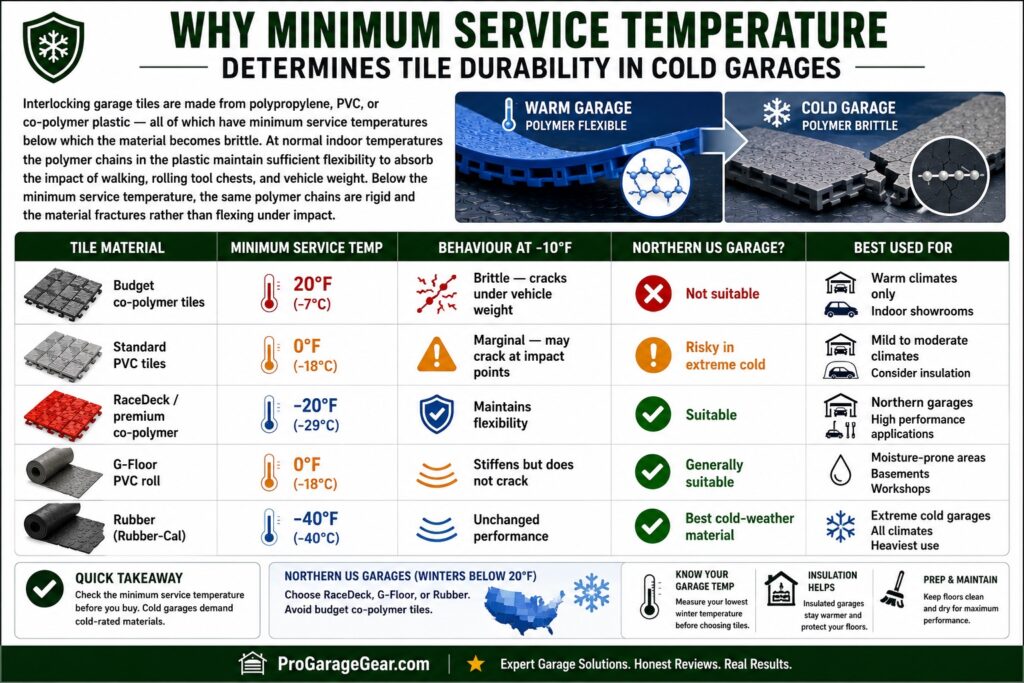
Interlocking garage tiles are made from polypropylene, PVC, or co-polymer plastic — all of which have minimum service temperatures below which the material becomes brittle. At normal indoor temperatures the polymer chains in the plastic maintain sufficient flexibility to absorb the impact of walking, rolling tool chests, and vehicle weight. Below the minimum service temperature, the same polymer chains are rigid and the material fractures rather than flexing under impact.
| Tile Material | Minimum Service Temp | Behaviour at -10°F | Northern US Garage? |
|---|---|---|---|
| Budget co-polymer tiles | 20°F (-7°C) | Brittle — cracks under vehicle weight | ❌ Not suitable |
| Standard PVC tiles | 0°F (-18°C) | Marginal — may crack at impact points | ⚠️ Risky in extreme cold |
| RaceDeck / premium co-polymer | -20°F (-29°C) | Maintains flexibility | ✅ Suitable |
| G-Floor PVC roll | 0°F (-18°C) | Stiffens but does not crack | ✅ Generally suitable |
| Rubber (Rubber-Cal) | -40°F (-40°C) | Unchanged performance | ✅ Best cold-weather material |
The practical test: If your unheated garage regularly reaches temperatures below 0°F in winter, specify only RaceDeck or comparable premium tiles with a documented -20°F minimum service temperature, or choose rubber matting which has no practical cold-weather limitation in any residential climate.
“For garage temperature management that extends the life of all floor coverings →” Weatherproof Garage for Summer
The Tool Chest Load Problem: What Happens When 900 Lbs Rolls Over a Tile
A fully loaded 72-inch mechanic’s tool chest — Husky, Craftsman, Snap-on — weighs 600–950 lbs with tools inside. This weight transfers to the floor through 4–6 casters. Each caster has a contact area of approximately 2–4 square inches. The resulting point load — 900 lbs ÷ 4 casters × ½ load on two front casters when rolling = 450 lbs per front caster ÷ 3 square inches = 150 lbs per square inch — exceeds the compressive strength of budget PVC tiles.
| Flooring Type | Point Load Rating (approx.) | Loaded Tool Chest Rolling Over? | Recommendation |
|---|---|---|---|
| Budget interlocking tiles (4mm) | ~50 lbs/sq.in. | ❌ Will permanently dimple or crack | Not suitable under tool chests |
| RaceDeck Diamond (7mm) | ~120 lbs/sq.in. | ⚠️ Marginal for 900+ lb chests | Acceptable for chests under 700 lbs |
| G-Floor (solid PVC, 4.5mm) | ~200 lbs/sq.in. | ✅ Handles any residential tool chest | Correct specification |
| Rubber mats (3/4″ thick) | ~300 lbs/sq.in. | ✅ Handles any load | Best for workshop areas |
The practical solution: Place G-Floor roll or rubber mat sections under any area where tool chests will be positioned or rolled. Interlocking tiles can be used in the parking and general traffic zones where point loads are distributed across a large vehicle footprint, but they should not be used directly under tool chest casters without a protective layer.
“For tool chest placement within the garage zone framework →Best Garage Power tools orgainizer”
Chemical Resistance: What Your Floor Mat Cannot Handle
Garages expose floor coverings to motor oil, gasoline, brake fluid, antifreeze, and cleaning solvents. These chemicals interact differently with the materials used in garage flooring:
| Chemical | PVC Roll (G-Floor) | Interlocking Tiles | Rubber Mat | Containment Mat (polyester) |
|---|---|---|---|---|
| Motor oil | ✅ Resistant | ✅ Resistant | ✅ Resistant | ✅ Absorbent (by design) |
| Gasoline | ⚠️ Short contact OK — prolonged exposure softens PVC | ⚠️ Same | ✅ Resistant | ⚠️ Absorbs — fire risk if saturated |
| Brake fluid (DOT 3/4) | ⚠️ Degrades PVC plasticizers over time | ⚠️ Degrades plasticizers | ✅ Resistant | ✅ Absorbs without damage |
| Antifreeze (ethylene glycol) | ✅ Resistant | ✅ Resistant | ✅ Resistant | ✅ Absorbs |
| Muriatic acid (floor etching) | ❌ Removes before etching — severely damages PVC | ❌ Remove before etching | ❌ Destroys rubber | ❌ Remove before etching |
The gasoline and brake fluid note for PVC: Prolonged (hours-long) pooling of gasoline or brake fluid on a PVC roll surface extracts the plasticizers from the PVC compound — the additives that keep PVC flexible. The affected area becomes stiff, discoloured, and eventually cracks. Clean up gasoline and brake fluid spills on PVC floor coverings immediately with an absorbent and then rinse with water. Do not allow them to sit.
The Moisture Trap: Why PVC Rolls on Damp Floors Need a Seasonal Check
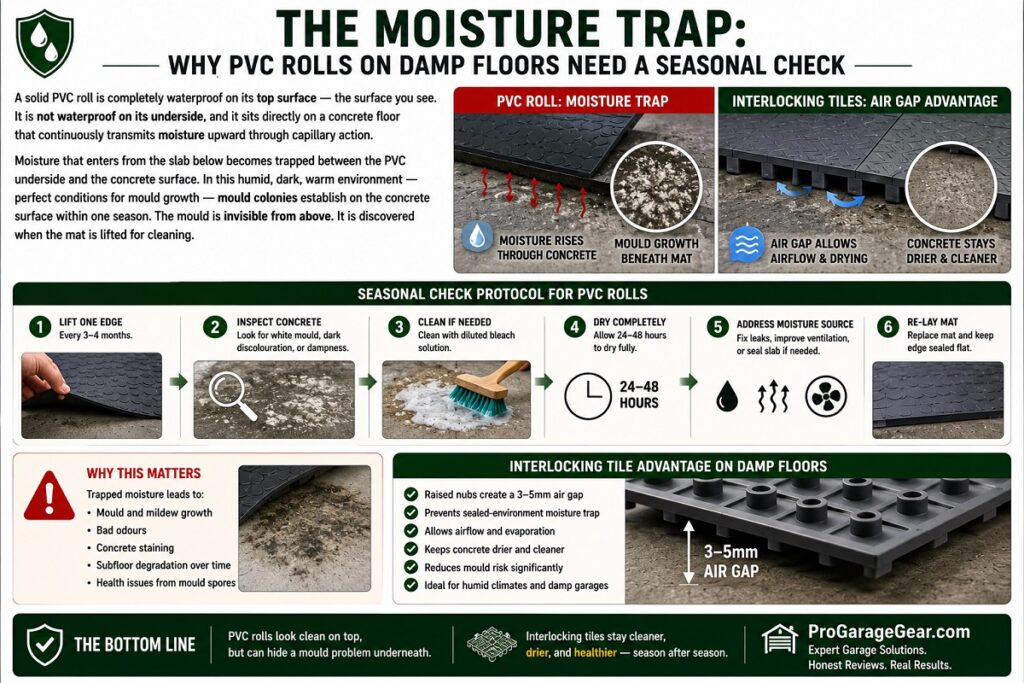
A solid PVC roll is completely waterproof on its top surface — the surface you see. It is not waterproof on its underside, and it sits directly on a concrete floor that continuously transmits moisture upward through capillary action.
Moisture that enters from the slab below becomes trapped between the PVC underside and the concrete surface. In this humid, dark, warm environment — perfect conditions for mould growth — mould colonies establish on the concrete surface within one season. The mould is invisible from above. It is discovered when the mat is lifted for cleaning.
The seasonal check protocol: Lift one edge of the PVC roll every 3–4 months and inspect the concrete beneath for white mould spots, dark discolouration, or persistent dampness. If moisture is present: clean the concrete with a diluted bleach solution, allow to dry completely for 24–48 hours, and address the slab moisture source before re-laying the mat.
The interlocking tile advantage for damp floors: This is the genuine practical benefit of interlocking tiles on damp concrete — mentioned in the buying guide but worth restating with context. Tiles sit on raised nubs that create an air gap of 3–5mm between the tile underside and the concrete surface. This air gap prevents the stagnant sealed-environment moisture trap. Damp garage floors benefit from interlocking tiles over solid PVC rolls for exactly this reason.
“For addressing slab moisture before laying any floor covering → Best Garage Dehumidifiers
The 5 Best Garage Floor Solutions (In-Depth Reviews)
1. AutoFloorGuard Containment Mat
Verdict: The Best for Snow & Mud
In winter, your car brings in gallons of frozen sludge. On bare concrete, this turns into a puddle that flows toward your walls. The AutoFloorGuard is designed to trap it.
- The “Lip”: It features a 1.25-inch raised foam edge that acts like a swimming pool for your car. It holds the water until you are ready to squeegee it out.
- Durability: Made from heavy-duty commercial grade polyester scrim fabric (similar to truck tarps).
- Usage Tip: You might need to buy a squeegee to push the water out once a week.
Pros:
- Prevents water damage to garage walls.
- Easy to clean.
- “Stay-Put” corners prevent it from sliding.
Cons:
- Not the prettiest option (it creates a wrinkle or two).
- Strictly for parking, not for rolling tool chests around.

2. G-Floor Coin Texture Roll (7.5′ x 17′)
Verdict: The Best “Instant Makeover”
If your garage floor is cracked, stained, or just ugly, G-Floor is the magic eraser. It is a solid polyvinyl roll that you simply unroll over the existing floor.
- Appearance: The “Coin Texture” looks like professional shop flooring. It immediately makes the room feel finished.
- Toughness: It is solid PVC, not foam. You can drive on it, park hot tires on it, and roll heavy tool chests over it without tearing it.
- Installation: You can trim it with a standard utility knife to fit around poles or corners.
Pros:
- 100% Waterproof.
- Extremely durable.
- Hides cracks instantly.
Cons:
- It is heavy (requires two people to move the roll).
- Will curl at the ends initially (needs sun/heat to flatten).

3. RaceDeck / Speedway Interlocking Tiles
Verdict: Best for the “Car Guy” Showroom Look
You’ve seen these in Jay Leno’s garage. Interlocking Tiles are hard plastic squares (usually 12″ x 12″) that snap together like LEGOs.
- Design Freedom: You can buy black and white tiles to create a checkerboard, or match your car’s colors.
- Airflow: Because they sit slightly raised off the concrete, air circulates underneath. This is crucial if your concrete “sweats” moisture, as it prevents mold buildup.
- The Sound: They make a satisfying “click-clack” sound when you walk on them (some love it, some hate it).
Pros:
- Looks incredibly professional.
- Easy DIY installation (no glue).
- If one tile breaks, you just pop it out and replace it.
Cons:
- Liquids (oil/water) flow through the cracks to the concrete below.
- Can be slippery when wet.

4. Armor All Garage Floor Mat
Verdict: Best Budget / Spot Protection
You don’t need to cover the whole floor to protect it. The Armor All Mat feels like a thick felt carpet but has a waterproof backing.
- Use Case: It absorbs liquids. If you have an older car that leaks a little oil, park over this. The mat absorbs the oil so you don’t track it into the house.
- Comfort: It’s soft to walk on, making it a nice addition to a laundry area in the garage.
Pros:
- Cheap (covers the parking spot area for a low cost).
- Washable (hose it off).
- Lightweight.
Cons:
- Not for heavy snow (it will soak through eventually if saturated for days).
- Can bunch up if you turn your steering wheel sharply while parked on it.

5. Rubber-Cal “Bubble” Mat
Verdict: Best Anti-Fatigue (For the Workbench)
Concrete is hard. If you stand at your workbench for hours, your knees and back will ache. You don’t park your car on this mat; you park yourself on it.
- Material: Made of industrial rubber with raised air pockets (bubbles) that compress slightly when you stand on them.
- Benefit: It forces your muscles to make micro-adjustments, which improves blood flow and reduces fatigue.
Pros:
- Saves your back and knees.
- Indestructible rubber.
Cons:
- Industrial smell (smells like new tires for a few weeks).

Installation Tip: The “Sun Cure”
If you buy a Roll-Out mat (like the G-Floor), it will arrive tightly rolled up in a box. When you unroll it, the edges will curl up.
Do not panic. This is normal.
- Unroll the mat on your driveway on a sunny day.
- Let the heat of the sun warm up the vinyl for 2-4 hours.
- It will relax and lay completely flat.
- Drag it into the garage while it is still warm.
Maintenance: Keeping It Clean
- For Containment Mats: Use a squeegee to push the water out the door.
- For Tiles: Use your [Shop Vac] (Link to Article 3) to suck up dirt from the cracks.
- For Oil Spills: Do not use harsh chemicals on vinyl. Use mild dish soap and water.
Frequently Asked Questions (FAQ)
Can I park a car with hot tires on these mats?
It depends on the specific product, and the current answer needs a correction. The AutoFloorGuard containment mat and G-Floor PVC roll are genuinely rated for hot tire contact — the polyester fabric of the AutoFloorGuard is heat-resistant to vehicle tire temperatures, and G-Floor’s solid PVC handles heat without deforming. The Armor All absorbent mat is acceptable for normal parking temperatures. The interlocking tile answer is more nuanced: premium tiles including RaceDeck use a co-polymer formulation that resists hot tire deformation at normal parking temperatures (tires after highway driving, typically 120–150°F surface temperature). Budget interlocking tiles from unbranded sellers use lower-grade plastic that can deform permanently under sustained hot tire contact — a condition called hot tire pickup. If your primary use is parking a car after highway driving: use G-Floor or AutoFloorGuard rather than budget tiles. Premium interlocking tiles (RaceDeck, Swisstrax) are rated for it. Budget tiles are not.
Will water get trapped underneath the mat?
It can. If you live in a very humid area, we recommend lifting the edge of the mat once a season to check for moisture. Interlocking tiles (RaceDeck) are best for damp floors because they breathe.
Can I cut the mats to fit?
Yes. The PVC rolls and the Armor All mats can be cut easily with a pair of heavy-duty scissors or a utility knife to fit around workbench legs or support poles.
Should I use a garage floor mat before or after epoxy coating?
After. Always after, and after the floor coating has fully cured — a minimum of 7 days for vehicle traffic and 14 days before any heavy stationary load. Placing a mat over uncured epoxy or polyaspartic coating traps solvents and moisture against the surface during the cure process, producing soft spots, bubbles, and delamination at the mat edges. Install the flooring system in the correct sequence: concrete preparation, coating, full cure period, then mat or tile installation on top. A containment mat placed over a properly cured epoxy floor protects the coating from salt brine and oil drips — the combination of epoxy coating plus containment mat is the optimal floor protection strategy, not either one alone.
My G-Floor keeps curling at the edges. How do I fix it permanently?
The Sun Cure method in this article (warming the roll on a sunny driveway) works for the initial installation. If curling returns after the floor cools, the permanent fix is double-sided tape specifically formulated for vinyl-to-concrete bonding, applied at the perimeter of the mat every 6–8 inches. Standard double-sided tape releases from concrete within weeks. Use a carpet tape with a pressure-sensitive adhesive rated for concrete and vinyl — it maintains adhesion through temperature cycling and is removable without concrete damage when you eventually lift the mat. The second permanent option: place a parking stop at the front edge of the mat so the vehicle’s front tires rest on the mat edge, preventing curl from the forward end where it is most common.
Final Verdict
- If you battle snow and slush: You need the AutoFloorGuard. It is the only thing that stops the water from ruining your walls.
- If you want a clean, finished look: Get the G-Floor Roll. It covers the ugly concrete instantly.
- If you just want to catch oil drips: Grab the budget-friendly Armor All Mat.
Protect your floor today, and it will look new for decades.
To keep your mats looking new, vacuum the debris weekly using a wet/dry vac.”