
Best Garage Fire Extinguishers 2026: Why Class Matters More Than Size (And What to Buy)
Affiliate Disclosure: Pro Garage Gear earns from qualifying Amazon purchases at no extra cost to you.
The “Wrong Extinguisher” Catastrophe: A homeowner’s car catches fire in the garage — likely an electrical fault under the dash. He grabs the CO2 extinguisher he bought because it was on sale. He discharges it directly at the flames. The CO2 displaces the oxygen locally — but the fire’s fuel source (wiring insulation) is still igniting. The CO2 disperses in 15 seconds. The fire reignites. He’s also now out of extinguishing agent and the garage is filling with carbon dioxide. He evacuates. The house sustains $80,000 in fire damage.
The wrong extinguisher doesn’t just fail to put out a fire — in some cases it creates conditions that make the fire and the environment more dangerous. This guide makes sure you have exactly the right equipment, correctly sized, for what’s actually in your garage. This guide will safe you from hazards of using the wrong system as we rank the best garage fire extinguishers suitable for the system.
🔥 Fire Extinguisher UL Rating Matcher
Answer 4 questions about your garage to get a personalized extinguisher recommendation — based on UL ratings, not guesswork.
| Item | Priority | Amazon |
|---|
* UL rating recommendations based on NFPA 10 Standard for Portable Fire Extinguishers. EV fire guidance based on NFPA 855 and FEMA lithium-ion battery fire research. Always follow local fire code requirements. Pro Garage Gear earns from qualifying Amazon purchases at no extra cost to you.
The Fire Class System: What’s Actually Burning in Your Garage
Every fire extinguisher is rated for specific fire classes. Using the wrong class on a fire is not just ineffective — water extinguishers on electrical fires can electrocute the user; CO2 on flammable metal fires can accelerate combustion.
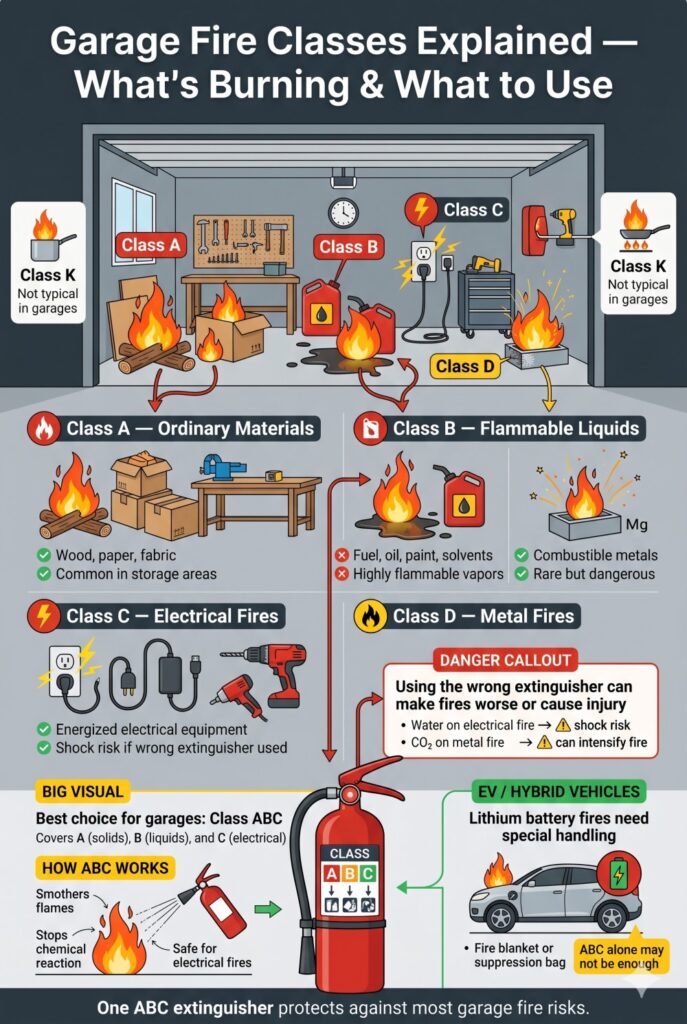
| Fire Class | What’s Burning | Common Garage Sources |
|---|---|---|
| Class A | Ordinary combustibles (wood, paper, fabric) | Lumber, cardboard boxes, shop rags, workbench |
| Class B | Flammable liquids and gases | Motor oil, gasoline, paint, solvent, spray cans |
| Class C | Electrical equipment (energized) | Power tools, wiring, battery chargers, EV batteries |
| Class D | Combustible metals | Magnesium (some car parts), titanium shavings |
| Class K | Cooking oils/fats | Not typically a garage concern |
The verdict for garages: You need a Class ABC extinguisher — it covers the three classes present in every garage. No other class combination covers all garage fire scenarios.
What “ABC” means on the label: The rating describes what the extinguisher handles. ABC uses dry chemical (monoammonium phosphate) as the agent — it smothers Class A fires, breaks the chain reaction in Class B fires, and is safe on Class C electrical fires without causing shock risk.
The exception — EV and hybrid vehicle owners: Lithium-ion battery fires (Class D adjacent) are notoriously difficult to extinguish with standard ABC dry chemical. They require immense quantities of water or specialized AVD (Aqueous Vermiculite Dispersion) agents. If you store an EV or hybrid, augment your ABC extinguisher with a dedicated EV battery fire suppression bag or blanket.
➡️ Shop EV Fire Suppression Blanket on Amazon
Attached Garage Health Risks: garage fire and CO risks
Understanding Extinguisher Ratings: The Numbers on the Label
An ABC extinguisher label shows a rating like 2-A:10-B:C or 4-A:80-B:C. This isn’t marketing — it’s a specific UL (Underwriters Laboratories) performance standard:
- The A number (1-A, 2-A, 3-A, 4-A…): Comparative rating for ordinary combustible coverage. 1-A = equivalent to 1.25 gallons of water. Each increase in A rating represents proportionally more coverage capacity.
- The B number (10-B, 40-B, 80-B…): The square footage of a Class B flammable liquid fire that a trained user can expect to extinguish. 10-B covers a 10 sq. ft. liquid fire; 80-B covers 80 sq. ft.
- The C rating is pass/fail — the agent is electrically non-conductive. No numeric value.
For a garage: Minimum 2-A:10-B:C. Recommended: 3-A:40-B:C or larger. If you store gasoline, solvents, or do automotive work: 4-A:80-B:C minimum — flammable liquid fires can expand rapidly and a small extinguisher runs out of agent before the fire is out.
2026 Rankings: Best Garage Fire Extinguishers
🥇 #1 — Amerex B456 10-lb. ABC Dry Chemical Extinguisher (Best Professional Grade)
Rating: 4-A:80-B:C Weight: 10 lbs. agent (total unit ~17 lbs.) Construction: Stored pressure, steel cylinder, brass valve Certification: UL Listed
The Amerex B456 is the benchmark for serious garage fire protection. The 10-lb. agent capacity delivers significantly more discharge time (18+ seconds) and coverage area than the 5-lb. units that dominate the home market. The 80-B rating handles a 9×9 ft. liquid fuel fire — adequate for a gasoline spill fire that has fully involved the floor.
The all-metal construction (steel cylinder, brass valve, aluminum handle) means it survives the temperature cycling and humidity of a working garage for decades without degradation. Many professional fire stations keep Amerex units as personal extinguishers for this reason.
Honest downside: Heavy — 17 lbs. total — requires a solid wall mount at a comfortable grab height.
🥈 #2 — First Alert PRO5 5-lb. ABC Extinguisher (Best For Most Homeowners)
Rating: 3-A:40-B:C Weight: 5 lbs. agent (total ~9 lbs.) Construction: Stored pressure, steel cylinder Certification: UL Listed
The First Alert PRO5 is the best balance of performance and usability for a residential garage. The 5-lb. unit is light enough to be grabbed and operated by any adult under stress — an important consideration, since a 17-lb. extinguisher that’s difficult to operate in a panic is less effective than a lighter one used confidently.
The 40-B rating covers a 6.3×6.3 ft. liquid fuel fire — adequate for most residential garage scenarios. For garages storing a single car and typical household chemicals, this rating covers the realistic fire scenarios you’re protecting against.
Honest downside: Shorter discharge time (~12 seconds) than the 10-lb. unit. In a rapidly spreading fire, every second of additional agent matters.
🥉 #3 — Kidde FA110 5-lb. Multi-Purpose Extinguisher (Best Budget Pick)
Rating: 1-A:10-B:C Weight: 5 lbs. agent Construction: Stored pressure Certification: UL Listed
The Kidde FA110 is the most widely available residential extinguisher and provides adequate basic protection at the lowest cost. The 1-A:10-B:C rating is the NFPA 10 minimum for residential garages — it covers early-stage fires where you catch the problem within the first 30–60 seconds.
Honest downside: The 10-B rating covers only a 3.16×3.16 ft. liquid fuel fire — if a gasoline or solvent fire has had 60 seconds to spread, this unit is likely inadequate. For garages with fuel storage or active automotive work, step up to the PRO5 or Amerex.
The Complete Fire Extinguisher Comparison Table
| Unit | Rating | Agent Wt. | Discharge | Best For | Amazon |
|---|---|---|---|---|---|
| Amerex B456 | 4-A:80-B:C | 10 lbs. | 18+ sec | Serious garages / fuel storage | View → |
| First Alert PRO5 | 3-A:40-B:C | 5 lbs. | 12 sec | Most residential garages | View → |
| Kidde FA110 | 1-A:10-B:C | 5 lbs. | 10 sec | Minimum protection, early fire only | View → |
| Amerex B402 (2.5-lb.) | 1-A:10-B:C | 2.5 lbs. | 8 sec | Vehicle-mounted / secondary unit | View → |
The Garage Fire Safety Setup (Beyond the Extinguisher)
A fire extinguisher is the last line of defense. These earlier-warning and prevention measures are equally important:
Smoke + CO Detector (Dual Sensor): Install one within 10 feet of the interior access door. Interconnected models that alarm the entire home when the garage detector triggers are the best choice for attached garages.
🚨 The Silent Garage Fire: Why Standard Alarms Fail Sleeping Families
Here’s the scenario that fire investigators encounter regularly: a garage fire starts at 2 AM — a charging lithium battery, a leaking gas can ignited by a water heater pilot light, spontaneous combustion in a pile of oil-soaked rags. The garage smoke alarm sounds. Nobody hears it. The alarm is in the garage. The family is asleep upstairs. By the time the heat or smoke reaches the bedroom smoke alarm — which may be 40 feet and two closed doors away — the garage has fully involved and the house is at critical risk.
A garage smoke alarm that only alerts in the garage is not adequate protection for a sleeping household.
The Interconnected Alarm Requirement
Interconnected smoke alarms are linked (wirelessly or by wire) so that when any alarm triggers, every alarm in the system sounds simultaneously. When the garage alarm detects smoke, the bedroom alarm sounds. The basement alarm sounds. Every floor of the house wakes up at once — immediately.
The National Fire Protection Association (NFPA 72) has required interconnected alarms in new residential construction since 1993. Millions of existing homes — including those with garages added or finished after construction — are not interconnected.
Wired interconnect: All alarms are hardwired to a shared trigger line. Reliable but requires an electrician for installation in existing homes.
Wireless interconnect (recommended for DIY): Each alarm communicates by RF signal. When one triggers, all trigger. Installation is identical to a standard battery alarm — no wiring required.
Best Pick: Kidde Wireless Interconnect Alarm (2-Pack)
The Kidde Wireless Interconnect series allows up to 24 alarms to be linked in a single network. Each alarm uses a distinct RF frequency to avoid false interconnect with neighbors. The combination smoke + CO model is recommended for garage installation — it detects both fire smoke and carbon monoxide.
Setup: Install the first alarm in the garage (within 10 feet of the interior door), install the second in the nearest sleeping area, press the “Learn” button on each within 30 seconds — they’re now connected.
➡️ Check Price — Kidde Wireless Interconnect Alarm 2-Pack (Smoke + CO) on Amazon
➡️ Shop Wireless Interconnected Smoke Alarms 3-Pack on Amazon
The Complete Garage Fire Alert System
| Item | Location | Purpose | Amazon |
|---|---|---|---|
| Kidde Wireless Combo (Smoke + CO) | Garage — near interior door | Primary detection + interconnect trigger | View → |
| Kidde Wireless Smoke Alarm | Master bedroom | Interconnected — wakes sleepers | View → |
| Kidde Wireless Smoke Alarm | Hallway between garage and bedrooms | Intermediate alert point | View → |
| Heat Detector (Rate of Rise) | Garage ceiling center | Detects heat even in dusty/dirty air where smoke alarms false-alarm | View → |
The Heat Detector Difference: Standard smoke alarms in working garages false-alarm constantly — sawdust, exhaust residue, spray paint mist, and cooking smoke from a garage grill all trigger them. This leads homeowners to remove or disable the garage alarm — the worst possible outcome. A rate-of-rise heat detector responds only to rapid temperature increase (the signature of a real fire, not of workshop activity) and never false-alarms from sawdust or exhaust. Install a heat detector as your primary garage unit and the smoke alarm interconnect at the interior door for the dual-protection approach that professional fire safety consultants recommend.
➡️ Check Price — Heat Detector (Rate of Rise) for Garage Ceiling on Amazon
➡️ Shop Dual Sensor Smoke/CO Alarm on Amazon
Proper Chemical Storage: Flammable liquids (gasoline, paint thinner, acetone) should be stored in an approved flammable storage cabinet — not in cardboard boxes on a shelf. Cabinets are designed to contain a fuel fire for a minimum of 10 minutes, allowing evacuation.
➡️ Shop Flammable Storage Cabinet on Amazon
Extinguisher Mount Position: Mount the extinguisher near the garage exit — not next to the most likely fire source. You want to be able to grab it on your way toward the fire, not trapped between the extinguisher and the fire when it ignites.
The PASS Technique: How to Actually Use It
Many people own extinguishers but have never practiced using one. In a real fire, your hands will be shaking. Knowing the PASS technique by memory (practiced in advance) is the difference between effective use and ineffective discharge.
P — Pull the safety pin (the pin that prevents accidental discharge) A — Aim the nozzle at the BASE of the fire, not the flames S — Squeeze the handle (maintain steady pressure) S — Sweep side to side across the base of the fire, moving closer as it diminishes
Practice: Purchase one inexpensive disposable unit and discharge it completely in an open outdoor space (a parking lot). This familiarizes you with the discharge pressure, time, and technique before you need it in an emergency.
Where should I mount my garage fire extinguisher?
Near the primary exit (garage door or interior access door), at shoulder height (approximately 5 feet off the floor to the top of the unit), visible and unobstructed. Never mount behind equipment or in a corner where retrieval requires moving around the fire.
How often should I inspect my fire extinguisher?
Monthly visual inspection: check the pressure gauge (needle in the green zone), check the pin is intact, check for visible corrosion or damage. Annual professional inspection is recommended by NFPA 10 (required for commercial; strongly recommended for residential).
When should I throw away a fire extinguisher?
Disposable (non-refillable) units: 5–12 years from manufacture date (check the label). Any unit after it has been fully or partially discharged — even partial discharge reduces pressure below effective operating range. Any unit showing corrosion, physical damage, or a pressure gauge out of the green zone.
Are automatic fire suppression systems worth it for garages?
Whole-garage automatic suppression (similar to commercial sprinkler systems) is available for residential garages but costs $1,500–$4,000 installed. For garages with EVs, fuel storage, or woodworking operations — the investment is justifiable. For standard residential garages — a proper extinguisher, smoke detector, and safe storage practices cover the risk adequately.
The Bottom Line
For most residential garages in 2026: buy the First Alert PRO5 (3-A:40-B:C) and mount it near the exit at shoulder height. If you store gasoline, do automotive work, or have an EV — step up to the Amerex B456 (4-A:80-B:C). Add a dual-sensor smoke/CO alarm within 10 feet of the interior door.
A fire extinguisher you never use is cheap. A fire you weren’t prepared for is expensive in every sense of the word.
Your garage is where you build things, fix things, and create things. Protect it with the same thoughtfulness you brought to building it.