Best Garage Door Locks & Security 2026: The 5 Garage Door Vulnerabilities Every Homeowner Must Know
Affiliate Disclosure: Pro Garage Gear earns from qualifying Amazon purchases at no extra cost to you.
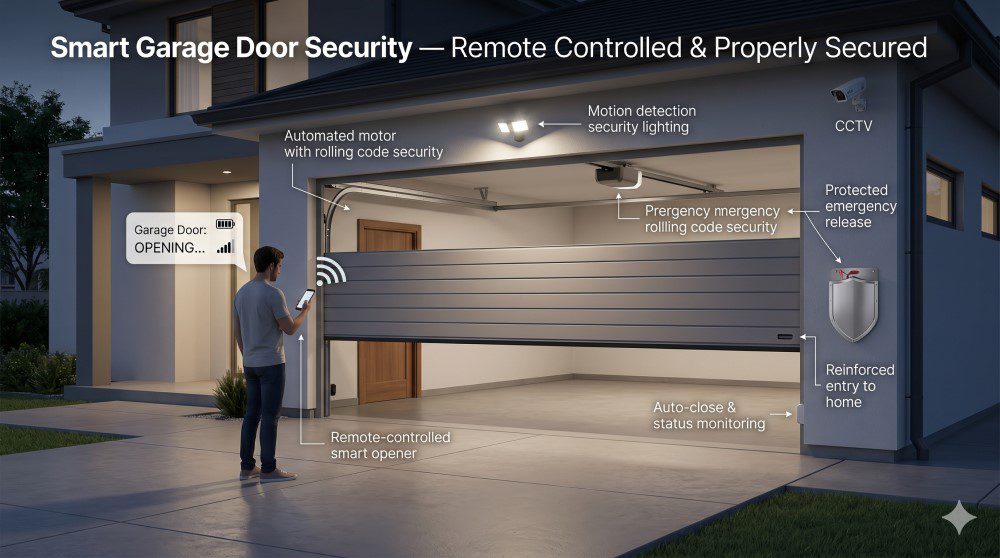
The “6-Second Break-In” Reality: A security researcher demonstrated in 2017 that a standard garage door with a default remote code can be opened in 6 seconds using a reprogrammable transmitter purchased for $30. That demonstration changed how the industry thinks about garage security. But the problem goes deeper than remote codes. Most residential garage doors have 5 distinct vulnerabilities — and most homeowners have protected exactly zero of them.
Your garage is often the least-secured entry point into your home. Unlike your front door (visible from the street, typically with a deadbolt and a reinforced frame), your garage door is typically at the side or rear, screened from view, operates on a remote code that’s been standard for years, and connects directly to your living space through an interior door that’s often less secure than your front door.
This guide covers every vulnerability; specific product that addresses each one and rank the best garage door locks and security appropriately.
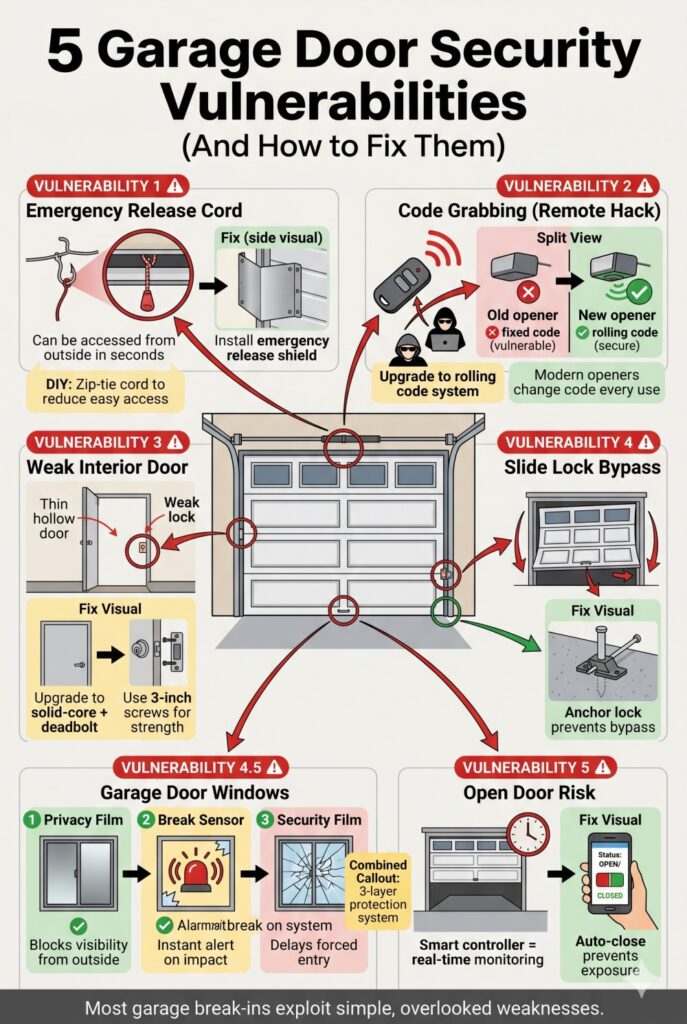
The 5 Garage Door Security Vulnerabilities
Vulnerability 1: The Emergency Release Cord
Every residential garage door has an emergency release cord (the red rope hanging from the opener rail) designed for use during power outages. From outside, a coat hanger or hook wire inserted through the top gap of the door can reach this cord and trigger the emergency release — opening the door in under 30 seconds without any tools.
The fix: A garage door emergency release shield (sometimes called a door defender or emergency release lock) is a metal bracket that physically blocks the release cord from being accessed from outside without removing the mechanism from inside.
➡️ Shop Emergency Release Door Defender on Amazon
Alternative DIY fix: Zip-tie the emergency release cord so it requires a deliberate two-handed action to activate. Not as secure as a shield, but prevents casual coat-hanger access.
Vulnerability 2: Code Grabbing and Relay Attacks
Older garage door openers use fixed remote codes — the same code is transmitted every time. Code-grabbing devices can capture this code and replay it. Modern openers use rolling code technology (also called Security+, HomeLink 3.0, or similar) that generates a new code with every use — making replay attacks ineffective.
The fix: If your opener is more than 10 years old, upgrade to a unit with rolling code technology. All major current openers (LiftMaster, Chamberlain, Genie, Overhead Door) use rolling code as standard.
Best Smart Garage Door Openers 2026: rolling code upgrade
Vulnerability 3: The Unlocked Interior Door
The door between your garage and your home is often a hollow-core door with a simple passage lockset — less secure than most interior bathroom doors. If an attacker gets into the garage through any means, the interior door is the last line of defense before they’re inside your home.
The fix:
- Replace hollow-core with a solid-core door
- Install a deadbolt (not just a passage set)
- Add a strike plate with 3-inch screws going into the wall framing (not just the door frame)
➡️ Shop Solid Core Interior Door Deadbolt on Amazon ➡️ Shop Heavy Duty Strike Plate with Long Screws on Amazon
Vulnerability 4: The Slide Lock Bypass
Slide locks (the horizontal bars that slide into the door track) are widely sold as garage door security upgrades. They’re better than nothing — but they can be defeated if the door has enough flex to move the slides past the catch. Steel garage doors flex 2–4 inches in the center when pushed from outside, which can move a slide lock past its retainer on some door styles.
The upgrade: A floor anchor lock (drills into the concrete and engages the door bottom) cannot be bypassed by door flex. It physically anchors the door to the floor through a hardened steel pin.
➡️ Shop Garage Door Floor Anchor Lock on Amazon
Vulnerability 4.5: The Window — Reconnaissance Tool and Access Point
Many residential garage doors include windows — panels of glass or polycarbonate in the upper sections of the door. They add natural light and visual appeal. They also provide burglars with two significant advantages:
Recon opportunity: A burglar who can see your car inside knows you’re home or away — critical information for planning a break-in or knowing they have time. Seeing an empty garage at 9 AM on a Tuesday tells a professional that someone left for work and won’t return for hours.
Guided access: The coat-hanger emergency release attack is most effectively executed when the attacker can see exactly where the release cord is. Opaque or frosted windows eliminate the visual guide that makes this attack efficient.
Fix 1: Privacy Window Film (Highest Priority)
One-way privacy film allows light to pass through (you lose the natural light benefit only minimally) while blocking the view from outside. Frosted or etched glass film options look intentional and attractive while providing complete visual privacy.
Application: Clean the glass with isopropyl alcohol, cut film to size, wet-apply with a spray bottle and soapy water solution, squeegee air bubbles out. Total time: 20–30 minutes per window pane.
➡️ Shop One-Way Privacy Window Film on Amazon
➡️ Shop Frosted Glass Window Film (No-Glue, Static Cling) on Amazon
Fix 2: Window Break Sensor Alarms
A window break sensor detects the vibration pattern of breaking glass and triggers an audible alarm within milliseconds — before any intruder can climb through. These are battery-powered, self-adhesive, and pair with most major smart home systems (Ring, Nest, SimpliSafe) as well as functioning as standalone alarms.
Best pick: Wyze Contact Sensor — pairs with Wyze app for phone alerts. Detects both window opening and breaking. Battery lasts 12+ months.
➡️ Check Price — Wyze Window and Door Sensor on Amazon
➡️ Shop Window Break Alarm Sensors on Amazon
Fix 3: Window Security Film (Smash-and-Grab Prevention)
Security film (3M Safety Series or equivalent) bonds to the inside of the glass and holds it in place even when broken — requiring 3–5 additional impacts to fully breach a window treated with security film, compared to a single impact on untreated glass. This transforms a 3-second window breach into a 30–60 second ordeal — long enough for alarms to activate and neighbors to notice.
➡️ Shop 3M Safety Window Security Film on Amazon
The combined window security protocol:
- Privacy film — eliminates visual access and reconnaissance
- Break sensor — detects breach and alerts immediately
- Security film — delays physical breach to give alarm time to work
Total cost for a standard 2-window garage door: $60–$120. Time to install: 90 minutes.
Vulnerability 5: The Open/Closed Uncertainty (The “Did I Close It?” Problem)
A garage door left open for even 2 hours is a significant security exposure. Most homeowners have experienced the anxiety of being unsure whether they closed the garage. Smart garage door controllers solve this with real-time status monitoring and automatic close features.
Best Smart Garage Door Controllers 2026: remote monitoring
The 2026 Security Product Rankings
🥇 #1 — Chamberlain MYQ-G0401 Smart Garage Door Controller (Best Smart Security)
The MyQ controller converts any existing opener into a smart system — you see real-time open/closed status, receive alerts when the door opens, and can close it remotely from anywhere. The automatic closing feature (closes the door if left open for a set time) is the single most impactful security upgrade for forgetful households.
Why it wins: It addresses Vulnerability 5 and adds monitoring for Vulnerabilities 2–4 through usage alerts. Any unexpected opening triggers an immediate phone notification.
🥈 #2 — Buddybar Door Jammer Garage Door Security Bar
The Buddybar is a mechanical bracing system for the interior door between garage and home — a hardened steel bar that props against the door at a calculated angle to prevent the door from being kicked in from the garage side. It requires no installation, stores flat against the wall when not in use, and makes the interior door effectively impervious to forced entry.
Why it wins: Addresses the weakest single point in most garage security setups — the interior door. Non-destructive, fully portable, and functions without electricity.
🥉 #3 — Garage Shield Emergency Release Lock (Best Mechanical Security)
The Garage Shield directly blocks the emergency release cord from outside access — the most common physical break-in vulnerability. Installation takes 10 minutes with a single bracket and screw.
The Complete Garage Security Upgrade Table
| Product | Vulnerability Addressed | Cost | Amazon |
|---|---|---|---|
| MyQ Smart Controller | Code monitoring, open/close alerts | $30–$50 | View → |
| Emergency Release Shield | Emergency cord bypass attack | $20–$35 | View → |
| Buddybar Door Jammer | Interior door forced entry | $40–$65 | View → |
| Floor Anchor Lock | Slide lock bypass | $30–$50 | View → |
| Smart Camera (garage interior) | Visual monitoring | $30–$80 | View → |
| Heavy Duty Strike Plate Kit | Interior door frame reinforcement | $15–$30 | View → |
| Motion Sensor Light (exterior) | Deters exterior approach | $20–$50 | View → |
The Garage Security Priority Matrix
Not every homeowner needs every upgrade. Here’s what to prioritize based on risk level:
| Risk Profile | Priority Upgrades | Estimated Total Cost |
|---|---|---|
| Low risk (rural, gated community) | MyQ smart controller + emergency release shield | $50–$85 |
| Moderate risk (suburban home) | Above + floor anchor lock + interior deadbolt | $100–$170 |
| High risk (high-crime area, previous break-in) | All of above + Buddybar + cameras + motion lights | $200–$350 |
Can my garage door be opened with a universal remote?
If your opener is less than 10 years old and uses rolling code technology — no, a generic remote cannot open it. If it’s older with fixed-code technology — yes, it’s vulnerable. Check your opener model for “Security+” or “rolling code” specification.
Is a keypad entry on the garage safer than a remote?
A keypad with a unique PIN is actually more secure than a standard remote — there’s no signal to capture. Use a PIN that isn’t your birthday, address, or any repeated digit pattern.
Should I lock the door between my garage and house?
Always. This is the most overlooked garage security measure. The garage is not “inside the house” from a security perspective — it’s a semi-public space. The interior door should be locked whenever the garage door is open and whenever you’re away.
The Bottom Line
The most impactful $80 you can spend on garage security is the MyQ smart controller ($40) and the emergency release shield ($30). Together they close the two most commonly exploited vulnerabilities: remote code interception and emergency cord bypass. Add the Buddybar for the interior door and you’ve addressed the three primary attack vectors for under $130.
Security is not about spending the most — it’s about knowing where you’re vulnerable and closing those specific gaps. Now you know.