
Best Garage Ceiling Storage Lifts 2026: Hoist Your Gear, Reclaim Your Floor
Affiliate Disclosure: Pro Garage Gear earns from qualifying Amazon purchases at no extra cost to you.
The “Garage Tetris” Frustration: Every time you want your kayak, you have to move three bikes. Every time you need the bikes, you have to move the camping gear. The camping gear is on top of a box that hasn’t been opened since 2019. Your garage floor is a full-time puzzle where every piece needs to move to access any other piece. You’ve lost access to 40% of your usable floor space to things that are used seasonally — and every one of them could be on your ceiling.
Ceiling lifts transform dead overhead space (the zone above the garage door opener, above your car, above the overhead storage racks) into active, accessible storage for the bulkiest, most floor-consuming items in your garage. And unlike the floor, the ceiling never gets more crowded — it scales vertically with every lift you add.
🏗️ Ceiling Lift Joist Safety Calculator
Before drilling a single hole: find out exactly how much weight your ceiling can safely carry, which lifts fit your ceiling, and what safety margin you have.
| Lift System | Capacity | Your Load Fits? | Recommendation |
|---|
⚠️ These are educational estimates only. Actual capacity depends on lumber grade, species, condition, and local building codes. For loads above vehicles or people, consult a licensed structural engineer. Pro Garage Gear earns from qualifying Amazon purchases.
The Four Types of Ceiling Lifts
Not all ceiling lifts work the same way. The right type for your situation depends on what you’re lifting, how often you access it, and how high your ceiling is.
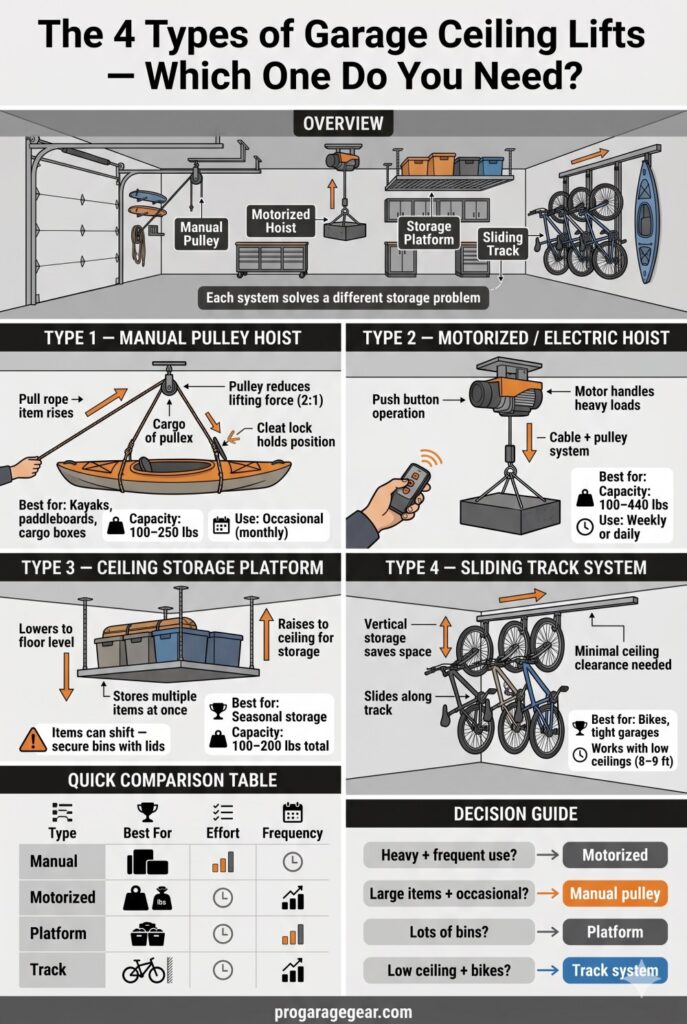
Type 1 — Manual Pulley Hoists (Rope and Pulley)
How they work: A system of pulleys multiplies your pulling force — typically 2:1 reduction, meaning a 100 lb. kayak feels like 50 lbs. to hoist. You pull the rope, the item rises. A cleat or cam lock holds the rope at height.
Best for: Kayaks, canoes, paddleboards, large cargo boxes, heavy seasonal gear Ceiling height needed: Minimum 9 ft. (item + hoist hardware + sling clearance) Weight capacity: 100–250 lbs. depending on system Access frequency: Monthly or less — pulling a rope manually is fine for occasional access
Type 2 — Motorized/Electric Hoists
How they work: An electric motor (110V or battery-powered) raises and lowers the item with the push of a button. Most include a remote control. The motor typically mounts to the ceiling joist; a cable runs through pulleys to the sling or hooks below.
Best for: Items accessed weekly or more frequently; heavy items where manual hoisting is tiring; accessible installations for family members who can’t handle manual rope systems Ceiling height needed: 10+ ft. preferred Weight capacity: 100–440 lbs. depending on motor rating Access frequency: Any — electric makes frequent access practical
Type 3 — Ceiling Storage Platforms (Lowering Shelves)
How they work: A full storage platform (2 ft. × 4 ft. or similar) lowers to floor level for loading, then rises to ceiling height for storage. Unlike individual item hoists, these store multiple bins or items at once.
Best for: Seasonal bins, holiday decorations, miscellaneous light items in quantity Ceiling height needed: 9 ft. minimum Weight capacity: 100–200 lbs. total platform Caution: These systems store items on a platform rather than in slings — items can shift during lowering. Use bins with lids and secure items before raising.
Type 4 — Sliding Track Systems
How they work: A wall-mounted track allows bikes or kayaks to be hoisted against the wall vertically (not horizontally) on a sliding hook system that moves along the track. Items store vertically, taking almost no floor or ceiling space when positioned correctly.
Best for: Garages with limited ceiling height but available wall height (8–9 ft. ceilings) Ceiling height needed: 8 ft. minimum Best items: Bikes (especially vertical bike storage in tight garages)
Best Overhead Garage Storage Racks for ceiling capacity guidance
Safety First: Joist Capacity for Ceiling Lifts
Any ceiling lift is only as strong as the ceiling it’s anchored to. Review these critical capacity estimates before purchasing any system:
| Joist Type | Span | Safe Hanging Capacity |
|---|---|---|
| 2×8 floor joist | Up to 10 ft. | 400–550 lbs. |
| 2×8 floor joist | 10–14 ft. | 200–350 lbs. |
| Roof truss (center) | Any | NOT recommended — anchor at wall plates only |
| 2×6 ceiling joist | Up to 8 ft. | 200–300 lbs. |
The 70% safety rule: Never load a ceiling system beyond 70% of the estimated structural capacity. A 400 lb. joist capacity supports a 280 lb. safe working load.
Always use lag screws: Minimum 3-inch lag screws into the center of the joist — not the edge. Pre-drill pilot holes to prevent splitting.
Heavy Duty Garage Wall Mounts – Same anchoring principles.
⚖️ The Off-Center Loading Problem: Why Platform Lifts Fail Mechanically
The Garage Gator and similar motorized platform lifts use a 4-cable suspension system — one cable at each corner of the platform. Each cable winds onto a separate drum inside the motor housing. When the platform is loaded unevenly — heavy tires on one side, light bins on the other — the cables on the heavy side bear proportionally more load. This creates two failure modes that manufacturers understate:
Failure Mode 1 — Cable Binding: The overloaded cable spool tightens faster than its counterpart, eventually binding in the drum housing. The motor continues trying to drive the bound spool, overloading the motor. Most units have thermal cutoffs that shut down the motor — but repeated thermal cycling shortens motor life significantly.
Failure Mode 2 — Platform Tilt During Descent: When lowering an off-center load, the heavy side descends faster than the light side because the cables unspool at different rates under different tensions. The platform tilts. Items on the platform shift toward the low side. If the shift is severe enough, items can slide off the platform during descent — directly onto your car, your floor, or you.
The Load Balancing Protocol (Follow This Every Time)
Rule 1 — Heavy items at the center or corners. The 4-cable system distributes load most evenly when heavy items are placed at the four corners of the platform (one heavy item per corner) or at the dead center. Never place all heavy items on one side.
Rule 2 — Distribute weight symmetrically across the centerline. Mentally draw a line across the center of the platform, both front-to-back and side-to-side. The weight on each side of each line should be approximately equal before you press the lift button.
| Platform Load Distribution | Cable Stress | Risk Level |
|---|---|---|
| Equal weight at all 4 corners | Balanced | Safe |
| Heavy center, light edges | Slightly uneven | Acceptable |
| All heavy items on one side | 2x cable load on heavy side | High — don’t do this |
| One corner heavily loaded | 3–4x load on one cable | Critical — do not lift |
Rule 3 — The “Lift 6 inches and check” test. Raise the platform 6 inches off the ground and stop. Look at the platform from the side. Is it level? Any visible tilt means the load distribution is off. Lower back down and redistribute before continuing.
The Essential Safety Add-Ons: Cargo Net and Ratchet Straps
Items on a platform lift can shift during both ascent (acceleration force) and descent (deceleration). Bins slide. Bags tip. The safest ceiling storage setups use cargo retention on the platform itself — not just trust in gravity.
Cargo Net (Platform Coverage): A cargo net with bungee or buckle attachment points anchors across the entire platform surface, preventing any item from moving during lift or descent. Look for nets rated for at least 50 lbs. distributed load.
🛒 Check Price on Amazon — Cargo Net for Storage Platform →Ratchet Straps (For Tires and Heavy Items): Seasonal tires are the heaviest items most users store on ceiling lifts, and they are also cylindrical — they roll. Two short ratchet straps (1-inch × 3-foot) looped through the platform frame and over each tire secure them against any movement during lifting.
🛒 Check Price on Amazon — Short Ratchet Tie-Down Straps →The Pro’s Safety Bundle for Ceiling Lifts: Ceiling Lift + Cargo Net + 4× Ratchet Straps = a system that fails safely even if the worst happens. These add-ons cost $25–$40 total and are the difference between a controlled descent and an expensive accident.
2026 Rankings: Best Garage Ceiling Storage Lifts
🥇 #1 — Garage Gator 220 Lb. Motorized Storage Lift (Best Motorized — Overall Winner)
Why it earns #1: The Garage Gator uses a 1/2 HP electric motor to raise and lower a 4×4 ft. storage platform with a remote control. At 220 lbs. capacity, it handles 6–8 large storage bins, a set of four tires, or comparable seasonal gear. The remote has a 30-ft. range, so you can operate it from inside the garage without standing under the load.
What sets it apart: Unlike single-item hoists, the Garage Gator stores an entire shelf’s worth of items at once — load the platform, press the button, and the entire seasonal collection disappears to the ceiling.
The data:
- Capacity: 220 lbs.
- Platform: 4 ft. × 4 ft.
- Lift height: Adjustable, up to 12 ft.
- Motor: 1/2 HP, 110V (standard outlet)
- Remote: 30-ft. wireless
- Safety: Auto-stop at height limit, manual release override
🥈 #2 — Rad Cycle Products Heavy Duty Pulley Hoist (Best Manual — Kayaks & Canoes)
Why it earns #2: For kayaks, canoes, and paddleboards, a dedicated sling-style pulley hoist is more appropriate than a platform system — it conforms to the shape of the hull rather than resting flat on a surface. The Rad Cycle hoist delivers 100 lbs. of load capacity with a 2:1 mechanical advantage (you pull 50 lbs. to hoist 100 lbs.).
The auto-locking cam cleat holds the kayak at ceiling height permanently — no rope to tie, no knot to secure, no risk of slippage. To lower, you press the cam release and control descent with the rope.
The data:
- Capacity: 100 lbs. (upgrade version: 200 lbs.)
- Mechanical advantage: 2:1 pulley system
- Lock: Auto-locking cam cleat
- Hooks: 4 included (hook, J-hook, and flat hooks)
- Ceiling height: Works with 8 ft.+ ceilings
🥉 #3 — Racor PRB-1R Pro Ceiling Mount Bike Lift (Best for Bikes)
Why it earns #3: Bike-specific ceiling hoists differ from general hoists because bicycles need to hang at two points — both wheels — rather than from a single central sling. The Racor Pro bike lift uses two padded hooks that cradle both wheels, keeping the bike horizontal and stable at ceiling height.
The Racor includes a secondary safety lock (a locking carabiner on the pulley rope) as a backup to the cam cleat — an extra layer of protection that becomes important when the bike is stored directly above a car.
The data:
- Capacity: 50 lbs. (handles most road, mountain, and gravel bikes)
- Hooks: Padded wheel cradles (no rim damage)
- Lock: Dual safety — cam lock + locking carabiner
- Ideal ceiling height: 8–12 ft.
Garage Bike storage – Bike storage Alternatives
The Complete Ceiling Lift Comparison Table
| System | Type | Capacity | Best Item | Ceiling Height | Amazon |
|---|---|---|---|---|---|
| Garage Gator 220 | Motorized platform | 220 lbs. | Storage bins, tires | 10+ ft. | Shop → |
| Rad Cycle Hoist | Manual pulley | 100–200 lbs. | Kayak, canoe | 8+ ft. | Shop → |
| Racor PRB-1R | Bike-specific | 50 lbs. | Bicycle | 8–12 ft. | Shop → |
| StoreYourBoard Hoist | Kayak/SUP | 125 lbs. | Kayak, SUP | 9+ ft. | Shop → |
| Fleximounts 440 lb | Motorized | 440 lbs. | Tires, heavy gear | 11+ ft. | Shop → |
| Harken Hoister 4-pt | Manual 4-point | 150 lbs. | Bike, kayak, cargo | 9+ ft. | Shop → |
What Items Benefit Most from Ceiling Hoists
These items are the highest-value candidates for ceiling storage, ranked by the floor space they reclaim:
Kayaks and canoes: A 12–14 ft. kayak sitting on floor sawhorses occupies 28–35 sq. ft. of floor space and creates an obstacle around it. On the ceiling: zero floor space. Floor reclaimed per kayak: 35+ sq. ft.
Bicycles (two or more): Two bikes on the floor using standard stands consume 10–16 sq. ft. and fall over constantly. Two ceiling-hoisted bikes: zero floor space. Floor reclaimed: 12–16 sq. ft.
Roof cargo box: An off-vehicle cargo carrier sitting on the floor is enormous and shape-awkward. On a ceiling platform: takes only the footprint of the box in overhead space. Floor reclaimed: 12–20 sq. ft.
Seasonal tires (one set): A set of four tires leaning against a wall takes 8–12 sq. ft. and mars the wall surface. On a ceiling hoist: zero floor, zero wall. Floor reclaimed: 8–12 sq. ft.
Camping gear collection: Tent, sleeping bags, camp chairs, lanterns — typically scattered across 15–25 sq. ft. of floor. On a platform hoist: 16 sq. ft. overhead footprint, zero floor.
The “Over the Car” Installation: Maximizing Overhead Space
The most efficient ceiling storage installation positions the hoist directly above where the car parks — the 90+ sq. ft. overhead zone that is currently completely unused. When the car is in the garage, the stored items are safely at ceiling height. When the car is out, the items can be lowered to floor level for loading/unloading.
The clearance calculation:
- Your car’s roof height + 4 inches minimum clearance = minimum hoist height when car is parked
- For most SUVs (6 ft. roof height): stored items must be at 6.5 ft.+ when car is parked
- For most sedans (4.5 ft. roof height): stored items must be at 5 ft.+
The electric hoist advantage here: A motorized hoist makes over-car storage genuinely practical — lower when the car is out, raise when it returns. A manual pulley hoist over the car is theoretically possible but less practical for frequent access.
Can I install a ceiling hoist myself?
Yes, for manual pulley systems — installation requires locating joists (use a quality stud finder), drilling pilot holes, and driving lag screws. Electric hoists require a nearby 110V outlet; if one isn’t present, running an outlet to the ceiling requires an electrician.
Are ceiling hoists safe above a car?
With properly installed lag screws into solid joists and a rated system loaded within its capacity limits — yes. The risk is equipment failure from improper installation (lag screws into drywall, not joists) or overloading. Follow weight limits strictly and never stand directly under a suspended load.
What’s the difference between a ceiling hoist and an overhead storage rack?
A rack is fixed storage — items sit on a stationary platform at ceiling height. A hoist is dynamic — items are raised and lowered on demand. Racks are better for items never accessed during storage (holiday bins). Hoists are better for items accessed seasonally (kayaks, bikes, cargo carriers).
How do I store a kayak safely in a ceiling hoist?
Use padded slings (not bare rope or hooks) that contact the hull at least 2 points. Do not hang the kayak from the grab handles — these are designed for hand-carrying, not sustained hanging loads. Position slings at the quarter-points of the kayak’s length for balanced loading.
The Bottom Line
The Garage Gator motorized lift is the premium choice for high-volume, mixed seasonal storage above your car — it’s the closest thing to a residential freight elevator. For kayaks and canoes specifically, the Rad Cycle pulley hoist is purpose-built for hull shapes. For bikes, the Racor Pro is the safest option with its dual-lock design.
Your ceiling is the most underutilized square footage in your garage. Use it.