7 Best Garage Heaters for Winter 2025: Electric, Propane & Natural Gas Reviewed
By Grace – Pro Garage Gear Last Updated: December 2025
Disclosure: This post contains affiliate links. If you use these links to buy something, we may earn a commission at no extra cost to you. Thanks for supporting our DIY community.
Winter is the enemy of the DIY enthusiast. Whether you are trying to change your oil, finish a woodworking project, or simply organize your tools, a freezing garage makes everything harder. Paints don’t cure, engines won’t start, and your fingers go numb in minutes.
But choosing the best garage heater isn’t as simple as grabbing a cheap space heater from the hallway. You need something powerful enough to battle concrete floors and uninsulated walls.
In this guide, we’ve tested and reviewed the top heating solutions for 2025. Whether you need a simple plug-in electric unit, a portable propane beast, or a permanent natural gas installation, we have found the perfect match for your workspace.
Quick Summary: The Top 7 Garage Heaters at a Glance
In a rush? Here is our “Cheat Sheet” for the best heaters based on garage size and fuel type.
| Category | Product Name | Fuel Type | Coverage | Best For | Check Price |
|---|---|---|---|---|---|
| Best Overall | Mr. Heater Big Buddy | Propane | 450 sq. ft. | Renters & Portability | Check Amazon |
| Best Electric (120V) | Dr. Infrared Heater DR-988 | Electric | 600 sq. ft. | Standard Outlets | Check Amazon |
| Best Heavy Duty | NewAir G73 Hardwired | Electric (240V) | 500+ sq. ft. | Permanent Heating | Check Amazon |
| Best Ceiling Mount | Comfort Zone Industrial | Electric (240V) | Wide Area | Saving Floor Space | Check Amazon |
| Best Natural Gas | Modine Hot Dawg | Nat. Gas | 1,000+ sq. ft. | Large Shops | Check Amazon |
| Best Torpedo | Dyna-Glo Delux | Kerosene/Diesel | 1,500 sq. ft. | Drafty Barns/Shops | Check Amazon |
| Best Budget | Lasko Ceramic Heater | Electric | Spot Heating | Small Workbenches | Check Amazon |
Buying Guide: Which Fuel Type Do You Need?
Before you buy, you must choose a fuel source. This is the #1 mistake buyers make—buying a heater they can’t actually power.
1. Electric Garage Heaters
- Pros: Safe, clean, no fumes, easy to install.
- Cons: Can increase your electric bill; powerful units require special wiring.
- Important Note: A standard household outlet is 120V. High-powered garage heaters often require 240V (like a dryer outlet). Check your wiring before buying!
2. Propane Garage Heaters
- Pros: Extremely hot, portable, works during power outages.
- Cons: You need to refill tanks; requires ventilation (crack a window/door) to prevent Carbon Monoxide buildup.
3. Natural Gas Heaters
- Pros: Cheapest fuel cost long-term; massive heat output.
- Cons: Expensive upfront; requires professional installation for gas lines and exhaust venting.
The 7 Best Garage Heaters of 2025 (In-Depth Reviews)
1. Mr. Heater Big Buddy (MH18B)
Verdict: The Best Overall & Best Portable Propane Heater
If you need heat right now and don’t want to mess with wiring, the Mr. Heater Big Buddy is the industry standard. It connects to small 1lb propane cylinders or a standard 20lb tank (with a hose adapter).
- Heat Output: 4,000 to 18,000 BTUs.
- The “Real World” Test: In an uninsulated 2-car garage, this unit raised the temperature by 15°F in about 20 minutes. It uses radiant heat, meaning it warms the objects in front of it (you and your tools) rather than just the air.
- Safety: It includes an ODS (Oxygen Depletion Sensor) that shuts the unit off if oxygen levels get too low.
Pros:
- Completely portable (great for camping too).
- No electricity required (unless you use the built-in fan).
- Safe for indoor use (with proper ventilation).
Cons:
- Burning propane creates moisture (humidity).

2. Dr. Infrared Heater DR-988
Verdict: Best Electric Heater for Standard Outlets
This is a powerhouse for its size. The Dr. Infrared DR-988 is rugged, red, and designed specifically for workshops. It uses a specialized heating element to blast warm air further than standard space heaters.
- Heat Output: 5,600 BTUs.
- Why we like it: It has an adjustable thermostat. Set it to 65°F, and it will cycle on and off to save money.
- Note: This requires a NEMA 6-30R receptacle (240V), so it is not for standard wall plugs, but it bridges the gap between light-duty and heavy-duty.
Pros:
- Very quiet operation.
- Cool-to-the-touch exterior.
- Built-in handle for portability.
Cons:
- Fan continues running after heat turns off (this is a feature to cool the coils, but can feel drafty).

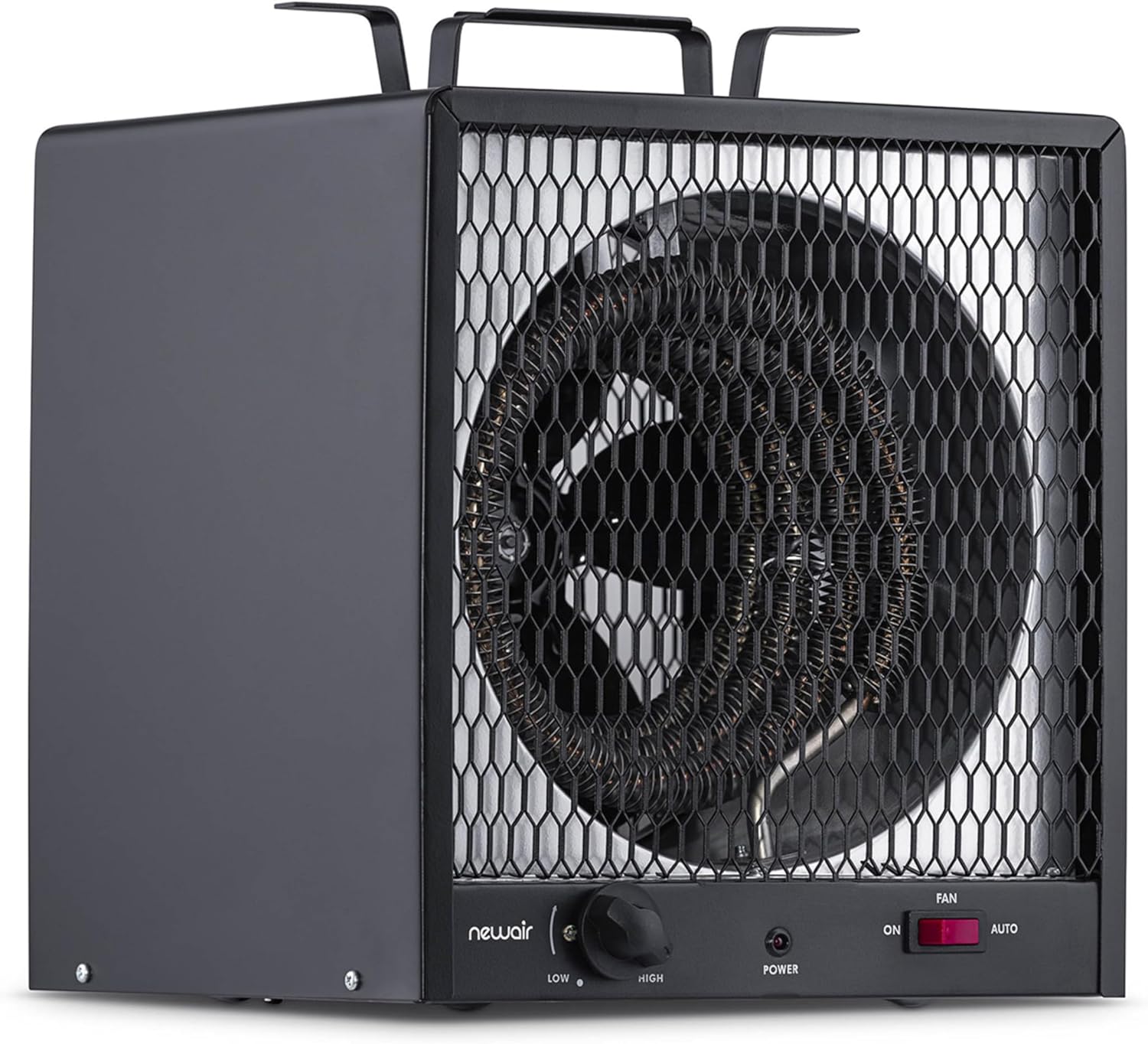
3. NewAir G73 Electric Garage Heater
Verdict: Best Heavy-Duty (Hardwired)
If you own your home and want a permanent solution, the NewAir G73 is a beast. It mounts to the wall or ceiling and must be hardwired into your breaker box.
- Heat Output: 17,060 BTUs (5,000 Watts).
- Performance: This is a true shop heater. It can take a 500 sq. ft. garage from “shivering” to “T-shirt weather” in under an hour. The louvers are adjustable so you can aim the heat exactly where you are working.
Pros:
- Durable stainless steel construction.
- Doesn’t take up floor space.
- Safe for dusty environments.
Cons:
- Requires an electrician to install if you aren’t comfortable with 240V wiring.
4. Comfort Zone Industrial Ceiling Mount
Verdict: Best Space Saver
Floor space in a garage is premium real estate. The Comfort Zone Industrial heater hangs from the ceiling, keeping your cords and unit out of the way of sawdust and foot traffic.
- Features: It comes with a remote control, which is essential since you’ll likely mount it high up out of reach.
- Heat Output: Variable wattage settings allow you to control the electric draw.
Pros:
- 12-hour timer function.
- Heavy-gauge steel body.
- Remote control included.
Cons:
- Installation is a two-person job due to the weight.

5. Modine Hot Dawg (HD45)
Verdict: Best Natural Gas for Large Shops
This is the professional’s choice. If you have a 3-car garage or a detached workshop, electric heaters won’t cut it. The Modine Hot Dawg runs on natural gas (or propane with a conversion kit).
- Heat Output: 45,000 BTUs.
- Efficiency: Because natural gas is generally cheaper than electricity, this unit pays for itself over a few winters if you work in the garage daily. It is essentially a furnace for your garage.
Pros:
- Massive heat output.
- Low operating cost.
- Extremely quiet.
Cons:
- Expensive upfront cost.
- Requires exhaust venting through the wall or roof.

6. Dyna-Glo Delux Torpedo Heater
Verdict: Best for Drafty Barns & Open Doors
If your garage is poorly insulated or you often work with the garage door open, you need a “Torpedo” heater. The Dyna-Glo Delux runs on Kerosene or Diesel and blasts a jet of hot air.
- Heat Output: 80,000 BTUs (Insane heat).
- Warning: These are loud and they smell like exhaust. They are not for sealed, airtight garages. They are for serious work in drafty areas.
Pros:
- Instant, intense heat.
- Rugged construction.
Cons:
- Loud.
- Odor.

7. Lasko Ceramic Space Heater
Verdict: Best Budget / Spot Heater
Sometimes you don’t need to heat the whole garage; you just need to keep your hands warm while you sit at the workbench. The Lasko Ceramic is cheap, small, and plugs into any standard outlet.
- Heat Output: 1500 Watts.
- Use Case: Place it on your workbench pointing at your hands.
Pros:
- Under $50.
- No special wiring needed.
- Very compact.
Cons:
- Will not heat the entire room.

Technical Deep Dive: How Many BTUs Do I Actually Need?
Don’t guess—calculate. If you buy a heater that is too small, it will run constantly and never warm the room.
The Rule of Thumb:
- 1-Car Garage (Insulated): 10,000 – 15,000 BTUs
- 2-Car Garage (Insulated): 20,000 – 30,000 BTUs
- 2-Car Garage (Uninsulated): 30,000 – 45,000 BTUs
- 3-Car Shop: 45,000+ BTUs
Note: If you have high ceilings (over 8ft) or live in an extremely cold climate (like Minnesota or Canada), bump up to the next power level.
Critical Safety Guide
Heating a garage comes with risks. Please follow these three rules:
- Clearance is King: Keep all heaters at least 3 feet away from sawdust, paint thinners, gas cans, and rags.
- Ventilation: If using Propane, Kerosene, or Natural Gas, you must have a carbon monoxide detector installed in the garage.
- Check Your Breaker: For 1500W electric heaters, do not plug other high-draw tools (like a table saw) into the same circuit while the heater is running, or you will trip the breaker.
Frequently Asked Questions (FAQ)
Q: Is it safe to leave a garage heater on overnight?
A: Generally, no. Electric hardwired heaters with thermostats are the safest, but we recommend turning the temperature down to 45°F-50°F just to keep pipes from freezing, rather than keeping it fully heated. Never leave a propane or kerosene heater unattended.
Q: What is the cheapest way to heat a garage?
A: In terms of fuel cost, Natural Gas is usually the cheapest, followed by Electric (in areas with low rates), and then Propane. However, Electric heaters have the lowest upfront cost.
Q: Can I use a patio heater in my garage?
A: No. Patio heaters are designed for open air. Using them in an enclosed garage creates a severe Carbon Monoxide risk.
Final Verdict
If you want the best all-around heater that requires zero installation and offers high heat, get the Mr. Heater Big Buddy.
If you want a permanent, “set it and forget it” solution and have access to 240V power, the NewAir G73 is the best investment for your home.
Don’t buy a heater until you have insulated your door. Read our guide on the Best Garage Door Insulation Kits first.”
Stay warm and happy DIY-ing!