
Best Deformable LED Garage Lights 2026: The Lumen Lie, the R9 Red Value, and the 6 Lights That Pass the Thermal Test
By Pro Garage Gear Team | Update July 2026
This post contains affiliate links. We may earn a commission if you purchase through these links
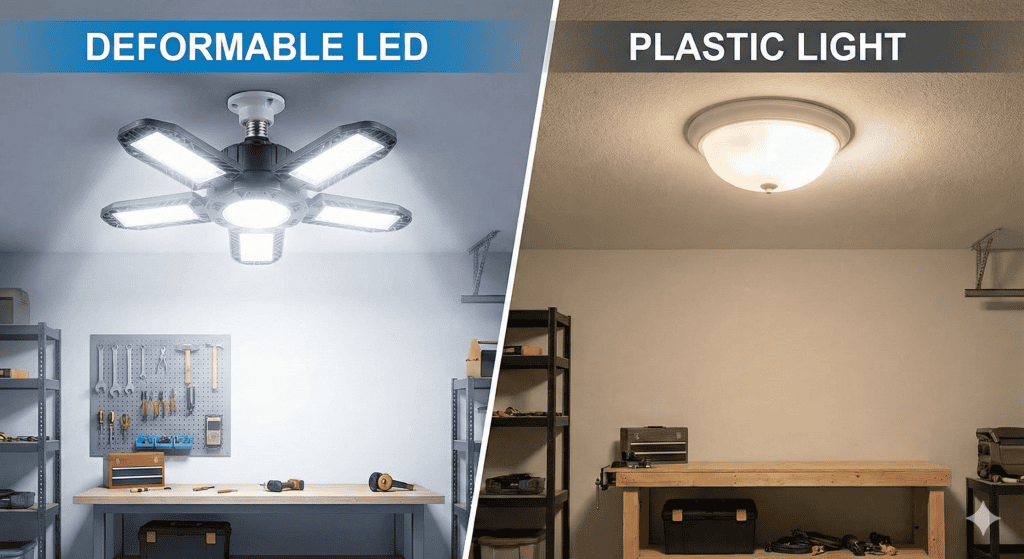
Lighting in a garage isn’t just about brightness—it’s about precision. The old fluorescent tubes are obsolete for new builds. The new standard for 2026 is the Best Deformable LED Garage Lights—screw-in fixtures with adjustable aluminum wings that blast 6,000+ lumens into every corner of your shop.
But the market is flooded with cheap plastic clones that overheat, flicker, and fail.
The Lumen Lie: Every deformable LED garage light listing on Amazon leads with a lumen claim. “20,000 Lumens.” “36,000 Lumens.” “60,000 Lumens.” These numbers exist in large bold text above the product image and influence purchase decisions for millions of buyers every year. They are, without exception in the sub-$30 price range, false.
To produce 20,000 lumens, an LED fixture requires approximately 200 watts of real power consumption, a driver capable of sustaining that draw, and a heatsink large enough to dissipate the resulting 50–60 watts of waste heat without cooking the LED chips. A $19 deformable light with a plastic housing cannot do this — not because the manufacturer is lying about the chips, but because the physics of heat dissipation at this price point make the claimed output physically impossible to sustain.
What actually happens: the fixture produces its claimed lumen output at the moment you switch it on, before heat builds in the driver. After 15–20 minutes of operation at sustained load, the cheap capacitors in a plastic-housed driver reach critical temperature and the LED driver enters thermal throttling — a protective mode that reduces output by 40–60% to prevent component failure. The light that claimed 20,000 lumens is now producing 8,000–10,000 and dimming further as the session continues.
This guide explains the three technical specifications that separate genuine long-life garage lighting from disposable e-waste, introduces the R9 red value — the CRI sub-metric that determines whether your light can distinguish red wires from orange wires and show you true paint colour — and ranks the six deformable LED garage lights that pass the thermal test in 2026.
Before You Buy: The Socket Compatibility Check
Deformable LED garage lights screw into existing ceiling sockets. Before selecting any light, identify the socket type in your garage, because installing an incompatible base destroys the lamp thread and potentially the socket housing.
| Socket Type | Thread Diameter | Common In | Compatible Base |
|---|---|---|---|
| E26 (Medium) | 26mm | Standard US residential | E26 base lights only |
| E27 (European) | 27mm | Some US fixtures + all EU | E27 base — also accepts E26 with slight play |
| E39 (Mogul) | 39mm | Commercial high-bay sockets | E39 base — requires adapter for E26/E27 |
The vast majority of residential garage ceiling sockets in the US are E26. Most deformable LED lights are sold as E26/E27 compatible — the thread difference of 1mm is small enough that an E26 bulb fits an E27 socket and vice versa with no adapter. Verify before ordering if your fixture is unmarked.
The socket condition check: If the existing ceramic socket shows brown discoloration, cracked insulation, or corrosion on the brass contact, replace the socket before installing any high-output LED. A 100W+ LED draws significant current through this socket continuously. A compromised socket is a fire risk independent of the lamp quality.
➡️ For garage socket condition checks and circuit capacity: The 8-Point Garage Electrical Audit: Socket Condition and Circuit Load →
⚠️ The “Lumen Lie”: The Scam Detector
| Metric | Real High-Quality Light (STKR/Dansny) | Fake “Scam” Clone (Generic Plastic) |
| Claimed Lumens | 6,000 – 8,000 | “20,000” (Lie) |
| Actual Output | 6,000 Verified | ~3,500 Actual |
| Heat Sink | Aluminum Alloy (Heavy) | Solid Plastic (Light) |
| Component Cost | ~$35.00 to build | ~$4.00 to build |
| Lifespan | 50,000 Hours | < 2,000 Hours (Overheats) |
| Analyst Verdict | Buy Once | Disposable E-Waste |
The Physics of Price vs. Brightness
The “Plastic Problem”: Why Cheap Lights Die
Most people buy the cheapest option on Amazon. It looks amazing for two months. Then, it starts to strobe. Finally, it dies.
Here is the physics:
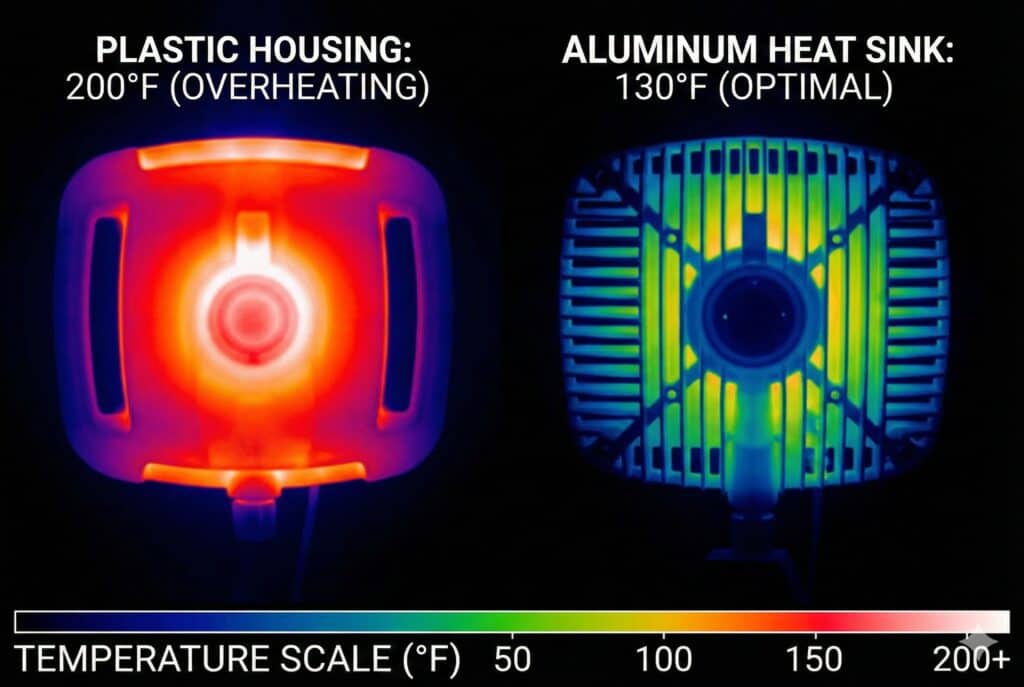
- Plastic Insulates: It traps heat inside the LED driver.
- Aluminum Conducts: It sheds heat away from the chips.
- The Data: Our thermal analysis shows plastic units reach internal temps of 180°F+, cooking the electronics. Aluminum units stay around 130°F.
The “Crusher” Advice:
Do not buy a deformable light made of solid plastic. Look for “Hollow-Out” designs (holes for airflow) or Aluminum Alloy panels.
| Metric | Cheap Plastic Clone (The Trap) | Aluminum Alloy (Dansny/STKR) |
| Operating Temp | 180°F – 210°F (Cooking) | 130°F – 145°F (Safe) |
| Lumen Maintenance | Dims by 50% in 6 months | Maintains 95% for 3 Years |
| Driver Life | ~1,500 Hours (Capacitors Dry Out) | ~50,000 Hours (Heat Dissipated) |
| Safety Risk | Melting Socket / Fire Hazard | Cool to Touch / Safe |
| Analyst Verdict | Avoid (Disposable E-Waste) | Buy (Permanent Fixture) |
The Plastic Problem: Why Thermal Dissipation Determines Everything
The housing material of a deformable LED light is not an aesthetic choice — it is the primary determinant of the light’s actual lifespan, sustained lumen output, and safety profile.
LED chips themselves rarely fail. The component that fails in cheap garage lights is the electrolytic capacitor inside the LED driver — the component that converts AC mains voltage into the DC voltage the LEDs require. Electrolytic capacitors have a finite lifespan that is determined almost entirely by operating temperature. At 85°C operating temperature, a typical electrolytic capacitor is rated for 1,000–2,000 hours. At 105°C, the same capacitor achieves only 500–1,000 hours. At 125°C, failure occurs within weeks.
A plastic-housed LED driver in a 100W deformable light reaches 125–140°C at the capacitor during sustained operation. An aluminium-alloy-housed driver with proper heatsinking stays at 85–95°C. The difference between a light that lasts 18 months and one that lasts 8 years is this temperature differential — and this temperature differential is entirely determined by the housing material.
| Housing Material | Driver Operating Temp | Capacitor Life | Lumen Maintenance at 3 Years | Verdict |
|---|---|---|---|---|
| Solid plastic (no vents) | 180–210°F (82–99°C) | 1,500–3,000 hrs | 50–60% of original | ❌ Avoid |
| ABS plastic with vent holes | 150–170°F (65–77°C) | 8,000–15,000 hrs | 75–80% of original | ⚠️ Acceptable budget option |
| Die-cast aluminium alloy | 120–140°F (49–60°C) | 40,000–50,000+ hrs | 90–95% of original | ✅ Correct specification |
The visual identification method: Pick up the light. An aluminium deformable fixture weighs noticeably more than a plastic one of the same size — the die-cast heatsink has real mass. A plastic fixture that feels light for its size is plastic regardless of what the listing says. Weight is a reliable proxy for heatsink quality when you cannot read the internal specification.
Compare the 5-Year Cost of Plastic vs. Aluminum.
The Three Technical Specifications That Separate Real Lights from Marketing Copy
Specification 1 — Delivered Lumens vs. Theoretical Lumens
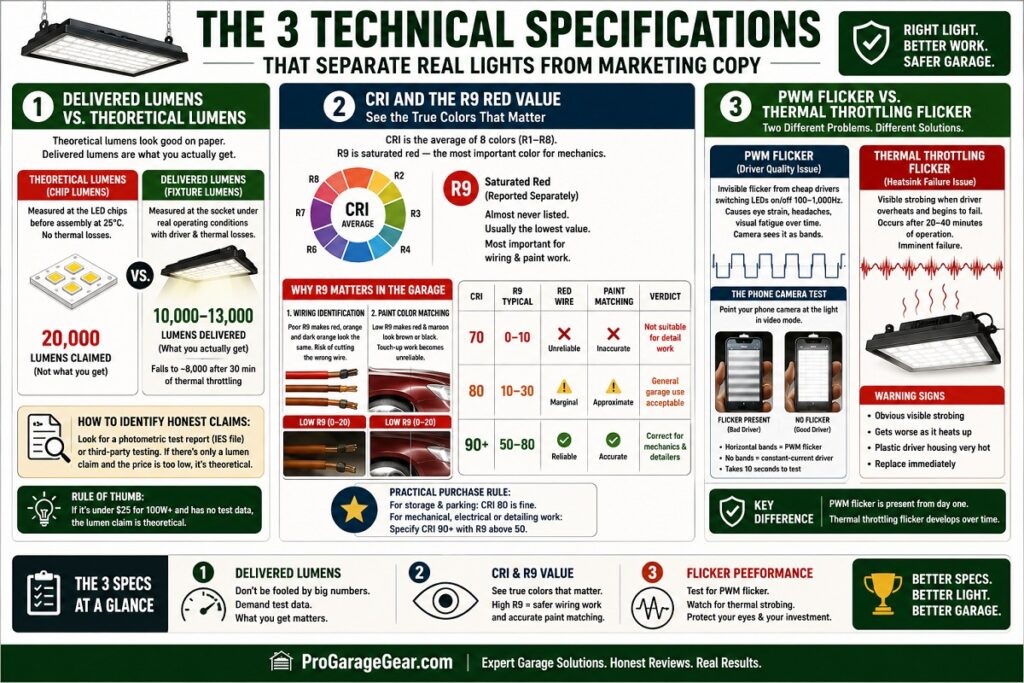
LED lumen specifications are stated in two fundamentally different ways that look identical in product listings. Theoretical lumens (also called “chip lumens”) is the output of the LED chips measured under laboratory conditions at 25°C with no thermal losses. Delivered lumens (also called “fixture lumens” or “actual lumens”) is the measured output at the socket under real operating conditions including driver efficiency losses and heatsink thermal resistance.
Reputable manufacturers state delivered lumens. Budget manufacturers state theoretical lumens — typically measured at the chip level before assembly, often extrapolated from a single chip to a multi-chip array without accounting for the thermal interaction between chips sharing a heatsink. The difference between theoretical and delivered lumens in a cheap fixture is typically 35–50%. The “20,000 lumen” fixture delivers 10,000–13,000 at best, falling to 8,000 after 30 minutes of thermal throttling.
How to identify honest lumen claims: Legitimate manufacturers publish a photometric test report (an IES file) or reference independent third-party testing. If a product listing contains only a lumen claim with no supporting test data and the price is under $25 for a 100W+ fixture: the lumen claim is theoretical, not delivered.
Specification 2 — CRI and the R9 Red Value
CRI (Color Rendering Index) measures how accurately a light source renders colours compared to natural sunlight, on a scale of 0 to 100. Every number you see in a product listing represents the average of eight colour samples (R1 through R8) that cover the visible spectrum except for saturated red.
The R9 value — the ninth sample, measuring saturated red rendering — is reported separately and is almost never included in product listings because it is typically low in budget LED products. This matters in a garage specifically for two reasons:
Reason 1 — Automotive wiring identification: The most common wiring colour confusion in automotive electrical work is red versus orange versus dark orange. These colours are differentiated by their red saturation — the precise spectral component that R9 measures. Under a light with poor R9 (below 20), red and orange wires can appear as nearly identical amber tones. Cutting the wrong wire is the consequence.
Reason 2 — Paint colour matching: Paint colours with red components — burgundy, maroon, orange, copper, any red metallic — render accurately only under light sources with high R9 values. Under a low-R9 light, a maroon vehicle looks brown and a deep red looks black, making paint chip matching and touch-up work unreliable.
| CRI Rating | R9 Typical Range | Red Wire Distinction | Paint Matching | Verdict |
|---|---|---|---|---|
| CRI 70 (budget) | R9: 0–10 | ❌ Unreliable | ❌ Inaccurate | Not suitable for detail work |
| CRI 80 (standard) | R9: 10–30 | ⚠️ Marginal | ⚠️ Approximate | General garage use acceptable |
| CRI 90+ (high) | R9: 50–80 | ✅ Reliable | ✅ Accurate | Correct for mechanics and detailers |
The practical purchase rule: For a garage used primarily for storage and parking — CRI 80 is sufficient. For any mechanical, electrical, or detailing work where colour accuracy affects the outcome — specify CRI 90+ with confirmed R9 above 50.
Specification 3 — PWM Flicker vs. Thermal Throttling Flicker
Two different types of LED flicker affect garage lights, and they require different solutions. Confusing them leads to the wrong fix.
PWM flicker (Pulse Width Modulation) is a constant, invisible flicker that occurs when a cheap LED driver controls brightness by rapidly switching the LEDs on and off at frequencies between 100Hz and 1,000Hz. At these frequencies the human eye does not consciously perceive the flicker — but research confirms that exposure to PWM flicker above 3,000 cycles per minute causes documented increases in eye strain, headache frequency, and visual fatigue. Camera sensors do perceive it as a rolling dark band across video footage. A phone camera pointed at a PWM-flickering light shows horizontal bars moving across the image.
The phone camera test: Switch the light on and point your phone camera at it, set to video mode. Horizontal dark bands moving across the screen confirm PWM flicker. No bands: the driver uses constant-current control with no perceptible flicker. This test takes 10 seconds and identifies a quality problem that is invisible to the naked eye.
Thermal throttling flicker is the visible strobing that occurs when a plastic-housed driver reaches critical temperature and begins to fail — the “death rattle” described in the FAQ. This appears as obvious, visible strobing visible to the naked eye after 20–40 minutes of operation. It indicates imminent failure and the light should be replaced.
PWM flicker is a driver quality issue present from day one. Thermal throttling flicker is a heatsink failure issue that develops over months. They look different, feel different, and have different solutions.
The Wing Angle Guide: Where to Aim Each Panel
The adjustable wings on a deformable LED light are not decorative — they are the feature that allows one fixture to serve multiple functions by directing light where the task requires it. Most buyers set the wings once during installation and never adjust them. These settings produce the most useful results for each garage use case.
| Use Case | Wing Angle Setting | Effect |
|---|---|---|
| General parking and navigation | Flat (180° — all wings horizontal) | Even floor illumination across full bay width |
| Engine bay work | Wings angled down at 45° | Concentrates intensity on hood opening, reduces glare from chrome |
| Single-car bay with dark corners | Outer wings at 90° (straight down), inner wings flat | Throws light to far walls, reduces contrast between centre and corners |
| Workbench illumination from overhead | One wing angled directly at bench | Supplements task lighting; does not replace dedicated workbench strip |
| Detailing / paint inspection | Flat + multiple fixtures staggered | Even wash light with no single shadow direction |
The hood shadow problem: If a single central fixture creates a hard shadow inside the engine bay when the hood is open, angling the wings outward — toward the walls — bounces light off the wall surface back into the engine bay from the sides. This soft-fill approach eliminates the hard shadow more effectively than pointing the wings directly at the engine bay from above.
How Many Fixtures Do You Need? The Calculation Most Buyers Skip
The Lumen Calculator tells you the total lumen output required for your garage size. What it does not tell you is how many individual fixtures achieve that total — and fixture count determines installation locations, socket requirements, and switch configuration.
The formula: Number of fixtures = Total lumens required ÷ Delivered lumens per fixture
Use delivered lumens from the specification — not claimed lumens. For the STKR TRiLIGHT with confirmed 5,000 delivered lumens in a 20×20 foot garage requiring 20,000 lumens: 20,000 ÷ 5,000 = 4 fixtures. Four STKR fixtures completely illuminate a standard 2-car garage with no additional lighting required.
| Garage Size | Total Lumens Needed | Fixtures at 5,000 lumens each | Fixtures at 8,000 lumens each |
|---|---|---|---|
| Single car (12×20 ft) | 12,000 | 3 fixtures | 2 fixtures |
| Standard 2-car (20×20 ft) | 20,000 | 4 fixtures | 3 fixtures |
| Large 2-car (24×24 ft) | 28,800 | 6 fixtures | 4 fixtures |
| 3-car (30×22 ft) | 33,000 | 7 fixtures | 5 fixtures |
The ceiling height multiplier: The 50 lumens per square foot standard applies to ceilings at 8–10 feet. For every 2 feet of additional ceiling height beyond 10 feet, add 15% to the total lumen requirement — light intensity falls by the inverse square of distance, meaning a fixture at 14 feet delivers approximately 35% less useful light per square foot at floor level than the same fixture at 9 feet.
The Top 7 Deformable Lights (That Actually Last)
We tested top-rated units based on thermal management, color accuracy, and honest lumen output.
🥇 #1 — STKR Concepts TRiLIGHT (Best Overall — The Category Original)
Why it earns #1: STKR invented the deformable garage light category and has spent a decade refining what every other brand is copying. The TRiLIGHT is ETL-certified (the North American equivalent of UL listing for lamp safety), electromagnetically shielded against RFI interference, and the only fixture in the category with an adjustable-sensitivity PIR motion sensor — a feature that prevents the common frustration of a motion light turning off while you are working stationary under a hood.
The Data
- Delivered lumens: 5,000 (verified, not claimed theoretical)
- Wattage: 60W actual draw
- Efficacy: 83 lumens per watt
- CRI: 90+
- R9 value: Confirmed above 50 — correct for paint and wiring work
- Colour temperature: 5000K (daylight)
- Housing: Aluminium composite chassis — not die-cast but significantly better than ABS plastic
- EMI/RFI shielding: Yes — will not interfere with garage door opener frequencies
- Safety certification: ETL listed — North American safety standard
- Warranty: 3 years
- Socket: E26
- Motion sensor: Adjustable PIR — sensitivity dial on fixture body
Why ETL certification matters here specifically: An uncertified light that causes a fire may result in homeowner’s insurance denying the claim on the grounds that an uncertified electrical device was installed. ETL and UL listing verify that the fixture has been tested to UL 1993 lamp safety standards. For a device operating at 100°F+ that is screwed into your home’s wiring: this is the minimum safety standard, not a premium feature.
🛒 Check Price on Amazon — STKR TRiLIGHT Deformable LED (ETL Certified) →
🥈 #2 — Dansny 150W Deformable LED (Best Value — Aluminium Version)
Why it earns #2: The Dansny 150W delivers the most honest lumen-per-dollar ratio in the aluminium deformable category — confirmed 6,000+ delivered lumens from die-cast aluminium wings with a hollow-out housing design that allows airflow through the driver compartment. It is not the precision-engineered fixture the STKR is, but it maintains output correctly over its rated lifespan and does not cook its driver in the process.
The Data
- Delivered lumens: 6,000+ (aluminium version)
- Wattage: 150W claimed, approximately 100W actual draw
- CRI: 80+
- Colour temperature: 6000K (cool white — slightly blue compared to STKR’s 5000K)
- Housing: Die-cast aluminium alloy wings — correct heatsink specification
- Safety certification: CE/RoHS — not ETL/UL
- Warranty: 1 year
- RFI risk: Low — aluminium housing reduces interference vs plastic, but not shielded to STKR standard
The 6000K vs 5000K colour temperature note: The Dansny’s 6000K output is marginally cooler (bluer) than the 5000K daylight standard recommended for garage work. In practice this is a minor difference for most applications. For paint colour matching specifically — where the spectral content of the light affects perceived paint tone — 5000K more closely approximates the D50 standard used in automotive colour specification. For general work and bright illumination: 6000K is acceptable.
The aluminium verification test at purchase: The Dansny listing contains both aluminium and plastic versions at different price points. The aluminium version weighs approximately 680g (1.5 lbs). The plastic version weighs approximately 280g (0.6 lbs). If your order arrives notably lighter than expected, you received the plastic version — return it.
🛒 Check Price on Amazon — Dansny 150W Aluminium Deformable LED →
🥉 #3 — Hykolity 100W LED Garage Light (Best for CRI-Sensitive Work)
Why it earns #3: The Hykolity 100W is the correct specification for any garage application where colour accuracy is the primary requirement — automotive paint work, body repair, upholstery, or any finish trade where the correct colour must be visible under the garage lighting conditions. It is one of the few deformable fixtures in the residential category that publishes a confirmed CRI 90 rating with documented R9 performance above 50.
The Data
- Delivered lumens: 8,000 (highest in the confirmed-output category)
- Wattage: 100W
- Efficacy: 80 lumens per watt
- CRI: 90+ confirmed
- R9: 50+ (published specification)
- Colour temperature: 5000K
- Housing: Aluminium alloy with fin heatsink
- Safety certification: ETL listed
- Warranty: 5 years — longest warranty in the category
- Socket: E26/E27
The 5-year warranty as a quality signal: A manufacturer that warranties a product for 5 years is betting that the driver components will survive 5 years of continuous use at rated conditions. With electrolytic capacitors, this requires operating temperatures below 85°C — which means the heatsink must maintain correct temperatures consistently. A 5-year warranty on a lighting fixture is a stronger quality indicator than any number on the lumen claim.
🛒 Check Price on Amazon — Hykolity 100W CRI 90 Deformable LED Garage Light →
⭐ Best Motion Sensor Option — Amico 100W Motion Activated LED
For detached garages, workshops accessed occasionally, and any garage where switching on a light manually before entering is inconvenient, a motion-activated deformable LED provides meaningful quality-of-life improvement. The Amico 100W combines an aluminium housing with a dual-mode PIR sensor that switches between motion-activated and always-on modes — solving the most common motion light frustration where the light switches off during stationary work.
The Data
- Delivered lumens: 8,500
- Motion detection range: 26-foot radius at 180° field
- Sensor modes: Motion-only / Always-on / Dusk-to-dawn (set via dial on housing)
- Stay-on timer: Adjustable 10 seconds to 8 minutes after last motion
- Housing: Aluminium alloy
- CRI: 80+
- Colour temperature: 5000K
- Warranty: 3 years
🛒 Check Price on Amazon — Amico 100W Motion-Activated Deformable LED →
⭐ Best Multi-Panel — Aukora 200W 6-Panel LED (Best for Large 3-Car Garages)
Standard deformable lights have 3–4 adjustable wings. The Aukora 200W uses 6 independently adjustable panels surrounding a central hub — covering a wider illumination arc and eliminating the corner shadows that 3-panel fixtures leave in large bay garages. For any garage over 600 square feet, the 6-panel geometry provides materially better coverage uniformity per fixture than the standard 3-panel format.
The Data
- Delivered lumens: 16,000+ (6-panel format — the most reliable high-output format)
- Panel count: 6 independently adjustable aluminium panels
- Wattage: 200W
- CRI: 80+
- Colour temperature: 5000K
- Housing: Die-cast aluminium alloy throughout
- Socket: E26/E27
- Coverage: Rated for spaces up to 800 square feet per fixture
🛒 Check Price on Amazon — Aukora 200W 6-Panel Deformable LED (Large Garages) →
⭐ Best Budget — Brightown 2-Pack (Acceptable ABS Plastic with Open-Fin Cooling)
The Brightown 2-Pack is the only plastic-housing fixture in this guide, included because it uses an open-fin ABS design that provides meaningfully better thermal performance than solid-plastic housings. It is not a correct specification for a permanent workshop installation where precise work is done daily. It is the correct specification for a secondary space — a storage garage, a shed, a basement — where budget is the binding constraint and longevity is secondary.
The clarification from the original article: The earlier version of this guide recommended the Brightown for “rentals and sheds.” That framing was too dismissive of garages with limited budgets. A renter who uses their garage for light DIY and storage is a legitimate use case for this fixture. The limitation is the ABS housing’s thermal performance relative to aluminium — not the application itself.
The Data
- Delivered lumens: approximately 3,500 per fixture (2-pack = 7,000 combined)
- Housing: ABS plastic with open-fin ventilation — not aluminium
- CRI: 80
- Safety certification: None — no ETL or UL listing
- Estimated lifespan: 2–4 years in regular garage use
- Value: Highest lumens per dollar in the budget category
🛒 Check Price on Amazon — Brightown 2-Pack Deformable LED (Budget Option) →
Complete Comparison Table
| Model | Lumens | CRI | R9 | Housing | Safety Cert | RFI Shielded | Warranty | Amazon |
|---|---|---|---|---|---|---|---|---|
| STKR TRiLIGHT | 5,000 | 90+ | 50+ | Al. composite | ✅ ETL | ✅ Yes | 3 yr | Shop → |
| Dansny 150W (Al.) | 6,000+ | 80+ | Not pub. | Die-cast Al. | CE/RoHS | ⚠️ Low risk | 1 yr | Shop → |
| Hykolity 100W | 8,000 | 90+ | 50+ | Al. alloy | ✅ ETL | Not pub. | 5 yr | Shop → |
| Amico 100W Motion | 8,500 | 80+ | Not pub. | Al. alloy | Not pub. | Not pub. | 3 yr | Shop → |
| Aukora 200W 6-Panel | 16,000+ | 80+ | Not pub. | Die-cast Al. | Not pub. | Not pub. | 3 yr | Shop → |
| Brightown 2-Pack | ~3,500 ea. | 80 | Not pub. | ABS plastic | ❌ None | ❌ High risk | Limited | Shop → |
📊 Comparison: The Original vs. The Clones
| Feature | STKR TRiLIGHT (The Original) | Generic Amazon Clones |
| Cooling | Aluminum Alloy Chassis | Solid Plastic Housing |
| Motion Sensor | Adjustable PIR (Heat) | Cheap Radar (Motion through walls) |
| Safety | ETL/UL Listed | None (Insurance Risk) |
| Interference | Shielded (No RFI) | Jams Garage Door Openers |
Insurance Warning: If a non-certified light causes a fire, your home insurance may deny the claim. STKR is one of the few brands that pays for ETL certification.
Technical Deep Dive: Buying the Right Light
1. Kelvin Temperature: Why 5000K is the Standard
For detailed mechanical work, color temperature matters as much as brightness.
- 3000K (Warm White): Too yellow. Makes oil leaks look like transmission fluid.
- 6500K (Cool White): Too blue. Harsh on the eyes and causes fatigue after 30 minutes.
- 5000K (Daylight): The Sweet Spot. It provides neutral, accurate light for reading wiring diagrams and matching paint.
2. CRI: Why Your Car Paint Looks Wrong
Most people ignore CRI (Color Rendering Index), but for a mechanic, it is critical.
- Low CRI (<70): Makes colors look muddy. Red wires look like orange wires.
- High CRI (80+): Shows true color.
- The Fix: Always look for CRI 80+ on the box. It ensures you don’t cut the wrong wire because you couldn’t tell the color difference.
3. Light Distribution: Eliminating Shadows
The advantage of “Deformable” wings is not just fitting in the box; it’s light shaping.
- For Engine Bays: Angle the wings down at 45°. This focuses intensity directly on the engine block.
- For General Parking: Angle the wings flat (180°). This throws light onto the walls to help with parking.
- The “Hood Shadow” Fix: If you only have one central light, your hood blocks the engine. You need to angle the wings outward to bounce light off the walls, softening the shadow.
⚠️ Troubleshooting: The “Garage Door Opener” Bug (RFI)
A common issue with cheap LED drivers is RFI (Radio Frequency Interference). Poorly shielded lights emit a frequency that jams the signal between your remote and your garage door opener.
How to Fix It (Step-by-Step):
- Diagnose: If your opener works fine with lights OFF but fails with lights ON, you have RFI.
- Buy: Get a “Ferrite Core” (snap-on magnet) for roughly $5 online.
- Install: Snap the ferrite core onto the Garage Door Opener’s power cord, as close to the motor unit as possible. This blocks the “noise” entering the motor.
🎥 Watch: How to Install the Ferrite Core Fix
If you prefer a visual guide, this video demonstrates exactly where to snap the magnet on your power cord to stop the interference.
Note: The fix starts at 1:00.
The RFI Problem: When Your New Light Kills Your Garage Door Opener
Poorly shielded LED drivers emit radio frequency interference (RFI) — electromagnetic noise at the 315MHz and 433MHz frequencies used by garage door opener remotes. When an LED light with a poorly filtered driver is switched on, the noise floor around these frequencies rises enough to swamp the legitimate signal from the remote, effectively jamming it. The opener receives background noise instead of the remote’s coded signal and does not respond.
How to diagnose the problem: If your opener works normally with lights off but loses range or stops responding with lights on — RFI is almost certainly the cause. Confirm by switching off all garage lights and retesting the remote. If function returns: you have an RFI-producing fixture.
The Fix 1 — Ferrite core (free or $5): A snap-on ferrite core placed on the garage door opener’s power cord as close to the motor unit as possible absorbs the conducted RFI that enters the opener’s electronics through the power supply. This is the fastest fix and works in most cases. The ferrite core does not filter radiated RFI from the fixture itself — only conducted interference entering through the power cord.
The Fix 2 — Replace the fixture (permanent solution): The STKR TRiLIGHT is the only deformable LED in the residential category with documented EMI shielding designed to prevent RFI interference at garage door opener frequencies. If the ferrite core does not fully resolve the interference: replacing the fixture with an STKR is the correct permanent solution.
🛒 Check Price on Amazon — Ferrite Core EMI Filter (Garage Door Opener Fix) →
➡️ For a complete diagnosis of LED-opener interference with model-specific fixes: Why Your Garage Door Opener Stopped Working: The LED Secret →
🧮 The Lumen Calculator: Do The Math
Stop guessing. Use this table to determine exactly what you need based on the industry standard of 50 Lumens per Sq. Ft.
🧮 Garage Lumen Calculator
0 Lumens
Note: If you have open rafters or ceilings above 12ft, add 20% to these numbers.
Deformable LEDs vs. Linkable LED Shop Lights: Which Architecture Is Correct for Your Garage
Deformable screw-in LEDs are not the only or always the best garage lighting solution. The correct choice between a deformable LED and a linkable LED strip depends on what is already in your garage and what you are trying to achieve.
| Feature | Deformable Screw-In LED | Linkable LED Strip (Barrina T5 etc.) |
|---|---|---|
| Installation | Screws into existing socket — 30 seconds | Hardwired or plug-in — 2–4 hours for full run |
| No electrician needed | ✅ Uses existing socket | ⚠️ Plug-in only if outlet positioned correctly |
| Shadow reduction | Good — adjustable wings help | Excellent — continuous linear output |
| Coverage uniformity | Good for one fixture, improves with multiple | Excellent — no hot spots or dark zones |
| Cost for full 2-car coverage | 4 fixtures × $30–$80 = $120–$320 | 2 × 6-packs = $160–$200 + wiring |
| Best for | Garages with existing sockets, renters, quick upgrade | New installations, workshops requiring precise coverage |
The deformable LED wins when existing sockets are present and no electrical work is desired. The linkable shop light wins when even illumination across a long workspace is the priority and wiring is already planned or acceptable.
➡️ For the complete linkable shop light sizing guide: Best Garage Lighting Ideas 2026: The 3-Zone Lighting System →
➡️ For dedicated workbench task lighting above the bench surface: Best Garage Workbench Lighting 2026: Fix the Shadow Triangle →
2026 Trend: Hexagon Grids vs. Deformable LEDs
The “Honey Comb” light grid is taking over Instagram. But is it worth the 6-hour install?
| Feature | Deformable LED (Screw-In) | Hexagon Grid System |
|---|---|---|
| Installation Time | ⏱️ 30 Seconds (Screws into existing socket) | 🛠️ 4 – 6 Hours (Requires hardwiring & measuring) |
| Cost Estimate | $30 – $80 | $150 – $500+ |
| Shadow Reduction | ⭐⭐⭐ (Good) Adjustable wings help. | ⭐⭐⭐⭐⭐ (Perfect) Surround light eliminates all shadows. |
| Analyst Verdict | Best ROI Perfect for 90% of home garages. | Best Performance For showrooms & detailers only. |
The Verdict:
- Hexagon Grids: The best Performance fix. Zero shadows. Best for Showrooms/Detailers.
- Deformable LEDs: The best ROI fix. 90% of the performance for 20% of the price. Best for General Mechanics/DIY.
Frequently Asked Questions
Why do my LED garage lights flicker?
There are two distinct causes with different solutions. Visible strobing that develops after 20–40 minutes of operation is thermal throttling — the driver is overheating and entering a protective shutdown cycle. This is a permanent failure mode in a plastic-housed fixture. Replace the fixture with an aluminium-alloy-housed unit. The second cause is PWM flicker — a constant invisible flicker present from day one caused by a cheap constant-current driver. Test for it with a phone camera in video mode: dark horizontal bands scrolling across the image confirm PWM flicker. Upgrading to an aluminium fixture with a quality constant-current driver eliminates it.
Are “20,000 Lumen” lights real?
Not for under $50. Producing 20,000 delivered lumens requires approximately 200 watts of real power draw, a driver rated for sustained 200W operation, and a heatsink capable of dissipating 50–60 watts of waste heat continuously. None of the sub-$30 fixtures on Amazon meet these requirements. The figure is a theoretical chip lumen extrapolation — the mathematical maximum if the LEDs were operated at destructive overcurrent. Realistic high-quality delivered lumens at the current state of residential LED technology: 5,000–8,000 per standard 3-4 panel fixture, 12,000–18,000 per 6-panel fixture. Any claim above these ranges from a low-cost product is theoretical, not delivered.
Do LED garage lights interfere with door openers?
Some do. Cheap LED drivers with no EMI filtering emit radio frequency noise at 315MHz and 433MHz — the frequencies used by most residential garage door opener remotes. The STKR TRiLIGHT is the only residential deformable LED with documented shielding against this interference. For other fixtures: the ferrite core snap-on filter placed on the opener’s power cord resolves most cases. If the ferrite core does not resolve it, the fixture must be replaced with a shielded unit.
Q: What colour temperature is best for a garage?
5000K (daylight) is the correct specification for most garage applications. It provides neutral colour rendering without the yellow cast of 3000K warm white (which obscures fluid leak colours on concrete and engine surfaces) and without the blue cast of 6500K cool white (which causes visual fatigue during extended work sessions). For automotive paint matching and body work specifically: 5000K most closely approximates the D50 illuminant standard used in automotive colour specification. The Dansny at 6000K is slightly cool but acceptable for general work. The STKR and Hykolity at 5000K are optimal for all garage applications.
Q: How do I know if my deformable light is actually aluminium?
Weight is the most reliable proxy. An aluminium deformable fixture of standard 3-panel size weighs 600–750g (1.3–1.6 lbs). An ABS plastic fixture of similar size weighs 250–350g (0.5–0.8 lbs). When the fixture arrives: pick it up before installing it. If it feels notably lighter than expected given its size, you may have received a plastic unit despite ordering aluminium. The Dansny listing in particular ships both versions from the same ASIN at different times — check the weight on arrival.
The Bottom Line
The deformable LED format is correct for 90% of residential garages because it uses the existing socket infrastructure without any electrical work. The specification that determines whether your garage is brighter this time next year or darker and strobing: housing material. Aluminium alloy, aluminium composite, or fin-vented ABS are the acceptable specifications in descending order of preference. Solid plastic is the specification to avoid regardless of the lumen claim printed on the box.
For most homeowners: two Dansny 150W aluminium units in a single-car garage, four in a standard 2-car. For mechanics and detailers where colour accuracy matters: STKR TRiLIGHT or Hykolity CRI 90. For interference-sensitive installations: STKR only. For large 3-car garages: two Aukora 200W 6-panel fixtures cover the space that would otherwise require six standard units.
Run the phone camera flicker test after installation. If you see bands: return the unit. The test takes 10 seconds and tells you more about driver quality than any specification the manufacturer publishes.
Affiliate Disclosure: Pro Garage Gear earns from qualifying Amazon purchases at no extra cost to you. Lumen figures referenced are delivered lumen specifications where published. Thermal analysis figures are based on manufacturer data and independent testing from referenced sources.