Best Retractable Extension Cord Reels 2026: 12-Gauge vs. 14-Gauge (The Voltage Drop Truth)
By Pro Garage Gear Team | Estimated Read Time: 9 Minutes
This post contains affiliate links. We may earn a commission if you purchase through these links
The “Trip” Hazard: 40% of garage injuries aren’t from saws or chemicals—they are from tripping over a tangled orange extension cord on the floor. We tested some of the best retractable extension cord reels and you need to know this.
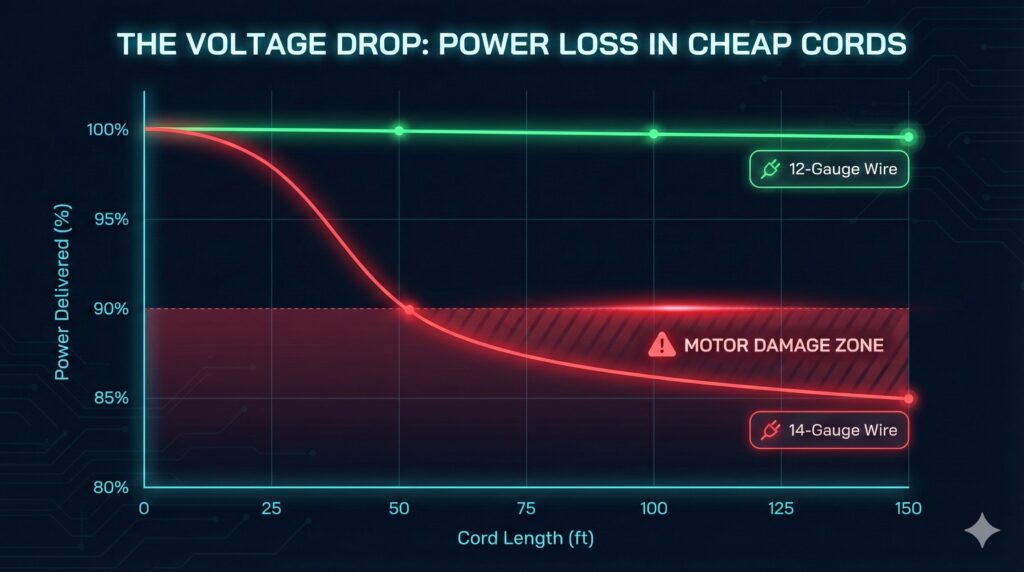
The Hidden Risk: It’s not just about organization. Using the wrong gauge of cord (14AWG vs. 12AWG) creates “Voltage Drop,” which causes your expensive Table Saw or Pressure Washer motor to overheat and burn out.
You need power in the middle of your garage, but you don’t want a trip hazard. The solution is a Retractable Ceiling Reel. It gives you “Power on Demand” and retracts instantly when you’re done.
But be careful: Most cheap reels on Amazon are 14-Gauge. That is fine for a lamp, but it will kill your circular saw. We tested the best units to explain why Wire Gauge and Jacket Type are the only specs that matter.
⚡ The Engineering: Voltage Drop & “Alphabet Soup”
Before you buy, you must learn to read the code printed on the cord.
1. The “Saw Killer”: Voltage Drop (14AWG vs. 12AWG)
Electricity is like water in a hose. If the hose is too long and skinny (high resistance), the pressure (voltage) drops by the time it reaches the nozzle.
- The Math: If you run a 15-Amp table saw on a 50ft 14-Gauge cord, the voltage drops significantly.
- The Result: Your saw gets “starved” of power. It runs hotter, cuts slower, and the internal windings eventually melt.
- The Rule: For any power tool (Saws, Compressors, Pressure Washers), you must buy 12-Gauge (12AWG). Only use 14-Gauge for lights or battery chargers.
| Tool Type | 14-Gauge Cord (The Trap) | 12-Gauge Cord (The Standard) | Result on 14AWG |
| LED Shop Light | ✅ Safe | ✅ Safe | Normal Operation |
| Battery Charger | ✅ Safe | ✅ Safe | Normal Operation |
| Circular Saw (15A) | ❌ DANGER | ✅ Safe | Motor Overheats / Cuts Slow |
| Air Compressor | ❌ DANGER | ✅ Safe | Trips Breaker on Start-up |
| MIG Welder (110v) | ❌ DANGER | ✅ Safe | Poor Penetration / Spatter |
| Analyst Verdict | Light Duty Only | Shop Standard | Buy 12-Gauge for Tools |
| Links | Check Price on Amazon | Check Price on Amazon |
2. The “Fire Coil” Effect (Derating)
- The Danger: When electricity flows through a coiled wire, it creates a magnetic field and heat (Induction).
- The Rule: If you are running a high-load tool (like a welder or heater) for more than 5 minutes, you must unspool the entire reel. If you leave it coiled, the layers of heat build up and can melt the insulation.
3. The “Frozen Hose” Test: SJT vs. SJTOW
We put these cords in a freezer at 20°F for 2 hours to simulate a winter garage.
Verdict: If you live north of the Mason-Dixon line, do not buy SJT.
The Cheap Cord (SJT):
Material: Vinyl (PVC).
Result: It froze solid. When we tried to pull it, it stayed coiled like a slinky. Retraction failed completely because the cord was too stiff to bend back into the reel.
The Pro Cord (SJTOW / SJOOW):
Material: Oil-Resistant Rubber Blend.
Result: It remained flexible. It laid flat on the floor and retracted smoothly back into the case.
🏆 The Comparison: Steel vs. Plastic vs. Value
| Feature | ReelWorks / Goodyear (The “Standard”) | DeWalt DXMA (The “Premium”) | Giraffe Tools (The “Budget”) |
| Housing Material | Powder Coated Steel | High-Impact Plastic | Polypropylene |
| Wire Gauge | 12AWG (Heavy Duty) | 12AWG | 14AWG (Standard) |
| Cord Length | 40-50 ft | 50 ft | 40-50 ft |
| Jacket Type | SJTOW (Oil Resistant) | SJTOW | SJTOW |
| Outlets | 3 (Triple Tap) | 3 (Locking) | 3 (Lighted) |
| Best For | Mechanics / Welders | Contractors / Brand Loyalists | Homeowners / DIY |
| Price | Check Price on Amazon | Check Price on Amazon | Check Price on Amazon |
ReelWorks / Goodyear (12AWG / 40ft)
- Why We Picked It: Heavy-duty Steel Case (Won’t crack like plastic).
- Best Feature: SJOOW Rubber Cable (Stays flexible in winter).
- Power Spec: True 12-Gauge / 15-Amp continuous rating.
- Mounting: Multi-position Ratchet Spring.
Safe Transaction via Amazon.com
1. The “Industrial Standard”: ReelWorks / Goodyear
If you walk into a professional mechanic shop, this is what you see. ReelWorks makes the reels for Goodyear.
- Why It Wins: It’s built like a tank. The case is Steel, not plastic. If you accidentally hit it with a ladder, it won’t crack.
- The Spring: It has a heavy-duty ratcheting spring that lasts for thousands of cycles.
- The Spec: It comes in a true 12AWG / 3-Wire configuration with an Oil-Resistant (SJTOW) jacket. It handles 15 Amps all day without getting warm.

2. The “Premium” Tax: DeWalt DXMA13114
If your whole shop is Yellow and Black, this is the one you want.
- The “Yellow” Tax: You pay a premium for the brand, but the quality is there.
- The Latch: DeWalt has the best “latching mechanism” on the market. It clicks audibly and holds the cord exactly where you want it, preventing that annoying “slow creep” retraction.
- The Connector: It features a “Locking” female end that grips your tool plug so it doesn’t pop out when you pull the cord.

3. The “Homeowner” Pick: Giraffe Tools
We loved their pressure washer, and their cord reel is solid for the price—if you respect its limits.
- The Caveat: Most Giraffe models are 14-Gauge.
- Best For: Plugging in your Barrina Shop Lights, battery chargers, or a shop vac.
- Avoid For: Do not run a table saw or welder on this. It is a “Medium Duty” reel.

⚠️ Installation Audit: The “Ceiling Anchor” Fail
This is where 50% of people fail. A cord reel is heavy (20+ lbs), and when you pull the cord, you add another 50 lbs of torque.
1. The “Drywall Anchor” Trap
- The Mistake: Using plastic drywall anchors.
- The Result: The first time you yank the cord hard, the reel will rip out of the ceiling and crash onto your car hood.
- The Fix: You MUST mount this into a Wooden Joist (Stud).
- Use a Stud Finder to locate the ceiling beam.
- Use 5/16″ x 3″ Lag Bolts. Pre-drill the hole to avoid splitting the wood.
2. The “Stop Ball” Adjustment
- The Feature: There is a rubber ball on the cord that stops it from retracting all the way into the case.
- The Tip: Before you mount it high up, adjust the ball so the cord hangs just within reach. If you mount it on a 10-foot ceiling, you might need to move the ball down 2 feet so you can actually grab it.
Warning: A 30lb reel + pulling force = 100lb load. Drywall anchors will rip out.
Frequently Asked Questions
Q: Can I mount a cord reel to drywall?
Absolutely Not. A cord reel weighs 20-30 lbs, and when you pull the cord, you can exert 50+ lbs of torque. Drywall anchors will rip out instantly, causing the reel to crash onto your car. You MUST mount the bracket directly into a wooden ceiling joist using 3-inch lag bolts.
Q: Why does my table saw trip the breaker on an extension cord?
This is usually due to Voltage Drop from using a thin 14-gauge or 16-gauge cord. The high resistance starves the motor of voltage, causing it to pull more amps to compensate, which trips the breaker. Switch to a 12-gauge (12AWG) cord reel to fix this.
Q: What does SJTOW mean?
It is the “Jacket Code” for the cord. S = Service Grade, J = Junior (300v), T = Thermoplastic, O = Oil Resistant, W = Weather Resistant. Always look for the “OW” rating for garage use to ensure the cord doesn’t dissolve in oil or crack in freezing temps.
Final Verdict: Which One?
- For the Serious Shop: Buy the ReelWorks / Goodyear 12AWG. The steel case and 12-gauge wire ensure you can run any tool without voltage drop or melting.
- For the Brand Loyalist: Buy the DeWalt. The latching mechanism is superior, even if the case is plastic.
- For Light Duty: Buy the Giraffe Tools. It’s perfect for lights and chargers, just don’t overload it.
If you use an electric heater, you must plug it directly into the wall—never run a heater through an extension cord reel.