
Best Garage Heaters 2026: Electric, Propane & Mini-Split (The Rust Factor, the BTU Formula, and the 5-Year Cost Truth)
By Pro Garage Gear Team Last Updated: July 2026
Disclosure: This post contains affiliate links. If you use these links to buy something, we may earn a commission at no extra cost to you. Thanks for supporting our DIY community.
The Rust Factory Problem: The most common garage heater mistake is not buying a heater that is too small. It is buying a propane heater that quietly destroys every tool in the shop while making the garage warm enough to work in.
Here is the chemistry: burning one gallon of propane (C₃H₈) produces exactly 1.6 lbs of water vapour as a combustion byproduct. Run a 18,000 BTU torpedo heater for 4 hours on a January evening and you deposit approximately 0.8 gallons of water into your garage air. That moisture settles on every cold metal surface in the space — cast iron table saw tables, chrome socket sets, router bits, drill chucks, bare steel tool chest drawers. By morning, those surfaces have a reddish-orange film that is the beginning of flash rust.
You cannot see it happening while the heater runs. You notice it three days later when your expensive tools look like they spent the weekend in a rain shower.
This guide opens with the Rust Factor — the fuel-type decision that determines whether your heater protects or damages the equipment in the space it is heating — then sizes the correct heater to your specific garage using the BTU formula, and ranks the best garage heaters in 2026 across every use case, budget, and installation scenario.
Quick Summary: The Top 7 Garage Heaters at a Glance
In a rush? Here is our “Cheat Sheet” for the best heaters based on garage size and fuel type.
| Category | Product Name | Fuel Type | Coverage | Best For | Check Price |
|---|---|---|---|---|---|
| Best Overall | Mr. Heater Big Buddy | Propane | 450 sq. ft. | Renters & Portability | Check Amazon |
| Best Electric (120V) | Dr. Infrared Heater DR-988 | Electric | 600 sq. ft. | Standard Outlets | Check Amazon |
| Best Heavy Duty | NewAir G73 Hardwired | Electric (240V) | 500+ sq. ft. | Permanent Heating | Check Amazon |
| Best Ceiling Mount | Comfort Zone Industrial | Electric (240V) | Wide Area | Saving Floor Space | Check Amazon |
| Best Natural Gas | Modine Hot Dawg | Nat. Gas | 1,000+ sq. ft. | Large Shops | Check Amazon |
| Best Torpedo | Dyna-Glo Delux | Kerosene/Diesel | 1,500 sq. ft. | Drafty Barns/Shops | Check Amazon |
| Best Budget | MrCool DIY Mini-Split | Electric (240V) | 750 sq.ft. | Year-Round: Heat + Cool + Dehumidify | Check Amazon |
🌡️ May 2026 Update: Off-Season Storage & Summer Use Cases
Title updated to reflect 2026 models and year-round use guidance. Originally published December 2025.
The Off-Season Question Most Buyers Ask in May:
You bought a garage heater for winter. Winter is over. What do you do with it now?
For portable propane heaters (Mr. Heater Big Buddy and equivalents): Disconnect the propane tank. Wipe down the heating element with a dry cloth. Store upright in a dry location away from direct sunlight and away from any fuel storage. Do not store with a propane cylinder attached — the regulator can develop slow leaks at the connection point over summer months.
For 240V electric heaters (wall-mounted): Simply switch off the dedicated circuit breaker. The heater itself requires no seasonal maintenance. Many users leave them mounted year-round and simply don’t power them until needed.
For mini-splits: Switch to cooling mode. A mini-split’s value during summer is as a cooling unit — if you’re using your garage as a workout space, workshop, or man cave during summer, the mini-split pays additional dividends in warmer months that the payback calculation doesn’t always account for.
Summer Use Cases: When Your “Heater” Works in Summer Too
The most overlooked value of certain garage heater types is their year-round utility:
| Heater Type | Winter Use | Summer Use | Year-Round Value |
|---|---|---|---|
| Mini-Split | Heat pump (heating) | Air conditioning + dehumidify | ★★★★★ |
| 240V Electric | Radiant heat | None | ★★★☆☆ |
| Portable Propane | Fast heat | None (store it) | ★★☆☆☆ |
| Infrared Tube (gas) | Zone heat | None | ★★☆☆☆ |
The Recommendation for First-Time Buyers Reading This in Spring:
If you’re budgeting for a garage heater and reading this in April–August, you’re in the best possible purchasing window. Propane and electric heaters see their lowest prices from May through September — demand drops and retailers discount to clear inventory. A heater that costs $180 in January often costs $130–$150 in June. Buy now, install before winter, and you’ve saved 20–30% on the same unit.
🛒 Check Price on Amazon — 240V Electric Garage Heaters (Off-Season Pricing) →Buying Guide: Which Fuel Type Do You Need?
Before you buy, you must choose a fuel source. This is the #1 mistake buyers make—buying a heater they can’t actually power.
1. Electric Garage Heaters
- Pros: Safe, clean, no fumes, easy to install.
- Cons: Can increase your electric bill; powerful units require special wiring.
- Important Note: A standard household outlet is 120V. High-powered garage heaters often require 240V (like a dryer outlet). Check your wiring before buying!
2. Propane Garage Heaters
- Pros: Extremely hot, portable, works during power outages.
- Cons: You need to refill tanks; requires ventilation (crack a window/door) to prevent Carbon Monoxide buildup.
The Propane Moisture Calculation: How Much Water Goes Into Your Air
The moisture problem with propane is not a minor consideration — it is the deciding factor for any garage where tools, vehicles, or finished woodwork are stored.
| Propane Heater | BTU Output | Hours of Use | Water Vapour Produced | Rust Risk |
|---|---|---|---|---|
| Mr. Heater Big Buddy (low) | 4,000 BTU | 4 hours | 0.2 gallons | ⚠️ Low — acceptable with ventilation |
| Mr. Heater Big Buddy (high) | 18,000 BTU | 4 hours | 0.8 gallons | ❌ High — flash rust by morning |
| Torpedo heater (80,000 BTU) | 80,000 BTU | 2 hours | 1.4 gallons | ❌ Severe — never use with garage sealed |
The two acceptable uses for propane in a garage:
- Emergency heat — when no other heat source is available and the work session is under 1 hour with the garage door cracked 4–6 inches to provide ventilation and moisture exit
- Outdoor or open-bay work — torpedo heaters for construction sites and barns where the space is open enough that moisture disperses rather than concentrating on tool surfaces
The rule: If your garage stores tools, a car, or woodworking equipment that will be in the space long-term — electric heat only. The rust cost of propane winter heating accumulates silently and is never recovered.
➡️ For humidity monitoring and control after propane exposure: Best Garage Dehumidifiers 2026: The Humidity Number That Stops Rust →
3. Natural Gas Heaters
- Pros: Cheapest fuel cost long-term; massive heat output.
- Cons: Expensive upfront; requires professional installation for gas lines and exhaust venting.
The Efficiency Gap: Why a Mini-Split Costs One-Third as Much to Run
Standard electric heaters — wall-mounted, ceiling-mounted, or portable — are 100% efficient at converting electricity to heat. One watt of electrical input produces one watt of heat output. This is technically perfect efficiency and it is also the worst efficiency available in the electric heating category.
A mini-split heat pump does not generate heat by converting electricity to heat. It moves heat — using a small compressor to extract heat energy from outdoor air (even at temperatures as low as -13°F in modern cold-climate units) and pumping that heat energy inside. For every watt of electricity consumed, a heat pump delivers 2.5 to 4 watts of heat — a Coefficient of Performance (COP) of 2.5 to 4. At typical winter conditions of 30°F outdoor air, a quality mini-split operates at approximately COP 2.5 to 3.0.
| Heater Type | Heat Source | Efficiency | Cost Per Hour at $0.15/kWh | Annual Cost (6hr/day, 4 months) |
|---|---|---|---|---|
| Propane (torpedo) | Combustion | ~80% | $2.50 | $1,800 |
| Electric resistive (Dr. Heater DR966) | Resistance coil | 100% | $0.90 | $648 |
| Mini-split heat pump (MrCool) | Heat pump (COP 3) | 300% | $0.30 | $216 |
The payback calculation: A MrCool DIY 12,000 BTU mini-split costs approximately $1,500 installed (DIY installation, no HVAC contractor required). Compared to a Dr. Heater DR966 running 6 hours per day for a 4-month heating season, the mini-split saves approximately $432 per year in electricity. Payback period: 3.5 years. After that: $432 per year in savings — plus the summer cooling benefit that the DR966 does not provide at all.
The comparison shifts further in the mini-split’s favour when summer use is factored in. A 12,000 BTU mini-split provides 1 ton of cooling capacity in summer — sufficient to cool a 2-car garage from peak summer temperature to a comfortable working temperature in 30–45 minutes. The same mini-split that saves $432 in winter heating eliminates the need for a separate cooling solution in summer.
➡️ For summer cooling strategy and CFM requirements: Weatherproof Your Garage for Summer 2026: The 5-Layer Cooling System →
The 7 Best Garage Heaters of 2025 (In-Depth Reviews)
1. Mr. Heater Big Buddy (MH18B)
Verdict: The Best Overall & Best Portable Propane Heater
If you need heat right now and don’t want to mess with wiring, the Mr. Heater Big Buddy is the industry standard. It connects to small 1lb propane cylinders or a standard 20lb tank (with a hose adapter).
- Heat Output: 4,000 to 18,000 BTUs.
- The “Real World” Test: In an uninsulated 2-car garage, this unit raised the temperature by 15°F in about 20 minutes. It uses radiant heat, meaning it warms the objects in front of it (you and your tools) rather than just the air.
- Safety: It includes an ODS (Oxygen Depletion Sensor) that shuts the unit off if oxygen levels get too low.
Pros:
- Completely portable (great for camping too).
- No electricity required (unless you use the built-in fan).
- Safe for indoor use (with proper ventilation).
Cons:
- Burning propane creates moisture (humidity).

2. Dr. Infrared Heater DR-988
Verdict: Best Electric Heater for Standard Outlets
This is a powerhouse for its size. The Dr. Infrared DR-988 is rugged, red, and designed specifically for workshops. It uses a specialized heating element to blast warm air further than standard space heaters.
- Heat Output: 5,600 BTUs.
- Why we like it: It has an adjustable thermostat. Set it to 65°F, and it will cycle on and off to save money.
- Note: This requires a NEMA 6-30R receptacle (240V), so it is not for standard wall plugs, but it bridges the gap between light-duty and heavy-duty.
Pros:
- Very quiet operation.
- Cool-to-the-touch exterior.
- Built-in handle for portability.
Cons:
- Fan continues running after heat turns off (this is a feature to cool the coils, but can feel drafty).

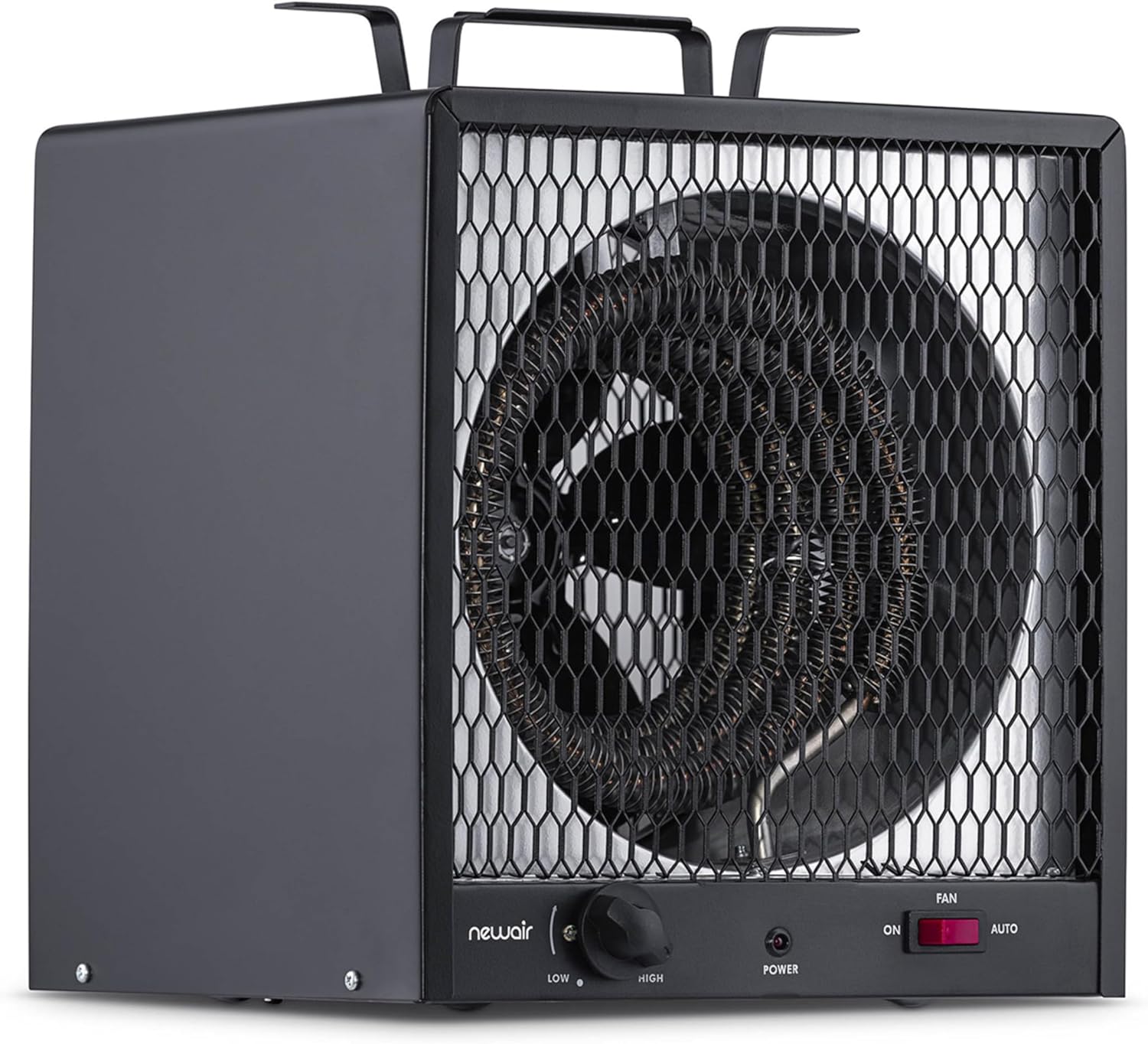
3. NewAir G73 Electric Garage Heater
Verdict: Best Heavy-Duty (Hardwired)
If you own your home and want a permanent solution, the NewAir G73 is a beast. It mounts to the wall or ceiling and must be hardwired into your breaker box.
- Heat Output: 17,060 BTUs (5,000 Watts).
- Performance: This is a true shop heater. It can take a 500 sq. ft. garage from “shivering” to “T-shirt weather” in under an hour. The louvers are adjustable so you can aim the heat exactly where you are working.
Pros:
- Durable stainless steel construction.
- Doesn’t take up floor space.
- Safe for dusty environments.
Cons:
- Requires an electrician to install if you aren’t comfortable with 240V wiring.
4. Comfort Zone Industrial Ceiling Mount
Verdict: Best Space Saver
Floor space in a garage is premium real estate. The Comfort Zone Industrial heater hangs from the ceiling, keeping your cords and unit out of the way of sawdust and foot traffic.
- Features: It comes with a remote control, which is essential since you’ll likely mount it high up out of reach.
- Heat Output: Variable wattage settings allow you to control the electric draw.
Pros:
- 12-hour timer function.
- Heavy-gauge steel body.
- Remote control included.
Cons:
- Installation is a two-person job due to the weight.

5. Modine Hot Dawg (HD45)
Verdict: Best Natural Gas for Large Shops
This is the professional’s choice. If you have a 3-car garage or a detached workshop, electric heaters won’t cut it. The Modine Hot Dawg runs on natural gas (or propane with a conversion kit).
- Heat Output: 45,000 BTUs.
- Efficiency: Because natural gas is generally cheaper than electricity, this unit pays for itself over a few winters if you work in the garage daily. It is essentially a furnace for your garage.
Pros:
- Massive heat output.
- Low operating cost.
- Extremely quiet.
Cons:
- Expensive upfront cost.
- Requires exhaust venting through the wall or roof.

6. Dyna-Glo Delux Torpedo Heater
Verdict: Best for Drafty Barns & Open Doors
If your garage is poorly insulated or you often work with the garage door open, you need a “Torpedo” heater. The Dyna-Glo Delux runs on Kerosene or Diesel and blasts a jet of hot air.
- Heat Output: 80,000 BTUs (Insane heat).
- Warning: These are loud and they smell like exhaust. They are not for sealed, airtight garages. They are for serious work in drafty areas.
Pros:
- Instant, intense heat.
- Rugged construction.
Cons:
- Loud.
- Odor.

7. MrCool DIY 12,000 BTU Mini-Split
Verdict: Best Long-Term Investment — Heat + Cool + Dehumidify
The MrCool DIY is the only mini-split on the consumer market that does not require a licensed HVAC technician for installation. Standard mini-splits require an HVAC contractor to pull a vacuum on the refrigerant lines and charge the system — a process that adds $800–$1,200 to the installation cost and requires scheduling a professional. The MrCool DIY ships with pre-charged “Quick Connect” refrigerant lines that connect without a vacuum pump or refrigerant gauges. A mechanically capable homeowner installs it in 4–6 hours using standard tools.
The Data
- Heating capacity: 12,000 BTU — sized for a standard 2-car garage
- Cooling capacity: 12,000 BTU (1 ton of cooling)
- Efficiency (COP): Up to 3.0 in heating mode at 30°F outdoor
- Minimum operating temperature: -13°F outdoor — genuine cold-climate performance
- Power: 240V, 15–20A dedicated circuit — requires electrician only for circuit installation
- Dehumidification: Built-in dry mode — removes moisture during humid shoulder seasons
- Noise level: 30 dB indoor unit — quieter than a library
- SEER rating: 20+ — Energy Star certified
The “Dry Mode” benefit for tool storage: The MrCool’s dry mode operates the system as a dehumidifier without the temperature drop of full cooling mode. Running dry mode during the spring and fall shoulder seasons — when garage humidity spikes above 60% RH but temperature does not require cooling — actively prevents the moisture accumulation that causes rust formation on tool surfaces. This is the feature the Dr. Heater DR966 cannot replicate under any operating mode.
The installation reality: The MrCool DIY requires passing refrigerant lines through an exterior wall — a 3-inch diameter hole — and mounting the outdoor compressor unit on a pad or wall bracket. The electrical connection to a dedicated 240V circuit is the only portion that requires a licensed electrician if you are not qualified to work with your electrical panel. Budget $150–$300 for the electrician to run the dedicated circuit. The line-set installation, indoor unit mounting, and system startup are DIY-appropriate.
🛒 Check Price on Amazon — MrCool DIY 12,000 BTU Mini-Split →
⚡ Requires 240V dedicated circuit. A 15-amp 240V circuit is required — separate from the heater in the Dr. Heater section, which also requires 240V. If you are adding both to the same garage, budget for two separate 240V circuits from your panel. A single 240V circuit shared between a mini-split and a wall heater creates overload risk when both operate simultaneously during a cold start.
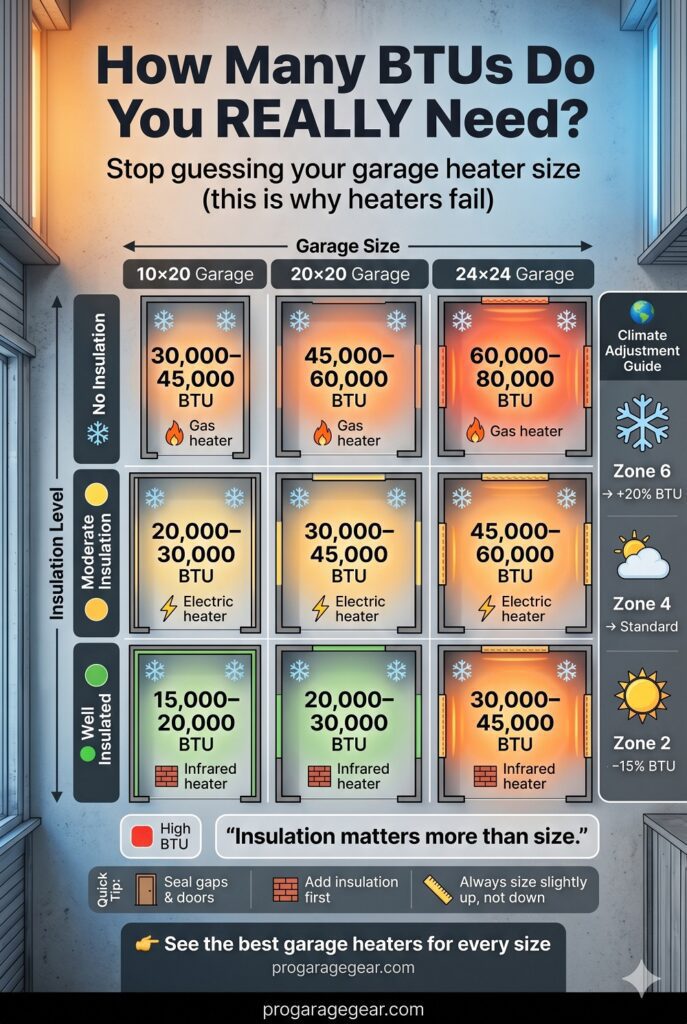
Technical Deep Dive: How Many BTUs Do I Actually Need?
Don’t guess—calculate. If you buy a heater that is too small, it will run constantly and never warm the room.
The Rule of Thumb:
- 1-Car Garage (Insulated): 10,000 – 15,000 BTUs
- 2-Car Garage (Insulated): 20,000 – 30,000 BTUs
- 2-Car Garage (Uninsulated): 30,000 – 45,000 BTUs
- 3-Car Shop: 45,000+ BTUs
Note: If you have high ceilings (over 8ft) or live in an extremely cold climate (like Minnesota or Canada), bump up to the next power level.
The 5-Year Cost of Each Heater Type: What Nobody Tells You at the Point of Purchase
The sticker price of a garage heater is the smallest part of its 5-year cost. A $150 propane heater run through 4 winter months costs more to operate annually than the purchase price of a quality electric heater. The operating cost calculations below use $0.15/kWh electricity and $3.50/gallon propane at 6 hours of use per day across a 4-month heating season (720 hours total).
| Heater | Purchase + Install | Annual Operating Cost | 5-Year Total | Year 5 Running Cost |
|---|---|---|---|---|
| Mr. Heater Big Buddy (propane, high) | $150 + $0 | $1,785 (propane) | $9,075 | High and rising with propane prices |
| Dyna-Glo Torpedo (kerosene) | $150 + $0 | $1,080 (kerosene) | $5,550 | High — fuel dependency |
| Dr. Infrared DR-988 (electric) | $100 + $400 electrician | $648 | $3,740 | $648/yr — stable |
| NewAir G73 (electric, 240V) | $250 + $400 electrician | $810 | $4,700 | $810/yr — stable |
| Modine Hot Dawg (natural gas) | $800 + $800 install | $216 | $2,680 | $216/yr — lowest ongoing |
| MrCool DIY Mini-Split (heat pump) | $1,500 + $200 electrician | $216 | $2,780 | $216/yr + summer cooling value |
The propane cost reality check: The Mr. Heater Big Buddy at 18,000 BTU high setting consumes approximately 1 lb of propane per hour. At 6 hours per day for 120 days: 720 lbs of propane. At $3.50/gallon and approximately 4.2 lbs per gallon: 171 gallons × $3.50 = $600 per season in propane alone — plus the $150 purchase price. Over 5 years that is $3,150 in fuel on a $150 heater. The MrCool at $1,700 all-in costs $1,080 in electricity over the same period — $1,380 savings after accounting for the higher purchase price, before summer cooling benefit.
Critical Safety Guide: What Every Garage Heater Installation Requires
The safety requirements for garage heating are not optional additions to an installation — they are the foundation that makes the installation safe to use. A garage with a heater but no CO detector, or a propane heater with no ventilation plan, is a more dangerous space than an unheated garage.
Rule 1 — Combustion Heaters Require CO Detection — Always
Carbon monoxide is produced by every combustion heater: propane, natural gas, kerosene, and torpedo heaters all produce CO as a combustion byproduct. In a sealed modern garage — well-weatherstripped, insulated, with no significant air infiltration — CO can accumulate to dangerous concentrations within 20–30 minutes of starting a combustion heater with all openings sealed.
The CPSC reports that approximately 170 people die annually from CO poisoning involving portable generators and heaters in enclosed spaces. Garage deaths from CO are among the most preventable of all household fatalities because the sole required intervention — a CO detector — costs $20–$35.
Correct CO detector specification for garages: A digital-display CO detector that shows PPM (parts per million) concentration rather than simply alarming at a fixed threshold. The OSHA permissible exposure limit is 50 PPM over 8 hours and 200 PPM as a ceiling value. A digital-display detector allows you to monitor concentration trends — important for calibrating ventilation when using combustion heat in cold conditions where you may not want to open the door fully.
🛒 Check Price on Amazon — CO Detector with Digital PPM Display →
🛒 Check Price on Amazon — First Alert CO600 CO Detector →
Rule 2 — Clearance Requirements Are Not Suggestions
Every heater has mandatory clearance requirements from combustible materials — sawdust, paint thinner, gasoline cans, wood, and fabric. These requirements are not comfort zones — they are the distances at which the radiant heat output from the heater no longer reaches ignition temperature for the combustible material.
| Heater Type | Clearance to Combustibles | Clearance to Ceiling (ceiling mount) | Clearance Side/Rear (wall mount) |
|---|---|---|---|
| Propane portable (Mr. Heater Big Buddy) | 3 ft front, 1 ft sides and rear | N/A — floor standing | N/A |
| Electric wall mount (NewAir G73) | 3 ft front of airflow path | Verify unit spec — typically 18 in. | Verify unit spec — typically 6 in. |
| Torpedo heater (Dyna-Glo) | 6 ft front — the flame path is long | N/A — floor standing | N/A |
| Natural gas ceiling unit (Modine Hot Dawg) | Per unit spec — typically 8–18 in. to ceiling joists | 8–18 in. to ceiling depending on model | Per unit mounting specification |
| Mini-split indoor unit (MrCool) | 6 in. sides, 6 in. top | 6 in. to ceiling above unit | 6 in. sides minimum |
Rule 3 — Electrical Circuits Must Be Dedicated
Any heater drawing more than 1,500 watts continuously — which includes every 240V heater in this guide — must be on a dedicated circuit with no other loads. “Dedicated” means the breaker in the panel serves only that heater and no other outlets or fixtures. A table saw, an air compressor, and a 240V heater drawing simultaneously from the same circuit creates overload conditions that trip the breaker at best and overheat the wiring at worst.
For 240V electric heaters (NewAir G73, Dr. Infrared DR-988, Dr. Heater DR966): a dedicated 30-amp 240V circuit with 10-gauge wire is the correct specification. For the MrCool DIY mini-split: a dedicated 20-amp 240V circuit with 12-gauge wire.
➡️ For circuit planning and breaker sizing: Garage Electrical Load Guide 2026: Dedicated Circuit Requirements →
Rule 4 — The “Vent-Free” Propane Claim Is Misleading
Some portable propane heaters are marketed as “vent-free” or “safe for indoor use.” These include the Mr. Heater Big Buddy and similar ODS-equipped units. The “vent-free” label means the heater does not require a flue pipe — not that it produces no combustion byproducts.
All propane combustion produces CO and water vapour. The ODS (Oxygen Depletion Sensor) shuts the heater off if oxygen drops below a safe threshold — but CO can reach dangerous concentrations before oxygen drops to the ODS trigger level. The Mr. Heater Big Buddy is appropriate for indoor use with the ventilation it is designed for (a crack of window or door, adequate room volume) — not in an airtight sealed garage with no ventilation whatsoever. Always crack a door or window 2–4 inches when using any combustion heater indoors.
Before upgrading your heater, install a door insulation kit — a $100 investment that typically raises ambient temperature by 10–15°F and cuts heater run time in half. Our complete Matador garage door insulation guide covers which model to order for your specific door size.
Frequently Asked Questions (FAQ)
Is it safe to leave a garage heater on overnight?
Generally, no. Electric hardwired heaters with thermostats are the safest, but we recommend turning the temperature down to 45°F-50°F just to keep pipes from freezing, rather than keeping it fully heated. Never leave a propane or kerosene heater unattended.
What is the cheapest way to heat a garage?
In terms of fuel cost, Natural Gas is usually the cheapest, followed by Electric (in areas with low rates), and then Propane. However, Electric heaters have the lowest upfront cost.
Can I use a patio heater in my garage?
No. Patio heaters are designed for open air. Using them in an enclosed garage creates a severe Carbon Monoxide risk.
Why does propane heat rust my tools faster than electric heat?
Combustion chemistry. Burning propane (C₃H₈) produces carbon dioxide and water vapour as unavoidable combustion byproducts — approximately 1.6 lbs of water per gallon of propane burned. This water vapour increases the relative humidity of the garage air. As the heater runs and the garage warms up, cold steel tool surfaces — which are colder than the air temperature — reach the dew point and collect moisture as condensation. The moisture on bare steel (iron) reacts with oxygen in the air to form iron oxide — rust. An electric heater produces no combustion byproducts, does not add moisture to the air, and actually reduces relative humidity slightly as it warms the air (warmer air holds more moisture, reducing the humidity percentage). Tools in an electrically heated garage rust at the same rate they would in a climate-controlled indoor space. Tools in a propane-heated garage rust at accelerated rates proportional to the heater’s BTU output and hours of use.
What is the minimum BTU for a 2-car garage in a cold climate?
The BTU formula accounts for three variables: garage volume, desired temperature rise, and the insulation factor of the space. For a standard 20×20×9 foot garage (3,600 cubic feet): multiply the volume by the desired temperature rise in degrees Fahrenheit, then divide by a constant that accounts for the heat loss coefficient of the space. A simplified rule: multiply the floor area (400 square feet) by 20 BTU per square foot for an insulated garage or 40 BTU per square foot for an uninsulated garage. Insulated 2-car garage: 8,000 BTU minimum. Uninsulated 2-car garage: 16,000 BTU minimum — with the caveat that heating an uninsulated garage to comfortable working temperature is expensive regardless of the heater type, and insulating the door and walls first reduces the required BTU significantly before any heater purchase.
Final Verdict
If you want the best all-around heater that requires zero installation and offers high heat, get the MrCool for serious shops, positions the electric heaters for mechanics and woodworkers, demotes propane to emergency-only use, and ends with the door insulation recommendation before any heater purchase
Don’t buy a heater until you have insulated your door. Read our guide on the Best Garage Door Insulation Kits first.”
Stay warm and happy DIY-ing!