
Small Garage Organization Ideas 2026: 15 Strategies That Transform a One-Car Garage Into a Real Workspace
Affiliate Disclosure: Pro Garage Gear earns from qualifying Amazon purchases at no extra cost to you.
The “Car Doesn’t Fit” Problem: You have a garage. You just can’t park in it. The floor is covered with bikes, holiday bins, sports equipment, garden tools, and boxes you haven’t opened since the Obama administration. The workbench — if you have one — is buried under things that have no other home. Sound familiar? You’re not alone. According to a 2023 survey by the National Association of Home Builders, 25% of Americans with garages can’t fit a car inside because of clutter.
Here’s the truth nobody in the garage organization industry wants you to know: a small garage doesn’t have an organization problem, it has a system problem. Everything you own has a home somewhere — just not in your garage. The strategies below create designated homes for everything and reclaim your floor for what it’s actually for.
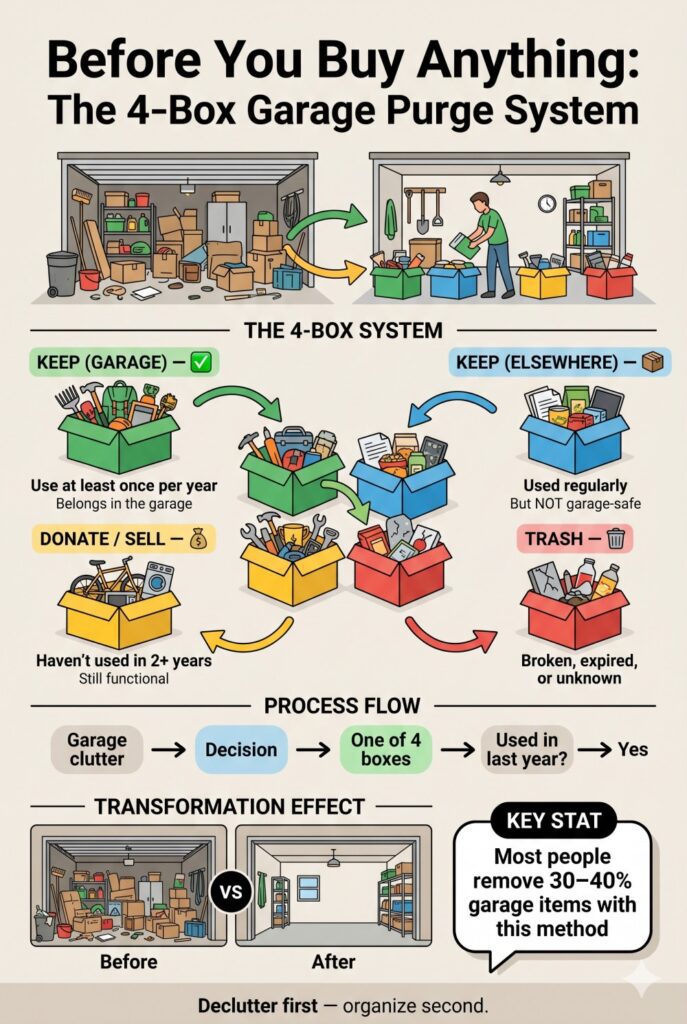
The Small Garage Organization Ideas – Before You Buy Anything: The 4-Box Purge
No organization system works without first reducing the number of items competing for space. Before spending a dollar on shelving or bins, do the 4-Box Purge:
- Box 1 — Keep (Garage): Things you use at least once per year and make sense to store in the garage
- Box 2 — Keep (Elsewhere): Things you use regularly but shouldn’t be in a garage (documents, food, electronics)
- Box 3 — Donate/Sell: Functional items you haven’t used in 2+ years
- Box 4 — Trash: Broken, expired, or unidentifiable items
Most people remove 30–40% of their garage contents in this step — before buying a single shelf. This is the most valuable hour you’ll spend on organization.
Strategy 1: Go Vertical — Your Walls Are Your Biggest Unused Asset
A standard 10×20 one-car garage has 200 sq. ft. of floor. But it has 80+ sq. ft. of vertical wall surface (not counting the garage door wall). Used correctly, that vertical surface holds far more than any floor footprint.
The Vertical Priority Stack:
- Eye level to 7 ft.: Frequently accessed items — tools, sports gear, frequently used bins
- 7–9 ft.: Less-frequent items — seasonal gear, camping equipment
- 9 ft. to ceiling (overhead): Rarely accessed items — holiday decorations, long-term storage
➡️ Shop Wall-Mount Shelving Systems on Amazon
Strategy 2: Install a Slatwall Panel System
A slatwall panel system on your primary work wall is the single highest-return organization investment per square foot. One 4×8 slatwall panel ($60–$90) holds hooks, bins, shelves, and tool holders that replace 20+ sq. ft. of floor-based storage.
The key advantage over pegboard: slatwall hooks are repositionable and don’t require alignment with specific hole patterns. You can reconfigure your entire layout in minutes as your tool collection evolves.
➡️ Shop Slatwall Panels on Amazon ➡️ Shop Slatwall Hooks and Accessories on Amazon
Slatwall vs. Pegboard: slatwall panel system
Strategy 3: Ceiling Storage for Seasonal Items
In a one-car garage, the ceiling is your secret weapon. A 4×8 ft. overhead rack holds 600 lbs. of storage and uses zero floor or wall space.
What goes overhead: Holiday bins, camping gear, off-season sports equipment, luggage, roof cargo boxes. Not overhead: Heavy items you access frequently, anything liquid.
Best Overhead Garage storage Racks: Ceiling storage
➡️ Shop Overhead Storage Racks on Amazon
Strategy 4: Wall-Mount Bike Storage
Bikes on the floor in a one-car garage consume an estimated 8–12 sq. ft. of floor per bike — and create an obstacle to every other item in the garage. Moving bikes to wall hooks recovers that floor space immediately.
The Steadyrack pivoting wall mount is the best option for tight spaces — the bike hangs on a pivot that swings sideways, allowing multiple bikes to be stored close together without handlebars conflicting.
➡️ Shop Wall Mount Bike Racks on Amazon
Best Garage Bike Storage 2026: wall-mount bikes
Strategy 5: Magnetic Tool Strips for Hand Tools
A magnetic tool strip on the wall above your workbench eliminates the drawer-hunting problem for frequently used hand tools. Every screwdriver, wrench, and plier has a visible, accessible home. A 24-inch strip holds 20+ tools and costs $15–$30.
➡️ Shop Magnetic Tool Strips on Amazon
Strategy 6: A Rolling Tool Cabinet as a Movable Wall
In a small garage, a rolling tool cabinet serves double duty: tool storage AND a movable wall that defines your workspace. Park it against the wall when you need the space; roll it to the center when you need a mobile tool station.
The YITAHOME rolling cabinet and Husky 41-inch rolling cabinet are the top picks under $300.
➡️ Shop Rolling Tool Cabinets on Amazon
Strategy 6b: The Wall-Mounted Folding Workbench — Your Space’s Best Trick
In a one-car garage where the floor is shared between parking, storage, and workspace, a standard workbench that occupies 6+ sq. ft. of floor permanently is often a non-starter. The solution that serious small-garage users have adopted: a wall-mounted folding workbench that provides a full-depth work surface when needed and folds flat against the wall — taking up 4 inches of depth when closed.
Option A: Pre-Built Folding Workbench (~$150–$250)
Wall-mounted folding benches (BenchMaster, Prepac, Seville Classics) mount to studs, fold down to reveal a work surface of 24–36 inches deep, and fold back up in one motion. Most include integrated storage (shelves, pegboard, tool holders) on the wall-facing surface that remains accessible even when the bench is closed.
Best pick: Black+Decker Workmate Folding Workbench — freestanding folding design with a vice built in, handles 350 lbs., folds to 4 inches thick for vertical wall storage.
➡️ Check Price — Black+Decker Workmate Folding Bench on Amazon
➡️ Shop Wall-Mount Folding Workbench on Amazon
Option B: DIY Folding Shelf with Heavy-Duty Brackets (~$60–$90)
The most cost-effective approach: heavy-duty folding shelf brackets mounted to studs, with a sheet of 3/4-inch plywood as the surface. The brackets fold down for use and up against the wall when parked.
Bracket requirements: Look for folding shelf brackets rated for 250 lbs. minimum (not the 50-lb. decorative brackets sold at most hardware stores). The difference is bracket arm thickness (3/8-inch vs. 1/8-inch steel) and the mounting plate size.
➡️ Shop Heavy Duty Folding Shelf Brackets (250-lb. rated) on Amazon
The Space Math on a Folding Bench
| Configuration | Floor Space When In Use | Floor Space When Folded |
|---|---|---|
| Standard fixed workbench (24″ deep) | 12 sq. ft. | 12 sq. ft. (permanent) |
| Wall-mount folding bench (24″ deep) | 12 sq. ft. | ~2 sq. ft. (wall bracket footprint) |
| Space recovered when folded | — | 10 sq. ft. |
Ten square feet recovered equals enough room to fully open a car door, move a bicycle, or lay out materials for a project. In a 200 sq. ft. garage, recovering 10 sq. ft. is recovering 5% of your total space — significant.
The 60-Second Workspace: A wall-mounted folding bench goes from “flat storage” to “full workspace” in under 60 seconds. Park the car out of the garage, fold down the bench, bring in materials — you now have a dedicated workshop where your car was.
Best Adjustable Garage Workbenches: Folding garage workbench
Strategy 7: Clear Stackable Bins with Labels
Opaque bins create mystery storage — you don’t know what’s in them without opening them. Clear stackable bins with standardized labels eliminate this problem. Every bin visible at a glance.
The labeling system that works: Use a label maker (not hand-written tape) and apply labels on the side of the bin facing the aisle, not the top. You’ll see the label without moving the bin.
➡️ Shop Clear Stackable Storage Bins on Amazon ➡️ Shop Label Maker for Garage on Amazon
Strategy 8: Garden Tool Wall Organizer
Rakes, shovels, brooms, and hoses leaning against walls are the #1 floor clutter item in one-car garages. A dedicated garden tool wall organizer mounts 10–15 long-handle tools in under 1 sq. ft. of wall space.
➡️ Shop Garden Tool Wall Organizers on Amazon
Strategy 9: Freestanding Shelving Units for the Back Wall
The back wall of a one-car garage is typically the entire width of the car’s length (20 ft. is the standard — 10 ft. for the car, 10 ft. for working in front). Heavy-duty steel shelving on the back wall holds the most items per linear foot at the lowest cost.
The spec that matters: Shelf capacity rating per shelf, not total unit rating. A “4,500 lb. capacity” shelf unit that distributes that across 5 shelves gives you 900 lbs. per shelf — which sounds great but is limited by the shelf’s actual load-bearing capacity, not the frame’s.
Look for individual shelf ratings of 500+ lbs. for serious garage storage.
➡️ Shop Heavy Duty Garage Shelving on Amazon
Strategy 10: A Dedicated Sports Equipment Zone
Sports equipment (balls, helmets, pads, bats, rackets) is shapeless and hard to store efficiently. A dedicated “sports zone” in one corner — typically a large open bin for balls, hooks for helmets and bags, and a bat/stick rack — keeps this category from spreading across the entire garage.
➡️ Shop Sports Equipment Storage Organizer on Amazon
The One-Car Garage Transformation Shopping List
| Item | Purpose | Approx. Cost | Amazon |
|---|---|---|---|
| Slatwall Panel (2 pack, 4×8 ft.) | Primary tool wall | $120–$180 | Shop → |
| Slatwall Hook/Accessory Kit | Hang tools, bikes, hoses | $40–$80 | Shop → |
| Overhead Ceiling Rack (4×8 ft.) | Seasonal/long-term storage | $80–$150 | Shop → |
| Wall-Mount Bike Hook (2-pack) | Get bikes off the floor | $30–$60 | Shop → |
| Steel Shelving Unit (5-tier) | Back wall storage | $80–$150 | Shop → |
| Clear Storage Bins (12-pack) | Labeled visible storage | $40–$70 | Shop → |
| Magnetic Tool Strip (24 in.) | Hand tools above bench | $15–$30 | Shop → |
| Garden Tool Organizer | Long-handle tools off floor | $20–$40 | Shop → |
| Label Maker | System labeling | $20–$35 | Shop → |
| Total | Complete 1-car transformation | ~$445–$765 |
How do I organize a garage with no wall space?
Use freestanding units (shelving, rolling cabinets) and ceiling overhead racks. A 4×8 overhead rack and a freestanding 5-shelf unit can transform storage without a single wall anchor.
What should I store in my garage vs. inside the house?
Garage-appropriate: lawn/garden tools, automotive supplies, sports equipment, seasonal items, power tools. Not garage-appropriate: food (temperature swings cause spoilage and attract pests), important documents (humidity damage), clothing (mold risk), electronics (temperature extremes damage components).
How do I keep my organized garage from getting cluttered again?
The “one in, one out” rule: for every item that enters the garage, one must leave. And every item must have a designated home — no “temporary” staging areas, which always become permanent piles.
The Bottom Line
A one-car garage transformed with slatwall, overhead storage, bike hooks, and labeled bins goes from parking-lot disaster to organized workshop in a single weekend and under $800. The car fits. The tools are accessible. And most importantly — you know where everything is.
Start with the slatwall and overhead rack. Those two items alone will recover 40–50% of your usable space. Build from there.