Best Pressure Washer for Cars 2026: The GPM Rule, the Two-Bucket Method, and the Coatings Warning Nobody Puts on the Box
By Pro Garage Gear Team Last Updated: August 2026
Disclosure: This post contains affiliate links. As an Amazon Associate, we earn from qualifying purchases. We recommend products that clean your car, not strip your paint.
One wrong move with a gas pressure washer can slice your tire sidewall or strip the clear coat right off your hood.
Most homeowners think “More Power = Better.” But when it comes to detailing cars, power is the enemy. You don’t need a 4,000 PSI industrial beast to wash a Honda Civic; you need flow, control, and the right attachments.
The secret to that thick, shaving-cream-style foam you see on Instagram isn’t high pressure—it is High Water Flow (GPM).
In this guide, we break down the best pressure washers for cars in 2026. We have selected machines that are safe for your paint, compatible with foam cannons, and built to last.
Quick Summary: The Detailer’s Cheat Sheet
Don’t have time to read the full technical breakdown? Here are our top picks for every budget.
| Category | Product Name | Specs | Best For |
| Best Overall | Active 2.0 Electric | 1800 PSI / 2.0 GPM | The “Perfect” Spec |
| Best Value | Sun Joe SPX3000 | 2030 PSI / 1.76 GPM | Beginners on a Budget |
| Best Premium | Karcher K5 Premium | 2000 PSI / 1.4 GPM | Longevity (Water Cooled) |
| Best Upgradeable | Karcher K1700 Cube | 1700 PSI / 1.2 GPM | Open M22 Fittings |
| Best Compact | Ryobi 1800 PSI | 1800 PSI / 1.2 GPM | Shelf Storage |
| Best Cordless | Worx Hydroshot | 320 PSI / 0.5 GPM | Apartment Living |
Buying Guide: The “PSI vs. GPM” Myth
Before you buy, you need to unlearn what the marketing box tells you.
1. PSI (Pounds per Square Inch) = Stripping Power
This is how “hard” the water hits. For concrete driveways, you want 3,000+ PSI. For car paint, anything over 2,000 PSI is dangerous. It can drive dirt into the clear coat rather than washing it off.
2. GPM (Gallons Per Minute) = Rinsing Power
This is how much water comes out. GPM is King for cars. Higher GPM flushes away dirt faster and creates thicker foam in a foam cannon.
- The Sweet Spot: You want a machine with 1,000 – 1,800 PSI and as close to 2.0 GPM as possible.
The Two-Bucket Method: The Technique That Matters More Than Which Washer You Buy
Every swirl mark on a car’s paint was put there by the wash process, not by dirt on the road. Specifically, by a wash mitt that picked up a grit particle from the paint surface, was rinsed in the same bucket of soapy water it started in, and then dragged that grit particle across the next panel. This is the single most common and most preventable cause of paint damage in home car care.
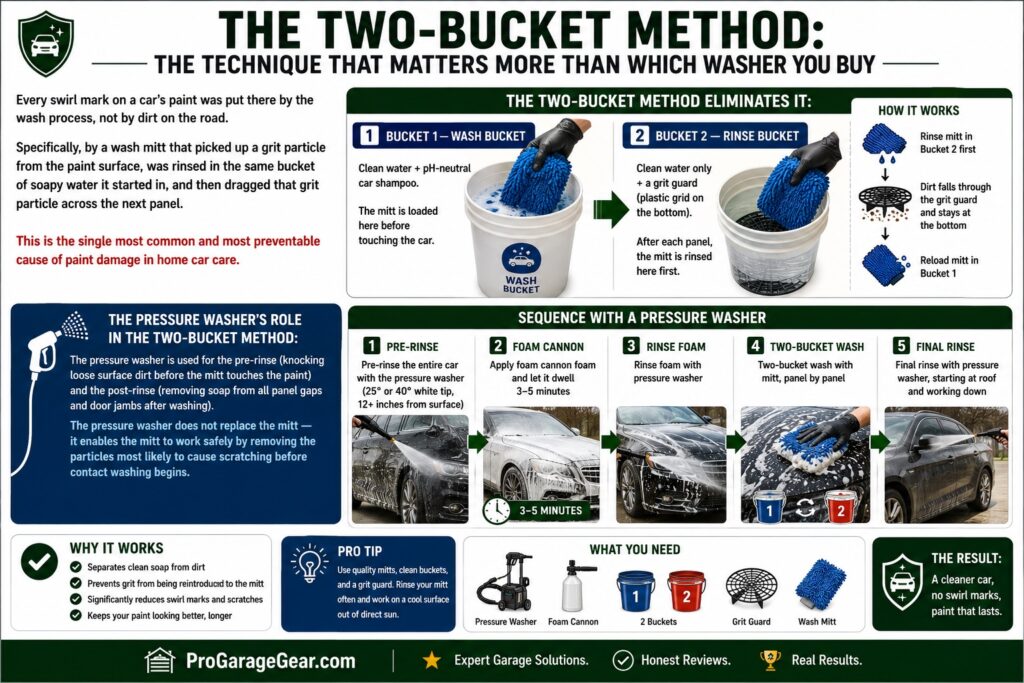
The two-bucket method eliminates it:
- Bucket 1 — Wash bucket: Clean water + pH-neutral car shampoo. The mitt is loaded here before touching the car.
- Bucket 2 — Rinse bucket: Clean water only + a grit guard (a plastic grid that sits on the bucket floor). After each panel, the mitt is rinsed in Bucket 2 first — dirt falls through the grit guard and stays at the bottom. Then the mitt is reloaded in Bucket 1.
The pressure washer’s role in the two-bucket method: The pressure washer is used for the pre-rinse (knocking loose surface dirt before the mitt touches the paint) and the post-rinse (removing soap from all panel gaps and door jambs after washing). The pressure washer does not replace the mitt — it enables the mitt to work safely by removing the particles most likely to cause scratching before contact washing begins.
Sequence with a pressure washer:
- Pre-rinse the entire car with the pressure washer (25° or 40° white tip, 12+ inches from surface)
- Apply foam cannon foam and let it dwell 3–5 minutes
- Rinse foam with pressure washer
- Two-bucket wash with mitt, panel by panel
- Final rinse with pressure washer, starting at roof and working down
🛒 Check Price on Amazon — Two-Bucket Wash Kit with Grit Guards →
“For the complete exterior detail sequence including clay bar and polish →” Complete Car Detailing Guide
The Coatings Warning: What High Pressure Does to Ceramic and PPF
If your vehicle has a ceramic coating or paint protection film (PPF), the pressure washing rules are different from unprotected paint — and more restrictive at specific locations on the car.
Ceramic coating and pressure washing: Ceramic coatings bond to the clear coat and are highly resistant to pressure washing across the main painted surfaces. The vulnerability is at panel edges and gaps — door jams, trunk lid edges, hood edges, and anywhere the coating terminates. At these termination points, sustained high-pressure water angled under the edge can lift the coating from the substrate. The rule: use the 40° white tip only, keep the nozzle parallel to panel edges rather than angling into them, and reduce pressure at all panel gaps and seams.
PPF (clear bra) and pressure washing: PPF is more vulnerable than ceramic at edges. Professional PPF installers typically recommend a maximum of 1,200 PSI at panel edges where the film terminates. Most of the machines in this guide at their lowest pressure setting are at or below this threshold — but the critical point is where you aim the nozzle. Never aim the nozzle at the edge of a PPF wrap at close range. Wash panel edges with a hand mitt rather than pressure washing them.
pH-neutral shampoo requirement for coated vehicles: Any shampoo with high or low pH degrades ceramic coatings significantly faster than pH-neutral products. The soap bottles that ship with pressure washers are not formulated for coated vehicles. Use a pH-neutral, coating-safe car shampoo specifically. This is not a premium option — it is the correct specification for coated paint.
🛒 Check Price on Amazon — pH-Neutral Car Shampoo (Ceramic Coating Safe) →
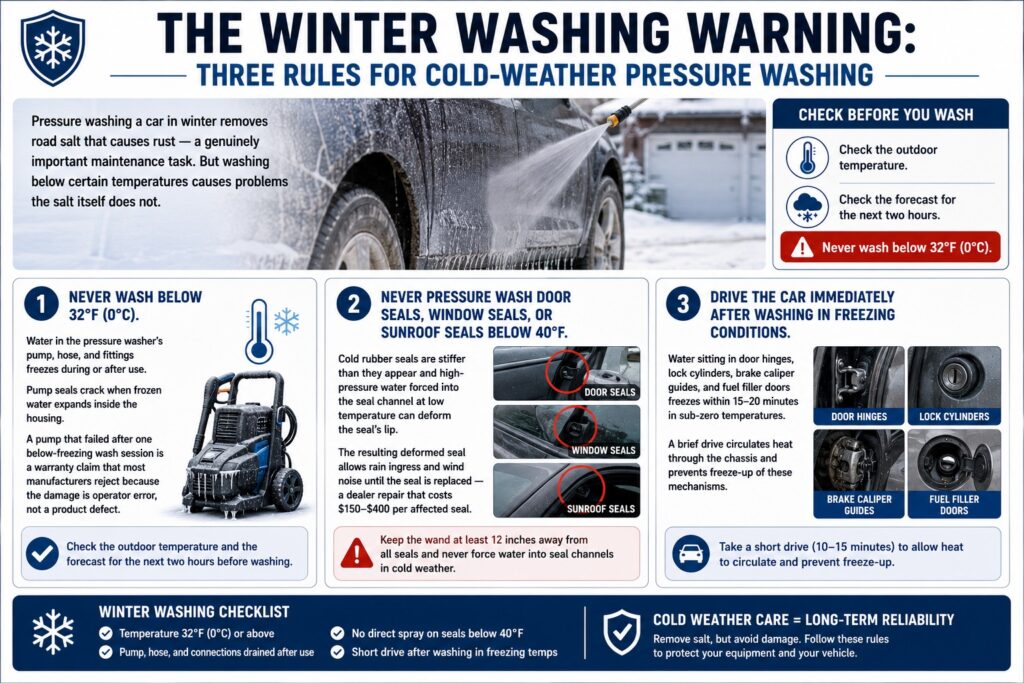
The Winter Washing Warning: Three Rules for Cold-Weather Pressure Washing
Pressure washing a car in winter removes road salt that causes rust — a genuinely important maintenance task. But washing below certain temperatures causes problems the salt itself does not.
Rule 1 — Never wash below 32°F (0°C). Water in the pressure washer’s pump, hose, and fittings freezes during or after use. Pump seals crack when frozen water expands inside the housing. A pump that failed after one below-freezing wash session is a warranty claim that most manufacturers reject because the damage is operator error, not a product defect. Check the outdoor temperature and the forecast for the next two hours before washing.
Rule 2 — Never pressure wash door seals, window seals, or sunroof seals in temperatures below 40°F. Cold rubber seals are stiffer than they appear and high-pressure water forced into the seal channel at low temperature can deform the seal’s lip. The resulting deformed seal allows rain ingress and wind noise until the seal is replaced — a dealer repair that costs $150–$400 per affected seal.
Rule 3 — Drive the car immediately after washing in freezing conditions. Water sitting in door hinges, lock cylinders, brake caliper guides, and fuel filler doors freezes within 15–20 minutes in sub-zero temperatures. A brief drive circulates heat through the chassis and prevents freeze-up of these mechanisms.
For moisture management after cold-weather washing → Best Garage Dehumidifiers
The M22 Fitting Problem: Check Before You Buy an Aftermarket Foam Cannon
The foam cannon recommendation in this guide assumes your pressure washer uses the M22 standard fitting — the most common threaded connection in the consumer pressure washer market. Most brands (Ryobi, Karcher K-series, Simpson) use M22-14mm fittings. Some electric brands including Sun Joe and Active use M22-15mm fittings. These look identical but have a 1mm inner diameter difference that causes the O-ring to seat incorrectly, producing a leak at the connection point every time.
Before ordering an aftermarket foam cannon: check your pressure washer’s documentation for its fitting specification. The fastest universal solution is to replace the pressure washer’s gun connection with a 3/8-inch quick-connect set — these eliminate the M22 threading question entirely and allow any QD-compatible accessory to snap on in one second without thread matching
.🛒 Check Price on Amazon — 3/8″ Quick Connect Kit (Universal Fitting Solution) →
The 6 Best Pressure Washer for Cars (In-Depth Reviews)
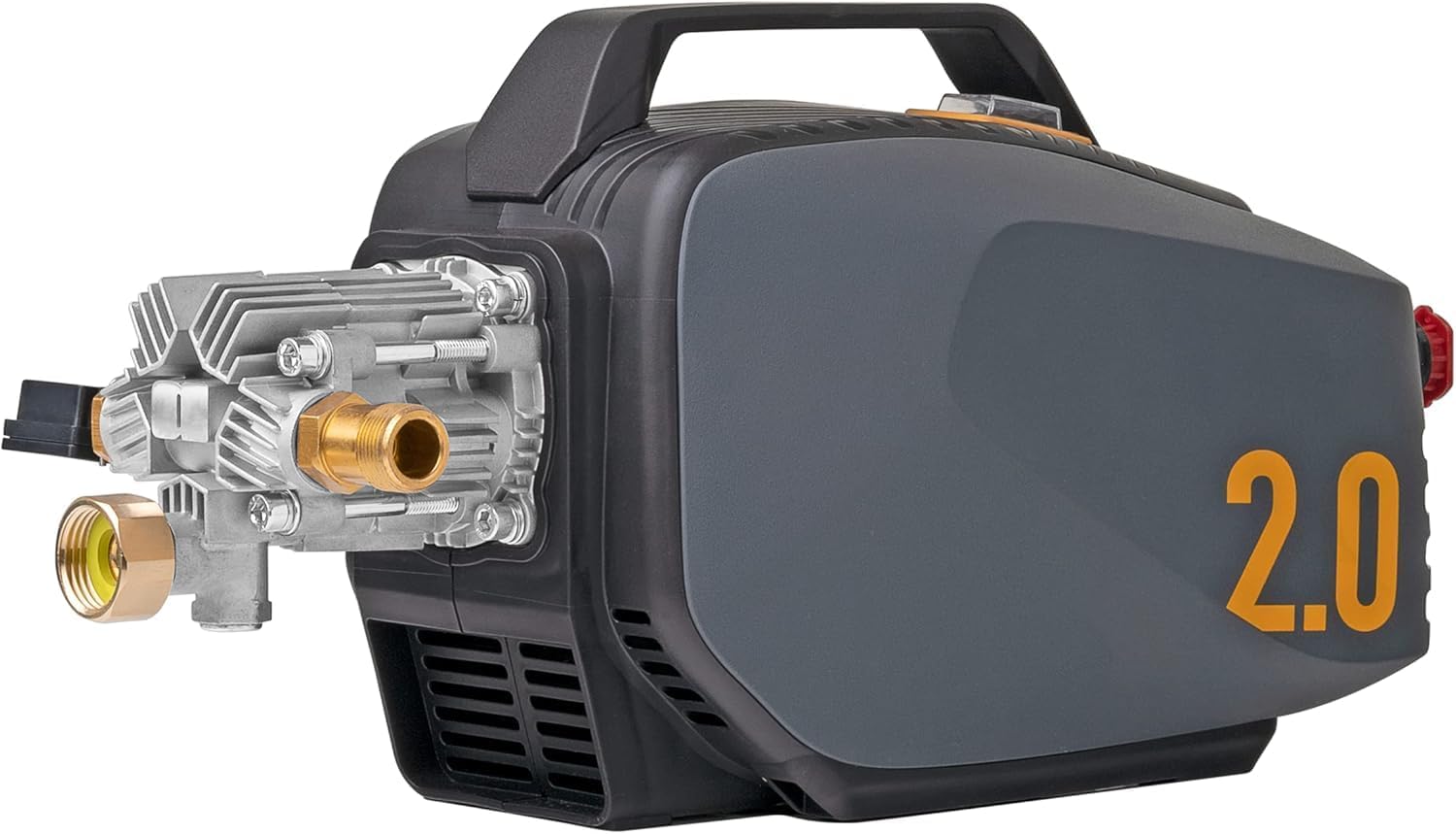
1. Active 2.0 Electric Pressure Washer
Verdict: The Detailer’s Favorite (Best Overall)
The Active 2.0 was built with one goal: Car Detailing. While other brands try to max out PSI to sell units, Active doubled the water flow to 2.0 GPM.
- The Foam Factor: Because of that high flow rate, this machine produces the thickest foam of any electric washer on this list when paired with a foam cannon.
- The Pump: It uses a patented 5-piston pump (most use 3), which allows it to work harder without overheating.
- Size: It is surprisingly small and sits low to the ground so it won’t tip over.
- PSI: 1,800 (rated) — safe for all vehicle paint
- GPM: 2.0 — best in the electric consumer category
- Pump: 5-piston (most have 3) — runs cooler, lasts longer
- Connections: Metal fittings throughout — no plastic at pressure connections
- Fitting: M22-15mm — use quick-connect kit for aftermarket accessories
- Hose length: 20 feet (included)
- Weight: 11.5 lbs
Pros:
- Best-in-class 2.0 GPM flow.
- Metal connections (not cheap plastic).
- Extremely compact.
Cons:
- The included hose is okay, but pros usually upgrade to a longer “Uberflex” hose later.
2. Sun Joe SPX3000
Verdict: The Budget King
This is the Toyota Camry of pressure washers. The Sun Joe SPX3000 is cheap, reliable, and parts are available everywhere.
- Performance: It claims 2030 PSI, but in real-world use, it settles around a safe 1,400 PSI with a 15-degree nozzle, which is actually perfect for cars.
- Features: It comes with two onboard soap tanks, though we still recommend using a separate foam cannon for better suds.
- The “Tip” Issue: It is tall and narrow, so it can tip over if you yank the hose too hard. Be gentle!
- PSI: 2,030 (rated) / ~1,400 in real use with 15° nozzle
- GPM: 1.76
- Total Stop System: Yes — shuts pump off when trigger released
- Fitting: M22-14mm standard
- Onboard soap tanks: Two (dual detergent tanks)
- Weight: 31 lbs — heaviest of the group
Pros:
- Incredible value for money.
- Total Stop System (TSS) shuts off pump when trigger isn’t pulled.
- Comes with 5 nozzle tips included.
Cons:
- Tips over easily.
- Hose connector is plastic (be careful not to cross-thread it).

3. Karcher K5 Premium
Verdict: Best Long-Lasting (Water Cooled)
Most electric pressure washers have a lifespan of about 50-100 hours because the motors get hot and burn out. The Karcher K5 is different.
- The Secret: It features a Water-Cooled Induction Motor. It circulates the cold water around the motor to keep it cool while running. This machine can last 5x longer than air-cooled competitors.
- Usability: It has a built-in hose reel (a huge headache saver) and feels very sturdy.
- PSI: 2,000
- GPM: 1.4 — lower than Active 2.0 but still adequate for foam cannon
- Motor type: Water-cooled induction — rated for 500 hours vs 50-100 for air-cooled
- Fitting: Proprietary Karcher bayonet — requires adapter for M22 accessories
- Hose reel: Built-in — no separate storage required
- Weight: 34 lbs
Pros:
- Commercial-grade motor life.
- Integrated hose reel.
- Very quiet operation compared to the Sun Joe.
Cons:
- Expensive.
- Uses proprietary Karcher fittings (you may need an adapter for aftermarket foam cannons).

4. The “Mod-Ready” Budget Pick — Karcher K1700 Cube
If the Active 2.0 is out of stock or above budget, the K1700 Cube is the correct fallback — not because it matches the Active 2.0’s flow rate, but because of a spec most buyers never check: fitting type.
Most budget electric pressure washers — Ryobi, Sun Joe in some model years — use proprietary quick-connect fittings that make it difficult or impossible to upgrade to an aftermarket gun, hose, or foam cannon later. The K1700 Cube uses standard M22 threading throughout, meaning every upgrade covered elsewhere in this guide — the Stubby Gun swap, foam cannon fitment — works on it without an adapter hunt.
The Data
- GPM: 1.2 — solid but well below the Active 2.0’s 2.0 GPM
- Fittings: Standard M22 — open to aftermarket guns, hoses, and cannons
- Controls: Foot switch — on/off without bending down
- Profile: Low centre of gravity, compact “cube” footprint — resists tipping
The honest trade-off: Lower flow than the Active 2.0 means slower rinsing and less foam-cannon output. Buy this specifically for the fitting flexibility and footprint, not to match the Active 2.0’s performance.
🛒 Check Price on Amazon — Karcher K1700 Cube (Open M22 Fittings) →
5. Ryobi 1800 PSI Electric
Verdict: The “Home Depot” Compact Pick
If you have limited shelf space in your garage, the Ryobi 1800 is the size of a lunchbox.
- Portability: It weighs just 16 lbs. You can easily carry it around the car with one hand while spraying with the other.
- Power: It delivers 1.2 GPM. It won’t give you “Active 2.0” levels of foam, but it is plenty strong enough to rinse off mud and brake dust.
Pros:
- Tiny and lightweight.
- 3-Year warranty (Ryobi support is excellent).
- Great price.
Cons:
- Low GPM means thinner foam.
- No hose reel (you have to coil it manually).

6. Worx Hydroshot (Cordless)
Verdict: Best for Apartments / No Hose Access
Live in an apartment complex with no hose spigot? The Worx Hydroshot is your savior. It runs on a 20V battery and pulls water from any source.
- How it works: You can drop the intake hose into a 5-gallon bucket of water, a lake, or even a 2-liter soda bottle.
- Power: It only produces 320-450 PSI. This is essentially a “Super Garden Hose.” It won’t blast away caked-on off-road mud, but it is perfect for a weekly maintenance wash in a parking lot.
Pros:
- No hose or power cord required.
- Uses the same battery as other Worx tools.
Cons:
- Weak pressure compared to plug-in units.
- Battery lasts about 15-20 minutes (enough for one car).

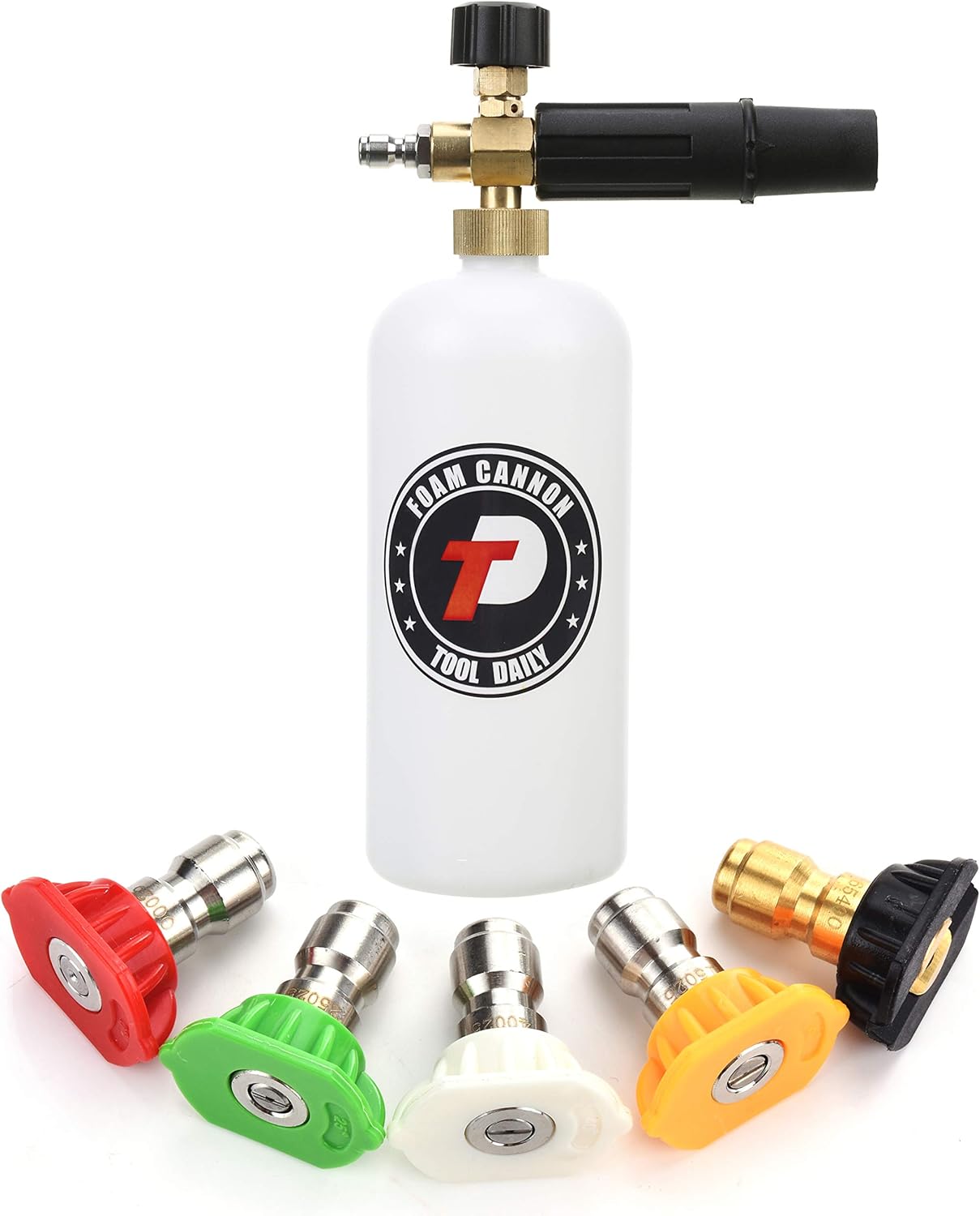
The Secret Weapon: The Foam Cannon
If you buy a pressure washer and use the little “soap bottle” that comes in the box, you will be disappointed. You will get watery, runny soap.
To get the thick, sticky foam that clings to the car and lifts dirt, you need an Aftermarket Foam Cannon.
- It replaces the wand tip.
- It mixes air, water, and soap under high pressure.
- Recommendation: Look for a cannon with a “wide base” (so it doesn’t tip over) and a brass connector.
Safety Guide: How NOT to Ruin Your Paint
We see this happen all the time: A beginner buys a pressure washer, puts on the wrong nozzle, and slices a line right through their clear coat.
Follow the Rules of the Rinse:
- The White Tip Only: Most washers come with Red (0°), Yellow (15°), Green (25°), and White (40°). ONLY use the White (40°) or Green (25°) tips on paint. Never use Red or Yellow.
- The 12-Inch Rule: Keep the nozzle at least 12 inches away from the surface.
- Watch the Tires: Do not blast your tires up close. High pressure can inject air into the rubber sidewall, causing a bubble that could blow out while driving.
The Stubby Gun Upgrade: The Accessory That Fixes the Most Annoying Part of Washing a Car
The long plastic wand that ships with every pressure washer is built for driveways and siding, not cars. It’s long, awkward at close range, and the stiff hose behind it fights you through every pass around the vehicle — dragging, kinking, and occasionally swinging the wand tip toward the paint when you least expect it.
The fix: a stubby gun with a live swivel. A stubby gun replaces the long wand with a short, compact handle that sits right in your grip for precise control at close range. The “live swivel” fitting at the base lets the hose rotate freely as you move around the car instead of twisting and kinking with every direction change — the single upgrade most detailers make immediately after buying any pressure washer.
| Option | Price Tier | Best For |
|---|---|---|
| McKillans Short Pressure Washer Gun | Budget | Anyone trying the stubby-gun upgrade for the first time |
| MTM Hydro SGS28 | Premium | Detailers who wash weekly and want the swivel and trigger feel to last years, not seasons |
Confirm your pressure washer’s fitting type before ordering either gun — see the M22 Fitting Problem section above. Both guns are available in M22 configurations; the Karcher K1700 Cube profiled above is specifically well-suited to this upgrade because of its open M22 threading.
🛒 Check Price on Amazon — McKillans Short Pressure Washer Gun (Budget) →
🛒 Check Price on Amazon — MTM Hydro SGS28 Stubby Gun (Premium) →
Frequently Asked Questions (FAQ)
Can I use a gas pressure washer on my car?
Yes, but be extremely careful. Gas washers often exceed 3,000 PSI. You must use a 40-degree white tip and stand further back. We generally recommend electric for cars because they are safer and quieter.
Can I run hot water through my pressure washer?
No. Unless the manual specifically says “Hot Water Rated,” do not connect it to your hot water tap. Hot water will melt the seals in the pump and destroy the machine.
Is it okay to wash the engine bay?
Yes, but cover sensitive electronics (alternator, fuse box, air intake) with plastic bags first. Use low pressure and keep the wand moving—don’t blast one spot continuously.
Does a pressure washer remove wax or sealant?
Yes, progressively. A single wash session with correct technique removes a negligible amount. Repeated washing at 1,800+ PSI over weeks gradually reduces the wax or sealant layer, particularly at panel edges where water impact concentration is highest. pH-neutral shampoo and a 40° white nozzle at 12 inches preserve the wax layer far longer than incorrect technique. A car washed weekly with correct technique and pH-neutral soap needs rewaxing approximately every 3–4 months. The same car washed with incorrect technique or alkaline detergent needs rewaxing monthly.
What is the correct distance between the nozzle and the car surface?
Twelve inches is the standard recommendation for a 40° wide-angle tip at 1,800 PSI. This distance changes with nozzle angle and PSI. A 25° green tip at the same 1,800 PSI concentrates approximately 2.5× more pressure per square inch than a 40° tip at the same distance — meaning a 25° tip needs to be held at 18–24 inches to produce the same surface impact as a 40° tip at 12 inches. The 12-inch rule applies to the 40° white tip only. For any narrower nozzle angle: increase distance proportionally, and test on an inconspicuous area first.
Final Verdict
- If you want the safest, foamiest wash, buy the Active 2.0. It is the machine designed by detailers, for detailers.
- If you want a reliable machine for under $150, buy the Sun Joe SPX3000.
- If you have no hose access, the Worx Hydroshot is the only way to go.
Grab your foam cannon, turn on the water, and enjoy the most satisfying wash of your life.
After you finish the exterior wash, use your Best Shop Vac to detail the interior.