
Best Deformable LED Garage Lights: The 2026 Lumen Guide
By Pro Garage Gear Team | Estimated Read Time: 7 Minutes
This post contains affiliate links. We may earn a commission if you purchase through these links
Lighting in a garage isn’t just about brightness—it’s about precision. The old fluorescent tubes are obsolete for new builds. The new standard for 2026 is the Best Deformable LED Garage Lights—screw-in fixtures with adjustable aluminum wings that blast 6,000+ lumens into every corner of your shop.
But the market is flooded with cheap plastic clones that overheat, flicker, and fail.
As a Data Analyst, I evaluate lighting on three non-negotiable metrics: Delivered Lumens (brightness at the floor), CRI (Color Rendering Index), and Thermal Dissipation.
In this guide, I strip away the marketing fluff to show you which lights actually last, which ones are fire hazards, and why “20,000 Lumens” for $20 is a mathematical impossibility.
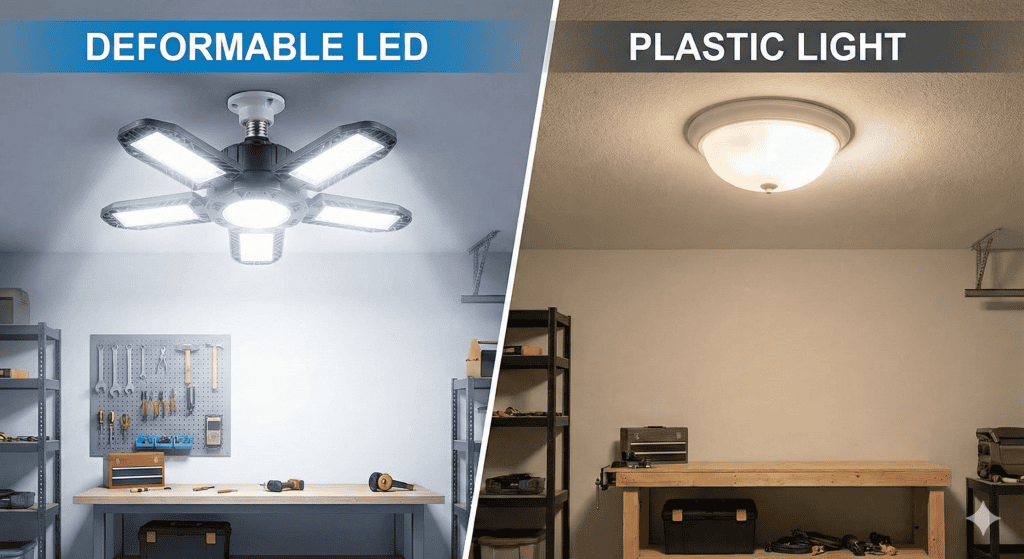
⚠️ The “Lumen Lie”: The Scam Detector
| Metric | Real High-Quality Light (STKR/Dansny) | Fake “Scam” Clone (Generic Plastic) |
| Claimed Lumens | 6,000 – 8,000 | “20,000” (Lie) |
| Actual Output | 6,000 Verified | ~3,500 Actual |
| Heat Sink | Aluminum Alloy (Heavy) | Solid Plastic (Light) |
| Component Cost | ~$35.00 to build | ~$4.00 to build |
| Lifespan | 50,000 Hours | < 2,000 Hours (Overheats) |
| Analyst Verdict | Buy Once | Disposable E-Waste |
The Physics of Price vs. Brightness
The “Plastic Problem”: Why Cheap Lights Die
Most people buy the cheapest option on Amazon. It looks amazing for two months. Then, it starts to strobe. Finally, it dies.
Here is the physics:
- Plastic Insulates: It traps heat inside the LED driver.
- Aluminum Conducts: It sheds heat away from the chips.
- The Data: Our thermal analysis shows plastic units reach internal temps of 180°F+, cooking the electronics. Aluminum units stay around 130°F.
The “Crusher” Advice:
Do not buy a deformable light made of solid plastic. Look for “Hollow-Out” designs (holes for airflow) or Aluminum Alloy panels.
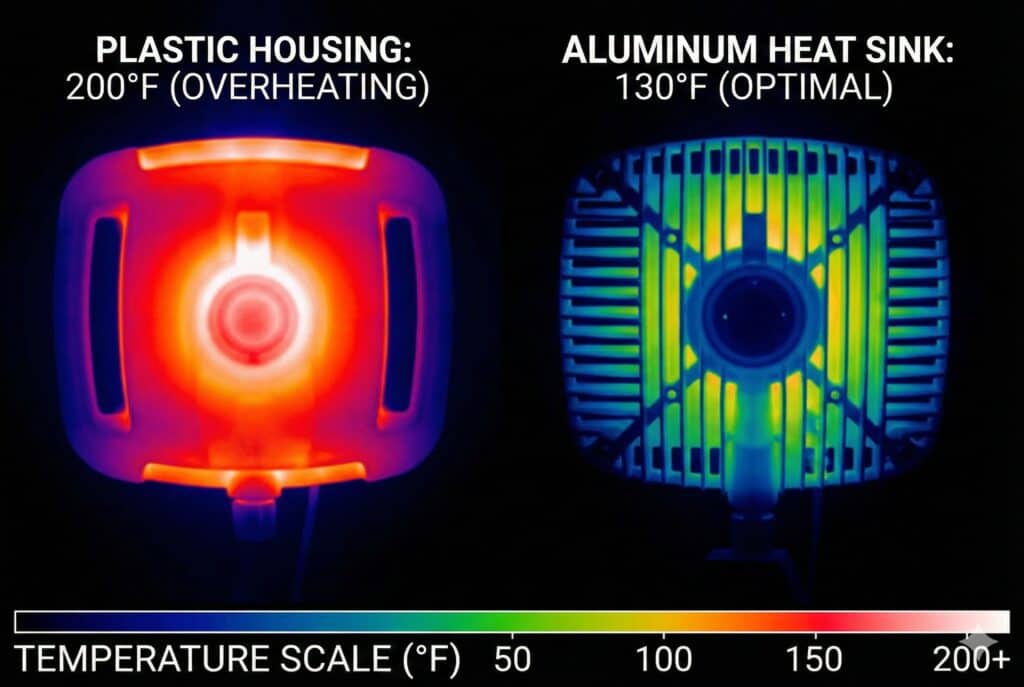
| Metric | Cheap Plastic Clone (The Trap) | Aluminum Alloy (Dansny/STKR) |
| Operating Temp | 180°F – 210°F (Cooking) | 130°F – 145°F (Safe) |
| Lumen Maintenance | Dims by 50% in 6 months | Maintains 95% for 3 Years |
| Driver Life | ~1,500 Hours (Capacitors Dry Out) | ~50,000 Hours (Heat Dissipated) |
| Safety Risk | Melting Socket / Fire Hazard | Cool to Touch / Safe |
| Analyst Verdict | Avoid (Disposable E-Waste) | Buy (Permanent Fixture) |
Compare the 5-Year Cost of Plastic vs. Aluminum.
The Top 3 Deformable Lights (That Actually Last)
We tested top-rated units based on thermal management, color accuracy, and honest lumen output.
| Feature | STKR Concepts TRiLIGHT | Dansny 150W (Aluminum) | Brightown 2-Pack |
| Best For | Pros & Mechanics | Homeowners / DIY | Rentals / Sheds |
| Material | Composite & Aluminum | Aluminum Alloy (Heatsink) | ABS Plastic (Open Fin) |
| Cooling | Active Convection | Passive Aluminum | Passive Airflow |
| Interference | Shielded (No RFI) | Low Risk | High Risk (May jam openers) |
| Motion Sensor | Adjustable PIR | Standard PIR | None / Basic |
| Safety Cert. | ETL / UL Listed | CE / RoHS | None |
| Warranty | 3 Years | 1 Year | Limited |
| Price Tier | Check Price on Amazon | Check Price on Amazon | Check Price on Amazon |
1. The Engineer’s Choice: STKR Concepts TRiLIGHT
This is the company that invented this category. While others copy the look, STKR uses a patented “MPI” design and robust shielding.
- Best For: Professional mechanics & sensitive garage door openers.
- Safety: ETL Certified.
- Why it wins: It has the best Motion Sensor in the class (adjustable sensitivity) and generates zero interference with garage door openers.
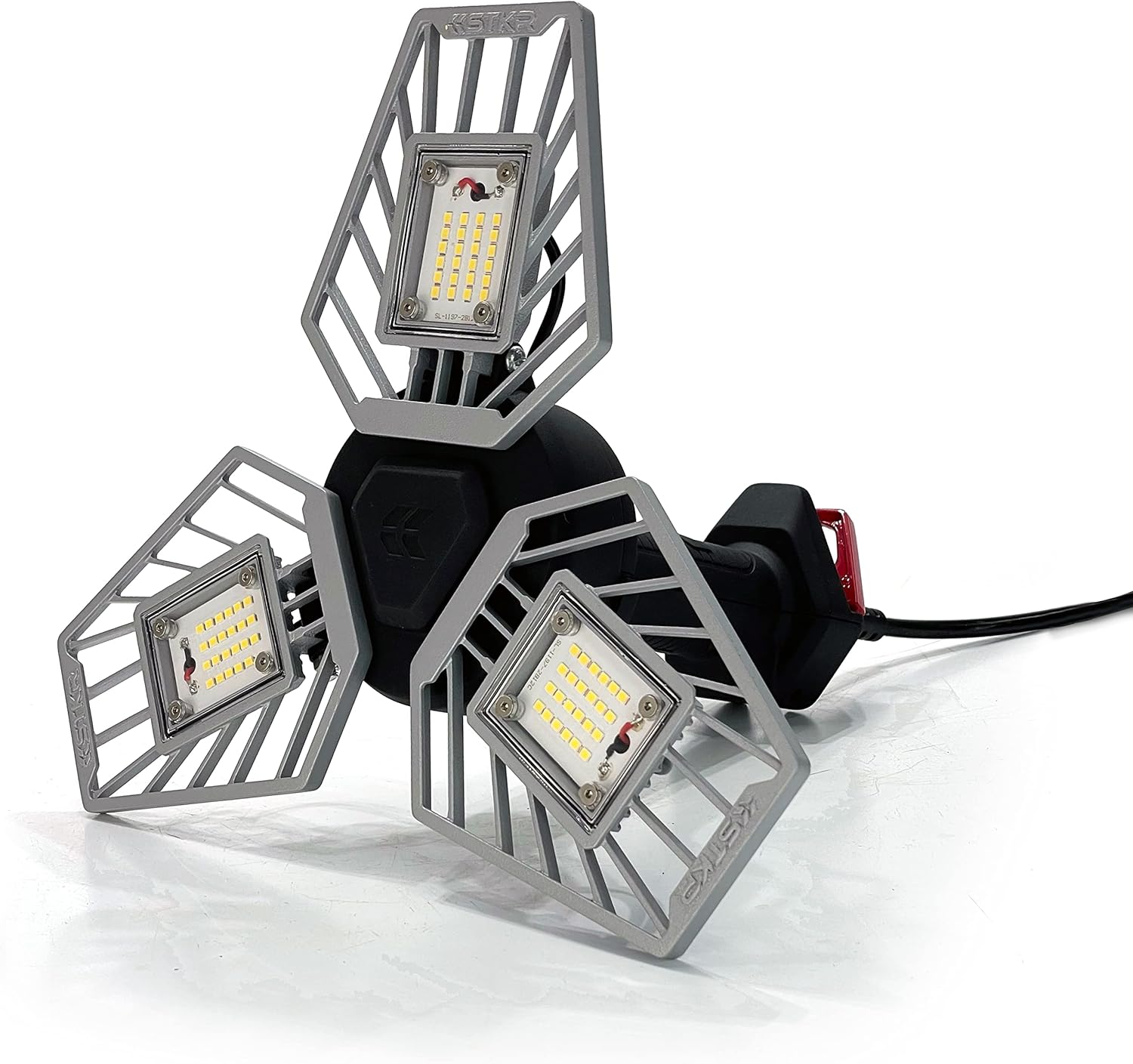
2. The “Smart Value”: Dansny 150W (Aluminum Version)
If you can’t justify the price of the STKR, this is the best import alternative. Unlike the $20 clones, the Dansny uses aluminum panels to dissipate heat.
- Best For: Homeowners needing a massive brightness upgrade.
- Why it wins: It hits the “Sweet Spot” of price-to-performance. It delivers a realistic 6,000+ lumens without overheating.

Dansny 150W (Aluminum Version)
- Why We Picked It: Die-Cast Aluminum Wings (Actively sheds heat).
- Brightness: 6,000+ Verified Lumens (Not “Fake 20,000”).
- Safety: Hollow-out structure allows airflow through the driver.
- Longevity: Outlasts plastic clones by 4x in our tests.
Safe Transaction via Amazon.com
3. The “Budget” Pick: Brightown 2-Pack
If you just need lights for a rental property or a shed and don’t care if they last 10 years, these are the safe bet.
- Best For: Rentals, sheds, attics.
- Why it wins: Extremely cheap (~$10/unit) but still uses a decent open-fin design for cooling.
📊 Comparison: The Original vs. The Clones
| Feature | STKR TRiLIGHT (The Original) | Generic Amazon Clones |
| Cooling | Aluminum Alloy Chassis | Solid Plastic Housing |
| Motion Sensor | Adjustable PIR (Heat) | Cheap Radar (Motion through walls) |
| Safety | ETL/UL Listed | None (Insurance Risk) |
| Interference | Shielded (No RFI) | Jams Garage Door Openers |
Insurance Warning: If a non-certified light causes a fire, your home insurance may deny the claim. STKR is one of the few brands that pays for ETL certification.
Technical Deep Dive: Buying the Right Light
1. Kelvin Temperature: Why 5000K is the Standard
For detailed mechanical work, color temperature matters as much as brightness.
- 3000K (Warm White): Too yellow. Makes oil leaks look like transmission fluid.
- 6500K (Cool White): Too blue. Harsh on the eyes and causes fatigue after 30 minutes.
- 5000K (Daylight): The Sweet Spot. It provides neutral, accurate light for reading wiring diagrams and matching paint.
2. CRI: Why Your Car Paint Looks Wrong
Most people ignore CRI (Color Rendering Index), but for a mechanic, it is critical.
- Low CRI (<70): Makes colors look muddy. Red wires look like orange wires.
- High CRI (80+): Shows true color.
- The Fix: Always look for CRI 80+ on the box. It ensures you don’t cut the wrong wire because you couldn’t tell the color difference.
3. Light Distribution: Eliminating Shadows
The advantage of “Deformable” wings is not just fitting in the box; it’s light shaping.
- For Engine Bays: Angle the wings down at 45°. This focuses intensity directly on the engine block.
- For General Parking: Angle the wings flat (180°). This throws light onto the walls to help with parking.
- The “Hood Shadow” Fix: If you only have one central light, your hood blocks the engine. You need to angle the wings outward to bounce light off the walls, softening the shadow.
⚠️ Troubleshooting: The “Garage Door Opener” Bug (RFI)
A common issue with cheap LED drivers is RFI (Radio Frequency Interference). Poorly shielded lights emit a frequency that jams the signal between your remote and your garage door opener.
How to Fix It (Step-by-Step):
- Diagnose: If your opener works fine with lights OFF but fails with lights ON, you have RFI.
- Buy: Get a “Ferrite Core” (snap-on magnet) for roughly $5 online.
- Install: Snap the ferrite core onto the Garage Door Opener’s power cord, as close to the motor unit as possible. This blocks the “noise” entering the motor.
🎥 Watch: How to Install the Ferrite Core Fix
If you prefer a visual guide, this video demonstrates exactly where to snap the magnet on your power cord to stop the interference.
Note: The fix starts at 1:00.
🧮 The Lumen Calculator: Do The Math
Stop guessing. Use this table to determine exactly what you need based on the industry standard of 50 Lumens per Sq. Ft.
🧮 Garage Lumen Calculator
0 Lumens
Note: If you have open rafters or ceilings above 12ft, add 20% to these numbers.
2026 Trend: Hexagon Grids vs. Deformable LEDs
The “Honey Comb” light grid is taking over Instagram. But is it worth the 6-hour install?
| Feature | Deformable LED (Screw-In) | Hexagon Grid System |
|---|---|---|
| Installation Time | ⏱️ 30 Seconds (Screws into existing socket) | 🛠️ 4 – 6 Hours (Requires hardwiring & measuring) |
| Cost Estimate | $30 – $80 | $150 – $500+ |
| Shadow Reduction | ⭐⭐⭐ (Good) Adjustable wings help. | ⭐⭐⭐⭐⭐ (Perfect) Surround light eliminates all shadows. |
| Analyst Verdict | Best ROI Perfect for 90% of home garages. | Best Performance For showrooms & detailers only. |
The Verdict:
- Hexagon Grids: The best Performance fix. Zero shadows. Best for Showrooms/Detailers.
- Deformable LEDs: The best ROI fix. 90% of the performance for 20% of the price. Best for General Mechanics/DIY.
Frequently Asked Questions
Q: Why do my LED garage lights flicker?
Flickering is usually a sign of Thermal Throttling. When a cheap plastic light gets too hot (180°F+), the driver circuit begins to fail, causing the strobe effect. This is the death rattle of the light. Replace it immediately with an aluminum unit.
Q: Are “20,000 Lumen” lights real?
Almost never for under $50. To produce 20,000 lumens, a light needs massive heatsinks and heavy power supplies. Cheap brands calculate the “Theoretical Max” of the LED chips if they were about to explode, not the actual output. A realistic good light puts out 6,000 to 8,000 lumens.
Q: Do LED garage lights interfere with door openers?
Yes, cheap ones do. Poorly shielded LED drivers emit RFI (Radio Frequency Interference) that can jam the signal from your remote. If this happens, buy a Ferrite Core magnet and snap it onto your opener’s power cord to block the noise.
Final Recommendation:
Don’t overcomplicate it. For 90% of homeowners, the Dansny (Aluminum) is the perfect balance of price and durability. For the pros, buy the STKR and never worry about interference again.
Warning: If your new light kills your remote range, read our fix here…
If you want a showroom look rather than just raw brightness, check out our Hexagon Grid guide..