Best Garage Flooring 2026: Swisstrax Tiles vs. Epoxy (Why Paint Fails)
By Pro Garage Gear Team | Estimated Read Time: 8 Minutes
This post contains affiliate links. We may earn a commission if you purchase through these links
The “Hot Tire” Warning: The #1 reason DIY floor paint fails is “Hot Tire Pickup.” Your tires heat up on the highway, you park in the garage, and the heat melts the bond between the paint and the concrete. Next time you back out, you peel the paint right off the floor.
The floor is the foundation of your garage, but it’s usually the last thing people upgrade. They spend thousands on cabinets and lights, only to park on cracked, stained, dusty concrete.
If you are looking for the Best Garage Flooring options in 2026, you generally have two choices: Coatings (Epoxy/Polyurea) or Tiles (Swisstrax/RaceDeck).
Here is the hard truth: Unless you are paying a professional $3,000+ to grind your floor with industrial diamonds, do not use epoxy. DIY kits from the hardware store will peel.
We recommend “Floating Tiles.” They are the “Lego for Adults” solution that transforms a garage from a dungeon to a showroom in 4 hours.
🏆 The Comparison: Tiles vs. Paint
| Feature | DIY Epoxy Kit (The “Trap”) | Professional Polyurea (The “Pro”) | Swisstrax Tiles (The “Winner”) |
| Cost | $ (Cheap) | $$$ (Expensive) | $$ (Moderate) |
| Installation | 3 Days (Acid Etching/Drying) | 2 Days (Pro Crew) | 4 Hours (Snap-In) |
| Durability | Low (Peels in 2 years) | High (15+ Years) | Lifetime (60k lbs rating) |
| Prep Needed | High (Degreasing/Etching) | Extreme (Grinding) | Zero (Sweep & Lay) |
| Wet Safety | Slippery (Dangerous) | Good (If flakes added) | Excellent (Non-Slip) |
| Link | Don’t Buy This | Local Contractor | Check Price on Amazon |
Swisstrax Ribtrax Pro
- Why We Picked It: 60,000 lb rollover rating & 15-year warranty.
- Best Feature: “Flow-Through” design eliminates winter puddles.
- Install Time: 4 Hours (DIY Snap-In).
🚧 Living with Tiles: The “Mechanic’s” Reality
1. The Creeper Issue: If you work on cars often, know this: Standard mechanic’s creepers with tiny 2-inch wheels rattle your teeth when rolling over ribbed tiles.
- The Fix: Upgrade to a “Big Wheel” Creeper (like the Bone Creeper) or lay down a piece of cardboard/plywood when you need to slide under the car.
2. The “Sun Buckle” Rule: Plastic expands when it gets hot. If you install your tiles tight against the wall in winter, they will expand in summer and “tent” (buckle up) in the middle of the garage.
- The Rule: Always leave a 0.5-inch gap between the tiles and the wall. The edges of the floor will hide this gap, but it gives the “floating” floor room to breathe during heatwaves.
1. Why Swisstrax Ribtrax Pro Wins
If you watch any high-end car YouTube channel, you see Swisstrax. It’s the “Showroom Standard.”
- The “Floating” Advantage: Unlike paint, Swisstrax doesn’t stick to the concrete. It “floats” on top. This means if your concrete has cracks or moisture issues, the tile hides them completely.
- The “Ribbed” Design: The tiles have an open-profile rib design. Dirt, snow, and water fall through the tile to the concrete below. You are always walking on a clean, dry surface.
- The Strength: These tiles are rated for 60,000 lbs of rolling weight. You can park a fire truck on them.
The “Fire Truck” Reality Check
⚠️ Physics Reality Check: The Slab Limit Swisstrax tiles are rated for 60,000 lbs of rollover weight. You could park a fire truck on them, and the tile wouldn’t break.
- The Catch: Your garage concrete slab is likely only rated for ~4,000 PSI.
- The Reality: The tile is stronger than your foundation. Swisstrax will protect the surface from crushing, but if you park a tank in your garage, the concrete underneath will crack long before the plastic tile fails.

2. Swisstrax vs. RaceDeck (The Budget Rival)
RaceDeck is the other big name. They are cheaper, but there is a reason.
- Thickness: Swisstrax is 0.75 inches thick. RaceDeck is usually 0.5 inches thick.
- The “Channeling” Difference: Because Swisstrax is taller, it sits higher off the ground. This allows water and debris to flow underneath it much easier. RaceDeck sits lower, which can trap debris and cause “slush dams” in winter.
- Verdict: If you are on a budget, RaceDeck is fine. If you want the “thud” of quality when you walk, buy Swisstrax.

3. The “Clack” Factor (And How to Fix It)
The only complaint people have with plastic tiles is the noise. When you walk on them, they can make a hollow “clacking” sound against the concrete.
The “Landscape Fabric” Hack:
Before you lay your tiles, roll out cheap Black Landscape Fabric (weed barrier) over your concrete.
- Why: It acts as a sound damper. It stops the plastic from hitting the concrete directly, making the floor sound solid and quiet.
- Cost: ~$30 for the whole garage. Do not skip this step.
| Setup | Sound Profile | Feel |
| Tile on Bare Concrete | “Clack-Clack” (High Pitch) | Hollow, cheap, plastic-y. |
| Tile on Landscape Fabric | “Thud-Thud” (Low Pitch) | Solid, premium, dampened. |
| Analyst Verdict | Annoying | Mandatory Upgrade ($30) |
4. Physics of Dirt “Ribbed” Tiles
A common fear: “If dirt falls through the ribs, isn’t my garage dirty underneath?”
Yes. But “Out of Sight, Out of Mind” is actually a benefit here. Your floor looks clean 99% of the time because the dust is hidden.
The Cleaning Ritual:
🧹 The “Dirt Basement” Reality Check Let’s be honest about where the dirt goes. It doesn’t disappear; it sits on the concrete under your tiles.
- Dry Debris: Leaves and dust will accumulate. You need a high-horsepower Shop Vac. Run it directly over the tiles; the suction is strong enough to pull dust through the ribs.
- The “Milk Spill” Rule: If you spill something organic (milk, protein shake, sugary soda), it will smell if you don’t treat it. You cannot just hose it down. You must use a flathead screwdriver to pop that single tile out, clean the concrete, and snap it back.
- The “Annual Flush”: Once a year, you need to use your pressure washer to push the sludge out. Warning: If your garage doesn’t slope toward the door, the water will pool in the middle. You will need a floor squeegee to push the water over the tiles to the exit.
5. The “Epoxy” Alternative (When to use it)
We only recommend epoxy/polyurea coatings if:
- You hire a Pro: If you pay a company to come in with a diamond grinder and shot-blaster to prep the floor.
- You need a smooth surface: If you roll creepers around all day or do heavy welding (welding slag can melt plastic tiles), a smooth coated floor is better.
🕵️ How to Vet an Epoxy Installer (Don’t Get Scammed) If you decide to paint, do not hire the guy who quotes $800. Hire the guy who can answer these three questions:
- “Do you use a diamond grinder?” (If they say “we just acid wash,” fire them immediately. The floor must be mechanically ground.)
- “Is the topcoat Polyaspartic or Epoxy?” (You want Polyaspartic. It doesn’t yellow in the sun and is 4x stronger.)
- “What is your moisture reading?” (If they don’t test your concrete for moisture content before painting, the floor will peel in 12 months.)
The Epoxy “Mop” Advantage
🧹 The One Thing Epoxy Does Better We trash DIY epoxy kits often, but a Professional Polyurea floor has one distinct advantage over tiles: Cleanability.
- The Difference: You can squeegee a smooth floor in 2 minutes. If you spill oil on Swisstrax, it drips through to the concrete, requiring you to pop the tile to clean the mess underneath.
- Verdict: If you run a messy shop with constant fluid spills, a smooth coating is logistically easier to maintain than “flow-through” tiles.
Pre-Purchase Logistics
📐 The “10% Waste” Rule for Ordering Don’t just measure your square footage and hit buy. You need to account for cuts around the edges and pillars.
- The Math: Calculate your Total Sq/Ft (Length x Width). Then multiply by 1.10 (10% extra).
- Why: Swisstrax tiles are 15.75″ x 15.75″. If you have a 10-foot wide wall, you will be cutting tiles to fit. If you don’t order the extra 10%, you will end up one tile short and have to pay shipping for a single piece.
🧪 Chemical Warning: The “Purple” Stain While Swisstrax tiles are chemically resistant to motor oil and brake fluid, there is one detailer-specific enemy: Iron Remover.
- The Risk: Products like IronX turn bright purple when they react with brake dust. If you let this dry on Pearl Silver or White tiles, it can leave a permanent purple haze.
- The Rule: If you use Iron Remover, rinse your floor immediately. Do not let it dwell on light-colored tiles.
🔧 The “10mm Socket Test”: Ribbed vs. Smooth
We dropped a standard 10mm socket from workbench height (36 inches) to test how each floor reacts.
1. The Epoxy Reaction (The “Ping”):
- Result: The socket hits the hard concrete, makes a loud “PING,” and bounces.
- The Risk: It often rolls under a cabinet or fridge.
- The Benefit: It is immediately visible. You don’t have to disassemble the floor to find it.
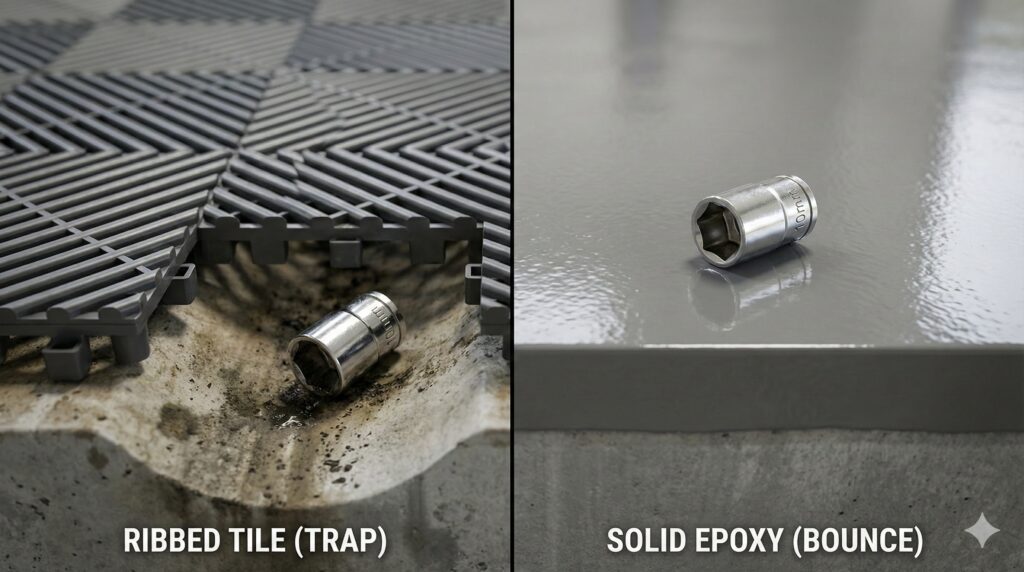
2. The Swisstrax Reaction (The “Trap”):
- Result: The socket hits the plastic rib, usually doesn’t bounce, and falls inside the tile.
- The Risk: It is gone. You cannot reach it with your fingers.
- The Fix: You must use a “Pick Tool” or pop the tile out.
- Pro Tip: If you do heavy engine work, install Swisstrax Diamondtrax (Solid Tiles) directly in front of your workbench. They interlock perfectly with the Ribbed tiles but stop parts from falling through.
| Metric | Ribbed Tiles (Swisstrax) | Solid Epoxy (Professional) | Solid Vinyl (G-Floor/Mats) |
| The “10mm Socket” Test | Trap & Hide (Falls through ribs) | Bounce & Roll (Easy to find) | Sit & Stay (Best visibility) |
| Knee Comfort | 8/10 (Plastic flexes) | 1/10 (Concrete hard) | 4/10 (Thin rubber) |
| Liquid Spills | Flow Through (Hidden) | Pools on Top (Slip Hazard) | Pools on Top (Cleanup required) |
| Winter Slush | Drains Away (Floor stays dry) | Puddles (Must squeegee) | Puddles (Must squeegee) |
| Analyst Verdict | Best for Detailing/General | Best for Engine Building | Best for Workbench Only |
| Link | Check Price on Amazon | Check Price on Amazon | Check Price on Amazon |
Frequently Asked Questions
Q: Is epoxy flooring slippery when wet?
Yes, standard epoxy is extremely slippery when wet, acting like an ice rink. To make it safe, you must add “anti-slip aggregate” (sand) into the topcoat during installation. In contrast, Swisstrax Ribtrax tiles have a non-slip profile and allow water to drain through, making them significantly safer in wet conditions.
Q: Can you jack up a car on plastic garage tiles?
Yes, but you need to be careful. Swisstrax Ribtrax tiles are rated for 60,000 lbs of rolling weight, so they easily support a car. However, the steel wheels of a floor jack concentrate thousands of pounds onto a tiny point. We recommend placing a small piece of plywood or a metal plate under your jack stands to prevent cosmetic damage to the plastic ribs.
Q: Do small parts get lost in ribbed tiles?
This is the main drawback for mechanics. Yes, small items like 10mm sockets or washers can fall through the open profile of Ribtrax tiles. For mechanic workstations, we recommend installing “Diamondtrax” (Solid Tiles) in the specific area where you do your bench work to prevent parts from getting lost.
Q: Can I install Swisstrax over cracked concrete?
Absolutely. This is the biggest advantage of a “floating floor.” Unlike epoxy, which requires a perfectly smooth surface, Swisstrax bridges over cracks, moisture pits, and ugly stains. It instantly hides a damaged floor without any expensive concrete repair work.
🏁 Analyst Verdict: Which Floor Fits Your Life?
Do not buy based on looks alone. Buy based on your Saturday routine.
- Buy Swisstrax Ribtrax If:
- You live in a Snow State (The self-draining ribs prevent puddles).
- You want a “Showroom” look in 4 hours (DIY Install).
- Your concrete is ugly/cracked (It hides everything).
- Buy Professional Epoxy If:
- You are a Full-Time Mechanic (You drop tiny parts daily).
- You need to wipe up oil spills instantly.
- You have a $3,000+ Budget and 3 days to wait.
To clean the dirt from under the tiles, simply blast it out with your ultimate wall-mounted wash station
Install your flooring before setting up your heavy Seville workbench.