
Why Your Garage Door Opener Remote Stopped Working (The “LED Secret”)
By Pro Garage Gear Team | Estimated Read Time: 6 Minutes
Disclosure: This post contains affiliate links. We may earn a commission if you purchase the shielded bulbs we recommend.
It’s a ghost story we hear all the time.
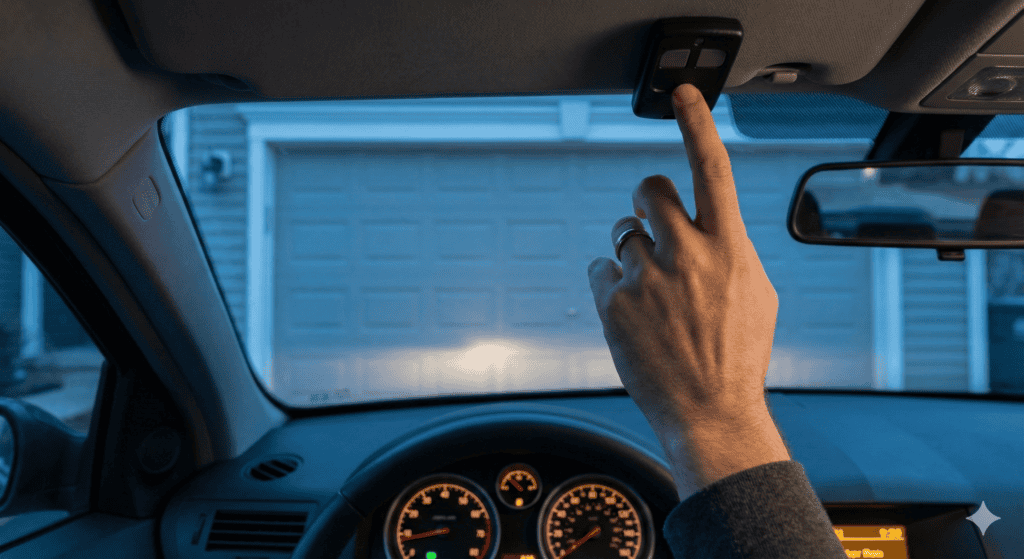
You drive home. You click the remote on your visor. Nothing happens. You pull closer to the driveway. You click again. Still nothing. Finally, you pull right up to the door, practically touching it with your bumper, click it for the tenth time, and finally, the door opens.
You assume your opener is dying. You change the batteries in the remote. You reprogram the keypad. You might even go to Home Depot to buy a new $300 Chamberlain unit.
Stop.
Before you spend a dime, look up. Did you recently install a new LED light bulb in your garage door opener?
If the answer is yes, you don’t have a broken opener. You have an Interference Problem.
Here is why your modern light bulbs are killing your radio signal, and the $15 fix that solves it instantly.
The Science: The “300MHz War”
To understand the problem, you have to understand how your garage door works.
Your remote control talks to the opener unit on a specific radio frequency. For most openers (LiftMaster, Chamberlain, Craftsman, Genie) manufactured after 1998, this frequency is usually 315 MHz or 390 MHz.
Enter the cheap LED Bulb. Inside every LED bulb is a tiny circuit board called a “Driver.” This driver converts your home’s AC power (120V) into DC power for the LED chip.
In high-quality bulbs, this driver is “shielded” (wrapped in metal) to prevent electromagnetic noise from leaking out. In cheap, generic LEDs, the driver is unshielded. When it turns on, it blasts out “radio noise” in every direction.
The Coincidence: Guess what frequency that cheap driver noise sits on? You guessed it: 300 MHz to 400 MHz.
Because the light bulb is screwed directly into the opener unit, it is sitting inches away from the antenna. It acts like a radio jammer. When you click your remote, the opener can’t “hear” the signal over the screaming noise of the LED bulb.
The Test (How to confirm this is your problem):
- Close your garage door.
- Walk to the end of your driveway.
- Click your remote. Does it open? (Yes).
- Now, unscrew the LED bulbs from the opener unit.
- Close the door again.
- Walk to the end of the driveway and click.
- Does it open instantly from far away?
If removing the bulb fixed the range, you have interference.
The Fix: “Shielded” Garage Door Bulbs
You cannot just buy any “Dimmable” or “Outdoor” bulb. You need a bulb specifically engineered to shield Radio Frequency Interference (RFI).
There is one bulb that is the gold standard for this.
The Winner: Genie Universal Garage Door Opener LED Bulb
This is the only bulb we recommend. It was designed by Genie specifically to stop their customer support phone lines from ringing with people complaining about “broken” openers.
- The Shielding: It effectively blocks RFI so your remote range stays strong (up to 100ft).
- The Vibration: Garage doors shake. Standard glass bulbs shatter or filaments break. The Genie bulb is shatter-resistant and vibration-tested to 5G force.
- The Weather: It is rated for damp locations and cold weather (down to -22°F), so it won’t flicker in the winter.

Option 2: The “Ferrite Core” Hack (For LED Shop Lights)
What if the interference isn’t coming from the bulb in the opener, but from those big 4ft LED Shop Lights or Hexagon Lights you just hung on the ceiling?
Since you can’t swap the “bulbs” in those fixtures, you need to choke the noise at the source.
The Tool: Snap-On Ferrite Cores These are little barrel-shaped magnets encased in plastic. You’ve probably seen them on your laptop charging cable.
How to install:
- Buy a pack of [5mm Ferrite Cores].
- Find the power cord for your LED Shop Light.
- Snap the ferrite core onto the cord, as close to the light fixture as possible.
- Loop the cord through the core twice if possible.
This magnet acts as a filter, suppressing the high-frequency noise before it can leak out and mess with your opener.
3 Other Things That Kill Your Remote Range
If you removed the bulbs and your range is still terrible, check these three culprits:
- The Antenna Wire: Look at the motor unit on your ceiling. There should be a small wire hanging down (usually yellow, purple, or grey). Make sure it is hanging straight down, not tucked up inside the housing.
- LED Christmas Lights: Believe it or not, cheap LED holiday lights plugged into the same circuit can feed noise back into the electrical line. Unplug them and re-test.
- Metal Siding/Roofs: If you have a metal garage (Pole Barn), your building is a Faraday cage. It blocks radio signals. You may need to buy a [Remote Antenna Extender Kit] to route the signal outside the metal shell.
The Verdict
Don’t buy a new opener. Don’t buy a new remote battery.
Spend the $15 on the Genie Shielded LED Bulbs. It is the cheapest repair you will ever make, and you’ll get your 100-foot range back instantly.
(“If you are installing big lights, make sure you use Ferrite Cores…”).