The Best Shop Vacs of 2025: Tested for Dust, Water, and Debris
By Pro Garage Gear Team Updated: December 2025
Disclosure: This post contains affiliate links. As an Amazon Associate, we earn from qualifying purchases. We only recommend tools that can survive a real garage.
Your $500 Dyson might be great for your living room rug, but if you take it into the garage, it will die.
Drywall dust kills motors. Metal shavings tear up hoses. And if you try to suck up a puddle of water with a regular vacuum, you risk electrocution. This is why every homeowner needs a dedicated Wet/Dry Vacuum (commonly known as a Shop Vac).
But the aisle at the hardware store is confusing. You see numbers like “Peak HP,” “CFM,” and “Water Lift.” What do they actually mean?
In this guide, we cut through the marketing fluff to find the best shop vacs for 2025. Whether you are detailing your car, connecting it to a table saw, or just cleaning up a flooded basement, we have a pick for you.
Quick Summary: The Top 5 Wet/Dry Vacuums
Need to buy one right now? Here are our top picks by category.
| Category | Product Name | Capacity | Best For |
| Best Overall | Craftsman CMXEVBE17595 | 16 Gallon | Heavy Duty Cleanup |
| Best for Cars | Vacmaster Professional “Beast” | 5 Gallon | Auto Detailing |
| Best Wall Mount | Bissell Garage Pro | 4 Gallon | Saving Floor Space |
| Best Quiet/Rugged | DeWalt DXV10P | 10 Gallon | Workshops |
| Best Budget | Armor All AA255 | 2.5 Gallon | Small Spills |
Buying Guide: The Truth About “Peak HP”
🎯 Which Vac Do You Need? (The Power Matrix)
Best for: Heavy bolts, deep car carpets, wet mats.
We Pick: Vacmaster BeastBest for: Sawdust piles, drywall dust, leaves.
We Pick: Craftsman 16-GallonBefore you buy, you need to understand one dirty secret of the industry: “Peak Horsepower” is mostly a marketing gimmick.
Manufacturers measure the horsepower for a split second before the motor burns out, just to put a big number on the box. Instead of HP, look for these two specs:
- CFM (Cubic Feet per Minute): This measures airflow. High CFM is what you need to pick up light, bulky debris like sawdust, leaves, and wood chips.
- Water Lift (Sealed Pressure): This measures suction force. High Water Lift is what you need to pull water out of a wet carpet or suck up heavy items like bolts and coins.
- Rule of Thumb: For a general garage vac, look for at least 90 CFM.
The 5 Best Shop Vacs of 2025 (In-Depth Reviews)
1. Craftsman 16-Gallon Heavy-Duty (CMXEVBE17595)
Verdict: The Best Overall “Do-It-All” Vacuum
If you picture a shop vac in your head, this is probably what you see. The Craftsman 16-Gallon is the workhorse of the American garage. It is big, loud, and virtually indestructible.
- Performance: With a massive 16-gallon tank, you can work for weeks without emptying it. It features a built-in drain port at the bottom, so if you suck up 10 gallons of water, you can just unscrew the cap and let it drain rather than trying to lift a heavy tank.
- The Hose: It comes with a 2.5-inch diameter hose, which is the “Gold Standard” for debris. It’s wide enough that wood chunks and crumpled paper won’t clog it.
Pros:
- Massive capacity.
- Dual-Flex hose resists kinking.
- Blower port (turn the hose around to blow leaves out of the garage).
Cons:
- Bulky (takes up a lot of floor space).

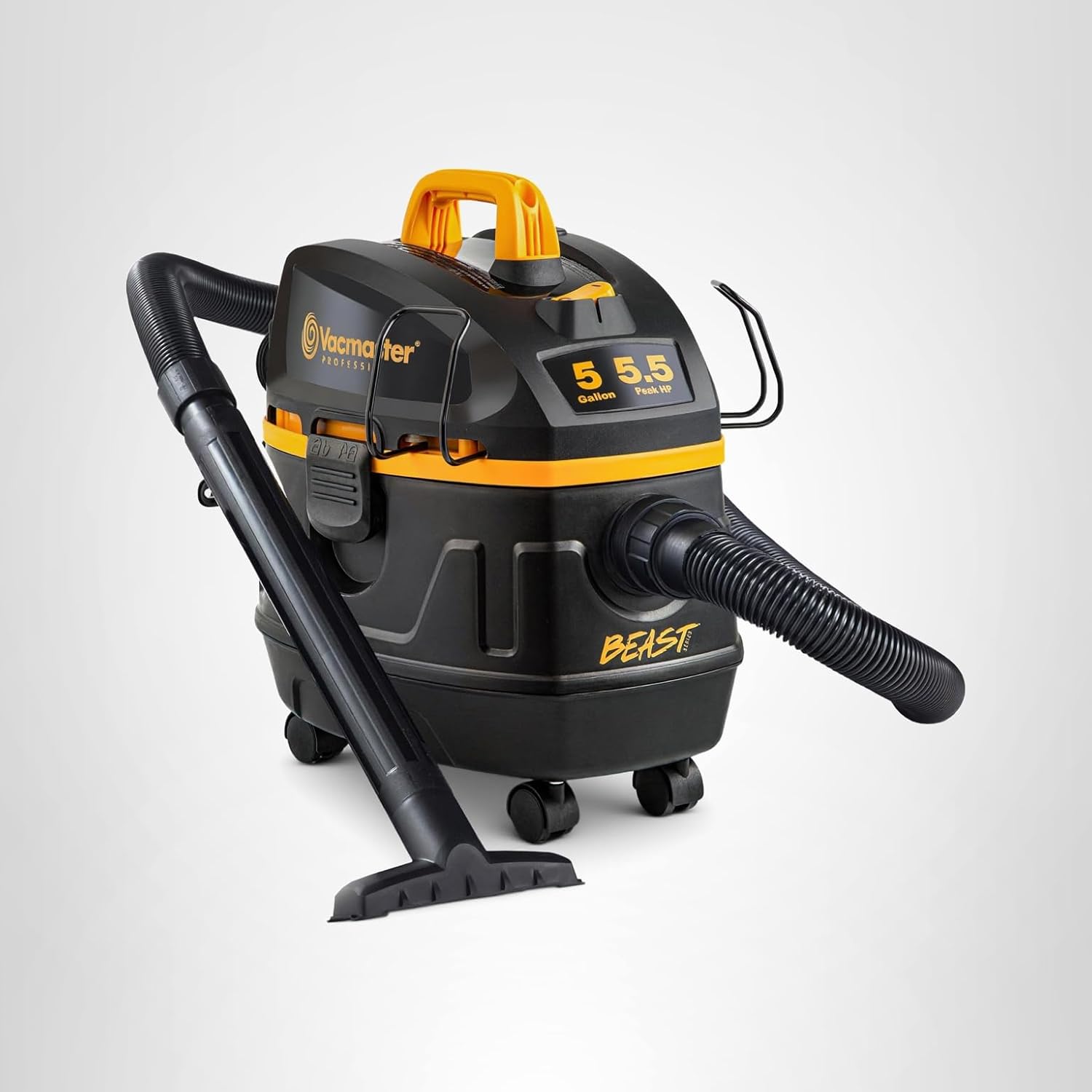
2. Vacmaster Professional “Beast” Series (5 Gallon)
Verdict: Best for Car Detailing
Bigger isn’t always better. If your main goal is detailing your car, a 16-gallon drum is annoying to drag around your driveway. The Vacmaster Beast is designed for mobility and high suction.
- Why Detailers Love It: It has incredible “Water Lift” specs, making it amazing at sucking shampoo/water out of car mats.
- Storage: The hose and cords store neatly on board, so you don’t have a tangled mess.
Pros:
- Easy to carry (lightweight).
- High suction power for its size.
- Comes with a foam filter for wet pickup.
Cons:
- The 5-gallon tank fills up fast if you are doing woodworking.
3. DeWalt DXV10P (10 Gallon)
Verdict: The Quietest & Most Rugged
If you run a workshop where you need to think (or listen to music) while you work, the “scream” of a standard shop vac is unbearable. The DeWalt DXV10P is significantly quieter than the competition while still offering pro-level power.
- Durability: It features heavy-duty rubberized casters (wheels) that roll smoothly over concrete cracks and cords without tipping over.
- Capacity: 10 Gallons is the “Sweet Spot”—big enough for sawdust, but small enough to tuck under a workbench.
Pros:
- Much quieter operation.
- Rugged construction.
- Sturdy handle for lifting.
Cons:
- Slightly more expensive than other brands.

4. Bissell Garage Pro Wall-Mounted System
Verdict: Best Space Saver
Stop tripping over your vacuum. The Bissell Garage Pro mounts permanently to your wall, just like the vacuums at the car wash.
- Reach: It comes with a massive 32-foot hose. You can mount the unit near the door and reach your car in the driveway without ever moving the vacuum.
- Filtration: It uses a 2-stage filtration system, which is great for fine dust.
Pros:
- Zero floor space required.
- Longest hose on the market.
- Looks professional on the wall.
Cons:
- Not portable (you can’t take it to the basement).
- Smaller tank capacity (4 gallons).

5. Armor All AA255 (2.5 Gallon)
Verdict: Best Budget / Portable
Sometimes you just need to clean up a spilled box of cereal or vacuum the trunk of your car. You don’t need a beast; you need the Armor All AA255.
- Power: Don’t be fooled by the size. It plugs into a standard wall outlet (it is not a weak 12V car vacuum) and has surprising suction.
- Conversion: It converts into a handheld blower, which is perfect for drying motorcycle engines or blowing dust off a dashboard.
Pros:
- Extremely cheap (often under $50).
- Lightweight and tiny.
Cons:
- Short hose.
- Not for heavy-duty construction debris.

Maintenance Tip: The “Filter Rule”
If you only remember one thing from this article, make it this:
⚠️ STOP: Check Your Filter Setup
- 1. Are you vacuuming LIQUIDS?
👉 REMOVE Paper Filter. Install Foam Sleeve. - 2. Are you vacuuming DRYWALL DUST?
👉 INSTALL Collection Bag. (Fine dust kills motors). - 3. General Garage Dirt?
👉 Standard Cartridge Filter is OK.
Remove the paper filter before sucking up water.
Standard pleated paper filters are for dry dust only. If they get wet, they turn into a soggy, moldy mess and will ruin your motor’s suction.
- For Dry Messes: Keep the white paper filter on (it stops dust from blowing back into the air).
- For Wet Messes: Take the paper filter off. Most vacs come with a “Foam Sleeve” for wet use.
Frequently Asked Questions (FAQ)
Q: Can I use a shop vac without a bag?
A: Yes. The bag is optional. However, if you are sucking up fine dust (like drywall or sanding dust), we highly recommend using a bag. Without it, the fine dust will clog your filter in minutes and blow back out the exhaust.
Q: What is the difference between a Shop Vac and a Dust Extractor?
A: A Shop Vac is a general-purpose cleanup tool. A Dust Extractor is a specialized, expensive tool (usually $400+) designed to connect directly to power tools (like sanders) to capture 99.9% of dust to protect your lungs. For general garage use, a Shop Vac is fine.
Q: Can a shop vac pick up glass?
A: Yes! Shop vacs handle broken glass easily. Just be careful when emptying the bin later.
Final Verdict
- For the Homeowner who wants one tool to do it all: Get the [Craftsman 16-Gallon]. It’s big, cheap, and powerful.
- For the Car Enthusiast: Get the [Vacmaster Beast]. It’s the perfect size for detailing.
- For the Small Garage: Get the [Bissell Garage Pro] and get it off the floor.
Keep your shop clean and your lungs safe! A Shop Vac cleans the floor, but what about the air? Read our review of Best Air Filtration Systems. For the exterior of your car, you’ll need Pressure Washer