
Garage Pest Control 2026: The Entry-Gap Standard, the Cleanup Rule Most Guides Get Wrong, and a Year-Round Calendar
Affiliate Disclosure: Pro Garage Gear participates in the Amazon Services LLC Associates Program. We earn from qualifying purchases at no extra cost to you. No manufacturer has paid for placement in this guide.
Garage Pest Control – The Advice Everyone Repeats, and Two Things It Leaves Out: Search for how to keep pests out of a garage and you get the same list from nearly every site: seal the gaps, clear the clutter, put out peppermint oil, switch to plastic bins. None of it is wrong. But the list stops exactly where the decisions start.
It never tells you how big a gap has to be to count as a problem, so “seal the gaps” turns into a vague intention rather than something you can check with a flashlight and a pencil. And when it gets to cleanup, some of it points the wrong way. Public health agencies are unambiguous that dry droppings and nesting material must never be swept or vacuumed, because that stirs contaminated dust into the air. Several garage guides still treat a vacuum as the obvious tool.
This guide gives you a measurable standard for every entry point, the safe cleanup procedure with the real sources behind it, an honest comparison of sealing materials (steel wool rusts; there are better options), and a seasonal calendar so you know what to check and when.
The Entry-Gap Standard: What Counts as Too Big
Pest control sources commonly put the threshold for mice at about 1/4 inch, roughly the width of a pencil. The National Pest Management Association describes it as a hole “the size of a dime,” which is a looser description and a bigger opening, so inspect to the stricter number. Anything wider than a pencil is an invitation. Insects need far less: if you can see daylight through a gap, ants and spiders can use it.
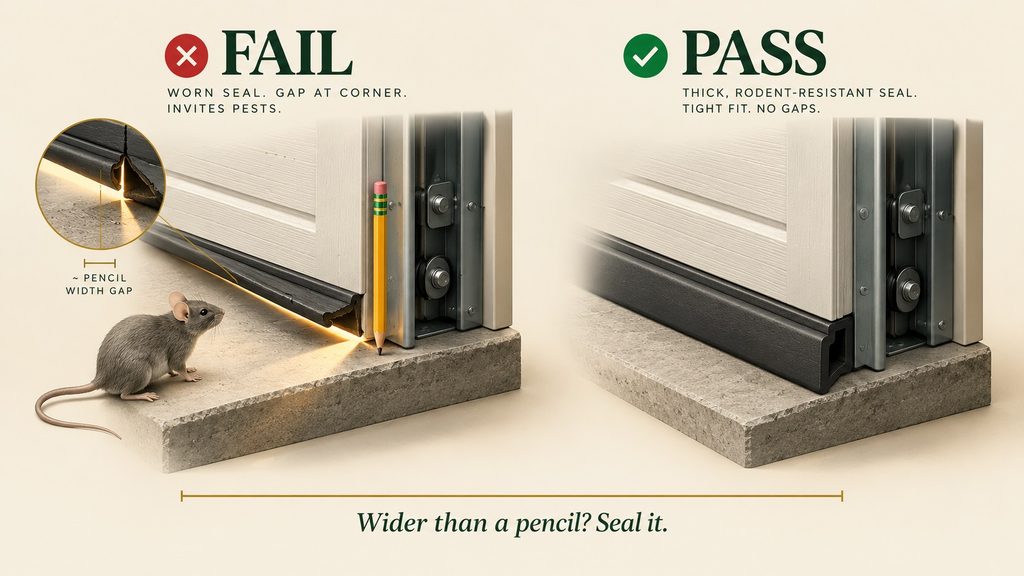
This is the same daylight test used in our winterizing guide: stand inside with the lights off on a bright day and look for light around the door. Light means insects can get through; a gap you can slide a pencil into means mice can.
➡️ For door seal lifespans and what to replace when: Winterizing Your Garage 2026 →
🛒 Check Price on Amazon — Rodent-Resistant Garage Door Bottom Seal →
After You Replace the Door Seal: Run the Opener’s Safety Test
A new bottom seal, especially a thicker rodent-resistant style or a floor-mounted threshold seal, can change where the closed door lands. Most like-for-like swaps change nothing. But if the new seal has a different profile, run one full close cycle and watch it: the door should close fully against the seal without reversing on its own. If it reverses early or stops short, the opener’s down-limit or force setting may need adjusting per its manual. Adjust the travel limit first, and don’t solve the problem by turning the force to maximum, since that reduces the margin that makes the door reverse when it meets an obstruction.
Then test the safety reversal. With the door fully open, lay a 2×4 flat (about 1½ inches high) on the floor, centered under the door, and close it. The door must reverse on contact. Chamberlain’s instructions say to repeat this test after any adjustment to the opener’s limit or force controls and after any repair to the door, and it’s recommended monthly regardless. A seal swap isn’t on the manufacturer’s list of triggers, so treat this as a two-minute precaution that matters most when the seal profile changes. Also check the photo-eyes while you’re there: wave a broom handle through the beam while the door is closing, and it should stop and reverse.
If the door won’t pass after repeated adjustment, stop using the opener and call a garage door technician. Never adjust springs or cables yourself.
A Floor-Mounted Threshold Seal Can Dam Water
A seal glued to the slab at the door line stops insects and drafts, but it can also stop water. Garage slabs normally slope toward the door so rain and melted snow from a parked vehicle drain out; a continuous dam can leave water pooled behind it, which raises humidity and attracts moisture-loving insects such as silverfish and earwigs. If you install a threshold seal, squeegee meltwater out after parking a wet vehicle, or choose a door-mounted bottom seal instead. In a garage that stays damp, pair it with a dehumidifier.
➡️ Best Garage Dehumidifiers 2026 →
The Materials Truth: Steel Wool Rusts
Steel wool is the most repeated sealing tip in garage pest advice, and it does work in the short term: rodents dislike chewing it. The catch, which Orkin and several pest control companies point out, is that ordinary steel wool is carbon steel. Moisture and oxygen rust it, and as it rusts it crumbles and leaves the gap open again. In a dry, indoor spot it can last; at a damp exterior gap it will not.
The method pest control pros use: the mesh-and-sealant sandwich. Pack copper mesh tightly into the gap with a screwdriver or putty knife until you can’t pull it out with your fingers, then run exterior-grade sealant over it, smooth and flush. The mesh stops the teeth; the sealant stops the draft and the insects. Where a gap is larger than the mesh will hold on its own, back it with hardware cloth.
A note on the vehicle: in our long-term car storage guide, steel wool in a stored vehicle’s exhaust tip or air intake is a temporary measure and is fine for that use. Treat it that way: remove it before you start the engine, and leave a visible reminder (a tag on the steering wheel works) so it never gets forgotten.
🛒 Check Price on Amazon — Pure Copper Mesh Roll →
🛒 Check Price on Amazon — Exterior-Grade Sealant (for the Mesh-and-Sealant Sandwich) →🛒 Check Price on Amazon — 1/4″ Galvanized Hardware Cloth →
Three Openings You Should Never Simply Screen or Plug
The 1/4-inch hardware cloth advice above is for passive vents and weep holes. Three kinds of opening are exceptions, and getting them wrong is a safety problem rather than a pest problem.
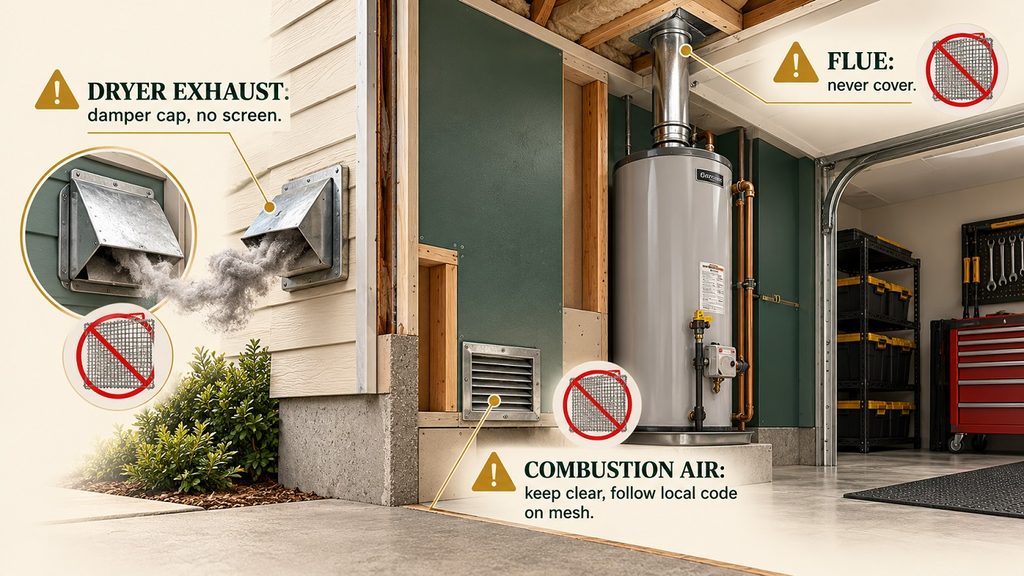
1. Dryer exhaust vents: no screen
If a dryer vents through your garage wall, do not cover the outside termination with hardware cloth or fine mesh. The International Residential Code says screens shall not be installed at a dryer duct termination, because lint collects on the mesh, chokes airflow, and creates a fire hazard. The U.S. Department of Energy’s weatherization job aid says the same: the termination fitting should have a backdraft damper and no grille, cage, or screen (DOE job aid; see also InterNACHI). To keep pests out, use a listed dryer vent cap with a damper that seals when the dryer is off, and follow your dryer’s manual.
🛒 Check Price on Amazon — Dryer Vent Cap with Damper (No Screen) →2. Combustion-air openings: don’t block them, and don’t assume the mesh size
If a gas water heater or furnace sits in your garage, it may rely on openings that supply air for combustion. Never plug, stuff, or seal over those, and keep the area around the appliance’s air inlets clear as its manual specifies. If an opening is screened, the mesh size and open area are set by code and vary by jurisdiction: the California plumbing code, for example, specifies 1/4-inch mesh, while a local handout from Anchorage specifies 1/2-inch (Anchorage combustion air handout). Follow your local code or installer, not the 1/4-inch figure used elsewhere in this guide.
3. Appliance flues and draft hoods: never cover
Leave any flue, vent pipe, or draft hood alone. Pest-proofing around them means sealing gaps in the surrounding wall, never covering the vent itself.
How real is the backdraft risk?
Gas appliances that draw combustion air from the room (atmospheric-vent models) can backdraft when negative pressure develops, drawing air down the flue so combustion gases enter the space instead of leaving it (DOE Building America; Energy Vanguard). In a typical garage, door seals alone are unlikely to create that problem: garages are leaky, and codes generally treat a space as unconfined, needing no extra openings, when it has at least 50 cubic feet of volume per 1,000 Btu/hr of appliance input (example city guidance).
The risk rises when three things combine: an unusually tight garage, an atmospheric-vent (draft hood) appliance rather than a sealed-combustion or power-vented one, and an exhaust device such as a dryer or fan running in the same space.
If that describes your garage, ask a qualified technician for a combustion safety check after you finish sealing, and keep working carbon monoxide alarms in the home.
➡️ For CO and ventilation in attached garages: Attached Garage Health Risks: CO, Benzene, and Ventilation →
The Cleanup Rule: Never Sweep or Vacuum Droppings
If you find droppings or a nest, how you clean it up matters more than most of the prevention advice. The U.S. CDC, the National Park Service, and the California Department of Public Health all give the same instruction: do not sweep, vacuum, or dust rodent droppings, urine, or nesting material. Doing so can put particles from dried material into the air, where they can be breathed in, and hantavirus is the reason the guidance is so firm. It is a rare disease, but a serious one, and the precaution costs a spray bottle.
That includes the shop vac. A garage is exactly where people reach for one, and it is the wrong tool until the area has been disinfected.
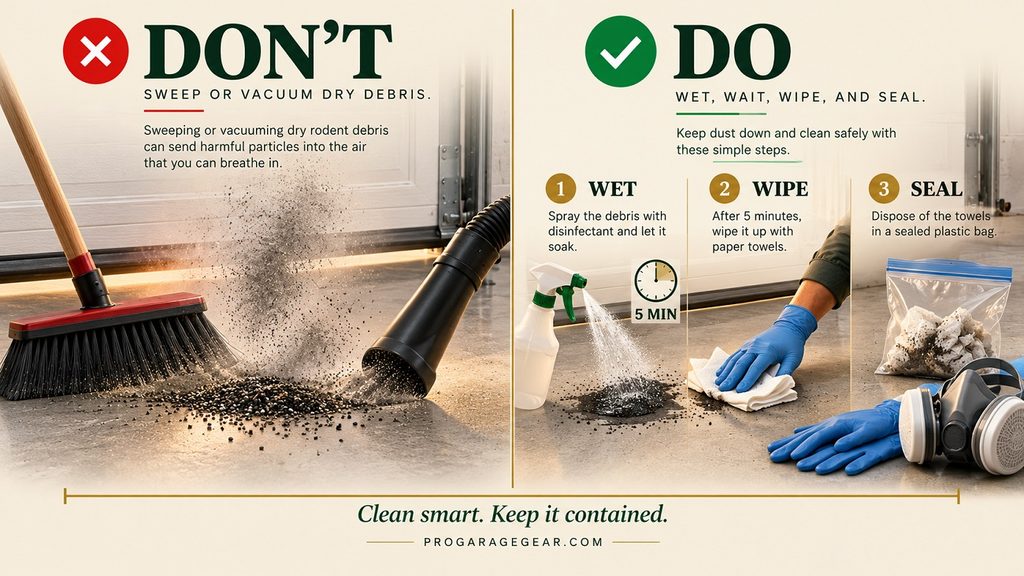
The Safe Cleanup Sequence
- Ventilate first. Open the garage door and any windows, and leave the space to air out for at least 30 minutes before you start (National Park Service guidance). Stay out of the space during that time if you can.
- Put on protection. Rubber or nitrile gloves at minimum. For a closed-up garage with heavy droppings or an established nest, CDC calls for additional precautions, including respiratory protection; its cleanup page specifies the type.
- Wet it down, don’t disturb it. Spray droppings, nests, and any urine stains with a bleach solution (about 1 part household bleach to 9 parts water, which is roughly 1½ cups of bleach per gallon of water, mixed fresh) or an EPA-registered disinfectant, until everything is very wet. Never mix bleach with other cleaning products.
- Let it soak for at least 5 minutes.
- Wipe up with paper towels, bag them, and throw them out. For a trapped rodent, invert a plastic bag over your gloved hand, pick up the trap and carcass through the bag, and seal it.
- Disinfect the surface again, then wash your hands thoroughly, and wash clothing that may have been contaminated.
- No pressure washer, no vacuum on the area until it has been disinfected; CDC specifically warns against using a high-pressure sprayer on contaminated surfaces.
The full steps, including what to do for heavy infestations, are on the CDC’s rodent cleanup page; the National Park Service and the California Department of Public Health publish matching guidance (linked in the sources below). If you develop fever, muscle aches, or trouble breathing in the weeks after cleaning up or disturbing rodent droppings, see a doctor and tell them about the exposure.
➡️ If your garage is attached to the house, the air quality and CO side of garage safety is covered here: Attached Garage Health Risks: CO, Benzene, and Ventilation →
🛒 Check Price on Amazon — Nitrile Gloves →
🛒 Check Price on Amazon — EPA-Registered Disinfectant Spray →🛒 Check Price on Amazon — P100 Half-Mask Respirator →
Trap Before You Seal, and Skip the Poison
Order matters. Pest pros commonly advise confirming the rodents are out before you seal the last gaps. Closing every opening with mice still inside can leave them trapped in the walls. Set snap traps along walls and near suspected entry points, check them daily, and finish sealing once they stop catching.
Why not loose bait or poison: a rodent that eats bait can wander into a wall void and die there, and the smell can take weeks to clear. Anticoagulant baits can also harm pets and wildlife that eat the poisoned rodent. Enclosed snap traps are the more predictable choice in a garage, especially one connected to the house.
🛒 Check Price on Amazon — Enclosed Snap Mouse Traps →
Storage Is Pest Control
Cardboard is shelter and food for some pests and nesting material for others, and boxes sitting on the slab create the dark ground-level hiding places mice and spiders look for. Two changes cover most of it: move stored items into airtight plastic or metal containers, and keep them 6 to 12 inches off the concrete so there’s no tucked-away space under them.
That is the same job shelving and cabinets already do. Sealed cabinets remove hiding places entirely, and shelving that lifts bins off the floor lets you see (and sweep) the whole slab.
➡️ For shelving that works with standard totes: Best Garage Shelving 2026: The Tote Depth Rule → and Best Garage Cabinet Systems 2026 →
Food is the other half. Pet food, birdseed, and a freezer or fridge with a loose seal all draw rodents; store any of them in sealed hard containers or move them out of the garage. Dampness draws insects, so fix leaks and run a dehumidifier if the garage stays damp.
➡️ For humidity control: Best Garage Dehumidifiers 2026 →
🛒 Check Price on Amazon — Airtight Latching Storage Totes →
The Year-Round Garage Pest Calendar
Pest pressure shifts with the seasons, and so should your inspection. This is a general national guide; local climate shifts the timing, and the Southwest adds pests such as scorpions that this guide doesn’t cover in depth.
➡️ For rodent damage to stored vehicles, including soy-based wiring and the cabin intake: Long-Term Car Storage 2026 →
The Garage Pest Risk & Prep Calculator
Answer a few questions about your garage to see your risk level and a prioritized to-do list for this season.
🐭 Garage Pest Risk & Prep Calculator
🐭 Garage Pest Risk & Prep Calculator
Get a risk level and a prioritized checklist for this season.
* General guidance based on common pest-control practice, public health cleanup guidance, and typical building-code principles. Local codes and conditions vary; for a large infestation, larger animals, stinging-insect nests you can’t safely reach, or any question about gas appliances, consult a licensed professional.
What applies to your garage? (check all)Cardboard boxes stored on the floorPet food, birdseed, or a loose-sealed freezerStacked wood or yard debris insideI’ve seen droppings, nests, or chew marksGet My Risk Level →
Frequently Asked Questions
What size gap can a mouse get through?
Pest control sources commonly cite about 1/4 inch, roughly the width of a pencil. The National Pest Management Association describes it as a hole the size of a dime, which is larger, so use the stricter measurement when you inspect. Anything wider than a pencil should be sealed with metal mesh and sealant. Insects can use far smaller gaps, so any visible daylight around a door is a problem for them.
Can I vacuum mouse droppings?
No. The CDC, the National Park Service, and the California Department of Public Health all say not to sweep or vacuum rodent droppings, urine, or nesting material, because it can stir contaminated particles into the air. Spray with a bleach solution or EPA-registered disinfectant until very wet, let it soak at least 5 minutes, and wipe up with paper towels. See the cleanup sequence above and the CDC’s page for the full steps.
Is steel wool or copper mesh better for sealing gaps?
For exterior or damp gaps, copper mesh or hardware cloth. Ordinary steel wool rusts and crumbles with moisture and can leave the gap open again within months. It’s acceptable for short-term, dry, indoor stuffing, and for temporarily plugging a stored vehicle’s exhaust tip, provided you remove it before starting the engine. Check that copper mesh is pure copper, since some listings sell copper-plated steel.
Does peppermint oil keep pests out of a garage?
It’s widely recommended, and some people find it helpful as a minor extra, but it is not a substitute for sealing entry points, and we haven’t found strong evidence that it keeps rodents out on its own. Essential oils can also be harmful to pets, particularly cats, so keep them out of reach. If you use it, treat it as a supplement to mesh, sealing, and trapping.
Should I use poison bait in the garage?
We’d skip it. A rodent that eats bait can die inside a wall, and the smell can last for weeks, and anticoagulant baits can also harm pets and wildlife that eat the poisoned rodent. Enclosed snap traps are more predictable. Whatever you use, follow the label and keep it away from children and pets.
When should I call a professional?
If you have a large or recurring rodent problem after sealing, signs of larger animals, or a stinging-insect nest in a spot you can’t safely reach. Heavy infestations also call for more cleanup precautions than the basic steps above, so check the CDC’s page first.
Can I put hardware cloth over my dryer vent to keep pests out?
No. Building code says screens shall not be installed at a dryer exhaust termination, because lint collects on the mesh, restricts airflow, and creates a fire hazard. Use a listed dryer vent cap with a damper that closes when the dryer is off, and check your dryer’s manual. The same caution applies to combustion-air openings and appliance flues: don’t cover them with hardware cloth, and follow your local code on any screening.
The Bottom Line
Garage pest control comes down to three habits. Hold every entry point to a measurable standard: nothing wider than a pencil, and no daylight around the door. Seal with materials that last, which means copper mesh, hardware cloth, and sealant on top rather than rusting steel wool. And clean up wet, never dry: no sweeping and no vacuuming of droppings, which is the one place where the common advice and the public health guidance disagree. Then check again each season, with fall as the important one.
Sources
- U.S. Centers for Disease Control and Prevention: “How to Clean Up After Rodents”
- National Park Service: Hantavirus Pulmonary Syndrome (cleanup directions, including 30-minute ventilation)
- California Department of Public Health: Hantavirus Infection
- National Pest Management Association (via Business Wire): seasonal pest guidance and the dime-sized-opening statement
- Orkin: Does Steel Wool Keep Mice and Rats Out? (rust and replacement guidance)
- Pest Control California: Pest Exclusion 101 (the mesh-and-sealant method, 1/4-inch standard)
- Cypress Creek Pest Control: Do Copper Mesh and Steel Wool Really Stop Rodents?
- Vision Doors: garage pest prevention (items stored 6-12 inches off the slab; poison bait odor risk)
- Advanced Door: seasonal garage pest guide (wasp nests on ceilings and in door tracks)
- Chamberlain Group support: How to Test the Safety Reversal System (2×4 test; retest after adjustments)
- U.S. Department of Energy: Vent a Clothes Dryer job aid (no grille, cage, or screen at the termination; backdraft damper required)
- InterNACHI: Dryer Vent Safety (IRC clothes dryer exhaust guidance)
- U.S. Department of Energy, Building America: combustion appliances and backdrafting
- Energy Vanguard: Problems with atmospheric combustion inside the building envelope
- Municipality of Anchorage: Combustion Air handout (example of a local screen-mesh requirement
- )City of Garden Grove: water heater installation in a dwelling or garage (50 cubic feet per 1,000 Btu/hr combustion air rule)
Several of these sources are pest control companies rather than government agencies; where a claim comes from one of them (material durability, trapping order), we’ve presented it as common professional practice rather than as regulation. The cleanup guidance comes from public health agencies.
Affiliate Disclosure: Pro Garage Gear earns from qualifying Amazon purchases at no extra cost to you. This guide is general information, not medical or pest-control advice for your specific situation; follow product labels and consult a licensed professional for large infestations.