
Why Your Garage Door Opener Remote Stopped Working (The “LED Secret”)
By Pro Garage Gear Team | Updated August 2026
Disclosure: This post contains affiliate links. We may earn a commission if you purchase the shielded bulbs we recommend.
It’s a ghost story we hear all the time.
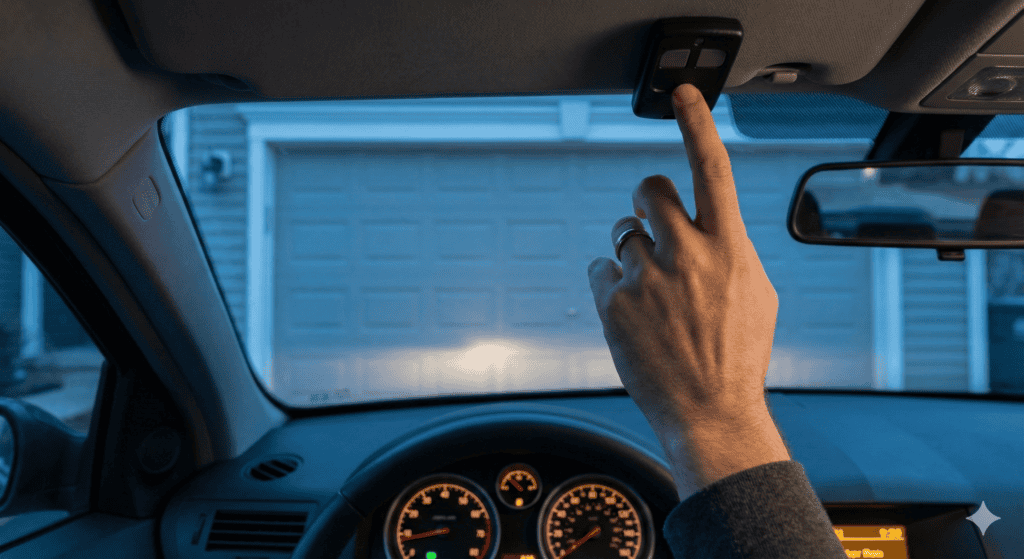
You drive home. You click the remote on your visor. Nothing happens. You pull closer to the driveway. You click again. Still nothing. Finally, you pull right up to the door, practically touching it with your bumper, click it for the tenth time, and finally, the door opens.
You assume your opener is dying. You change the batteries in the remote. You reprogram the keypad. You might even go to Home Depot to buy a new $300 Chamberlain unit.
Stop.
Before you spend a dime, look up. Did you recently install a new LED light bulb in your garage door opener?
If the answer is yes, you don’t have a broken opener. You have an Interference Problem.
Here is why your modern light bulbs are killing your radio signal, and the $15 fix that solves it instantly.
The Science: The “300MHz War”
To understand the problem, you have to understand how your garage door works.
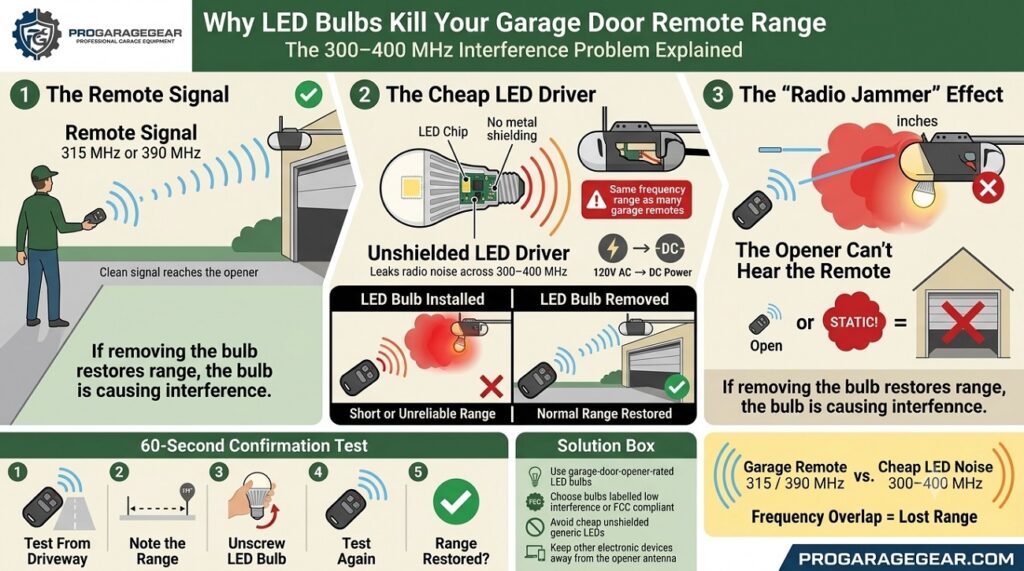
Your remote control talks to the opener unit on a specific radio frequency. For most openers (LiftMaster, Chamberlain, Craftsman, Genie) manufactured after 1998, this frequency is usually 315 MHz or 390 MHz.
Enter the cheap LED Bulb. Inside every LED bulb is a tiny circuit board called a “Driver.” This driver converts your home’s AC power (120V) into DC power for the LED chip.
In high-quality bulbs, this driver is “shielded” (wrapped in metal) to prevent electromagnetic noise from leaking out. In cheap, generic LEDs, the driver is unshielded. When it turns on, it blasts out “radio noise” in every direction.
The Coincidence: Guess what frequency that cheap driver noise sits on? You guessed it: 300 MHz to 400 MHz.
Because the light bulb is screwed directly into the opener unit, it is sitting inches away from the antenna. It acts like a radio jammer. When you click your remote, the opener can’t “hear” the signal over the screaming noise of the LED bulb.
The Test (How to confirm this is your problem):
- Close your garage door.
- Walk to the end of your driveway.
- Click your remote. Does it open? (Yes).
- Now, unscrew the LED bulbs from the opener unit.
- Close the door again.
- Walk to the end of the driveway and click.
- Does it open instantly from far away?
If removing the bulb fixed the range, you have interference.
The Fix: “Shielded” Garage Door Bulbs
You cannot just buy any “Dimmable” or “Outdoor” bulb. You need a bulb specifically engineered to shield Radio Frequency Interference (RFI).
There is one bulb that is the gold standard for this.
The Winner: Genie Universal Garage Door Opener LED Bulb
This is the only bulb we recommend. It was designed by Genie specifically to stop their customer support phone lines from ringing with people complaining about “broken” openers.
- The Shielding: It effectively blocks RFI so your remote range stays strong (up to 100ft).
- The Vibration: Garage doors shake. Standard glass bulbs shatter or filaments break. The Genie bulb is shatter-resistant and vibration-tested to 5G force.
- The Weather: It is rated for damp locations and cold weather (down to -22°F), so it won’t flicker in the winter.

If the Genie Bulb Is Unavailable: How to Identify Any Shielded Bulb
The Genie bulb above is the one we recommend by default, but it’s a single SKU — if it’s out of stock, discontinued, or unavailable in your region, you don’t need to wait for it to come back. Any bulb explicitly marketed for garage door opener use will work, because the shielding is what matters, not the brand.
What to look for on the packaging: the words “garage door compatible” or “EMI-shielded” (sometimes written “RFI-shielded”). Manufacturers that build for this specific use case test and label for it directly — a bulb that doesn’t mention shielding anywhere on the box or listing almost certainly isn’t built for it, regardless of brand reputation in other categories.
What doesn’t help: “dimmable,” “smart,” or “outdoor-rated” labels have nothing to do with RFI shielding — a dimmable bulb can be just as unshielded as a basic one. Don’t substitute one of these claims for the specific shielding language above.
Option 2: The “Ferrite Core” Hack (For LED Shop Lights)
What if the interference isn’t coming from the bulb in the opener, but from those big 4ft LED Shop Lights or Hexagon Lights you just hung on the ceiling?
Since you can’t swap the “bulbs” in those fixtures, you need to choke the noise at the source.
The Tool: Snap-On Ferrite Cores These are little barrel-shaped magnets encased in plastic. You’ve probably seen them on your laptop charging cable.
How to install:
- Buy a pack of 5mm Ferrite Cores.
- Find the power cord for your LED Shop Light.
- Snap the ferrite core onto the cord, as close to the light fixture as possible.
- Loop the cord through the core twice if possible.
This magnet acts as a filter, suppressing the high-frequency noise before it can leak out and mess with your opener.
Option 3: The Zero-Interference Fallback — Rough-Service Incandescent
If you’d rather not shop for a specialty LED at all, there’s a simpler option: a rough-service incandescent bulb. Incandescent bulbs have no driver circuit — no electronics translating AC to DC, nothing to generate RFI in the first place. It’s not a workaround or a compromise; it’s a guaranteed zero-interference light source by virtue of how the bulb works.
“Rough-service” specifically means the filament is built with extra support wires designed to survive the vibration of a moving garage door — a standard household incandescent bulb will burn out fast in this application, but a rough-service or “vibration-resistant” rated one is built for exactly this use.
The trade-off: incandescent bulbs run hotter and use more power than LEDs, and won’t last anywhere near as long. For most people the shielded LED above is still the better long-term choice. But if you need a same-day fix from a hardware store that doesn’t stock garage-specific LEDs, a rough-service incandescent solves the interference problem completely, today, for a couple of dollars.
🛒 Check Price on Amazon — Rough-Service Incandescent Bulb (Vibration-Resistant) →
One more thing to check before you buy: most opener fixtures have a maximum wattage printed on the socket housing itself or in the owner’s manual — commonly 60W equivalent. Confirm any replacement bulb, shielded or not, stays within that rating; exceeding it is a heat-related safety issue independent of the RFI question this article is about.
After installing the fix: repeat the exact test from the top of this article — walk to the end of your driveway and click the remote. If range is fully restored, you’ve confirmed the bulb was the cause. If range is still weak, work through the “3 Other Things” section below before assuming the new bulb didn’t work — the antenna wire position and metal-building interference are both independent of bulb type entirely.
➡️ Installing hexagon or shop-light grids next? The same ferrite-core fix applies there too — see the circuit and interference sections in our Hexagon Garage Lights guide →
3 Other Things That Kill Your Remote Range
If you removed the bulbs and your range is still terrible, check these three culprits:
- The Antenna Wire: Look at the motor unit on your ceiling. There should be a small wire hanging down (usually yellow, purple, or grey). Make sure it is hanging straight down, not tucked up inside the housing.
- LED Christmas Lights: Believe it or not, cheap LED holiday lights plugged into the same circuit can feed noise back into the electrical line. Unplug them and re-test.
- Metal Siding/Roofs: If you have a metal garage (Pole Barn), your building is a Faraday cage. It blocks radio signals. You may need to buy a Remote Antenna Extender Kit to route the signal outside the metal shell.
The Verdict
Don’t buy a new opener. Don’t buy a new remote battery.
Spend the $15 on the Genie Shielded LED Bulbs. It is the cheapest repair you will ever make, and you’ll get your 100-foot range back instantly.
If you’ve tried the bulb swap, the ferrite core, and the antenna check, and range is still poor: at that point the interference explanation has been ruled out, and a genuinely failing opener is back on the table. See our Best Smart Garage Door Openers 2026 guide → for what to buy — and while you’re there, the belt-drive vs. chain-drive breakdown explains why your current unit might be worth replacing anyway, interference aside.
Frequently Asked Questions
Will any LED bulb cause garage door interference, or just certain ones?
Only unshielded ones — and most budget/generic LED bulbs fall into this category, because shielding adds a small manufacturing cost that budget bulbs skip. It’s not that “LED bulbs are bad” — it’s that the driver circuit inside an unshielded LED emits electrical noise in the same 300-400MHz range most garage remotes use. A shielded LED, a bulb explicitly labeled for garage door use, or a rough-service incandescent all avoid the problem entirely — see the options above.
I already reprogrammed my remote and changed the batteries. Could it still be interference?
Yes, and this is the most common wasted troubleshooting step. Reprogramming and battery replacement fix a genuinely dead remote or a lost pairing — they do nothing for an interference problem, because the remote and opener are both working correctly; the opener simply can’t hear the signal over the noise. If you’ve already tried these steps with no improvement, skip straight to the bulb-removal test at the top of this article.
Does this affect keypad entry too, or just the remote?
Both, generally, since wireless keypads communicate on the same frequency band as clicker remotes. If your keypad has also become unreliable at the same time your remote range dropped, that’s additional confirmation pointing toward interference rather than a keypad-specific problem.
Can I just leave the old bulb out and use a flashlight instead?
You can — running the opener with no bulb installed causes no functional problem, since the light is a convenience feature, not a requirement for the door mechanism. It’s not a long-term fix most people want (a dark garage at night is its own inconvenience), but it’s a valid zero-cost way to confirm the diagnosis before you spend anything on a replacement bulb.