
Garage Electrical Load Guide 2026: Why Your Breaker Trips & The 20-Amp Upgrade
By Pro Garage Gear Team | Estimated Read Time: 12 Minutes
This post contains affiliate links. We may earn a commission if you purchase through these links.
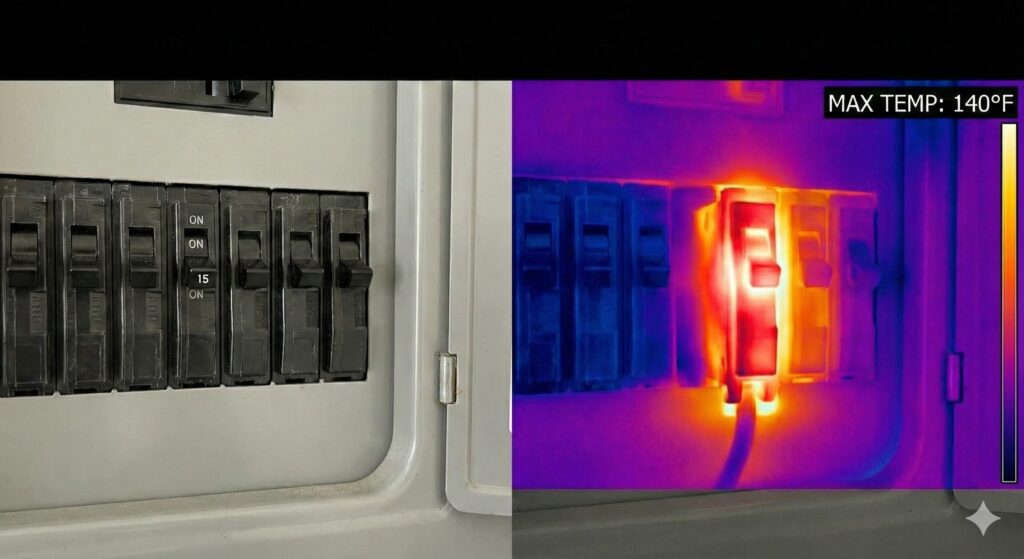
The “Garage Blackout”: You pull the trigger on your new pressure washer. Suddenly, the lights die, the music stops, and you are left standing in the dark with a half-soaped car. It isn’t a ghost; it’s physics. Our Garage electrical wiring guide explains the phenomena.
Most residential garages are wired for a lightbulb and a radio, not a 2026 workshop. If you are plugging in a Wall Mount Pressure Washer, a 240V Garage Heater, or a bank of Deformable LED Lights, you are likely pushing your “Builder Grade” electrical system to the melting point.
This guide explains the “Physics of Failure”—from Voltage Drop to Startup Surge—and provides the exact roadmap for the “20-Amp Upgrade” you need to stop the trips.
🏆 The “Physics of Failure” Cheat Sheet
| Symptom | The Culprit | The Risk | The Fix | Link |
|---|---|---|---|---|
| Breaker Trips immediately | In-Rush Current | Nuisance | Dedicated 20-Amp Circuit | Buy on Amazon |
| Lights Dim when tool starts | Voltage Sag | Motor Damage | Thicker (12-Gauge) Wire | Buy on Amazon |
| Cord gets hot | Resistance | Fire Hazard | Uncoil Reel / Upgrade Cord | Buy on Amazon |
| Door Opener range drops | RFI Interference | Annoyance | Ferrite Core on LEDs | Buy on Amazon |
⚠️ The “15-Amp Trap”: Why Standard Garage Wiring Fails
If your home was built before 2010, your garage likely runs on a shared 15-Amp Circuit. This is the bottleneck for every tool you own.
The “Builder Grade” Standard: 14-Gauge (Yellow) vs. 12-Gauge (Orange)
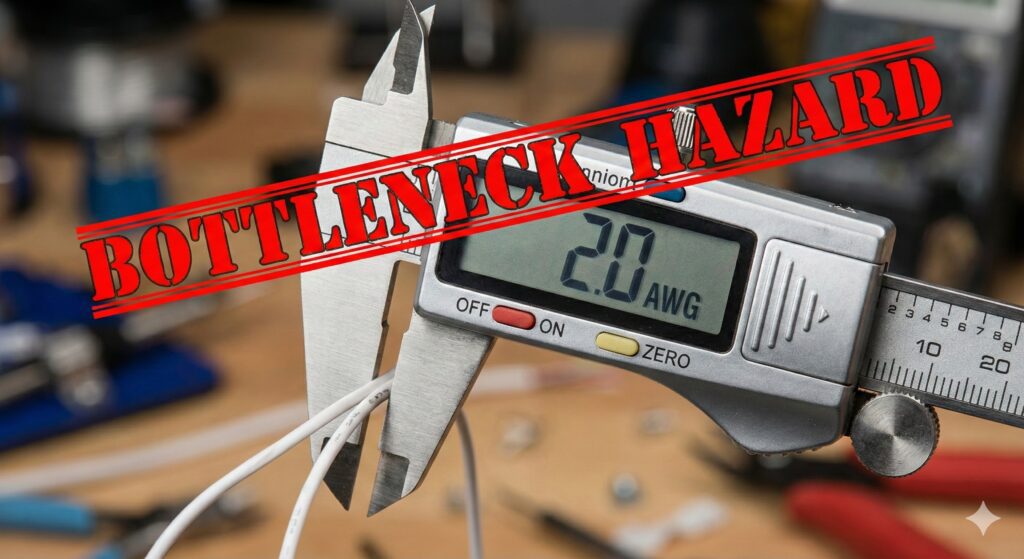
Wire thickness is measured in “Gauge” (AWG). The lower the number, the thicker the wire.
- 14-Gauge (Yellow Sheath): The standard for cheap home builds. Rated for 15 Amps. Thin wire creates high resistance over long distances.
- 12-Gauge (Orange Sheath): The standard for workshops. Rated for 20 Amps. Thicker copper allows power to flow freely with minimal voltage drop.
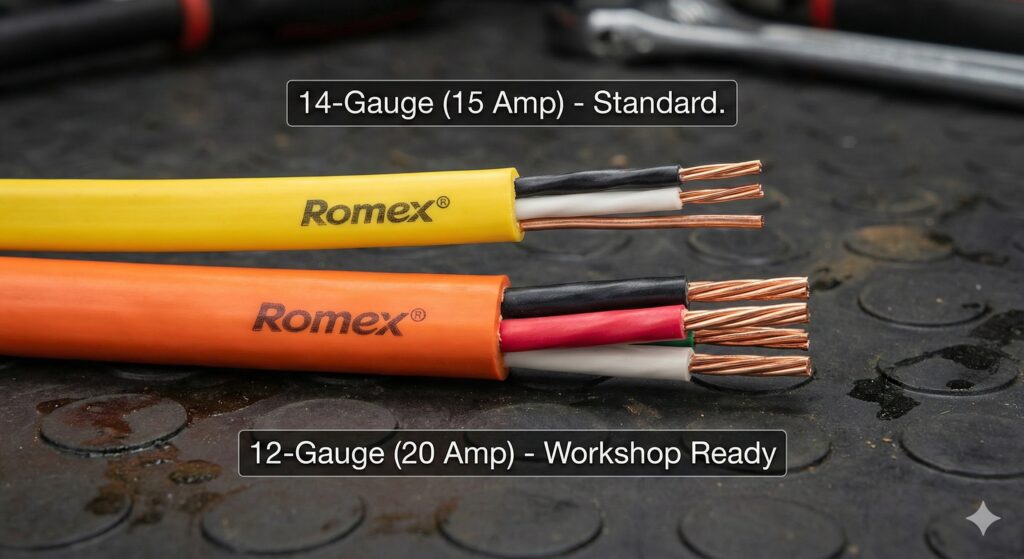
Visual Check: Go to your electrical panel. If the breaker handle says “15,” you have thin wires. You CANNOT simply swap the breaker for a “20.” Doing so will overheat the thin wires inside your walls and cause a fire.
The 80% Rule (Continuous Load Rating)
The National Electrical Code (NEC) has a “Safety Buffer” rule. A circuit breaker should only handle 80% of its rating for continuous loads (running 3+ hours).
- 15-Amp Breaker Max: 12 Amps.
- The Problem: A standard 1,500W Space Heater draws 12.5 Amps.
- The Result: If you plug a heater into a 15-Amp circuit, you are already in the “Trip Zone.” If you turn on a single light bulb, the breaker pops.
The “Ghost Load” Audit
You think your circuit is empty, but “Ghost Loads” are eating your amperage buffer.
- Wi-Fi Extenders
- Smart Garage Door Controllers
- Drill Battery Chargers
- Freezer/Fridge
These devices sip power constantly. By the time you pull the trigger on your saw, your 15-Amp bucket is already half full.
⚡ The “Startup Surge”: Why Pressure Washers Trip Breakers
We analyzed the data in our Active 2.0 vs. Kranzle Review. The number one complaint is “It trips my breaker.”
Running Amps vs. In-Rush Current
Electric motors have two power states:
- Running Amps: The power needed to keep the motor spinning (e.g., 11 Amps).
- In-Rush (Surge) Amps: The massive spike of power needed to start the motor from a dead stop (e.g., 18 Amps).
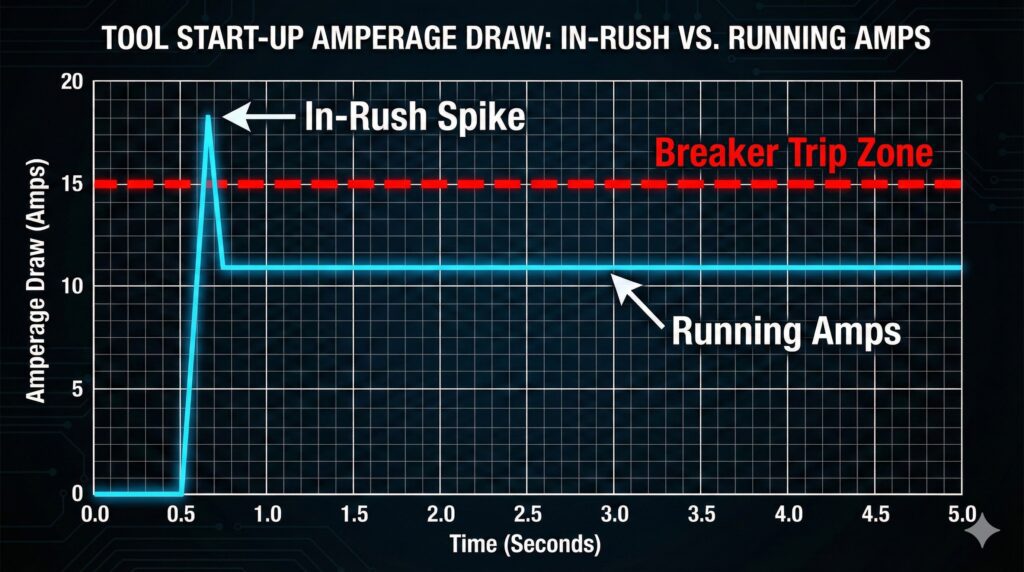
This spike lasts only milliseconds, but it is enough to trigger a sensitive 15-Amp breaker. This is why “Soft Start” capacitors (found in expensive units like Kranzle) are worth the money—they smooth out this spike.
The “Garage Freezer” Conflict
The “Shared Circuit Disaster” happens when two motors surge at once.
- Scenario: You are washing your car. Your garage freezer compressor kicks on to cool down.
- Math: 13 Amps (Washer Surge) + 8 Amps (Freezer Surge) = 21 Amps.
- Result: Click. Silence.
The Fix: Never plug your pressure washer into the same outlet chain as your refrigerator.
🔥 The “Saw Killer”: Voltage Drop & Extension Cord Physics
Extension cords are not just “longer wires.” They are resistors. Every foot of cord adds electrical friction (resistance), which drops the voltage available to your tool.
The Resistance Calculation (14AWG vs. 12AWG)
In our Extension Cord Reel Test, we proved that using a thin 14-gauge cord on a high-draw tool (like a Table Saw or Tile Saw) is destructive.
- The Physics: Lower Voltage = Higher Amperage (to compensate) = Heat.
- The Damage: Your saw motor runs hotter and slower. Eventually, the internal windings melt.
- The Rule: For any tool drawing 13+ Amps, you MUST use a 12-Gauge (12/3) extension cord shorter than 50 feet.
The “Fire Coil” Effect (Induction)
If you have a retractable cord reel, you must unspool the entire cord before running high-load tools (like heaters or saws).
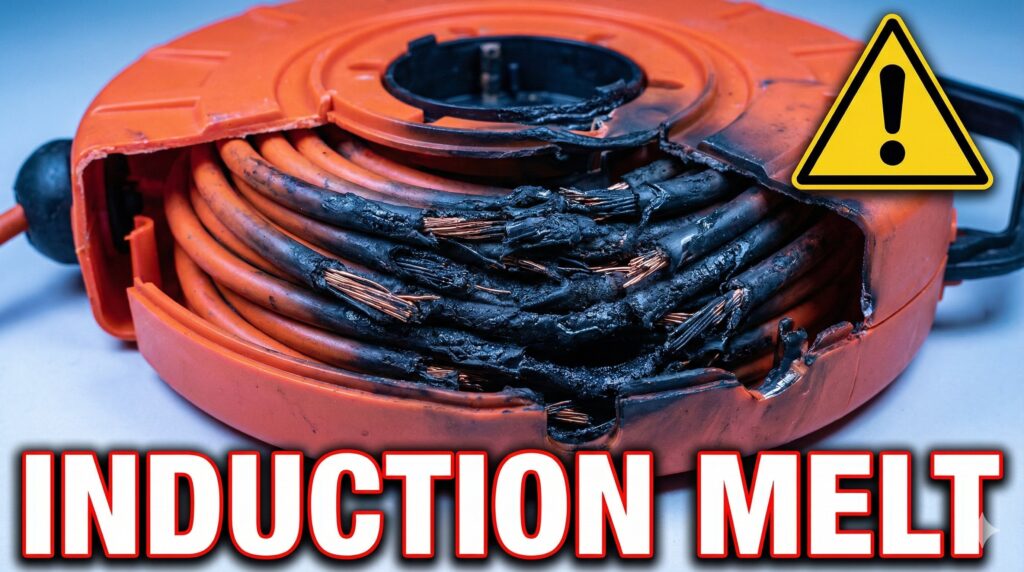
- Why? A coiled wire carrying current creates a magnetic field (Induction). This traps heat inside the layers of the coil.
- The Risk: We have seen reel casings melt into a plastic blob because the user ran a heater through a coiled extension cord.
🔌 High Voltage Infrastructure: Heaters & Heavy Duty Power
If you are upgrading your climate control, a standard plug won’t cut it.
The “$400 Surprise”: Hardwiring 240V
As noted in our Garage Heater Guide, powerful 5,000W electric heaters (like the Dr. Heater DR966) do not have plugs.
- Requirement: Dedicated Double-Pole 30-Amp Breaker.
- Wiring: 10-Gauge Wire (Thick!).
- Cost: Expect to pay an electrician $300–$500 to run this line.
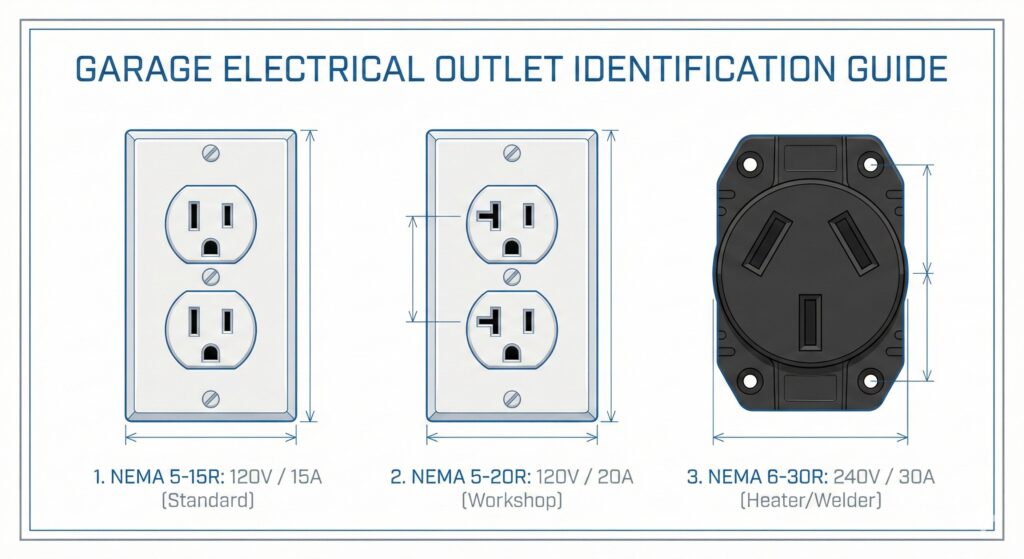
NEMA Plug Cheat Sheet
Don’t buy a tool you can’t plug in. Check the plug shape:
- NEMA 5-15: Standard household plug (Two parallel blades). Max 15 Amps.
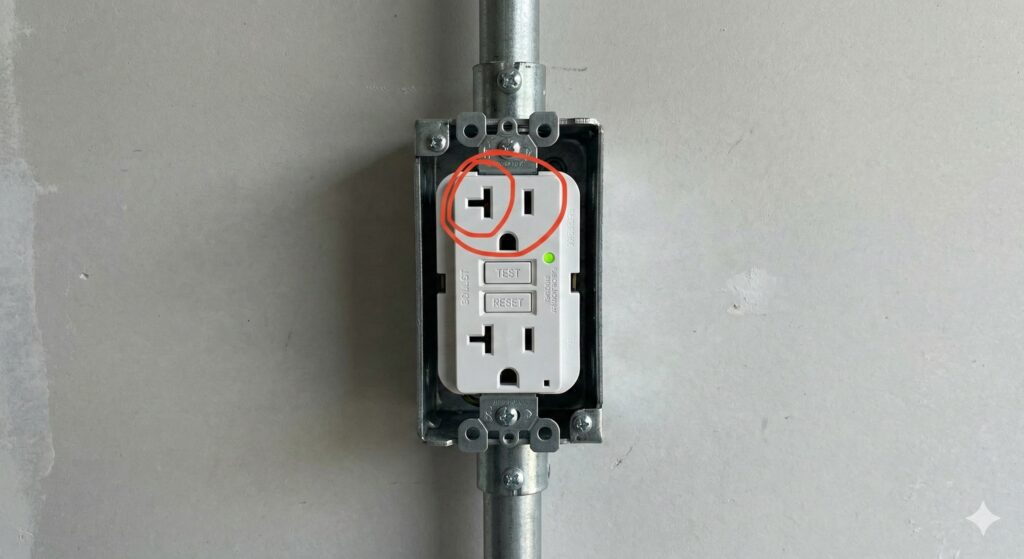
- NEMA 5-20: One vertical blade, one horizontal “T” blade. Requires a 20-Amp outlet.
- NEMA 6-30: Large 3-prong plug (Crow’s foot shape). Used for 240V heaters/welders.
Propane vs. Electric: The Rust Factor
Why do we push electric heat over propane? Chemistry.
Burning propane releases Water Vapor as a byproduct. In a cold garage, this moisture condenses on your cold cast-iron table saw and electrical panel, causing flash rust. Electric heat is “Dry Heat,” protecting your expensive gear.
💡 Lighting Loads: The “Daisy Chain” Fire Hazard
Modern Hexagon Grid Lights and LED tubes are efficient, but they have a limit.
The 6-Unit Limit
Most linkable shop lights (like Barrina or PrimeLights) use thin internal wiring (20-gauge).
- The Trap: Users plug 12 lights together in one long chain.
- The Physics: The first light in the chain has to carry the current for all the lights after it.
- The Failure: The connector on the first light overheats and melts.
- The Fix: Never link more than 6 units. Split your layout into two separate power feeds.
RFI Interference: The “Garage Door Opener Bug”
If your Garage Door Remote stops working when your new lights are on, you have RFI (Radio Frequency Interference). Cheap LED drivers emit “noise” on the same frequency (315/390 MHz) as openers.
- The Fix: Snap a Ferrite Core magnet onto the power cord of the LED light nearest the motor to block the signal noise.
🛠️ The Upgrade Roadmap: Specifications for Electricians
If you are hiring a pro, do not just say “Add an outlet.” Be specific to future-proof your shop.
The “Pro” Standard: Dedicated 20-Amp GFCI Circuits
Ask for this exact spec:
“I need a Dedicated 20-Amp Circuit run with 12-Gauge Copper Wire (Yellow/Orange Romex), terminated with a NEMA 5-20 T-Slot GFCI Receptacle.”
- Dedicated: Means nothing else (no fridge/lights) shares this wire.
- 20-Amp: Gives you the headroom for startup surges.
- GFCI: Mandatory for garage wet locations (especially for car washing).
Hiding the Mess (Sub-Panels)
If your main panel is far away, install a Sub-Panel in the garage. This allows you to add more circuits later (e.g., for an EV Charger). You can hide this ugly industrial box inside a NewAge Pro 3.0 Locker for a seamless, clean look.
❓ Frequently Asked Questions (FAQ)
Q: Why do my lights flicker when the compressor turns on?
A: This is called Voltage Sag. Your compressor draws a massive “In-Rush” current, momentarily draining the available power in the circuit. If your lights are on the same circuit, they starve. The fix is to move the compressor to a dedicated 20-Amp circuit.
Q: Can I replace a 15-Amp breaker with a 20-Amp breaker?
A: NO. This is a fire hazard. The breaker is sized to protect the wire. If you put a 20-Amp breaker on thin 14-gauge wire, the wire will overheat and melt inside your walls before the breaker trips. You must upgrade the wire to 12-gauge first.
Q: How many LED lights can I put on one switch?
A: A standard 15-Amp circuit can handle ~1,400 Watts continuously. A typical 4ft LED shop light uses 40 Watts. Theoretically, you could run 35 lights (1400 / 40). However, respect the “Daisy Chain Limit” of 6 units per physical connection to prevent melting connectors.
Final Verdict: The “Capacity Planning” Checklist
Don’t let bad wiring kill your new gear.
- The Renter’s Kit: If you can’t rewire, buy a 12-Gauge Heavy Duty Extension Cord and a high-quality Surge Protector.
- The Homeowner’s Upgrade: Install One Dedicated 20-Amp Line right next to the garage door. This will power your Pressure Washer and Heater safely.
- The Dream Shop: Install a 60-Amp Sub-Panel. This gives you room for an EV Charger, a Mini-Split, and a Welder.
Now that your infrastructure is safe, you are ready to build your Ultimate Wall Mounted Pressure Washer Setup without fear of the dark.