
Best Garage Bike Storage 2026: Floor Stands vs. Wall Mounts vs. Ceiling Hoists (The Complete Comparison)
This post contains affiliate links. We may earn a commission if you purchase through these links.
The “Bike Avalanche” Experience: You reach past the first bike to grab the second. The first one tips. It catches the third one. In two seconds, you have three bikes, two helmets, and a pump on your garage floor in a tangled pile, and someone’s derailleur is bent. This is what happens when you store bikes by leaning them against walls.
Bikes are the most awkward objects to store in a garage — tall, narrow at the bottom, wide at the handlebars, and with protruding components (pedals, derailleurs, rear cassette) that catch on everything. The right storage system makes accessing your bike a 5-second experience. The wrong system means the bikes live on the floor and nobody rides them because the effort of extraction isn’t worth it.
This guide ranks every major storage system type and tells you exactly what to buy for your garage.
The 3 Variables That Determine Your Best System
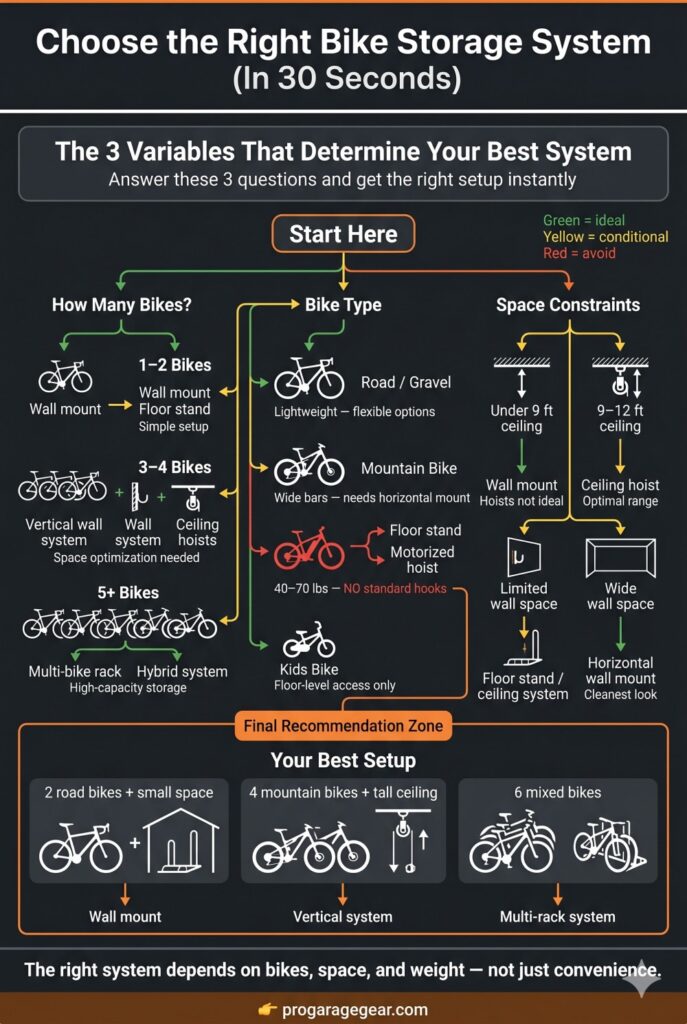
1. How Many Bikes?
- 1–2 bikes: Wall mount or floor stand. Keep it simple.
- 3–4 bikes: Vertical wall mount system or ceiling hoist (one per bike).
- 5+ bikes: Freestanding multi-bike storage rack or a combination approach.
2. What Type of Bikes?
- Road/gravel bikes (narrow, lightweight): Nearly any system works.
- Mountain bikes (wide handlebars, heavy): Need horizontal mounts with heavy-duty hooks; some vertical systems can’t fit wide bars.
- E-bikes (heavy — 40–70 lbs.): Require floor stands or motorized ceiling hoists. Not suitable for standard ceiling hooks.
- Kids’ bikes: Floor-level storage only — they need to access bikes themselves.
3. Ceiling Height and Wall Space?
- Under 9 ft. ceiling: Ceiling hoists are tight. Favor wall mounts.
- 9–12 ft. ceiling: Ceiling hoists work well.
- Limited wall space: Floor stand or ceiling hoist.
- Wide open walls: Horizontal wall mount is the cleanest solution visually.
Option 1: Floor Stands
Best for: Renters, frequent riders who access bikes daily, those who can’t mount anything to walls or ceilings.
How they work: A freestanding metal frame holds one or more bikes upright, usually engaging the wheel or the pedal/crank arm.
Pros:
- No tools, no installation, no damage to walls or ceiling
- Fully portable — take it when you move
- Works on any floor surface
- Accessible for kids and short riders
Cons:
- Uses floor space (your most valuable garage resource)
- Less visually clean than mounted systems
- Less secure (bikes can tip over if bumped)
Best picks:
Feedback Sports Velo Hinge Wall Rack (converted to floor): One of the only wall racks that folds flat against the wall when not in use — essentially giving you wall-mount cleanliness with near-floor-stand accessibility.
Bikehand Floor Bike Stand: Simple, adjustable, single-bike. Best for everyday-use bikes where you want maximum accessibility without any installation. It holds the bike by the crank arm rather than the wheel — better for bikes with fragile carbon fiber rims.

Option 2: Horizontal Wall Mounts
Best for: 1–4 bikes, available wall space, and riders who want a visually clean garage.
How they work: A hook screws directly into a wall stud. The bike hangs horizontally by one wheel (the front, usually), perpendicular to the wall.
Space math: Each horizontally hung bike requires approximately 24″ of wall width and projects 5–6 ft. into the garage from the wall. This is non-trivial. A bike hanging horizontally on a 6 ft. deep wall mount is 6 ft. of depth you can no longer use.
Pros:
- Inexpensive (quality hooks start at $15–$30)
- Easy installation (one lag screw per hook into a stud)
- Can double-stack if ceiling is high enough (one bike high, one bike at head height)
- Bikes are easily visible and accessible
Cons:
- Projects significantly into garage space
- Handlebars can snag on items behind the hung bike
- Not suitable for very heavy bikes (e-bikes, cargo bikes)
Best picks:
Steadyrack Classic Rack: The most innovative horizontal wall mount available. The bike pivots on the hook — the rear wheel swings in, and the bike hangs in a slightly angled position rather than fully horizontal. This reduces the depth projection and allows bikes hung next to each other to offset their handlebars. A garage game-changer for 2–4 bike households.
Delta Cycle Leonardo Single-Bike Wall Hook: The best basic option. Heavy-duty steel, foam padding to protect the rim, single lag-screw installation. At $25, this is the best bang-for-buck per bike.
Make sure your wall can safely support your bike storage system before drilling. Read our Heavy Duty Garage Wall Mounts guide for anchoring guidance specific to garage wall types.
Option 3: Vertical Wall Mounts (Tires-Up Storage)
Best for: Tight wall space, 2–6 bikes, standard (not extra-wide) handlebars.
How they work: The bike is stored vertically — front wheel up, rear wheel down — hung by the front wheel from a hook on the wall. This dramatically reduces the wall width required per bike.
Space math: Each vertically hung bike requires only 10–15″ of wall width. Four bikes can fit in a 5 ft. wall section that would hold only two bikes horizontally.
Pros:
- Maximum bikes per linear foot of wall space
- Clean, professional look (popular in bike shops)
- Weight is lower on the hook (lighter bike tail near the ceiling)
Cons:
- Harder to lift bikes for older or shorter riders
- Thin-walled carbon fiber tires can be stressed by hook pressure over time (use foam-padded hooks)
- Standard mounts don’t work well with extra-wide mountain bike tires (2.4″+)
Best picks:
RAD Cycle Bicycle Wall Hanger Hook (4-Pack): Budget, reliable, foam-padded. Handles bikes up to 40 lbs. per hook. The 4-pack means you’re getting a full wall station at a fraction of the cost of branded systems.
Kuat Bottle Rocket Wall Mount: Premium option with an adjustable angle hook and dedicated helmet/gear holder integrated into the mount. For riders who want aesthetics and function in the same piece.
Option 4: Ceiling Hoists
Best for: 3+ bikes, high ceilings (9 ft.+), and garages where both wall and floor space is fully claimed.
How they work: A pulley system mounts to ceiling joists. Two padded hooks cradle the bike’s wheels. A rope lowers and raises the bike from the ceiling. Most hoists include a locking mechanism that holds the bike at ceiling height.
The weight reality: Most consumer hoists are rated for 50–100 lbs. per system. Standard bikes (road, mountain) weigh 20–30 lbs. — well within range. E-bikes at 50–70 lbs. require purpose-built e-bike hoists with higher ratings.
Pros:
- Uses zero wall and zero floor space
- Completely out of the way when not in use
- Can store 4–6 bikes above a parked car in a standard 2-car garage
Cons:
- Requires ceiling joist access (not suitable for all garage ceiling types)
- Physical effort to lower and raise (not ideal for daily use bikes)
- Risk of dropped bikes if locking mechanism fails — buy quality hoists only
- Not practical for children’s bikes (kids cannot operate the pulley)
Best picks:
Rad Cycle Products Heavy-Duty Bike Hoist: The most widely reviewed and consistently reliable bike ceiling hoist. The dual-pulley system means you only lift half the actual bike weight. The auto-locking mechanism engages automatically when you stop pulling the rope — the bike stays up without you holding anything. Rated for 100 lbs.
Racor PHB-1R Pro Ceiling Mount Bike Lift: Premium option with a locking carabiner safety system in addition to the standard rope lock. Two locking mechanisms means twice the protection against accidental drops. Worth the extra cost for homes with children.
Before mounting ceiling hoists, read our ceiling storage guide on joist load capacity: Best Overhead Garage Storage Racks 2026.
The Accessories That Complete Any Bike Storage System
Helmet Hook: Add a dedicated helmet hook adjacent to each bike mount. Helmets left on handlebars unbalance the bike and get knocked off constantly. A simple hook at eye level eliminates this problem.
Gear Hook/Shelf: Gloves, lights, pumps, and locks need a home near the bikes. A small wall-mount shelf or pegboard section adjacent to the bike area keeps all accessories together without searching.
Tire Pump with Gauge: A floor pump with an integrated pressure gauge should be stationed permanently in the bike zone. Checking tire pressure before every ride takes 60 seconds and prevents more flats than any other single habit.
Floor Mat Under the Storage Area: Bikes drip road grime, lubricant, and debris when brought in. A rubber mat under the bike storage area protects your floor and keeps the area contained and easy to clean.
For the best options to protect your floor under bike storage, see our Best Garage Floor Mats and Tiles guide.
🔒 Security Ratings: How to Lock Your Bikes While They’re on the Rack
Hanging a $3,000 carbon road bike or a $5,000 e-bike from a wall hook without any additional security is the same as parking your car on the street with the door unlocked. A garage break-in is fast — an unsecured bike off a wall hook takes under 15 seconds to remove. Here’s how to add a security layer to every rack type:
Security Compatibility by Rack Type
Floor Stands — Security Rating: ⭐⭐☆☆☆ (Low) Floor stands provide zero inherent security — the bike simply lifts off. To secure:
- Run a U-lock or chain lock through the frame and rear wheel, anchored to a floor anchor bolt (a concrete-anchor loop bolt, available for $15–$30)
- The floor anchor must be embedded in concrete with a minimum 3″ concrete anchor bolt — not screwed into tile or a thin surface
- A U-lock through the frame only (not anchored) prevents opportunistic theft but not a determined thief
Horizontal Wall Hooks — Security Rating: ⭐⭐⭐☆☆ (Moderate) The bike can be lifted off a horizontal hook easily — the hook offers friction only. To upgrade:
- Add a cable lock run through the frame and looped around the hook mount — this prevents the bike from being lifted off without cutting the cable
- For higher value: a U-lock through the rear wheel and frame, locked to the stud-mounted hook plate with a hardened shackle
- Recommended lock: Kryptonite Kryptolok Series 2 (rated Gold by Sold Secure — the European cycling security standard)
Steadyrack Pivoting System — Security Rating: ⭐⭐⭐☆☆ (Moderate) The Steadyrack’s pivot mechanism means the bike is held by the wheel hub — a determined thief can still remove the front wheel and take the bike. To upgrade:
- Use a front wheel skewer with a locking skewer (Pinhead or Pitlock brand) so the front wheel cannot be removed without the proprietary key
- Pair with a U-lock through the rear triangle anchored to the wall plate
Vertical Wall Mounts (tire-up storage) — Security Rating: ⭐⭐⭐⭐☆ (Good) Vertical storage is inherently more secure than horizontal — the bike’s weight works against an opportunistic thief (it’s awkward to grab and run with a vertically hung bike). To upgrade:
- Add a coiled cable lock run through the frame and looped over the mount arm — prevents lifting without cutting
- For maximum security: Replace stock mount bolts with security Torx bolts (require a special key-style driver to remove) so the mount itself cannot be unbolted
Ceiling Hoists — Security Rating: ⭐⭐⭐⭐⭐ (Excellent) Ceiling hoists are the most secure bike storage option. The bike is 8–12 feet in the air. The rope must be released to lower it. Theft requires a ladder, significant noise, and time. To make it virtually impossible:
- Add a Kryptoflex 1018 coiled cable run through the frame and locked to the rope anchor point at the ceiling
- Use a locking carabiner (rated for the bike’s weight) on the hoist rope so it cannot be unhooked without a key
The Security Layer System
For any rack type, the most effective security follows the “3-layer” principle used by professional bike security experts:
Layer 1 — Anchor: Something that connects the bike to a permanent structure (floor anchor, stud-mounted plate, or hoist ceiling mount) Layer 2 — Frame Lock: A hardened steel U-lock through the rear triangle of the frame (the main structural loop) — never lock only a wheel Layer 3 — Secondary Deterrent: A visible cable or coiled lock that makes theft visually complicated — most opportunistic thieves skip a bike that requires two cuts rather than one
Lock Ratings — What to Look For:
- Sold Secure Silver: Adequate for garage interiors (not street parking)
- Sold Secure Gold: Recommended for garages with vehicle access or e-bikes
- Sold Secure Diamond: The highest rating; necessary for high-value bikes or garages in high-crime areas
Recommended Minimum: For any bike over $1,000 stored in a garage: a Kryptonite Kryptolok (Gold rated) through the rear triangle and frame, anchored to the rack mount. For e-bikes over $2,500: a Kryptonite New York Fahgettaboudit (the most theft-resistant U-lock available) with a floor anchor.
The Insurance Consideration: Many homeowner’s insurance policies cover bikes stored in a locked garage up to $1,000–$2,500. For bikes above that value, a dedicated cycling insurance policy (Markel, Simple Bike Insurance) covers the full replacement value and typically requires documented secure storage (a locked garage + a rated lock). The annual premium for a $4,000 bike is usually $100–$200/year.
The Best System for Your Situation
| Situation | Best System |
|---|---|
| 1 bike, access daily | Bikehand Floor Stand or Delta Wall Hook |
| 2–3 bikes, available wall space | Steadyrack Classic (horizontal, pivoting) |
| 4+ bikes, tight wall space | Vertical wall mounts (RAD Cycle 4-pack) |
| 3+ bikes, 9+ ft. ceiling | Rad Cycle or Racor ceiling hoists |
| E-bikes or cargo bikes | Specific e-bike rated floor stand only |
| Kids’ bikes | Floor-level only — kids need independent access |
Is it bad to store a bike hanging by one wheel?
For most bikes, no. Aluminum and steel wheels handle this without issue. Carbon fiber wheels with very thin sidewalls can develop stress points over many months of the same hang point. Rotate the contact point occasionally or use a padded hook to distribute pressure.
Can I store bikes outside the garage in a shed instead?
You can, but humidity control is important. Outdoor sheds without climate control can develop high humidity levels that accelerate cable corrosion, bolt rusting, and drive lubricant breakdown. A dehumidifier in a sealed shed is worth considering for expensive bikes.
How do I store bikes so they don’t scratch each other’s paint?
Use foam pipe insulation (available at hardware stores for under $5) cut to length and slid onto any contact points between bikes. Cheap, effective, and nearly invisible.
The Bottom Line
Stop letting bikes live on your garage floor. The Steadyrack Classic is the best single system for 1–3 bikes in a home garage — the pivoting mechanism alone transforms how much space the bikes take. For 3+ bikes with ceiling height, the Rad Cycle Hoist lifts your entire bike fleet above your car and gives you your floor and walls back.
Your bikes deserve better than leaning against the wall. And so does your garage.