
Best Snow Foam Cannons 2026: How to Get Shaving-Cream Thick Foam (Spring Guide)
By Pro Garage Gear Team Last Updated: July 2026
Disclosure: This post contains affiliate links. We may earn a commission if you purchase through these links. We recommend products that actually create thick, clinging foam.
If your foam is runny, it’s not the soap. It’s the cannon.
We have all seen those Instagram photos: a high-end sports car completely coated in a layer of white foam so thick it looks like shaving cream.
But when you try it at home with your new pressure washer, it looks like… watery milk. It slides right off the paint before it can loosen any dirt.
The problem isn’t your soap, and it usually isn’t your pressure washer. The problem is the cheap plastic foam cannon that came in the box. In this guide we analyze the best snow foam cannons for pressure washer.
To get that “sticky” foam that dwells on the paint and pulls dirt off safely, you need a dedicated Snow Foam Cannon. And if you are using an electric pressure washer, you need to know the “1.1mm Secret.”
Foam Cannon vs. Foam Gun: Do You Need a Pressure Washer?
Everything in this guide assumes you own a pressure washer — a foam cannon requires pressurized water flow to atomize soap into thick foam, and none of the cannons below will produce meaningful foam on garden hose pressure alone.
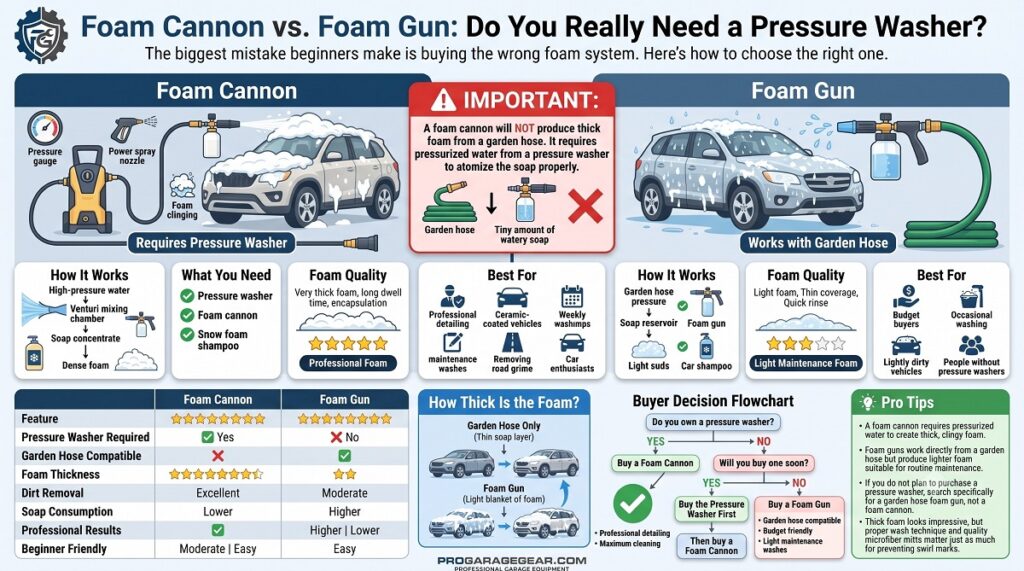
If you do not own a pressure washer and don’t plan to buy one, a foam gun — a separate category of product that attaches directly to a garden hose — produces a lighter, less dense foam using only hose pressure. It will not achieve the shaving-cream thickness this guide is about, but it is a legitimate lower-cost option for light maintenance washes. If a pressure washer is not in your plans, search “garden hose foam gun” rather than the cannons reviewed here.
➡️ Don’t have a pressure washer yet? Start here: Best Pressure Washer for Cars 2026 →
| Image | Product Name | Best For… | Build Quality | Buy Button |
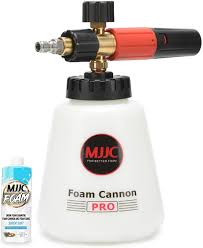 | MJJC Pro V2.0 | 🥇 Thickest Foam | Brass / Heavy | Buy Direct – 10% Off |
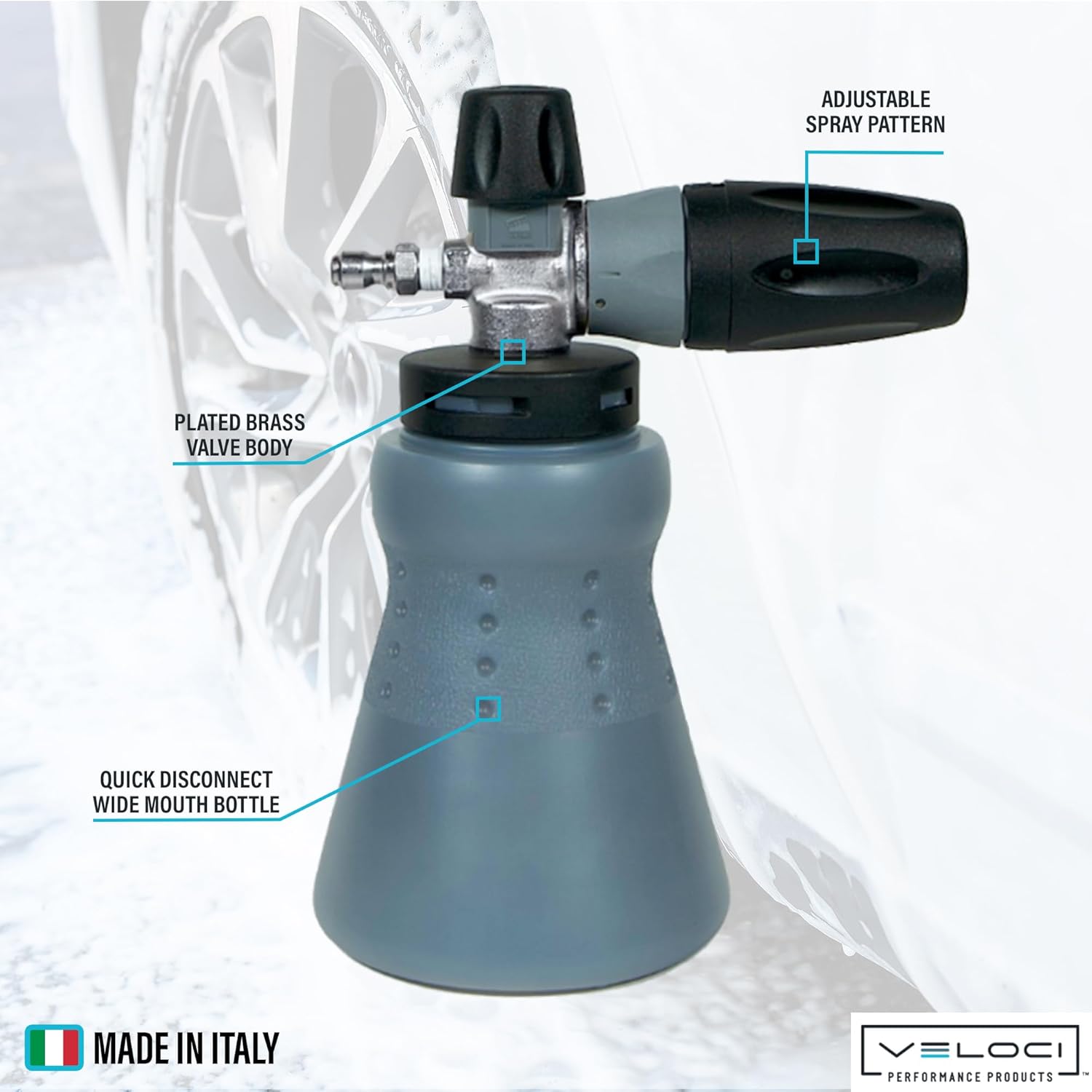 | MTM PF22.2 | “Buy It For Life” | Italian Brass | Check Amazon |
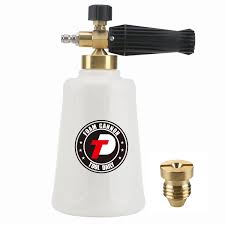 | Tool Daily | Budget Hack | Plastic/Brass | Check Amazon |
Here is the ultimate guide to foam cannons for 2025.
The Top 3 Foam Cannons (Ranked by Thickness)
1. The Undisputed King: MJJC Pro V2.0
Ask any professional detailer what they use. 9 out of 10 will say MJJC.
- The Build: It uses a heavy brass body, not cheap plastic. The bottle is wide and sturdy so it doesn’t tip over when you set it on the ground.
- The Tech: The “Pro V2” features a mesh filter system that agitates the soap mixture better than any other brand.
- The Result: It produces foam so thick it literally hangs on the car for 5 minutes without sliding off.
- The Feature: It comes with a flexible weighted straw, so you can spray upside down or at weird angles and it still sucks up soap.

2. The Best Value: MTM Hydro PF22.2
For years, this was the gold standard. It is still incredible, though slightly more expensive than the MJJC.
- Why buy it: It is Italian-made and virtually indestructible. If you want a tool that you will hand down to your grandkids, this is it.
- Adjustability: The nozzle allows you to adjust the fan pattern from vertical to horizontal, which is great for hitting roof racks or wheels.

3. The Budget Pick: Tool Daily Foam Cannon
If you cannot justify spending $50–$80 on a sprayer, this $20 Amazon option is “good enough”—IF you do the modification below.
- The Reality: Out of the box, it’s okay.
- The Hack: If you swap the internal orifice (see below), it competes with the big boys.
4. The “Built for Life” Alternative — Chemical Guys TORQ Foam Cannon
For buyers already invested in the Chemical Guys product ecosystem, the TORQ cannon is a legitimate step up from the Tool Daily budget tier without reaching MJJC/MTM pricing. It uses a brass core with a wide-mouth bottle designed specifically to pair with Chemical Guys’ own foam soaps.
- Build: Brass core, polycarbonate bottle (UV-stable)
- Bottle size: 1 Liter (34 oz)
- Adjustability: Separate dials for foam thickness and spray fan width
- Stock orifice: 1.25mm — electric pressure washer owners should budget for the 1.1mm swap
🛒 Check Price on Amazon — Chemical Guys TORQ Foam Cannon →
5. The Large-Bottle Option — Adam’s Polishes Foam Cannon
Most cannons ship with a 1-liter bottle, sufficient for one full vehicle wash. For anyone regularly foaming multiple vehicles (a driveway with 2-3 cars) or larger vehicles (trucks, RVs) in one session, a larger reservoir means fewer soap refills mid-wash.
- Build: Brass core with reinforced bottle threading
- Bottle size: 1.3 Liter — largest standard reservoir in this category
- Adjustability: Foam thickness dial + adjustable fan pattern
🛒 Check Price on Amazon — Adam’s Polishes Large Foam Cannon →
Complete Comparison: All 5 Cannons Side by Side
| Cannon | Build | Bottle Size | Stock Orifice | Price Tier | Best For |
|---|---|---|---|---|---|
| MJJC Pro V2.0 | Brass | 1L | 1.1mm (included!) | $$$ | Thickest foam, electric washers |
| MTM Hydro PF22.2 | Italian brass | 1L | 1.25mm | $$$ | Buy-it-for-life durability |
| Tool Daily | Plastic/brass | 1L | 1.25mm | $ | Budget + DIY orifice swap |
| Chemical Guys TORQ | Brass | 1L | 1.25mm | $$ | Chemical Guys ecosystem buyers |
| Adam’s Polishes | Brass | 1.3L | 1.25mm | $$ | Multiple vehicles per session |
The 1.1mm Orifice Hack: The Fix Electric Pressure Washer Owners Need
This is the secret that most detailing blogs won’t tell you.
Standard foam cannons ship with a 1.25mm orifice pre-installed. This size is calibrated for high-flow gas pressure washers (3+ GPM). If you run an electric pressure washer — Active 2.0, Ryobi, Sun Joe, Greenworks, or Giraffe Tools, all of which flow under 2.5 GPM — that 1.25mm opening is too large for your water flow to build pressure inside the cannon chamber. The result: watery, runny foam that slides off the paint instead of clinging to it.
The fix costs about $5 and takes five minutes.
Step-by-Step: Swapping the Orifice
- Buy a 1.1mm orifice nozzle — a small brass screw, sold separately on Amazon for most cannon brands.
- Access the internals. Use a crescent wrench to unscrew the 1/4″ quick-connect plug from the back of the cannon head.
- Locate the stock orifice. Inside the chamber you’ll see a flathead screw slot holding the factory 1.25mm orifice.
- Make the swap. Unscrew the 1.25mm orifice, screw in the 1.1mm replacement. Snug only — brass strips easily if overtightened.
- Reassemble and test. The restricted opening increases internal pressure, and a weak electric washer suddenly produces thick, rich foam instead of watery mist.
Note: The MJJC Pro V2 ships with a 1.1mm orifice already installed in the box — no swap needed if you buy that model.
Which Orifice Do You Actually Need?
| Pressure Washer | Flow Rate | Correct Orifice |
|---|---|---|
| Ryobi / Greenworks / Sun Joe (electric) | Under 2.0 GPM | 1.1mm — required |
| Active 2.0 / Kranzle (electric, higher-flow) | 2.0–2.5 GPM | Test both — 1.1mm usually thicker foam, 1.25mm is gentler on the motor |
| Simpson / Honda (gas) | Over 2.5 GPM | 1.25mm — keep stock |
🛒 Check Price on Amazon — 1.1mm Orifice Replacement Nozzle →
The Fitting Trap: Why Your New Cannon Leaks on Day One
The second most common foam cannon complaint after “the foam is watery” is “it leaks where it connects to my gun.” This is almost always a fitting mismatch, not a defective product.
Most snow foam cannons use a 1/4″ quick-connect fitting on the input side — but pressure washers themselves use different thread standards depending on brand. The most common conflict: M22-14mm vs M22-15mm threading on the pressure washer’s gun output. These look nearly identical but have a 1mm inner diameter difference that prevents the O-ring from seating correctly, producing a slow leak at the connection point every time the trigger is pulled.
Karcher uses a proprietary bayonet-style connector rather than M22 threading entirely — a Karcher-specific adapter is required to run most aftermarket foam cannons on a Karcher machine.
The universal fix: Rather than chasing the exact thread spec for your specific pressure washer brand, install a 3/8″ quick-connect kit at the gun output. This eliminates the fitting-matching question permanently — any QD-compatible foam cannon, nozzle, or accessory snaps on in one second with no leaks.
🛒 Check Price on Amazon — 3/8″ Quick Connect Kit (Universal Fitting Fix) →
➡️ For the full pressure washer fitting compatibility guide including Karcher-specific adapters: Best Wall Mount Pressure Washer with Reel 2026: The M22 Fitting Problem →
The Best Snow Foam Soaps
The cannon makes the foam, but the soap does the cleaning.
1. Best for Maintenance: Adam’s Car Shampoo
- Why: It is pH neutral. This means it won’t strip your wax or ceramic coating. It’s slick, foamy, and smells like berries. A safe, everyday choice.
2. Best for “Sticky” Foam: Chemical Guys Honeydew Snow Foam
- Why: This soap is formulated specifically for thickness. If your goal is just the coolest-looking foam for Instagram, this is the winner.
3. Best for Grime: Bilt Hamber Auto Foam
- Why: This is for the serious detailers. It doesn’t look as thick, but the cleaning power is unmatched. It eats road salt and bug guts better than anything else.
How to Mix (Stop Wasting Soap)
Don’t just dump soap in the bottle.
- Warm Water: Fill the cannon bottle 4/5ths full with Warm Water (not cold). Warm water mixes better.
- The Soap: Add 2–3 ounces of soap.
- Shake: Shake it gently.
- Settings: Turn the knob on top of the cannon all the way to the “Minus” (-) side. This means “Less Water / More Soap.”
| Foam Thickness | Soap Amount | Water Temp | Best For |
|---|---|---|---|
| Runny | 1 oz | Cold | Quick Rinse / Light Dust |
| Shaving Cream | 3 – 4 oz | WARM | Heavy Mud / “Instagram Shots” |
| Paint-Like | 5 oz+ | Warm | Not Recommended (Wastes Soap) |
Final Verdict
- Best Overall: Get the MJJC Pro V2.0. It includes the 1.1mm orifice you need for electric washers and produces the best foam, period.
- Best Budget: Get a generic Tool Daily Cannon and buy the separate 1.1mm Orifice.
Stop washing with watery soap. Upgrade your cannon and protect your paint.
(“You need a good pressure washer to power these cannons…”).
“Store your new cannon on your shelf next to your Wall mounted pressure washers
Frequently Asked Questions
Why is my foam cannon producing watery foam instead of thick foam?
Three most likely causes, in order of likelihood: (1) You have an electric pressure washer under 2.5 GPM running the stock 1.25mm orifice — swap to 1.1mm as described above. (2) Your soap is wax-heavy or an “all-in-one” formula — these foam thinner regardless of cannon quality; switch to a dedicated foam-specific soap. (3) You’re using cold water — warm water (not hot) mixes with soap concentrate more completely and produces thicker foam than cold water in the same cannon.
Do all foam cannons fit all pressure washers?
No. The input connector varies by pressure washer brand — most use M22 threading (in either 14mm or 15mm variants) while Karcher uses a proprietary bayonet connector. Check your pressure washer’s gun output fitting before ordering a cannon, or install a universal 3/8″ quick-connect kit to sidestep the compatibility question entirely (see Fitting Trap section above).
Can I use a foam cannon without a pressure washer?
Not for true “shaving cream” thick foam. Foam cannons rely on pressurized water flow to atomize soap into dense foam. Without a pressure washer, use a garden-hose foam gun instead — a different product category that produces lighter foam using only hose pressure.
How much soap should I use per wash?
For a standard 1-liter bottle: 2-3 oz for a maintenance wash on a lightly dirty car, 3-4 oz for the thick “Instagram” foam look on heavier dirt. Beyond 5 oz you’re wasting soap without meaningfully increasing thickness — see the Perfect Foam Recipe table above for the full breakdown by use case.
Is a brass foam cannon actually better than plastic?
Yes, for two concrete reasons beyond perceived quality. First, brass internals resist the corrosive effect of car soap concentrate better than plastic over repeated seasons of use — plastic threading on budget cannons is the most common failure point after 1-2 years. Second, brass adds weight low in the assembly, making the cannon more stable when set down on the ground between passes rather than tipping over.