Best Shop Vacs 2026: The Hose Diameter Rule, the Auto-Start Advantage, and the 6 Wet/Dry Vacuums That Handle Any Garage Mess
By Pro Garage Gear Team Updated: July 2026
Disclosure: This post contains affiliate links. As an Amazon Associate, we earn from qualifying purchases. We only recommend tools that can survive a real garage.
Your $500 Dyson might be great for your living room rug, but if you take it into the garage, it will die.
Drywall dust kills motors. Metal shavings tear up hoses. And if you try to suck up a puddle of water with a regular vacuum, you risk electrocution. This is why every homeowner needs a dedicated Wet/Dry Vacuum (commonly known as a Shop Vac).
But the aisle at the hardware store is confusing. You see numbers like “Peak HP,” “CFM,” and “Water Lift.” What do they actually mean?
In this guide, we cut through the marketing fluff to find the best shop vacs for 2025. Whether you are detailing your car, connecting it to a table saw, or just cleaning up a flooded basement, we have a pick for you.
The Hose Diameter Rule: Why This Spec Matters More Than Gallons or HP
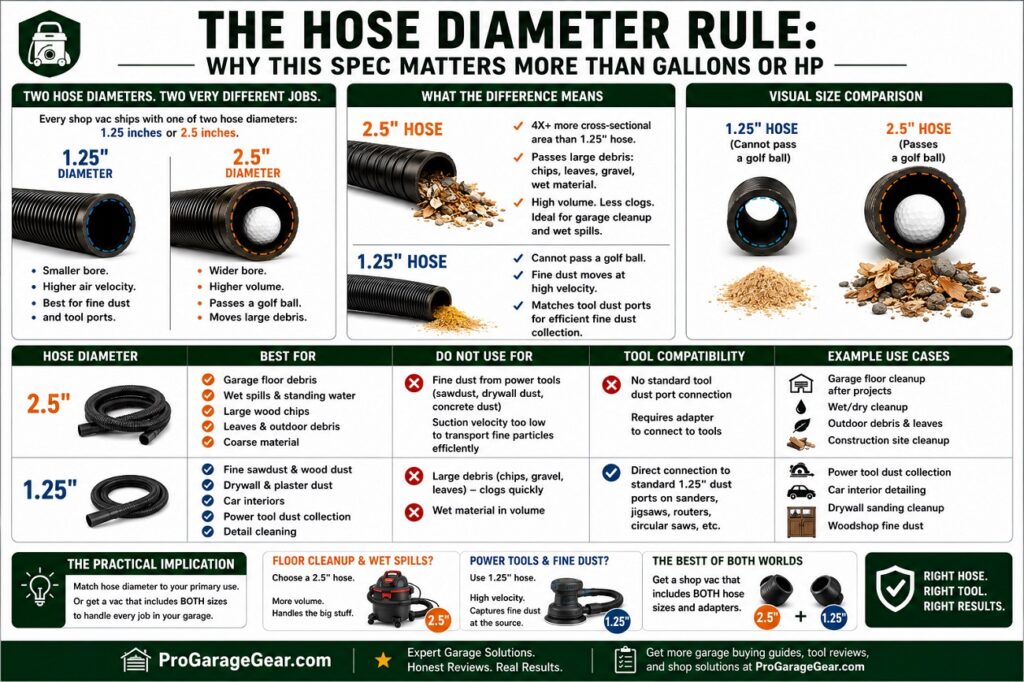
Every shop vac ships with one of two hose diameters: 1.25 inches or 2.5 inches. This is not a minor sizing detail — it determines what the vac can physically pick up and whether it is compatible with the dust ports on your power tools.
A 2.5-inch hose has more than four times the cross-sectional area of a 1.25-inch hose. It can pass a golf ball. Crumpled paper, large wood chips, wet leaves, and gravel flow through it freely. Connect it to a large debris source — a floor full of chips after running a router, a flooded garage after a storm — and the wide bore moves high volumes of material without clogging.
A 1.25-inch hose cannot pass a golf ball. Fine sawdust, drywall dust, and car interior debris move through it at high velocity because the smaller bore concentrates the airflow. It also matches the 1.25-inch dust port standard used by sanders, jigsaws, and circular saws — the port size built into most power tools for on-tool dust collection.
| Hose Diameter | Best For | Do NOT Use For | Tool Compatibility |
|---|---|---|---|
| 2.5 inches | Garage floor debris, wet spills, large chips, leaves, coarse material | Fine dust from power tools — suction velocity too low to transport fine particles efficiently | No standard tool dust port connection — requires adapter |
| 1.25 inches | Fine sawdust, drywall dust, car interiors, power tool dust collection | Large debris — clogs immediately with chips, gravel, or wet material in volume | Direct connection to standard 1.25″ sander, jigsaw, router dust ports |
The practical implication: For a garage used primarily for vehicle storage, general cleanup, and wet spills — the Craftsman 16-Gallon with its 2.5-inch hose is the correct specification. For a garage with an active woodworking bench where fine sawdust is the primary waste product — a vac that includes both a 2.5-inch hose for floor cleanup AND a 1.25-inch adapter for tool connection handles both use cases. The RIDGID NXT and most Vacmaster professional models ship with both hose sizes included.
🛒 Check Price on Amazon — Shop Vac Hose Adapter 1.25″ to 2.5″ (Dual-Use) →
The Auto-Start Advantage: The Feature That Turns a Shop Vac Into a Workshop System
A standard shop vac is a reactive tool — you run it after the mess is made. An auto-start shop vac is a proactive system — it captures dust at the moment of generation, before it becomes airborne, before it reaches the floor, and before it coats every surface in the shop.
Auto-start (also called tool-trigger or auto-on) works through a switched outlet built into the vac’s body. Plug your sander, circular saw, or router into this outlet, and the vac activates automatically when the tool is switched on — with no additional action from you. When the tool stops, the vac continues running for 3–6 seconds to clear residual dust from the hose, then shuts off automatically. You never touch the vac controls during the entire work session.
The health case for auto-start: Fine wood dust and MDF dust (which contains formaldehyde-based binders) are classified as human carcinogens by the IARC. The dust generated in the first second of a sanding operation — before you could reach down to switch on a separate vac — is the dust that lingers longest in room air. Auto-start captures it at source during those first seconds, reducing airborne dust concentration by 70–90% compared to manual-start vacuuming of the accumulated debris after the session.
Which vacs in this guide have auto-start:
- ✅ RIDGID NXT 14-Gallon — auto-start with switched outlet (see ranking below)
- ✅ DeWalt DXV10P — auto-start capable with tool-trigger accessory (sold separately)
- ✅ Vacmaster Professional Beast — auto-start capable with the VF408 adapter
- ❌ Craftsman 16-Gallon CMXEVBE17595 — no auto-start in base configuration
- ❌ Bissell Garage Pro — no auto-start (wall-mount unit, manual switch only)
🛒 Check Price on Amazon — Auto-Start Adapter for Shop Vac Tool-Trigger →
Dust Class Ratings: The Health Specification Nobody Mentions at the Point of Sale
The CFM number on a shop vac measures how fast it moves air. It says nothing about how much of the dust it captures stays in the machine rather than being exhausted back into the room through the filter. This is the specification that matters for respiratory health — and it is almost never mentioned in consumer shop vac listings.
IEC 60335-2-69 dust class ratings classify vacuums by their filtration efficiency:
| Dust Class | Filtration Efficiency | Suitable For | Not Suitable For |
|---|---|---|---|
| L-class (Low) | ≥99% at ≥1 µm particles | General construction debris, drywall mud, plaster | Fine wood dust, silica, MDF dust |
| M-class (Medium) | ≥99.9% at ≥0.5 µm particles | Fine wood dust, sanding residue, cement dust | Asbestos, lead paint, carcinogenic dusts |
| H-class (High) | ≥99.995% at ≥0.3 µm particles | Asbestos, lead paint, carcinogenic hardwood dusts | N/A — highest residential rating |
The practical translation for garage use:
- General garage cleanup (leaves, chips, garage floor): Standard cartridge filter — no class rating needed
- Wood sanding and sawdust: M-class filtration minimum — a standard pleated filter does not qualify. Requires a bag filter system or a HEPA cartridge that reaches M-class efficiency
- MDF cutting and sanding: M-class minimum. MDF dust contains formaldehyde-resin particles classified as carcinogenic at sustained exposure
- Old building materials (pre-1980): H-class — consult a professional before any DIY dust-generating work on pre-1980 construction materials
The honest shop vac limitation: Most consumer shop vacs sold at Home Depot and Amazon are not IEC dust class rated — they use standard pleated filters with no verified filtration efficiency specification. If your work regularly generates fine wood dust, MDF dust, or drywall compound dust: the correct solution is either a dedicated M-class dust extractor (Festool, Bosch) or a shop vac with a genuine HEPA cartridge filter that reaches M-class efficiency. The RIDGID NXT is the closest consumer shop vac to M-class performance with its HEPA cartridge option.
The Gallon Guide: How Much Tank Capacity Do You Actually Need?
Bigger tanks hold more before emptying — but a larger tank means a heavier, bulkier unit that is harder to manoeuvre around a car, under a workbench, and through a doorway. The correct tank size is the smallest size that does not require mid-session emptying for your most common use case.
| Primary Use | Recommended Capacity | Why |
|---|---|---|
| Car interior detailing | 2.5–5 gallons | Lightweight, portable, fits between seats. 16-gallon is unwieldy on a driveway. |
| Small woodworking projects (under 1 hour) | 5–10 gallons | Catches a session of dust without filling mid-project |
| Full garage floor cleanup | 10–16 gallons | Large debris volume fills small tanks quickly |
| Wet spill cleanup (flooding, water heater leak) | 12–16 gallons | Water is heavy — 5 gallons of water weighs 42 lbs. Smaller tanks fill and become unmovable quickly. |
| Connected to table saw or miter saw (auto-start) | 10–14 gallons | Fine dust compresses — a full session of sawing generates less volume than it looks. 10 gal handles most sessions. |
The 10-gallon sweet spot rule: For a homeowner who does a mix of general garage cleanup, occasional woodworking, and seasonal wet spill response, a 10-gallon unit handles every scenario without being too large for car detailing or too small for a flooded corner. The DeWalt DXV10P at 10 gallons exists at this sweet spot deliberately — it is the correct size for exactly this multi-use garage scenario.
Vacmaster Professional Beast — The Full Specification
- Tank capacity: 5 gallons
- CFM: 100
- Water Lift: 72 inches — highest in the 5-gallon category, best for pulling water from carpet
- Hose diameter: 1.875 inches — between the two standards, compatible with most tool ports via adapter
- Noise level: 79 dB
- Auto-start: Compatible with VF408 auto-start adapter (sold separately)
- IEC dust class: Not rated in base configuration
- Weight (empty): 6.5 lbs — most portable in the guide
DeWalt DXV10P — The Full Specification
- Tank capacity: 10 gallons
- CFM: 104
- Water Lift: 58 inches
- Hose diameter: 2.5 inches (included); 1.25-inch adapter compatible
- Noise level: 71 dB — the quietest in this guide; 11 dB quieter than the Craftsman
- Auto-start: Tool-trigger accessory compatible (DXCORDSET sold separately)
- IEC dust class: Not rated in base configuration; HEPA filter option upgrades performance
- Weight (empty): 17.6 lbs
Bissell Garage Pro — The Full Specification
- Tank capacity: 4 gallons
- CFM: 72 — lowest in this guide; adequate for car interior and light cleanup
- Water Lift: 52 inches
- Hose diameter: 1.25 inches — car interior and fine dust use
- Hose length: 32 feet — longest in the guide; parks on wall, reaches driveway
- Noise level: 74 dB
- Auto-start: No
- Mounting: Wall-mount bracket included; requires stud mounting
4. RIDGID 50313 WD1450 NXT Wet/Dry Vac (14 Gallon) — Best for Workshop Tool Connection
Verdict: The Correct Specification for Active Woodworkers
The RIDGID NXT is the shop vac that professional woodworkers and finishing carpenters specify when they need auto-start tool connection, a large tank that handles a full project session without emptying, and a genuine HEPA filter option that approaches M-class dust class performance. It is not the cheapest option in this guide. It is the correct option for any garage shop where power tools run daily and fine dust management is the primary concern.
The Data
- Tank capacity: 14 gallons — the largest capacity with auto-start in the consumer category
- CFM: 147 — near-Craftsman airflow with better filtration
- Water Lift: 60 inches
- Hose diameter: 2.5 inches (included) + 1.25-inch adapter (included) — both sizes ship in the box
- Noise level: 76 dB — 6 dB quieter than the Craftsman 16-gallon
- Auto-start: Yes — switched tool-trigger outlet on the vac body, included as standard
- IEC dust class: Not rated by default; optional HEPA cartridge (RV2400HF) approaches M-class
- HEPA filter option: Yes — sold separately, recommended for MDF and fine hardwood dust
- Drum material: High-impact polypropylene — resistant to chemicals including acetone and mineral spirits
- Weight (empty): 22.6 lbs
- Warranty: Lifetime warranty on all components including motor
Why the lifetime warranty matters for this category: Shop vac motors fail primarily from clogged filters — running fine dust through a vac without the correct filter loads the motor until it overheats. RIDGID’s lifetime warranty is backed by their nationwide service network and their confidence in the NXT motor assembly under sustained workshop use. No other consumer shop vac manufacturer in North America offers a lifetime motor warranty at this price point.
The auto-start installation: Plug the RIDGID into your 120V wall outlet. Plug your sander or saw into the tool-trigger outlet on the vac body. Switch the vac to “Auto” mode. From that point: the vac starts when the tool starts, runs for 5 seconds after the tool stops, and shuts off — fully automatic, no further interaction required.
🛒 Check Price on Amazon — RIDGID NXT 14-Gallon Auto-Start Wet/Dry Vac →
🛒 Check Price on Amazon — RIDGID HEPA Filter Upgrade (Fine Dust / MDF) →
Quick Summary: The Top 5 Wet/Dry Vacuums
Need to buy one right now? Here are our top picks by category.
| Model | Gallons | CFM | Hose | Noise | Auto-Start | Best For | Amazon |
|---|---|---|---|---|---|---|---|
| Craftsman 16-Gal | 16 | 150 | 2.5″ | 82 dB | ❌ | General garage cleanup | Shop → |
| Vacmaster Beast | 5 | 100 | 1.875″ | 79 dB | Via adapter | Car detailing | Shop → |
| DeWalt DXV10P | 10 | 104 | 2.5″ | 71 dB ✅ | Via accessory | Quiet workshop use | Shop → |
| RIDGID NXT 14-Gal | 14 | 147 | Both incl. | 76 dB | ✅ Built-in | Workshop tool connection | Shop → |
| Bissell Garage Pro | 4 | 72 | 1.25″ | 74 dB | ❌ | Wall-mount, small garage | Shop → |
| Armor All AA255 | 2.5 | 65 | 1.25″ | 72 dB | ❌ | Car trunk, compact spaces | Shop → |
Buying Guide: The Truth About “Peak HP”
🎯 Which Vac Do You Need? (The Power Matrix)
Best for: Heavy bolts, deep car carpets, wet mats.
We Pick: Vacmaster BeastBest for: Sawdust piles, drywall dust, leaves.
We Pick: Craftsman 16-GallonBefore you buy, you need to understand one dirty secret of the industry: “Peak Horsepower” is mostly a marketing gimmick.
Manufacturers measure the horsepower for a split second before the motor burns out, just to put a big number on the box. Instead of HP, look for these two specs:
- CFM (Cubic Feet per Minute): This measures airflow. High CFM is what you need to pick up light, bulky debris like sawdust, leaves, and wood chips.
- Water Lift (Sealed Pressure): This measures suction force. High Water Lift is what you need to pull water out of a wet carpet or suck up heavy items like bolts and coins.
- Rule of Thumb: For a general garage vac, look for at least 90 CFM.
The 6 Best Shop Vacs for Garage Use: 2026 Rankings
1. Craftsman 16-Gallon Heavy-Duty (CMXEVBE17595)
Verdict: The Best Overall “Do-It-All” Vacuum
The Full Specification
- Tank capacity: 16 gallons (dry) / 15 gallons (wet)
- CFM: 150 — best airflow in the standard consumer category
- Water Lift: 56 inches — strong suction for heavy debris
- Hose diameter: 2.5 inches — correct for floor cleanup and large debris
- Noise level: 82 dB — louder than the DeWalt, appropriate for open garages
- Auto-start: No — manual switch only
- IEC dust class: Not rated — standard pleated filter
- Drain port: Yes — bottom drain, no lifting required for liquid disposal
- Blower function: Yes — hose reversal converts to blower
- Weight (empty): 14.7 lbs
If you picture a shop vac in your head, this is probably what you see. The Craftsman 16-Gallon is the workhorse of the American garage. It is big, loud, and virtually indestructible.
Pros:
- Massive capacity.
- Dual-Flex hose resists kinking.
- Blower port (turn the hose around to blow leaves out of the garage).
Cons:
- Bulky (takes up a lot of floor space).

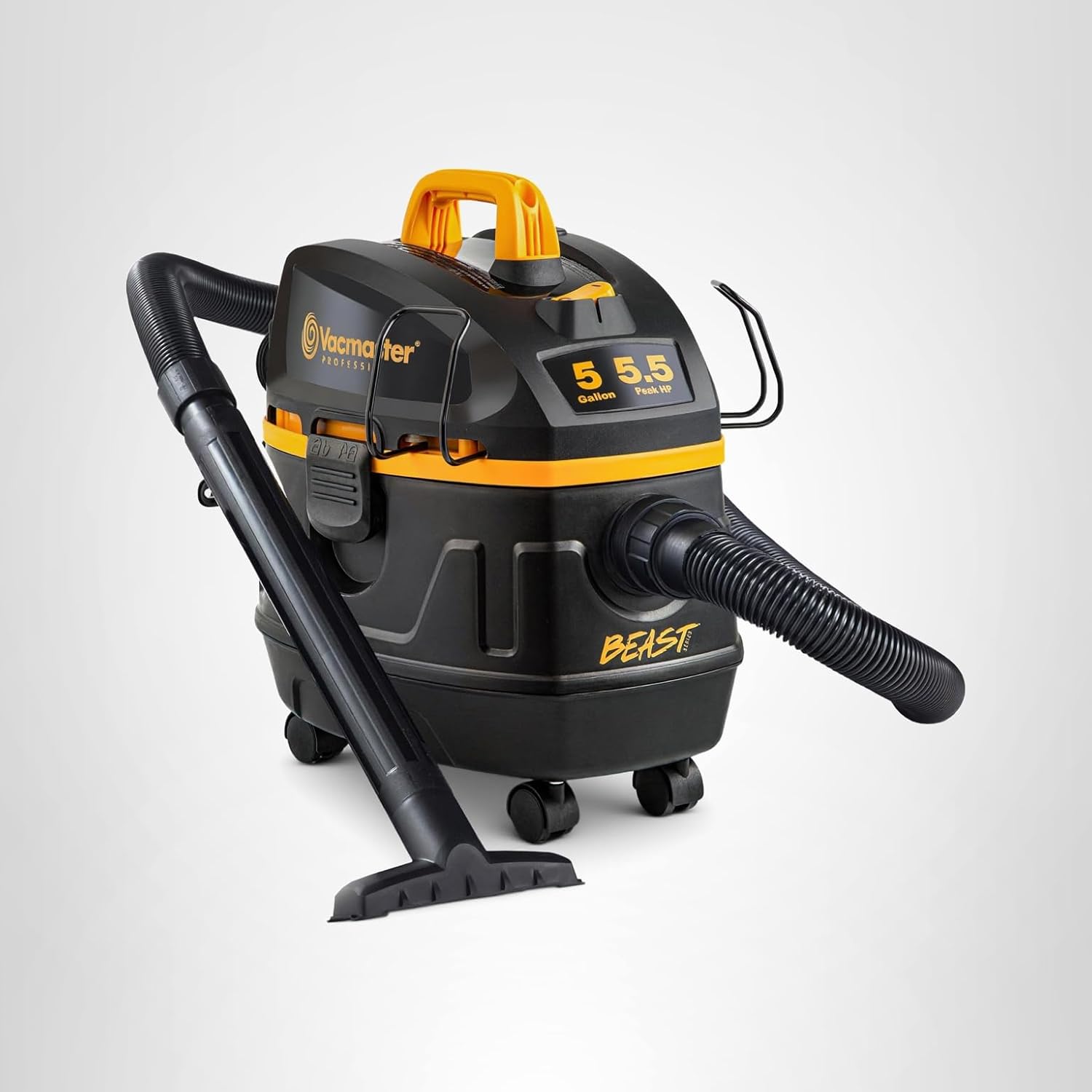
2. Vacmaster Professional “Beast” Series (5 Gallon)
Verdict: Best for Car Detailing
The Full Specification
- Tank capacity: 5 gallons
- CFM: 100
- Water Lift: 72 inches — highest in the 5-gallon category, best for pulling water from carpet
- Hose diameter: 1.875 inches — between the two standards, compatible with most tool ports via adapter
- Noise level: 79 dB
- Auto-start: Compatible with VF408 auto-start adapter (sold separately)
- IEC dust class: Not rated in base configuration
- Weight (empty): 6.5 lbs — most portable in the guide
Bigger isn’t always better. If your main goal is detailing your car, a 16-gallon drum is annoying to drag around your driveway. The Vacmaster Beast is designed for mobility and high suction.
- Why Detailers Love It: It has incredible “Water Lift” specs, making it amazing at sucking shampoo/water out of car mats.
- Storage: The hose and cords store neatly on board, so you don’t have a tangled mess.
Pros:
- Easy to carry (lightweight).
- High suction power for its size.
- Comes with a foam filter for wet pickup.
Cons:
- The 5-gallon tank fills up fast if you are doing woodworking.
3. DeWalt DXV10P (10 Gallon)
Verdict: The Quietest & Most Rugged
The Full Specification
- Tank capacity: 10 gallons
- CFM: 104
- Water Lift: 58 inches
- Hose diameter: 2.5 inches (included); 1.25-inch adapter compatible
- Noise level: 71 dB — the quietest in this guide; 11 dB quieter than the Craftsman
- Auto-start: Tool-trigger accessory compatible (DXCORDSET sold separately)
- IEC dust class: Not rated in base configuration; HEPA filter option upgrades performance
- Weight (empty): 17.6 lbs
If you run a workshop where you need to think (or listen to music) while you work, the “scream” of a standard shop vac is unbearable. The DeWalt DXV10P is significantly quieter than the competition while still offering pro-level power.
- Durability: It features heavy-duty rubberized casters (wheels) that roll smoothly over concrete cracks and cords without tipping over.
- Capacity: 10 Gallons is the “Sweet Spot”—big enough for sawdust, but small enough to tuck under a workbench.
Pros:
- Much quieter operation.
- Rugged construction.
- Sturdy handle for lifting.
Cons:
- Slightly more expensive than other brands.

4. Bissell Garage Pro Wall-Mounted System
Verdict: Best Space Saver
The Full Specification
- Tank capacity: 4 gallons
- CFM: 72 — lowest in this guide; adequate for car interior and light cleanup
- Water Lift: 52 inches
- Hose diameter: 1.25 inches — car interior and fine dust use
- Hose length: 32 feet — longest in the guide; parks on wall, reaches driveway
- Noise level: 74 dB
- Auto-start: No
- Mounting: Wall-mount bracket included; requires stud mounting
Stop tripping over your vacuum. The Bissell Garage Pro mounts permanently to your wall, just like the vacuums at the car wash.
- Reach: It comes with a massive 32-foot hose. You can mount the unit near the door and reach your car in the driveway without ever moving the vacuum.
- Filtration: It uses a 2-stage filtration system, which is great for fine dust.
Pros:
- Zero floor space required.
- Longest hose on the market.
- Looks professional on the wall.
Cons:
- Not portable (you can’t take it to the basement).
- Smaller tank capacity (4 gallons).

5. RIDGID 50313 WD1450 NXT Wet/Dry Vac (14 Gallon) — Best for Workshop Tool Connection
Verdict: The Correct Specification for Active Woodworkers
The RIDGID NXT is the shop vac that professional woodworkers and finishing carpenters specify when they need auto-start tool connection, a large tank that handles a full project session without emptying, and a genuine HEPA filter option that approaches M-class dust class performance. It is not the cheapest option in this guide. It is the correct option for any garage shop where power tools run daily and fine dust management is the primary concern.
The Data
- Tank capacity: 14 gallons — the largest capacity with auto-start in the consumer category
- CFM: 147 — near-Craftsman airflow with better filtration
- Water Lift: 60 inches
- Hose diameter: 2.5 inches (included) + 1.25-inch adapter (included) — both sizes ship in the box
- Noise level: 76 dB — 6 dB quieter than the Craftsman 16-gallon
- Auto-start: Yes — switched tool-trigger outlet on the vac body, included as standard
- IEC dust class: Not rated by default; optional HEPA cartridge (RV2400HF) approaches M-class
- HEPA filter option: Yes — sold separately, recommended for MDF and fine hardwood dust
- Drum material: High-impact polypropylene — resistant to chemicals including acetone and mineral spirits
- Weight (empty): 22.6 lbs
- Warranty: Lifetime warranty on all components including motor
Why the lifetime warranty matters for this category: Shop vac motors fail primarily from clogged filters — running fine dust through a vac without the correct filter loads the motor until it overheats. RIDGID’s lifetime warranty is backed by their nationwide service network and their confidence in the NXT motor assembly under sustained workshop use. No other consumer shop vac manufacturer in North America offers a lifetime motor warranty at this price point.
The auto-start installation: Plug the RIDGID into your 120V wall outlet. Plug your sander or saw into the tool-trigger outlet on the vac body. Switch the vac to “Auto” mode. From that point: the vac starts when the tool starts, runs for 5 seconds after the tool stops, and shuts off — fully automatic, no further interaction required.
🛒 Check Price on Amazon — RIDGID NXT 14-Gallon Auto-Start Wet/Dry Vac →
🛒 Check Price on Amazon — RIDGID HEPA Filter Upgrade (Fine Dust / MDF) →
6. Armor All AA255 (2.5 Gallon)
Verdict: Best Budget / Portable
Sometimes you just need to clean up a spilled box of cereal or vacuum the trunk of your car. You don’t need a beast; you need the Armor All AA255.
- Power: Don’t be fooled by the size. It plugs into a standard wall outlet (it is not a weak 12V car vacuum) and has surprising suction.
- Conversion: It converts into a handheld blower, which is perfect for drying motorcycle engines or blowing dust off a dashboard.
Pros:
- Extremely cheap (often under $50).
- Lightweight and tiny.
Cons:
- Short hose.
- Not for heavy-duty construction debris.

Maintenance Tip: The “Filter Rule”
If you only remember one thing from this article, make it this:
⚠️ STOP: Check Your Filter Setup
-
1. Are you vacuuming LIQUIDS?
👉 REMOVE Paper Filter. Install Foam Sleeve. -
2. Are you vacuuming DRYWALL DUST?
👉 INSTALL Collection Bag. (Fine dust kills motors). -
3. General Garage Dirt?
👉 Standard Cartridge Filter is OK.
Remove the paper filter before sucking up water.
Standard pleated paper filters are for dry dust only. If they get wet, they turn into a soggy, moldy mess and will ruin your motor’s suction.
- For Dry Messes: Keep the white paper filter on (it stops dust from blowing back into the air).
- For Wet Messes: Take the paper filter off. Most vacs come with a “Foam Sleeve” for wet use.
Frequently Asked Questions (FAQ)
What is the difference between a Shop Vac and a Dust Extractor, and when does the distinction matter?
A shop vac is a general-purpose wet/dry vacuum with a large drum, high CFM, and a standard pleated filter. A dust extractor is a purpose-built tool for capturing fine dust directly at the source, with certified filtration efficiency (M-class or H-class IEC rating), lower airflow but higher filter capture rate, and a sealed system designed to prevent bypass — fine particles escaping around the filter into the exhaust air. The distinction matters when the dust itself is the hazard: for MDF sanding, hardwood routing, and any dust that you breathe continuously over the course of a workshop session. For general garage floor cleanup, wet spills, and coarse debris: a shop vac is always the correct tool. For sustained fine dust work where you do not wear a respirator: either a dust extractor or a shop vac upgraded to M-class filtration is the correct choice.
Can I use my shop vac for drywall dust?
Yes, with an important filter modification. Drywall dust is extremely fine — particles in the 0.5–10 micron range — and it passes through a standard pleated paper filter in high volumes. Using a shop vac for drywall dust without a collection bag causes two problems: the filter clogs within minutes and suction drops severely, and fine particles bypass the clogged filter and exhaust into the room air. The correct setup for drywall dust: install a disposable collection bag inside the drum before the filter, use a fine dust cartridge filter or HEPA upgrade, and empty the bag outside. This setup maintains suction throughout the session and prevents fine dust recirculation. Replace the bag after every drywall cleanup session regardless of how full it appears — drywall dust is denser than it looks and the bag load is heavier than it feels.
How often should I clean my shop vac filter?
For dry debris use: after every session that involves fine dust (sanding, drywall, sawdust). For general garage debris: every 3–5 uses or when suction noticeably decreases — whichever comes first. The fastest filter check: hold your hand 6 inches from the exhaust port. Warm dusty air exhausting from the port means the filter is bypassed and needs cleaning or replacement. No perceptible exhaust from the port means the filter is clogged and restricting airflow. Tap the cartridge filter sharply against the inside of a rubbish bin to dislodge the dust cake without washing — washing a pleated paper filter leaves residual moisture that collapses the pleats when it dries and permanently reduces filter area.
Can I use a shop vac without a bag?
Yes. The bag is optional. However, if you are sucking up fine dust (like drywall or sanding dust), we highly recommend using a bag. Without it, the fine dust will clog your filter in minutes and blow back out the exhaust.
What is the difference between a Shop Vac and a Dust Extractor?
A Shop Vac is a general-purpose cleanup tool. A Dust Extractor is a specialized, expensive tool (usually $400+) designed to connect directly to power tools (like sanders) to capture 99.9% of dust to protect your lungs. For general garage use, a Shop Vac is fine.
Can a shop vac pick up glass?
Yes! Shop vacs handle broken glass easily. Just be careful when emptying the bin later.
Final Verdict
If you connect tools to your vac: RIDGID NXT (auto-start built-in, both hose sizes included, lifetime warranty). If silence is the priority: DeWalt DXV10P at 71 dB — 11 dB quieter than the Craftsman. All other use cases below:
- For the Homeowner who wants one tool to do it all: Get the Craftsman 16-Gallon. It’s big, cheap, and powerful.
- For the Car Enthusiast: Get the Vacmaster Beast. It’s the perfect size for detailing.
- For the Small Garage: Get the Bissell Garage Pro and get it off the floor.
Keep your shop clean and your lungs safe! A Shop Vac cleans the floor, but what about the air? Read our review of Best Air Filtration Systems. For the exterior of your car, you’ll need Pressure Washer