Best Garage Workbench Vises 2026: The One Tool That Makes Every Other Tool Work Better
Affiliate Disclosure: Pro Garage Gear earns from qualifying Amazon purchases at no extra cost to you.
The “Third Hand” Moment: You’re trying to cut a dovetail joint. You need both hands on the saw, but the workpiece keeps sliding. You’ve clamped it to the bench, but the clamp is in the way of the cut. You’ve tried holding it with your knee. You’ve tried leaning on it. None of it works — because you’re trying to do a two-handed job with one piece of equipment. A bench vise is your third hand. And the right one makes every cutting, filing, assembly, and bending task faster, safer, and more precise.
But the wrong vise — and there are many wrong vises being sold as “professional grade” — strips its screw under load, has jaw faces that flex, or mounts to the bench with a rocking, unstable base that defeats the entire purpose of clamping something firmly.
This guide shows you the difference.
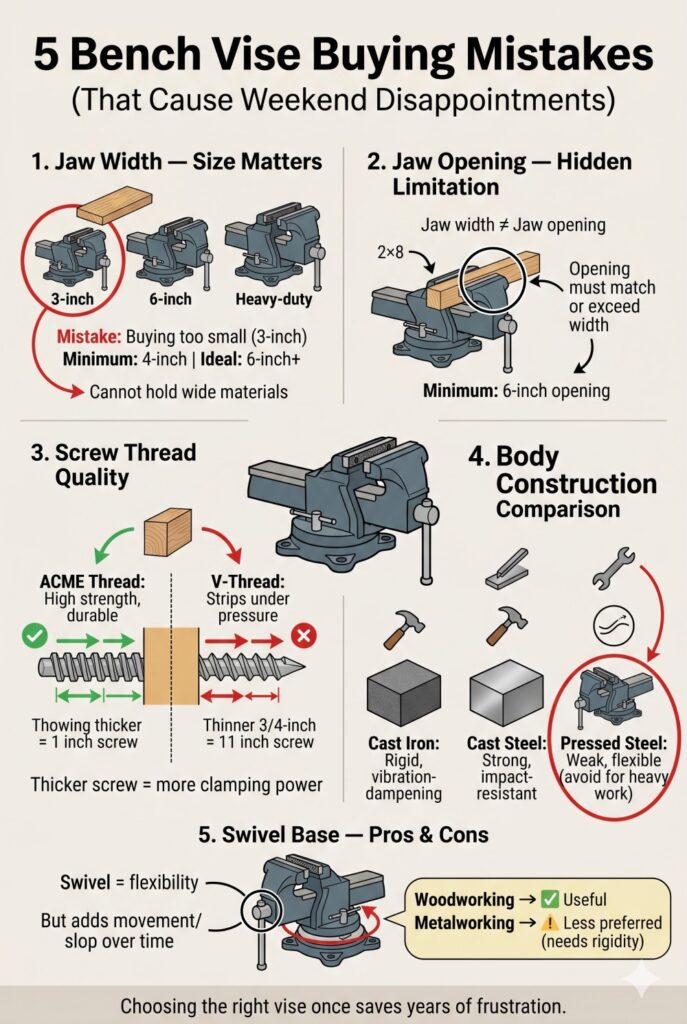
The 5 Specifications That Separate Workshop Vises from Weekend Disappointments
1. Jaw Width — The Primary Size Indicator
Jaw width determines the maximum width of material you can grip. The minimum for a functional garage workshop vise is 4 inches. Serious workshop use: 6 inches. Automotive and heavy fabrication: 8 inches+.
A common mistake: buying a 3-inch jaw vise (sold as “compact” or “hobby”) thinking it will handle most tasks. Assembling anything wider than a 2×4 — shelving, door frames, workbench legs — becomes impossible with a 3-inch jaw.
2. Jaw Opening — How Much It Opens
Distinct from jaw width. A 6-inch wide vise with only a 6-inch opening can’t hold a piece of 2×8 lumber on edge. Look for an opening at least equal to (ideally greater than) the jaw width. For general workshop use: 6-inch opening minimum.
3. Screw Thread Type and Diameter
The screw mechanism transfers your clamping force to the jaws. Quality vises use ACME thread screws — a trapezoidal thread profile that handles high clamping loads without stripping. Cheap vises use standard V-thread (the same thread as a bolt) which strips under high torque.
Screw diameter: 3/4-inch screw handles light work. 1-inch or larger handles serious workshop loads. The screw diameter is rarely advertised — ask the manufacturer or look for reviews that mention screw size.
4. Body Construction: Cast Iron vs. Cast Steel vs. Pressed Steel
| Material | Properties | Best For |
|---|---|---|
| Ductile Cast Iron | High rigidity, vibration-dampening, can crack under shock loads | General woodworking, metalworking without impact |
| Cast Steel | Higher strength than cast iron, withstands impact | Automotive, heavy fabrication |
| Pressed/Stamped Steel | Lightweight, flexible under load, not suitable for heavy use | Hobby/light use only |
How to identify at purchase: Cast iron vises are heavy and have a slightly rough, matte texture. Pressed steel vises are light and have sharply stamped edges. Cast steel is heavier than pressed steel but lighter than cast iron. In all cases, the vise body should feel rigid — press hard on the jaw with your hand and there should be zero flex.
5. Swivel Base — Necessary or Not?
A swivel base rotates the entire vise relative to the bench, allowing you to orient the workpiece in any direction without rotating the workpiece itself. For woodworking: useful. For metalworking: less critical (metalworkers often want a fixed, zero-flex mounting). The swivel mechanism adds a joint — and joints can develop slop over time.
Recommendation: For general garage use, a swivel-base vise is worth the premium. Lock it solid during use — the swivel is for positioning, not for use under load.
⚠️ The Anvil Safety Warning: The Crack That Ends Your Vise
Every bench vise has a flat area on the top of the fixed jaw called the anvil. It looks like a natural hammering surface — flat, steel, solidly mounted. Many users instinctively use it as one. This is where cast iron vises fail catastrophically.
Cast iron is rigid but brittle. It handles compressive loads (clamping) exceptionally well. It handles impact loads (hammering) very poorly. A sharp impact concentrates stress at the base of the anvil — exactly where the casting transitions from the anvil pad to the jaw body. This is the thinnest, most stress-concentrated section of the entire casting. One hard hammer blow can crack the vise body at this junction — a crack that propagates invisibly until the jaw suddenly separates during use.
| Vise Material | Safe for Hammering on Anvil? | Why |
|---|---|---|
| Ductile Cast Iron | ❌ Never | Brittle — impact causes cracking at anvil base |
| Gray Cast Iron | ❌ Never | More brittle than ductile iron |
| Cast Steel | ✅ Yes, moderate | Malleable — deforms rather than cracks under impact |
| Forged Steel (Yost FSV-6) | ✅ Yes | Highest impact resistance of any vise material |
For the Olympia Budget Pick (cast iron): Never hammer on the anvil. If you need an anvil surface, use a separate hardy anvil block mounted to your bench. The Olympia is an excellent clamping vise — keep it as one.
For the Yost FSV-6 (forged steel) and Wilton 11106 (cast steel): Moderate hammering on the anvil is acceptable, but the anvil pad is hardened separately from the body — heavy striking can pit or crack the hardened pad over time. Use a steel-faced hammer, not a ball-peen, for any anvil work.
➡️ Shop Hardy Anvil Block for Workbench on Amazon
🧲 The “Frequently Bought Together” Add-On: Magnetic Soft Jaw Pads
Every vise purchase should include a set of magnetic soft jaw pads — full stop. The hardened steel serrations on vise jaw faces will mar finished wood, scratch aluminum, deform copper tubing, and leave permanent impressions on any soft material. Soft jaw pads clip or magnetically attach over the steel faces in seconds and protect the workpiece completely.
Why magnetic matters over clip-on: Magnetic pads install and remove with one hand — you can switch from steel to soft jaws in 3 seconds while holding the workpiece. Clip-on pads require two hands to install and often fall off during clamping.
Best pick: Pair-Tec Magnetic Vise Pads — neodymium magnets hold to any steel jaw face, available in 4-inch and 6-inch widths to match your vise.
➡️ Check Price — Magnetic Vise Jaw Pads (4-inch, fits Olympia) on Amazon
➡️ Check Price — Magnetic Vise Jaw Pads (6-inch, fits Yost/Wilton) on Amazon
The “Complete Vise Kit” Bundle: Vise + Magnetic Soft Jaws + Hardy Anvil Block = a complete metalworking and woodworking station for under $250. Add a bench dog set for through-bench clamping and you’ve eliminated the need for a separate clamping table.
➡️ Shop Bench Dog Sets on Amazon
2026 Rankings: Best Garage Workbench Vises for Workshops
🥇 #1 — Yost FSV-6 6-Inch Forged Steel Vise (Best All-Around)
Jaw Width: 6 inches Jaw Opening: 7.5 inches Body: Forged steel (stronger than cast iron, shock-resistant) Screw: 1-inch diameter ACME thread Base: Full swivel with locking
The Yost FSV-6 is the benchmark home garage vise because it delivers forged steel construction (typically found only in professional vises costing $300+) at a price accessible to serious DIYers. The forged steel body won’t crack under impact — a critical advantage for automotive work where you’re pounding things free.
The 1-inch ACME screw delivers genuinely usable clamping force. At full torque on the handle, the Yost generates enough pressure to crush softwood — which means it holds anything you’ll ever need to hold with confidence.
The 7.5-inch opening handles almost every common workshop task: door assembly, cabinet building, pipe work, engine parts.
Honest downside: Heavy at 26 lbs. Mounting to a lightweight workbench requires the bench itself to be well-secured to the floor or wall.
🥈 #2 — Wilton 11106 6-Inch Bench Vise (Best Premium Pick)
Jaw Width: 6 inches Jaw Opening: 6.5 inches Body: Cast steel Screw: 1-inch ACME Base: Swivel
Wilton is the name professional metalworkers and machinists reach for when they need a vise that will be used daily for decades. The 11106 uses cast steel with hardened steel jaw faces (removable and replaceable — an important detail for long-term ownership). The jaw face hardness (Rockwell 60) means the serrations that grip the workpiece stay sharp for years of heavy use.
The heavy-duty swivel base locks absolutely solid — there’s no movement or flex when locked, which is characteristic of professional-grade vises and rare in consumer models.
Honest downside: Expensive. If you use a vise 5 times a year, the Yost is more appropriate. If you use it daily, the Wilton pays for itself through longevity.
🥉 #3 — Olympia Tools 38-624 4-Inch Bench Vise (Best Budget Pick)
Jaw Width: 4 inches Jaw Opening: 4 inches Body: Cast iron Screw: 3/4-inch Base: Fixed (no swivel)
For the homeowner who needs a vise for occasional use — holding work while drilling, light bending, basic assembly — the Olympia 4-inch delivers legitimate cast iron construction at a budget price. The fixed base is a compromise (no swivel) but creates a more rigid mounting than most swivel-base vises at this price.
Honest downside: 4-inch jaw limits what you can work on. The 3/4-inch screw limits maximum clamping force. Sufficient for light workshop use; not suitable for automotive or heavy metalworking.
The Complete Vise Comparison Table
| Vise | Jaw Width | Opening | Body | Screw | Swivel | Best For | Amazon |
|---|---|---|---|---|---|---|---|
| Yost FSV-6 | 6″ | 7.5″ | Forged Steel | 1″ ACME | Yes | General/Automotive | View → |
| Wilton 11106 | 6″ | 6.5″ | Cast Steel | 1″ ACME | Yes | Professional Daily | View → |
| Olympia 38-624 | 4″ | 4″ | Cast Iron | 3/4″ | No | Light Workshop | View → |
| JET 321545A 5″ | 5″ | 6.5″ | Ductile Iron | 7/8″ | Yes | Woodworking | View → |
| Irwin 226354 4″ | 4″ | 3.75″ | Cast Iron | 5/8″ | Yes | Budget/First vise | View → |
Installing Your Vise: The Right Way
Mount position: The vise jaw should be flush with the front edge of the bench top — this allows long pieces to hang down vertically through the jaw without hitting the bench leg.
Height: When standing at your normal posture, the top of the closed vise jaws should align with the crease at the bottom of your palm. Too high = shoulder strain. Too low = back strain.
Fasteners: Use through-bolts, not screws into the bench top. A vise generates enormous downward and rocking forces on its mount. Screws into wood will pull out over time; through-bolts are permanent.
Soft Jaw Pads: Hardened steel jaw faces will mar finished wood and soft metals. Purchase or fabricate soft jaw pads (available in wood, plastic, or rubber) that clip over the steel jaws for finishing work.
➡️ Shop Bench Vise Soft Jaw Pads on Amazon
Best Adjustable Garage Workbenches 2026: mounting your vise
What size bench vise do I need?
4-inch for occasional light use. 6-inch for a real workshop. 8-inch+ for automotive/heavy fabrication. If you’re unsure, buy 6-inch — you’ll never wish you had less jaw width, and you’ll frequently wish you had more.
Cast iron vs. cast steel — which is stronger?
Cast steel is stronger and more impact-resistant. Cast iron is more rigid and excellent at dampening vibration, but can crack under sharp impact loads. For general woodworking: cast iron is fine. For automotive work involving hammering: choose cast steel.
How do I lubricate a bench vise?
Apply a thin coat of machine oil or white lithium grease to the screw thread every 6–12 months of regular use. Wipe the jaw slides with an oily rag. Never use WD-40 for long-term lubrication — it’s a water displacer, not a lubricant, and it evaporates quickly.
The Bottom Line
For most garage workshops in 2026, the Yost FSV-6 is the correct choice — forged steel construction, 1-inch ACME screw, and a 7.5-inch opening that handles virtually every task at a price that doesn’t require justification. Mount it to a solid bench, install through-bolts, and it will be there for every project you do for the next 20 years.
A bench without a vise is just a table. A bench with a good vise is a workshop.