
Best Garage Cabinet Systems 2026: The Steel Gauge Reality Check Nobody in This Industry Wants to Publish
Affiliate Disclosure: Pro Garage Gear participates in the Amazon Services LLC Associates Program. We earn from qualifying purchases at no extra cost to you. No manufacturer has paid for placement in this guide.
Best Garage Cabinet Systems – The Backwards Number: Every garage cabinet listing on the internet advertises its steel gauge as if a bigger number were better. “24-gauge steel construction.” “18-gauge heavy-duty frame.” Buyers see the bigger number and assume it means more steel, more strength, more durability — the same intuition that applies to horsepower, PSI, or lumens everywhere else in this category.
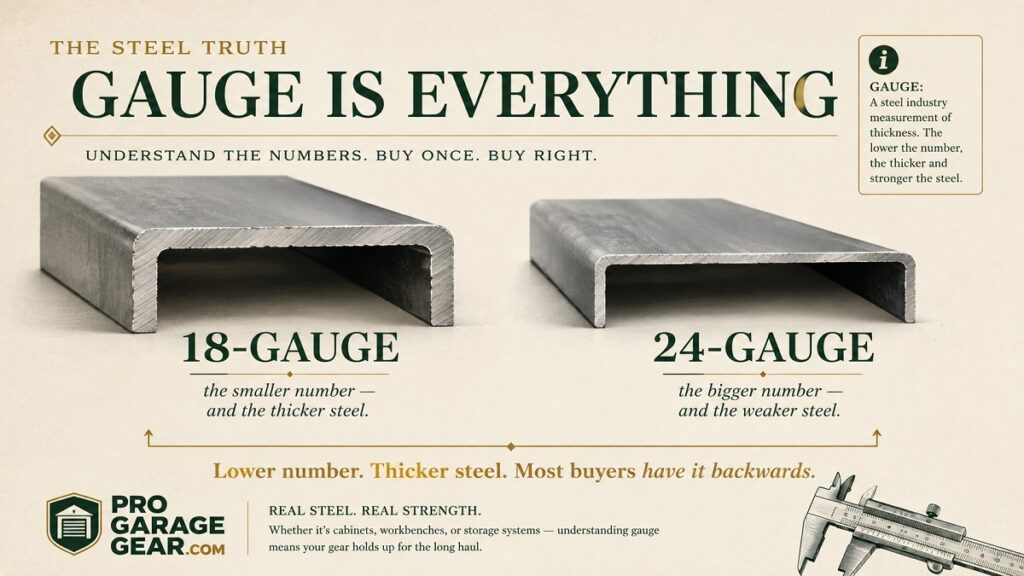
It’s backwards. In sheet steel gauge measurement, the number is inversely proportional to thickness — 18-gauge steel is thicker and stronger than 24-gauge steel, not the other way around. A cabinet advertised with the bigger, more prominent gauge number is, specification for specification, the thinner and weaker one. This single point of confusion is responsible for more garage cabinet buyer’s remorse than any other factor in this category, and after reading through the marketing copy of every major manufacturer in this space, we found exactly zero of them clarify it anywhere near the number itself.
It gets worse. Manufacturers don’t all measure gauge at the same point on a cabinet. Some state the gauge of the door face. Others state the frame. A few blend an average across the whole unit in their marketing copy without specifying which component they measured. Two cabinets can both claim “20-gauge steel” and have meaningfully different actual wall thickness once you account for where each brand took its measurement.
This guide starts by normalizing steel gauge into actual measured thickness across every major brand in this category — the comparison the manufacturers themselves have never published side by side — then covers weight capacity methodology, a full Total Cost of Ownership breakdown, and ranks the best garage cabinet systems for 2026 across every tier from entry-level to professional-grade.
The Steel Gauge Reality Check: What the Numbers Actually Mean
Before any brand comparison, here is the conversion table that should appear on every cabinet listing and doesn’t. Sheet steel gauge is a legacy measurement system with no consistent mathematical formula across metal types — for the carbon/mild steel used in garage cabinets specifically, the standard conversion looks like this:
The Steel Gauge & Weight Capacity Calculator
Select a gauge from the table above and a real-world load type to see an estimated effective shelf capacity — and why the same shelf behaves differently depending on how it’s actually loaded.
📏 Steel Gauge & Weight Capacity Calculator
Estimate effective shelf capacity based on gauge and real-world loading.
* Base capacity figures are illustrative estimates for typical residential shelf spans at each gauge tier, not measured ratings for any specific product — always confirm the manufacturer’s actual stated capacity for the exact model you’re buying. Use this tool to understand how load type changes effective capacity, not as a substitute for a product’s own spec sheet.
The practical takeaway: when comparing two cabinets, the one with the lower gauge number has thicker, heavier, more dent-resistant steel — full stop. If a listing doesn’t state a gauge number at all, treat that as a red flag rather than an oversight; it’s almost always because the number would be unflattering.
➡️ For the full dent-resistance testing methodology behind these numbers, applied specifically to NewAge’s own two tiers: NewAge Bold 3.0 vs Pro 3.0: The Dent Factor Test →
Where Manufacturers Measure Gauge — And Why It Matters
A second, subtler problem: “the cabinet is 20-gauge steel” doesn’t tell you which part of the cabinet that refers to. The three components that matter most, roughly in order of how much they affect real-world durability:
- Door face gauge — what you touch and see, and what takes impact damage from tools, bikes, and the occasional dropped wrench. This is the component most brands are proudest of and most likely to prominently state.
- Frame/carcass gauge — the structural box the doors and drawers mount to. Often thinner than the door face because it doesn’t take direct impact, but this is what determines whether the whole unit racks or flexes under load over years of use.
- Shelf gauge — frequently the thinnest component on any cabinet regardless of brand, and the one most likely to sag under a genuinely heavy, concentrated load (a stack of paint cans, a car battery, a toolbox).
The buying rule: if a product listing states only one gauge number with no component specified, assume it refers to the most flattering measurement — almost always the door face — and budget for the frame and shelves to be a step down from that number in actual thickness.
Weight Capacity: The Number That’s Almost Always Measured Under Ideal Conditions
Every cabinet lists a weight capacity — “200 lbs per shelf,” “1,000 lbs total” — and almost none of them specify the loading condition that number assumes. This matters because the real-world way people load a garage cabinet is rarely the way manufacturers test it.
| Load Type | What It Means | Real-World Example | Effective Capacity vs. Rated |
|---|---|---|---|
| Evenly distributed | Weight spread uniformly across the full shelf surface | A layer of small parts bins covering the whole shelf | Matches rated capacity most closely |
| Concentrated / point load | Weight focused on a small contact area | A car battery or a single dense toolbox sitting in the shelf’s center | Can be 40-60% of rated capacity before visible deflection |
| Dynamic / impact load | Weight dropped or set down with force rather than placed gently | Sliding a full 5-gallon bucket onto the shelf rather than lifting it | Can exceed static rated capacity momentarily regardless of gauge |
The rated capacity on any cabinet’s spec sheet is a static, evenly-distributed number obtained under laboratory conditions. A shelf rated for 200 lbs distributed does not reliably hold 200 lbs concentrated at its center — this is a function of basic beam deflection physics, not a manufacturing shortcoming, and it applies to every brand in this guide equally. Heavier-gauge steel (lower gauge number) narrows this gap because the material itself resists deflection better under concentrated load, but no cabinet at any price point is immune to the distinction.
Protecting the Steel You’re Loading
Bare steel shelves and drawer bottoms scratch under the weight of tools sliding in and out — and in an uninsulated garage, exposed scratches are where localized rust starts first, well before the rest of the cabinet shows any wear. A non-slip rubber drawer liner protects the finish and keeps tools from sliding during the concentrated-load scenarios covered above.
🛒 Check Price on Amazon — Extra-Thick Non-Slip Drawer Liner →
The Three-Tier Market: Where Every Buyer Actually Falls
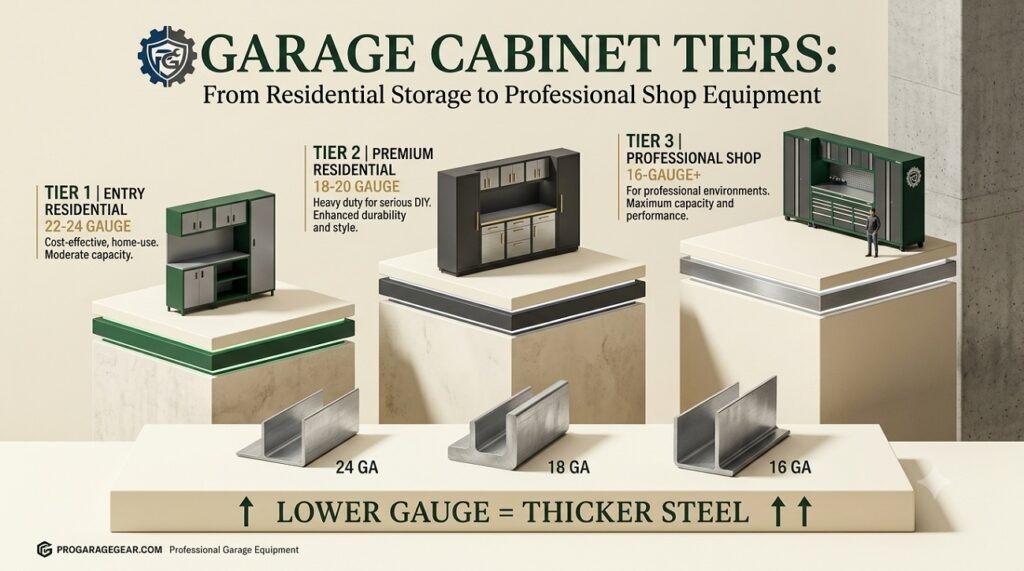
Nearly every garage cabinet buying guide compares the same three or four mainstream brands at similar price points. What almost none of them do is acknowledge that a genuine professional tier exists above all of them — and that for a meaningful subset of buyers, that tier is the correct answer even though it never appears in mainstream “best of” lists.
Tier 1 — Residential Entry ($150–$600 per cabinet)
24-to-22-gauge steel, RTA (ready-to-assemble) construction, typically sold individually or in small sets. NewAge Bold 3.0 and most Husky Ready-to-Assemble products live here. Correct for light-to-moderate storage, occasional DIY use, and buyers who want a clean organized look without a five-figure investment.
Tier 2 — Residential Premium ($600–$1,500 per cabinet)
20-to-18-gauge steel, heavier hardware, often available pre-assembled or with white-glove delivery. NewAge Pro 3.0 and premium Gladiator GearBox configurations live here. Correct for active home mechanics, serious hobbyists, and anyone whose garage functions as a genuine workspace rather than just parking-plus-storage.
Tier 3 — Professional / Industrial ($2,000–$20,000+ per cabinet)
16-gauge and heavier steel, often built to commercial/industrial specifications, sold by companies that primarily serve auto shops, fabrication businesses, and collector garages rather than residential DIYers. This tier essentially never appears in mainstream residential buying guides — but it’s exactly what serious enthusiasts on forums like Garage Journal are actually comparing when budget stops being the constraint.
| Brand | Typical Gauge | Market Position | Who It’s For |
|---|---|---|---|
| Lista | 16-gauge+ | Industrial modular drawer systems | Collectors and shops with high-value small-parts organization needs |
| Vidmar | 16-gauge+ | Industrial modular drawer systems | Similar positioning to Lista — often compared as a direct alternative |
| Strong Hold | Heavy industrial | Cabinets, workbenches, shelving built for constant heavy-duty commercial handling | Buyers who move/reconfigure cabinets often and need units that survive forklift bumps |
| Sonic Tools (MSS/MSS+) | Premium modular | High-end modular systems with foam tool organization integration | Enthusiasts building a showroom-quality shop who want the foam-inlay aesthetic |
The honest guidance on Tier 3: if you’re reading a $300 cabinet review trying to decide between NewAge Bold and Husky RTA, this tier is not relevant to you yet, and that’s fine — Tier 1 and 2 genuinely serve the overwhelming majority of residential garages well. This tier exists for the reader whose budget question has already shifted from “which brand” to “how much am I willing to spend on the best possible outcome” — and for that reader, not knowing this tier exists at all is a bigger gap than any spec comparison within Tier 1 or 2 could fix.
2026 Rankings: The Best Garage Cabinet Systems by Tier
🥇 Best Overall (Tier 2) — NewAge Pro 3.0
Why it earns #1: 18-gauge steel across the frame (verified against the gauge table above — genuinely heavy-duty, not just marketed as such), a 24-inch cabinet depth that accommodates full-size storage totes without modification, and a limited lifetime warranty on the structural frame. This is the reference standard the rest of the residential-premium tier is measured against.
The Data
- Steel gauge: 18-gauge frame
- Depth: 24 inches
- Door mechanism: Side-swing hinged doors
- Warranty: Limited lifetime on frame/structure; 1-3 years on moving hardware
- Assembly: RTA — approximately 6 hours for a full multi-piece set
➡️ For the full internal NewAge comparison including the Tote Test, Wall Fit Calculator, and door mechanism breakdown: NewAge Bold 3.0 vs Pro 3.0: The Complete Guide →
🛒 Check Price on Amazon — NewAge Pro 3.0 Garage Cabinet System →
🥈 Best Value (Tier 1) — Gladiator Ready-to-Assemble GearBox
Why it earns #2: A genuinely modular system — full-door and half-door configurations, an optional caster kit, and a hardwood worktop accessory that turns a base cabinet into a functional workbench. Backed by a 10-year limited warranty, longer than most products at this price tier offer.
The Data
- Typical dimensions (full-door GearBox): 28″W x 31″H x 18″D
- Extra Large GearBox: 6ft H x 4ft W x 1.5ft D — sized for oversized items like tents and large tubs
- Warranty: 10-year limited
- Modularity: Compatible with optional caster kit and hardwood worktop; not compatible with caster kit on the Extra Large configuration specifically — confirm compatibility per model before ordering accessories
🛒 Check Price on Amazon — Gladiator GearBox Garage Cabinet →
Worth adding at purchase: the optional caster kit turns a GearBox from a fixed floor unit into a mobile one — genuinely useful in a garage where you periodically need to clean or work behind the cabinet, not just for repositioning. Confirm compatibility with your specific GearBox configuration before ordering, since the Extra Large model is not compatible with the standard caster kit.
🛒 Check Price on Amazon — Gladiator Heavy-Duty Caster Kit →
🥉 Best Budget Entry (Tier 1) — Husky Ready-to-Assemble Steel Cabinet
Why it earns #3: The lowest genuine cost-per-cabinet in the steel category covered in this guide, without dropping to plastic construction. Correct for buyers organizing a garage for the first time who want a real steel cabinet rather than a resin unit, at the lowest defensible price point.
The Data
- Steel gauge: Typically 20-22 gauge depending on specific model — verify the listing states a gauge number at all before ordering (see the red-flag guidance above)
- Construction: RTA, standard hardware
- Best for: First-time garage organization, budget-conscious buyers who still want steel over resin
🛒 Check Price on Amazon — Husky Ready-to-Assemble Steel Garage Cabinet →
⭐ Best Entry Point — NewAge Bold 3.0
For buyers specifically comparing within the NewAge ecosystem rather than across brands, Bold 3.0 remains the correct entry tier — 24-gauge steel, 18-inch depth, and meaningfully lower cost than Pro 3.0. The full trade-off analysis (tote compatibility, door mechanism, dent resistance) is covered in depth in our dedicated comparison.
➡️ Full NewAge Bold vs Pro comparison, including the Wall Fit Calculator →
🛒 Check Price on Amazon — NewAge Bold 3.0 Garage Cabinet →
Complete Comparison Table
| System | Tier | Steel Gauge | Depth | Warranty | Best For | Amazon |
|---|---|---|---|---|---|---|
| NewAge Pro 3.0 | 2 (Premium) | 18-gauge | 24″ | Limited lifetime (frame) | Best overall — active workspace | Shop → |
| Gladiator GearBox RTA | 1 (Entry) | Varies by model | 18″ | 10-year limited | Best value / modularity | Shop → |
| Husky RTA Steel | 1 (Entry) | 20-22 gauge | Varies | Standard limited | Lowest-cost genuine steel option | Shop → |
| NewAge Bold 3.0 | 1 (Entry) | 24-gauge | 18″ | Limited lifetime (frame) | NewAge ecosystem entry point | Shop → |
| Lista / Vidmar / Strong Hold | 3 (Professional) | 16-gauge+ | Varies | Commercial-grade terms | Enthusiast/collector shops, budget secondary | Contact dealer directly |
The Total Cost of Ownership Calculator
The sticker price on a single cabinet is rarely the full cost of a finished garage wall. Enter your planned setup below to estimate the real total — including assembly time valued at your own hourly rate, and the accessories most buyers add after the base purchase.
💰 Total Cost of Ownership Calculator
💰 Total Cost of Ownership Calculator
Base cabinets are only part of the real cost — see the full picture.
* Estimates based on typical pricing patterns at each tier as of this guide’s publication. Actual prices vary by retailer, promotion, and specific model. Professional-tier (Tier 3) pricing varies too widely by configuration for a meaningful per-cabinet estimate — contact a dealer directly for a quote.
Level Before You Anchor: The Sloped Floor Problem
Most garage floors slope toward the door by design — typically 1/8″ to 1/4″ of fall per foot, there to send water toward the driveway rather than pooling against the back wall. That slope is invisible when you’re looking at an empty floor and very visible the moment you join several rigid cabinets into one run without accounting for it.
A cabinet bank set directly on a sloped floor without independent leveling doesn’t sit flat — it leans, and when adjacent units are bolted together to form one continuous run, that lean translates into the frames racking slightly against each other. The visible symptom shows up weeks later, not on install day: side-swing doors that no longer latch flush, or drawers that bind partway through their travel because the whole box has twisted a few degrees out of square.
The fix — before joining any units together:
- Use adjustable leveling legs (most Tier 1 and Tier 2 cabinets ship with them, or they’re a cheap add-on if not) rather than setting the unit directly on the floor.
- Place a 4-foot level across the top of each individual cabinet in both directions — depth and width — before connecting it to its neighbor.
- Adjust the leveling legs to bring each cabinet level on its own, compensating for the floor’s slope at that specific spot, before joining it to the next unit.
- Only after every individual cabinet is independently level should you bolt the run together and anchor it to the wall.
Skipping this step is the single most common reason a correctly-assembled RTA cabinet run develops door and drawer problems after installation — it’s rarely a manufacturing defect, it’s the floor.
🛒 Check Price on Amazon — Adjustable Leveling Legs (Garage Cabinet) →
🛒 Check Price on Amazon — 48″ Magnetic Aluminum Level →

Installation and Anchoring: What Every System Needs Regardless of Brand
A cabinet’s steel gauge only protects the contents if the unit itself is secured correctly. Freestanding cabinets over about 4 feet tall should be anchored to a wall stud with a tip-restraint strap, especially in households with children — this applies equally to every brand and tier in this guide.
For brick or concrete block walls specifically: the standard anchor hardware that ships with most cabinets is sized for wood studs, not masonry. If you’re anchoring a freestanding unit to a block or brick wall — which matters most as a tip-restraint safety measure in households with children — a masonry-rated anchor kit is the correct hardware rather than whatever came in the box.
🛒 Check Price on Amazon — Tapcon Masonry Anchor Kit →
➡️ For stud spacing, anchor pull-out ratings by wall type, and the full load-capacity math behind wall-mounted storage generally: Best Garage Shelving 2026: The Anchor Capacity Test →
For wall-hung cabinet configurations specifically (as opposed to freestanding base cabinets), confirm your wall construction meets the same anchor standards covered in that guide before mounting anything above a workbench or vehicle.
Mounting Against Raw Concrete or Masonry: The Condensation Risk
If your garage walls are uninsulated concrete block or a raw foundation surface rather than framed and drywalled, direct contact between that masonry and a steel cabinet back is worth a second thought — particularly for Tier 1’s thinner 22-to-24-gauge steel, which cools and warms faster than heavier gauge material.
Masonry holds a lot of thermal mass and stays cool relative to the surrounding air, especially through spring and summer temperature swings. Warm, humid garage air reaching a cabinet back that’s in direct contact with that cool surface can condense at the contact point — the same basic mechanism behind the “Wind Tunnel Effect” moisture problems covered in our garage door insulation guide. This isn’t a certainty in every garage; it’s a real risk that’s more pronounced in humid climates, in garages without any climate control, and during seasonal humidity swings rather than a guaranteed outcome everywhere.
The fix: use plastic spacers or shims behind the cabinet’s mounting points against masonry walls, creating a small air gap — roughly 1/8 inch — between the steel back and the wall surface. This breaks the direct thermal contact and gives any moisture that does form a path to evaporate rather than staying trapped against the steel.
➡️ For the same moisture mechanics applied to garage doors and the broader Wind Tunnel Effect concept: Best Garage Door Insulation Kits 2026 →
🛒 Check Price on Amazon — Plastic Standoff Spacers (Wall Mounting) →
Frequently Asked Questions
Is lower gauge steel always better for garage cabinets?
For raw strength and dent resistance, yes — lower gauge number means thicker steel, as covered in the Reality Check section above. It isn’t the only factor worth weighing, though: heavier gauge steel adds real weight to the cabinet itself, which matters if you’re wall-mounting rather than floor-standing, and it typically adds meaningfully to cost. For a floor-standing cabinet in a garage with normal residential use, Tier 2’s 18-20 gauge range delivers strong real-world durability without the cost premium of Tier 3’s 16-gauge-and-heavier professional systems.
How much weight can a typical garage cabinet shelf actually hold?
Check the manufacturer’s stated rating first, then apply the distinction in the Weight Capacity section above — a shelf rated for 200 lbs evenly distributed will not reliably hold 200 lbs concentrated in the center. For heavy, dense items (car batteries, cast iron tools, large paint cans), place them toward the rear of the shelf near the frame’s structural support rather than centered on an unsupported span, and don’t assume the full rated number applies to a small-footprint heavy object.
Should I buy pre-assembled or RTA (ready-to-assemble) garage cabinets?
RTA is standard at Tier 1 and common at Tier 2, and the Total Cost of Ownership calculator above accounts for the real time cost of DIY assembly — for a full 4-6 cabinet Tier 2 setup, budget 6-10+ hours of assembly time. Pre-assembled or professionally-installed options exist at higher cost but eliminate that time investment and generally reduce the risk of alignment issues that can affect door and drawer operation on a self-assembled unit. If your time has a high opportunity cost, run both scenarios through the calculator above before deciding.
One assembly warning regardless of which route you choose: if you do go RTA, never assemble Tier 1 cabinets (22-24 gauge steel) with a high-torque impact driver. Thin sheet metal strips out its pre-threaded holes almost instantly under impact-driver torque, and once a hole is stripped the structural connection at that point is permanently compromised — there’s no clean fix short of re-threading or replacing the panel. Use hand tools, or a cordless drill with the clutch set to its lowest torque setting, and stop the moment you feel resistance rather than driving through it.
What’s the difference between NewAge, Gladiator, and Husky at a similar price point?
At comparable price points, the differences come down to steel gauge (verify using the conversion table above rather than trusting the raw number alone), warranty length (Gladiator’s 10-year limited warranty on GearBox products is longer than most comparable Tier 1 options), and modularity (Gladiator’s accessory ecosystem — caster kits, worktops — is broader than most competitors at the same tier). NewAge differentiates primarily through its two clearly defined tiers (Bold vs Pro) making the upgrade decision more transparent than brands with less clearly segmented product lines.
When does it make sense to look at professional-tier brands like Lista or Vidmar?
When your actual requirement has shifted from “organize a residential garage affordably” to “build the best possible outcome regardless of cost” — see the Three-Tier Market section above. This is also the right tier to investigate if your garage functions as a genuine income-generating workspace (a side business, a serious restoration project with high-value tools and parts) where the cabinet system is a business asset rather than a household purchase, and the total cost is evaluated against that different set of priorities.
The Bottom Line
Steel gauge is the single most misunderstood specification in this entire product category — remember that the smaller number means the thicker, stronger steel, and verify which component of the cabinet any stated gauge actually refers to before comparing two products on that basis alone. For most residential garages, Tier 2 systems like the NewAge Pro 3.0 deliver the best balance of genuine durability and reasonable cost. For budget-conscious first-time buyers, Gladiator’s GearBox and Husky’s RTA steel line both deliver real steel construction without a Tier 2 price tag. And for the reader whose garage has become a serious workspace or business asset: know that Tier 3 exists, even though almost nobody else covering this category will tell you.
Affiliate Disclosure: Pro Garage Gear earns from qualifying Amazon purchases at no extra cost to you. Steel gauge and thickness conversions are standard industry figures for carbon/mild steel. Always confirm the specific gauge and measurement point for any individual product listing before purchasing, as specifications can vary by model year and configuration.