
Best Garage Dehumidifiers 2026: Why Your Tools Are Rusting (And the Humidity Number You Must Hit)
This post contains affiliate links. We may earn a commission if you purchase through these links.

The “Invisible Rust” Problem: You store a beautiful set of chrome socket wrenches in your garage. Six months later, you open the drawer and find a reddish-brown film coating the chrome. You didn’t leave them outside. You didn’t get them wet. But they rusted anyway. Here’s why: your garage air is doing it for you — silently, invisibly, every single night.
Garages are humidity traps. Concrete floors absorb and release moisture. Vehicle exhaust adds water vapor. Rain drives moisture under door seals. And the single most effective thing you can do to protect your tools, your car, your flooring, and your lungs from all of it costs less than $300 and runs on a standard outlet.
This is the definitive guide to garage dehumidifiers in 2026.
Understanding Garage Humidity: The Numbers That Matter
Relative Humidity (RH%) is the percentage of water vapor in the air relative to the maximum amount air can hold at that temperature.
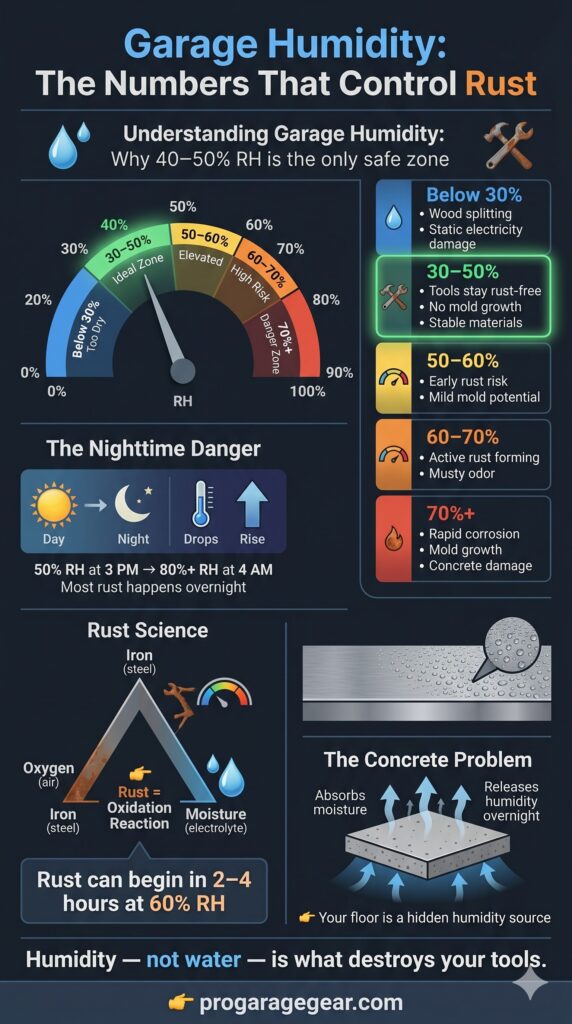
For a garage workshop, the target is 40–50% RH year-round. Here’s what happens outside that range:
| RH% | Condition | Consequences |
|---|---|---|
| Below 30% | Too dry | Bare wood splits, static electricity damages electronics |
| 30–50% | Ideal | Tools stay clean, flooring is stable, no mold risk |
| 50–60% | Elevated | Mild rust risk on bare steel, slight mold potential |
| 60–70% | High | Active rust on unprotected tools, musty odor starts |
| Above 70% | Dangerous | Rapid rust, mold growth on walls and cardboard, concrete efflorescence |
The morning dew point matters most. Temperature drops overnight, and relative humidity rises — often dramatically. A garage that’s 50% RH at 3 pm can hit 80%+ RH at 4 am. This is when most tool rust, mold, and structural moisture damage occurs.
Garage air quality encompasses more than humidity. If you use power tools or work with paints and chemicals, read our Best Garage Air Filtration Systems guide for a complete air management strategy.
The Rust Science (Why Humidity Destroys Steel)
Steel rusts through an electrochemical process called oxidation. For rust to form, you need: iron (in the steel), oxygen (in the air), and an electrolyte — a liquid medium for ion transfer. In your garage, that electrolyte is thin films of condensation that form on cool metal surfaces when warm, humid air hits them.
At 60% RH, a bare steel surface can develop a thin enough moisture film to initiate rusting in as little as 2–4 hours. Chrome plating slows this significantly, but chrome surfaces with microscopic scratches — invisible to the naked eye — allow moisture to reach the steel beneath.
The concrete problem: Concrete is porous and hygroscopic. It absorbs moisture from the ground (even with a vapor barrier), from rain, and from humid air. Then it releases that moisture back into the garage air over hours and days. This is why garages in humid climates can feel dry on a sunny day and oppressively damp the next morning — the concrete is acting as a humidity buffer in the wrong direction.
A quality garage floor coating dramatically reduces concrete moisture release. See how epoxy compares to tile systems in our Best Garage Flooring 2026 guide.
Key Buying Factors for Garage Dehumidifiers
1. Pint Capacity (Daily Moisture Removal)
Dehumidifiers are rated by how many pints of water they remove per day at a standardized test condition (80°F, 60% RH). The higher the number, the more capacity.
For garage use, this rating is often misleading, because garages are typically cooler and larger than the standardized test environment. In real-world conditions, a “50-pint” unit may perform more like a 30-pint unit in a cold garage.
Recommendation: Oversize your dehumidifier by at least 50% for garage use. If your garage is 400 sq. ft., buy a unit rated for 600+ sq. ft.
2. Operating Temperature Range
Most residential dehumidifiers use refrigerant coil technology, which loses effectiveness below 65°F and often shuts off entirely below 41°F. Many garages fall below these temperatures regularly.
For cold garages, you need a desiccant dehumidifier — they use a moisture-absorbing material (not refrigerant coils) and work effectively down to 33°F. They cost more but are the only real option for unheated garages in cold climates.
3. Auto-Drain vs. Manual Bucket
Dehumidifiers collect water in a tank. When it’s full, most units shut off automatically — which means they stop dehumidifying until you empty it. If you’re running the unit overnight or while you’re away, a model with an auto-drain hose connection is essential. You connect a standard garden hose and route the water to a floor drain. The unit runs continuously without intervention.
4. Continuous Operation (vs. Humidistat-Controlled)
The best garage dehumidifiers include a built-in humidistat — a sensor that measures RH% and turns the unit on/off to maintain your target level. Without this, the unit runs full-time (wasting energy) or not at all. A humidistat-equipped unit runs only when needed and maintains your target RH% automatically.
🗺️ The Regional Humidity Buying Guide: Which Unit for Your US Climate Zone
Generic dehumidifier reviews tell you to “buy a 70-pint unit.” But whether you need a 70-pint refrigerant unit, a 50-pint unit, or a desiccant system depends entirely on your local climate. Here’s the region-by-region breakdown:
Zone 1 — Pacific Northwest (WA, OR, Northern CA Coast)
Climate Profile: High rainfall, moderate temperatures (rarely below 40°F), sustained moderate humidity (60–75% RH typical in garages year-round) Primary Problem: Chronic moderate humidity — not extreme spikes, but never-ending moisture that corrodes tools slowly Recommended Unit: 50-pint refrigerant dehumidifier with auto-drain. The temperatures rarely drop low enough to disable refrigerant units, and a 50-pint running consistently is more effective than a 70-pint that cycles on and off. Special consideration: Run continuously in winter months. A hygrometer logging data will show you that “dry” days still hit 65%+ RH overnight.
Zone 2 — Gulf Coast (TX, LA, MS, AL, FL Panhandle)
Climate Profile: High temperature + extreme humidity (80–95% RH common in summer), mild winters Primary Problem: Summer humidity spikes that exceed refrigerant unit capacity; condensation on tools and equipment after AC-cooled items are moved into the garage Recommended Unit: 70-pint refrigerant dehumidifier, minimum. In a 2-car garage in Houston or New Orleans, consider two 50-pint units placed at opposite ends rather than one 70-pint centrally. Special consideration: Change the filter every 30 days in summer months. Gulf Coast humidity loads filters faster than in any other US region.
Zone 3 — Upper Midwest / Great Lakes (MN, WI, MI, IL, OH, IN)
Climate Profile: Extreme seasonal swings — high summer humidity, temperatures regularly below 20°F in winter Primary Problem: Dual challenge: summer refrigerant unit works great; winter temperatures disable it, leaving moisture to accumulate during the season your garage is coldest Recommended Unit: 70-pint refrigerant dehumidifier for April–October. For November–March, supplement with Eva-Dry desiccant units inside tool chests and enclosed storage. Special consideration: Winterize your refrigerant unit by storing it inside the home during extended below-freezing periods. Operating a refrigerant unit below its rated minimum temperature damages the compressor.
Zone 4 — Northeast (NY, PA, NJ, New England)
Climate Profile: Humid summers, cold winters (below 20°F regularly), variable shoulder seasons Primary Problem: Spring “garage thaw” — when a cold slab meets warm spring air, condensation forms on the floor and tools for weeks. This is when most Northeastern garages see their worst rust damage. Recommended Unit: 50-pint refrigerant unit with humidistat, plus a thermal hygrometer with logging capability so you can identify your highest-risk periods. Special consideration: During spring thaw weeks (typically March–April), run the dehumidifier at maximum capacity. This 4–6 week period causes more rust than the rest of the year combined.
Zone 5 — Mountain West / High Desert (CO, UT, AZ, NM, NV, ID)
Climate Profile: Low average humidity (20–40% RH common), but dramatic daily swings and high-altitude conditions. Summer monsoon season in AZ/NM brings rapid spikes. Primary Problem: Most garages in this region don’t need a dehumidifier at all for 9–10 months. The risk is the monsoon or wet season spike Recommended Unit: A hygrometer first. Monitor for 30 days before buying anything. If you never exceed 55% RH — you don’t need a dehumidifier.
If monsoon season spikes you to 75%+ for 6 weeks — a 30-pint portable unit seasonal deployment is sufficient. Special consideration: Concrete in dry climates can become very porous and actually pull moisture aggressively during humidity spikes. A penetrating concrete sealer is often more effective than a dehumidifier in this zone.
Zone 6 — Southeast (GA, SC, NC, TN, VA, AR)
Climate Profile: Hot, moderately humid summers; mild but damp winters. Less extreme than Gulf Coast but more sustained than the Midwest. Primary Problem: Year-round moderate humidity that never fully breaks. Tools stored in garages corrode slowly and consistently across all seasons. Recommended Unit: 50-pint refrigerant unit with auto-drain, running from April through October. A desiccant unit inside the tool chest for winter months.
The Quick Decision Tree:
Does your garage ever drop below 40°F in winter?
  ├── YES → Do you also have hot, humid summers (over 70% RH)?
  │          ├── YES (Midwest/Northeast) → 70-pt refrigerant (summer) + Desiccant supplement (winter)
  │          └── NO (Mountain West) → Monitor first; 30-pt seasonal unit if needed
  └── NO → Are you Gulf Coast or Pacific NW?
             ├── Gulf Coast → 70-pt refrigerant, consider two units for large garages
             └── Pacific NW/Southeast → 50-pt refrigerant with auto-drain, run continuously
2026 Rankings: Best Garage Dehumidifiers
🥇 #1 — Frigidaire 70-Pint Dehumidifier with Pump (Best for Heated Garages)
Capacity: 70 pints/day Coverage: Up to 4,500 sq. ft. Operating Range: 41°F–95°F Auto-Drain: Yes, with built-in pump (pumps water up 16 ft. — useful for garages without floor drains) Humidistat: Yes, adjustable 35–85% RH Energy Star: Certified
The Frigidaire 70-pint is the gold standard for garages that stay above 45°F year-round. The built-in pump (not just a gravity drain connection) means you can route condensate to a utility sink or directly outside even if the drain is above the unit’s collection pan — a genuinely useful feature most competitors lack.
The continuous drain mode keeps it running 24/7 without intervention. Set your target RH%, connect the hose, and forget it.
The limitation: Below 41°F, the refrigerant coils ice over and the unit shuts down. In climates where garages regularly fall below 45°F overnight, this unit must be paired with a garage heater.
If you need to keep your garage warm enough for the dehumidifier to operate, see our Best Garage Heaters 2026 guide.

🥈 #2 — hOmeLabs 4,500 Sq. Ft. Dehumidifier (Best Value for Large Garages)
Capacity: 50 pints/day (real-world tested, not just rated) Coverage: Up to 4,500 sq. ft. Operating Range: 41°F–95°F Auto-Drain: Gravity drain (no pump) Humidistat: Yes
The hOmeLabs unit punches above its price point in real-world humidity control. Independent testing by HVAC professionals consistently shows it performing close to its rated capacity — which is more than can be said for many competitors. The larger 1.8-gallon tank gives you more time between manual empties if you don’t use the drain hose.
The tradeoff: The gravity drain (no built-in pump) means your drain connection must be at or below the tank level. This limits placement options in garages without floor drains.
🥉 #3 — Eva-Dry E-333 Renewable Mini Dehumidifier (Best for Cold/Unheated Garages)
Type: Desiccant (not refrigerant) Coverage: Up to 333 cu. ft. (approximately a 10×10 room) Operating Range: Down to 32°F Power: Plug-in to recharge (wireless in operation) Capacity: 6 oz. per cycle before recharge needed
This isn’t a whole-garage solution — it’s a tool chest, cabinet, or enclosed storage solution. The Eva-Dry desiccant unit absorbs moisture from the air around it without any water tank or drain. When it’s saturated (the indicator window turns pink), you plug it into an outlet for 8–10 hours to dry the desiccant crystals — then unplug and replace it in your storage area.
Where it excels: Inside tool chests, gun safes, electronics storage areas, and small enclosed spaces where a refrigerant unit can’t reach or isn’t practical. In below-freezing garages, this may be your only option for protecting enclosed storage.
Humidity Monitoring: You Can’t Control What You Don’t Measure
Every garage should have a hygrometer — a device that displays current temperature and relative humidity. Without one, you’re flying blind.
Recommended: The Govee Digital Hygrometer ($15–$20) connects to your phone via Bluetooth and logs humidity data over time. This lets you see your overnight humidity trends and confirm your dehumidifier is actually maintaining your target level.
Set alerts for anything above 55% RH. When the alert triggers, your dehumidifier is either undersized, needs its filter cleaned, or the tank is full. Address it immediately.
Will a dehumidifier make my garage cooler?
Slightly — removing humidity makes air feel cooler and more comfortable. A dehumidifier is not an air conditioner, but in very humid conditions, it dramatically improves perceived comfort.
Can I run a dehumidifier and a garage heater at the same time?
Yes. In fact, this is the recommended approach for cold climates. The heater keeps temperatures above the dehumidifier’s operating range; the dehumidifier controls moisture. They perform complementary functions.
How much does it cost to run a dehumidifier?
A typical 70-pint Energy Star unit draws about 700 watts. At the U.S. average electricity rate of $0.13/kWh, running it 8 hours/day costs approximately $0.73/day, or about $22/month. Compared to the cost of rusted tools and mold remediation, this is trivial.
Where should I place the dehumidifier in my garage?
In the center of the garage if possible, elevated off the floor (concrete can block air intake on floor-level units), and away from walls. Leave at least 12″ of clearance on all sides for airflow. Do not place in a corner.
The Bottom Line
Every garage in a humid or variable climate needs a dehumidifier. Full stop. The Frigidaire 70-Pint is the best choice for heated garages — it’s powerful, has a pump for flexible drain routing, and runs unattended indefinitely. In cold climates where your garage drops below 45°F, pair it with a heater, or use the Eva-Dry for enclosed storage areas.
Buy a $15 hygrometer first. Measure your garage humidity over 48 hours. If it spikes above 60% — you already have a rust and mold problem in the making. Fix it now, before your tools pay the price.