
Best Garage Fans & Ventilation 2026: The “Fume Pocket” Problem and How to Fix It
Affiliate Disclosure: Pro Garage Gear earns from qualifying Amazon purchases at no extra cost to you.
The Invisible Danger: Carbon monoxide has no color and no smell. Neither do the VOC vapors from spray paint, lacquer, and automotive chemicals. In a sealed garage on a hot day, these compounds accumulate in what HVAC engineers call “dead air pockets” — stagnant zones near the floor and in corners where air circulation never reaches. A garage without proper ventilation isn’t just uncomfortable. It’s a genuine health risk every time you run a vehicle, spray paint, or use solvent-based chemicals.
This guide solves the problem completely and show how to get the best garage fans & ventilation — for every garage type, budget, and climate.
🌀 Garage Ventilation CFM Calculator
Calculate exactly how much airflow your garage needs to stay safe from fumes, heat, and humidity — using the same ACH formula HVAC engineers use.
| Fan Option | CFM | Meets Requirement? | Amazon |
|---|
* ACH values based on ASHRAE 62.2 and NIOSH ventilation guidelines. Results are estimates for planning purposes. Consult a licensed HVAC professional for commercial or high-risk applications. Pro Garage Gear earns from qualifying Amazon purchases.
Understanding Garage Air Flow: The Physics You Need to Know
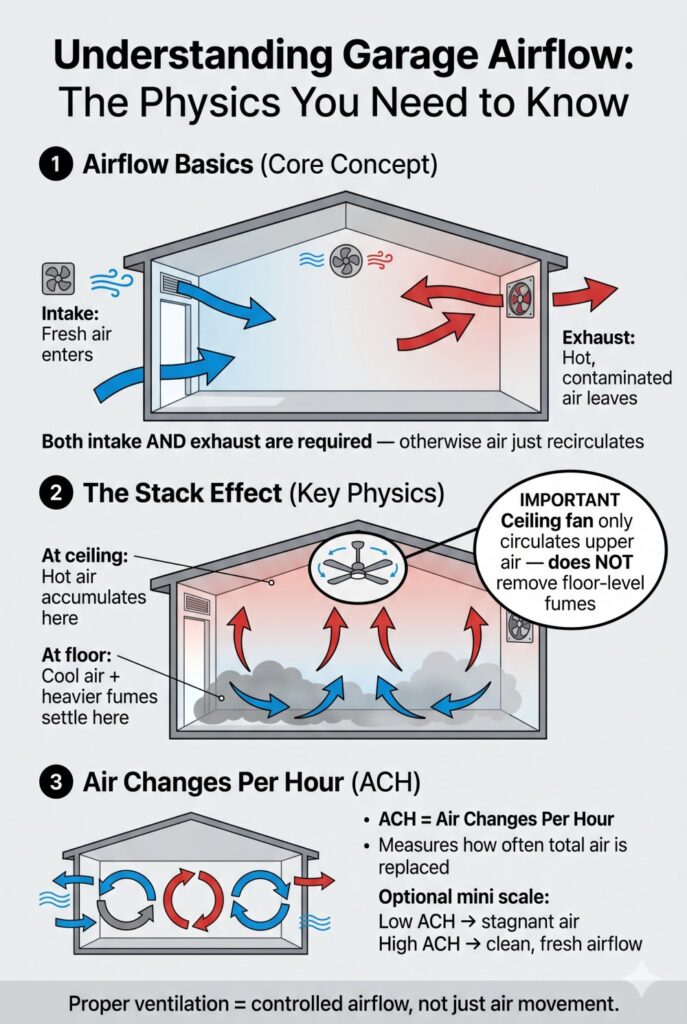
Effective garage ventilation requires two things happening simultaneously: exhaust (stale, hot, contaminated air leaving) and intake (fresh air entering to replace it). Without both, you’re just moving the same air in circles.
The Stack Effect: Hot air rises. In a sealed garage, heat accumulates at ceiling level, while cooler, denser air (and heavier chemical fumes) settle at floor level. This is why a single ceiling fan does almost nothing for fume removal — it circulates the ceiling air but doesn’t flush the floor-level contamination.
Air Changes Per Hour (ACH): HVAC engineers measure ventilation effectiveness by how many times per hour the entire air volume of a space is replaced with fresh air. Recommendations by use:
| Use Case | Minimum ACH | Notes |
|---|---|---|
| Storage only | 2–4 ACH | Basic comfort and moisture control |
| Workshop (power tools) | 4–6 ACH | Sawdust and debris management |
| Vehicle work / running engines | 6–10 ACH | CO and exhaust fume removal |
| Spray painting / chemical use | 10–20 ACH | Requires dedicated exhaust + filtered intake |
Calculating Your Required CFM: The formula: Garage Volume (cu. ft.) × Target ACH ÷ 60 = Required CFM of ventilation.
Example: 20×20 ft. garage, 9 ft. ceiling = 3,600 cu. ft. × 6 ACH ÷ 60 = 360 CFM minimum for vehicle work.
Attached Garage Health Risks:VOC fume dangers
Best Garage Air Filtration Systems: complete air management
Best Garage Fans & Ventilation – 4 Types: Honest Comparison
Type 1 — Portable Box / Pedestal Fans
CFM range: 1,000–4,000 CFM Cost: $30–$150 Best for: Air circulation on hot days; moving air while you work
Box fans and pedestal fans move large volumes of air but don’t create true exhaust — they circulate garage air without replacing it with fresh outdoor air (unless you place them in a window or door opening). They’re a comfort tool, not a ventilation solution.
Best use position: In the open garage door, facing out — this creates a partial exhaust effect and draws fresh air in from the opposite side.
➡️ Shop Box Fans for Garages on Amazon
Type 2 — Wall-Mount Exhaust Fans
CFM range: 200–1,500 CFM Cost: $80–$400 Best for: Permanent ventilation; fume removal; workshop use
A wall-mount exhaust fan installs through an exterior wall (or roof) and pulls contaminated air out of the garage. When combined with fresh air intake (a louvered vent or cracked door on the opposite wall), it creates genuine through-ventilation.
🌡️ The Seasonal Fan Logic: Venting Without Losing Your Heat
Running your exhaust fan at full speed in January solves your fume problem and creates a new one — you’ve just pushed $40 of heated air out of the garage in 10 minutes. The solution isn’t to choose between safety and efficiency. It’s to match fan speed to the task.
The iLIVING Winter vs. Summer Speed Protocol
| Season | Situation | Recommended Speed | Why |
|---|---|---|---|
| Winter | General workshop use (sawdust, no fumes) | 35% (low) | Removes particulates without significant heat loss |
| Winter | Running vehicle / exhaust fumes | 100% (high) for 10 min, then off | CO and exhaust require maximum ACH — brief purge, then close |
| Winter | Spray paint / solvents | 100% (high) + crack door for makeup air | Flammable vapor needs maximum removal; makeup air prevents pressure drop |
| Summer | General workshop | 60–80% (medium-high) | Balances comfort and noise |
| Summer | Grinding / heavy dust | 100% (high) | Particle removal at maximum |
| Summer | Light assembly work | 0% — use ceiling fan only | No fume risk; ceiling fan provides comfort without energy waste |
The “10-Minute Vehicle Purge” Rule: When running a vehicle in the garage — even briefly to back out — run the exhaust fan at 100% for a minimum of 10 minutes after the vehicle leaves. CO binds to the room air even after the vehicle is gone. A 10-minute full-speed purge at 780 CFM (iLIVING 12″) completely exchanges the air volume of a 2-car garage twice. This is the NIOSH-recommended minimum purge time for residential garages.
Attached Garage Health Risks :CO purge rule
⚡ The Smart Upgrade: Humidity-Activated Fan Switch
The next level of garage ventilation isn’t running the fan manually — it’s having the fan turn itself on when conditions demand it. A smart humidity/VOC switch replaces your standard wall switch and monitors the garage air continuously. When humidity exceeds your threshold (say, 60% RH) or when VOC levels spike (from finishing products, exhaust, or chemical use), the fan activates automatically and shuts off when levels return to normal.
This eliminates the #1 failure mode of garage ventilation: forgetting to turn it on.
Best pick: Lutron Caseta smart fan speed control — pairs with any 0–10V variable-speed fan (including the iLIVING) and can be automated via humidity sensor trigger through a smart home system.
➡️ Shop Smart Fan Speed Controllers on Amazon
Standalone humidity switch: The Inkbird IBS-TH3 humidity controller plugs in-line with the fan. Set your target humidity. The fan turns on and off automatically — no smart home system required.
➡️ Check Price — Inkbird Humidity Controller on Amazon
The math on automation: A garage exhaust fan running at 35% speed draws approximately 40 watts. Running 6 hours/day costs about $1.05/month. Running only when needed (humidity above threshold, typically 2–3 hours/day in moderate climates) cuts that cost by 50–60% while delivering better air quality management than a manual-on system.
The 2-inch rule: Install the exhaust fan as HIGH on the wall as possible — this removes the hot, contaminated air at ceiling level where it accumulates. Fresh air intake vents go LOW on the opposite wall — this creates diagonal airflow that sweeps across the floor where fumes settle.
Key specs to compare:
| Spec | Minimum for 2-Car Garage | Recommended |
|---|---|---|
| CFM | 350+ | 500–750 CFM |
| Sone Rating (noise) | Under 3 sones | Under 2 sones |
| Motor Type | PSC or EC | EC (variable speed, most efficient) |
| Weatherproofing | UL Listed for outdoor/damp | UL Listed |
| Backdraft Damper | Required | Motorized damper (seals when off) |
🏆 Best Wall Exhaust Fan: iLIVING 12-Inch Variable Speed Fan
Why it wins: The iLIVING 12″ delivers 780 CFM on high — enough for a 2-car garage at 6 ACH. The variable speed (35%–100%) lets you run quietly at low speed for general work and crank to full for paint or fume-generating tasks. The motorized shutter closes automatically when the fan is off, preventing backdraft on cold days.
Runner-up — Hurricane Classic 6-inch Inline Fan: For smaller garages (1-car, up to 500 CFM requirement), the Hurricane inline fan mounts in ductwork and operates nearly silently. Ideal for attached garages where noise matters.
Type 3 — Ceiling-Mount Shop Fans (High-Volume, Low-Speed)
CFM range: 3,000–12,000 CFM Cost: $200–$600 Best for: Large garages (3+ car); temperature management; high-heat climates
High-volume, low-speed (HVLS) ceiling fans move enormous amounts of air at low RPM — they’re the large-diameter fans you see in warehouses and commercial shops. In a large garage, a single 6-foot HVLS fan can create enough air movement to drop the perceived temperature by 8–10°F and prevent hot spots.
Important: HVLS fans move air but don’t exhaust it. They’re a comfort and temperature-management tool, not a fume-removal system. Use them in combination with wall exhaust fans.
➡️ Shop Garage Ceiling Fans (HVLS) on Amazon
Best Ceiling Fan Pick: Minka-Aire 60″ Garage Fan
For standard 2-car garages (9–12 ft. ceilings), the Minka-Aire 60-inch with 3 blades delivers 7,477 CFM on high — more than sufficient for an entire 2-car garage. The damp-rated motor handles garage humidity without corrosion.
Type 4 — Whole-Garage Ventilation Systems (ERV/HRV)
CFM range: 50–200 CFM continuous Cost: $400–$1,200 installed Best for: Attached garages where continuous CO and fume protection is needed
Energy Recovery Ventilators (ERV) continuously exchange indoor garage air with outdoor air while recovering most of the thermal energy — meaning they ventilate without wasting heating or cooling energy. They’re the only ventilation type that operates continuously, silently, and without the energy waste of leaving windows or doors cracked.
In attached garages (where garage air infiltrates living spaces), a continuously operating ERV is the most comprehensive health solution available.
The Complete Ventilation Product Table
| Product | Type | CFM | Best For | Amazon |
|---|---|---|---|---|
| iLIVING 12″ Variable Speed Wall Fan | Wall Exhaust | 780 CFM | 2-car garages, all uses | View on Amazon → |
| Broan-NuTone 8″ Exhaust Fan | Wall Exhaust | 350 CFM | 1-car garages, basic ventilation | View on Amazon → |
| Hurricane Classic Inline Fan | Inline Duct | 200–400 CFM | Silent exhaust for attached garages | View on Amazon → |
| Minka-Aire 60″ Ceiling Fan | HVLS Ceiling | 7,477 CFM | Large garages, heat management | View on Amazon → |
| PELONIS 20″ Box Fan | Box/Portable | 2,012 CFM | Budget circulation; door-mount use | View on Amazon → |
| Stanley High-Velocity Blower Fan | Portable Blower | 1,000–3,000 CFM | Fume purging after spray sessions | View on Amazon → |
The Spray Painting Ventilation Setup (Non-Negotiable)
If you spray paint, lacquer, or use solvent-based products in your garage, standard shop ventilation is insufficient. You need:
- Dedicated exhaust fan rated for flammable vapors (explosion-proof motor — standard fans create ignition sparks)
- Filtered intake on the opposite wall (keeps overspray from coating everything)
- Respirator (a $15 dust mask is NOT adequate for solvent vapors)
- No ignition sources during and for 30 minutes after spraying
➡️ Shop Explosion-Proof Exhaust Fans on Amazon
Attached Garage Health Risks: Dust Mask
Do I need a permit to install a wall exhaust fan?
In most jurisdictions, installing a wall exhaust fan through an exterior wall requires a building permit if it creates a new penetration in the wall. Check your local building department. Many allow DIY installation with a post-installation inspection.
How loud is a typical garage exhaust fan?
Consumer exhaust fans range from 1.5 sones (very quiet — like a library) to 6+ sones (noticeably loud). For a garage used as a workshop, under 3 sones is comfortable. For an attached garage near bedrooms, target under 2 sones.
Can I use my garage door as intake ventilation?
Yes — a partially open garage door (6–12 inches) provides substantial intake air when combined with an exhaust fan on the opposite or upper wall. This is the simplest intake solution for most garages.
Will a ceiling fan help with fumes from a running car?
No. Carbon monoxide fumes require active exhaust ventilation — air that flows out of the garage, not just circulated within it. A ceiling fan alone is inadequate and potentially dangerous for CO management.
The Bottom Line
Most garages need two things: a wall exhaust fan for active fume removal and a ceiling fan for temperature management. The iLIVING 12-inch wall exhaust fan handles the former; a 60-inch HVLS ceiling fan handles the latter. Together they create a complete system for under $400 that makes your garage safe, comfortable, and usable year-round.
Install the exhaust fan high. Install the intake low. And never run a vehicle or use chemical sprays without active ventilation running.