
Garage Insurance 2026: What Your Policy Actually Covers in the Garage, and the Gaps That Cost Money
Affiliate Disclosure: Pro Garage Gear participates in the Amazon Services LLC Associates Program. We earn from qualifying purchases at no extra cost to you. We don’t recommend, sell or earn from any insurance company or product, and the only product links on this page are safety gear. No manufacturer or insurer has paid for placement in this guide.
Facts last checked: October 24, 2026. Limits shown are typical; your policy and your state decide yours.
Garage Insurance – The Garage Is Where Insurance Assumptions Go to Die: Most people assume the homeowners policy covers “the garage.” It does, partly. Which part of the policy responds depends on whether the garage is attached, what is in it, whether any of it is used to make money, who gets hurt in it, and what kind of water is involved. A detached garage typically gets a fraction of the protection an attached one does. Your car isn’t covered at all. And a side business in the garage can fall almost entirely outside a standard policy.
This guide puts the whole garage on one page. It maps each part of your garage to the part of a standard policy that covers it, shows the limits that usually cause surprises, and ends with a tool that turns your own numbers into a list of questions for your agent. It is general information, not insurance advice or a quote. We don’t recommend any company or product, and your own policy language always controls.
The Coverage Map: What Responds to What
A standard homeowners policy (the common HO-3 form) is organized into six coverages, labelled A to F. Garage questions mostly land on five of them, plus two things the homeowners policy doesn’t cover at all.
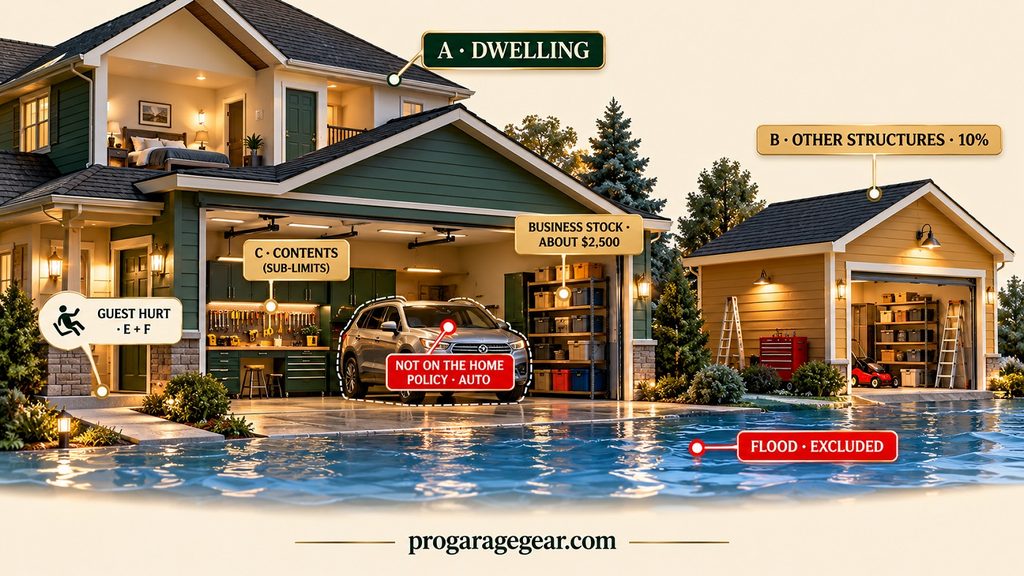
Sources: a state insurance regulator’s consumer guide, several insurer and agency explainers, and FEMA documents, listed at the end. Limits and wording vary by insurer.
The 10% Trap: Your Detached Garage Has a Ceiling
An attached garage is part of the house and shares your full dwelling limit. A detached garage is a separate structure, covered under “other structures” coverage, and sources agree that its default limit is typically 10% of your dwelling coverage. Two details make this bite:
- The limit is shared. It covers all detached structures combined: the garage, a shed, a fence, a pergola, a guest house. It isn’t a separate 10% for each.
- It’s easy to be under-insured. If the cost to rebuild the garage is more than 10% of your dwelling limit, a total loss won’t be covered in full. This is most likely when the garage was built or renovated after the policy was written, or when it’s really a workshop.

The fix is usually simple: sources say insurers will generally raise the other-structures limit if you ask. The point is to ask before a loss. The tool below does this arithmetic with your numbers.
Rebuilding to Today’s Code: Ordinance or Law Coverage
If an older garage is destroyed, local codes may require the rebuild to meet today’s standards, which can include electrical, fire-separation, energy and structural requirements the old building never had. Those code-upgrade costs are what ordinance or law coverage is for.
Sources describe a base amount as often already built in: standard homeowners forms commonly include ordinance or law as an additional coverage of about 10% of the dwelling limit, and an endorsement can raise it to 25% or 50%, while some policies include more. The catch is that a base amount may not stretch far on an older structure, and how it applies to a detached garage depends on your policy. We don’t recommend a percentage, because it depends on the age of the building and your local codes. Ask your agent:
- Is ordinance or law coverage included in my policy, and at what percentage?
- Does it apply to my detached garage or only to the house?
- What would a higher limit cost?
What’s Inside: Contents, Sublimits, and Your Car
Contents. Tools, lawn equipment, bicycles and stored boxes are generally covered under personal property coverage, in both attached and detached garages. The catch is the “limits within limits”: many policies cap specific categories, such as tools and electronics, well below what you might actually own. The place to look is the special limits of liability section of your declarations page. A well-equipped workshop can exceed it. If yours does, ask about scheduling high-value items.
The car in the garage. A homeowners policy does not insure your vehicle; motor vehicles are excluded from personal property coverage. If the garage burns, your car is a claim under your auto policy’s comprehensive coverage, not your home policy. The same goes for ATVs and motorcycles. That’s worth a five-minute check of your auto policy if you own something valuable.
Wear, pests and slow leaks. Standard homeowners policies (the common HO-3 form) exclude normal wear and tear, gradual deterioration, and damage from “birds, vermin, rodents, or insects,” because insurers treat them as maintenance, not sudden accidents. A sudden, accidental water discharge, such as a burst supply line, is typically covered; a slow leak under the utility sink is not. One nuance: an ensuing-loss clause can still cover a separate covered event that results. If a mouse chews wiring and a fire follows, the chewed wiring isn’t covered, but the fire damage may be. Prevention is the practical answer; see our pest control guide.
🛒 Check Price on Amazon — Water Leak Detector Sensors →
A leak sensor won’t make a slow leak a covered loss, but it can catch one early, before it becomes the kind of gradual damage a policy excludes.
Replacement Cost vs Actual Cash Value: Why a Payout Can Be Smaller Than You Expect
A policy can settle a claim in two ways, and the difference matters most for the tools you own:
- Replacement cost pays what it costs to replace the item new today.
- Actual cash value (ACV) pays replacement cost minus depreciation for age and wear.

According to insurance education sources, without a personal property replacement-cost endorsement a homeowners policy pays contents at actual cash value. State Farm describes contents as written on either basis: normally actual cash value until you replace the item, and, where the policy provides replacement cost, the depreciated amount paid after you replace it. Some property isn’t eligible for replacement cost even with the endorsement. The default varies by insurer and policy, so don’t assume.
An illustration, not a prediction: if an adjuster values a ten-year-old table saw at half of what a new one costs, an actual-cash-value payout covers about half the price of replacing it, and you fund the rest. Insurers’ depreciation schedules vary, so the real figure depends on your policy and the item. For a workshop full of older tools, the gap can add up.
What to do: look at your declarations page for how personal property (Coverage C) is settled. Ask what a personal property replacement-cost endorsement costs, how depreciation is paid, and which items are excluded from it. Your dwelling and other structures can be settled differently, so ask about those too. Keep receipts and the photo inventory from the audit below, which is how you prove what you owned.
The Business-Use Cliff
If you build furniture to sell, detail cars for money, repair bikes, or run an online shop from the garage, the homeowners policy is not designed for it. The pattern is consistent across the sources:
Weekend woodworking for your own use isn’t the issue. Selling what you make, or doing paid work, is. The line between a hobby and a business can be blurry, so if you earn money from the garage, tell your agent and ask in plain terms what is and isn’t covered.
Guests, Helpers and Liability
Two parts of the homeowners policy respond when someone other than you is hurt on your property:
- Coverage E (personal liability) pays legal costs and damages if you’re found responsible for someone’s injury or property damage. Standard policies commonly start at $100,000, and many people carry $300,000 or more.
- Coverage F (medical payments) pays a guest’s minor medical bills regardless of fault. Typical limits run $1,000 to $5,000.
An umbrella liability policy raises liability above the homeowners limit. It doesn’t change what the homeowners policy excludes.
Equipment questions. A garage is full of things that can hurt people: a car lift, a table saw, a welder, a home gym with a loaded barbell. We found no authoritative source describing how insurers treat each of these, so we won’t guess. Ask your insurer directly whether any exclusion or condition applies to the equipment you own, and keep the answer in writing. Our car lift guide covers the slab and electrical requirements that matter for safety.
Flood and the Garage
Flood damage is excluded from standard homeowners policies, and sources agree on this without exception. The federal National Flood Insurance Program (NFIP) and private flood insurers fill the gap, and the NFIP’s treatment of garages is worth knowing:
Definitions matter. In one FEMA flood-insurance appeal decision, a building without a door or opening large enough for a full automobile was ruled not to be a “detached garage,” and the claim was denied. NFIP contents are also generally paid at actual cash value, not replacement cost. Check your flood zone and talk to an agent; the NFIP’s limits for most residential policies are $250,000 for the building and $100,000 for contents, and a private policy can be tailored to your actual values.
A Car in Long-Term Storage
If a vehicle will sit in the garage for months, ask your auto insurer about storage coverage, also called comprehensive-only or parked-car coverage. It is widely described as keeping protection against theft, fire, flood, hail and vandalism while dropping liability and collision. Points that matter:
- It typically applies to a vehicle stored for 30 days or more, and the car can’t be driven on it. Reinstate liability and collision before you drive.
- State rules differ. Most states require liability insurance on a registered vehicle even if it isn’t driven, so ask your insurer and your DMV what applies.
- If you have a loan, the lender typically requires comprehensive and collision until it’s paid off. Some will accept comprehensive-only with written confirmation that the car is in secured storage.
- Don’t just cancel the policy: a lapse can raise your rates later.
➡️ For the physical side of storage (battery, fuel, tires, rodents, moisture): Long-Term Car Storage 2026 →
Permits, DIY Work and Your Claim
Garage upgrades often involve exactly the work that needs a permit: a 240V circuit, a sub-panel, an EV charger, a car lift, a heater, or turning part of the garage into a workshop. Skipping the permit can complicate a claim, though the picture is less absolute than some sources suggest.
- There’s no blanket rule. Sources written by electricians and contractors often say unpermitted work can void your coverage. More careful sources say it doesn’t automatically void a policy, and that no rule says every claim involving unpermitted work is denied. The outcome depends on your policy and on the facts of the loss.
- Policies exclude faulty workmanship. The standard homeowners form excludes loss caused by faulty or defective work, which is where an insurer can argue about wiring that was never inspected. A separate ensuing-loss clause can still preserve coverage for a resulting covered event such as a fire, so the answer isn’t automatic either way.
- Work done by a previous owner counts too. An investigator looks at the work, not who did it.
What protects you: pull the permits for work that needs them; use licensed professionals where your area requires it; and keep the permit sign-offs, inspection reports and licensed-contractor invoices with your inventory, along with photos of the work before the walls are closed up. If you’re unsure whether past work was permitted, ask your agent how your insurer treats it. Our electrical audit and cost guide cover which upgrades usually need permits.
The 30-Minute Garage Insurance Audit
Do these in order. They cost nothing and are what an adjuster will ask for after a loss.
- Pull your declarations page. Note Coverage A, B and C, the liability limit, and the “special limits of liability.”
- Estimate your garage’s rebuild cost. Ask a local contractor or use your insurer’s estimate; don’t use the purchase price.
- Photograph or video the garage, inside and out, including the shelves, workbench and every tool. Narrate what’s there.
- Write an inventory with approximate replacement values and, for anything expensive, serial numbers and receipts.
- Find out how contents are settled: replacement cost or actual cash value, and what the replacement-cost endorsement costs.
- Collect permits and invoices for any electrical or structural work, with photos taken before the walls were closed.
- Store the copies away from the garage, in the cloud or in a fireproof bag, so a fire doesn’t take the evidence too.
- Call your agent with the questions the tool below builds for you.
🛒 Check Price on Amazon — ABC Fire Extinguisher →
🛒 Check Price on Amazon — Fireproof Document Bag →
🛒 Check Price on Amazon — Heat Alarm for a Garage →
🛒 Check Price on Amazon — Waterproof Lockable Document Case →
Fires are the garage’s biggest insurable risk: industry estimates put garage-originating house fires at over 6,000 a year in the U.S. See our garage data page for the sourcing.
The Garage Coverage Gap Finder
Enter a few numbers and the finder does the arithmetic and lists the questions to ask your agent. It uses typical limits, not your policy. It can’t see your actual coverage.
🛡️ Garage Coverage Gap Finder
🛡️ Garage Coverage Gap Finder
Frequently Asked Questions
Does homeowners insurance cover my garage?
Yes, for covered causes such as fire, wind, hail and theft. An attached garage is covered as part of the dwelling, up to your dwelling limit. A detached garage is covered under other structures coverage, which typically defaults to 10% of your dwelling limit and is shared with other detached structures.
Is a detached garage covered the same as an attached one?
No. Sources agree that a detached garage falls under “other structures” coverage, usually limited to 10% of your dwelling coverage, while an attached garage shares the full dwelling limit. If rebuilding your detached garage would cost more than that, ask your agent to raise the limit.
Does homeowners insurance cover my car in the garage?
No. Motor vehicles are generally excluded from a homeowners policy. Damage to a car from fire, theft or similar causes is handled by the comprehensive coverage on your auto policy.
Are my tools covered if they’re stored in the garage?
Generally yes, under personal property coverage, but many policies cap certain categories such as tools and electronics. Check the special limits of liability on your declarations page and ask about scheduling expensive items.
Is a business run from the garage covered by homeowners insurance?
Only barely. A standard policy typically covers a small amount of business property, commonly about $2,500 on the premises, and generally excludes business liability. A business run in a detached structure may not be covered at all. Ask about an endorsement, an in-home business policy, or a business owner’s policy.
Is flood damage to my garage covered?
Not by a standard homeowners policy. Flood needs a separate policy from the federal program (NFIP) or a private insurer. The NFIP covers a detached garage only up to 10% of the dwelling limit and only if it’s used for parking and storage, and it excludes most vehicles.
Do I need insurance on a car that just sits in the garage?
Usually yes, in some form. Many insurers offer comprehensive-only storage coverage for vehicles stored 30 days or more, but state rules on liability for registered vehicles differ, and a lender may require full coverage. Ask your insurer and your DMV, and reinstate liability and collision before you drive.
Does homeowners insurance pay replacement cost for my tools?
Not necessarily. Without a personal property replacement-cost endorsement, a homeowners policy pays contents at actual cash value, which is replacement cost minus depreciation. Check how Coverage C is settled on your declarations page, and ask what the endorsement costs and how depreciation is paid.
Does my policy cover the extra cost of rebuilding a garage to current code?
Often partly. Standard homeowners forms commonly include a base amount of ordinance or law coverage, about 10% of the dwelling limit according to several sources, and an endorsement can raise it to 25% or 50%. How it applies to a detached garage depends on your policy, so ask your agent.
Can unpermitted work void my homeowners insurance?
There’s no blanket rule. Unpermitted or non-compliant work can complicate or lead to the denial of a claim tied to it, and policies exclude faulty workmanship, but it doesn’t automatically void a policy, and a resulting covered event such as a fire may still be covered. Outcomes depend on your policy and the facts. Get permits for work that needs them, keep the records, and ask your agent how your insurer treats existing unpermitted work.
The Bottom Line
The garage is covered in pieces, and each piece has its own ceiling. Know whether your garage is attached, check the 10% limit if it isn’t, read the special limits for your tools, keep your vehicles on your auto policy’s radar, treat any money-making activity as a separate insurance question, and remember that flood needs its own policy. Then spend 30 minutes documenting what’s in there, before you ever need to prove it.
Sources
- Maine Bureau of Insurance: A Consumer’s Guide to Homeowners Insurance (state regulator; coverages, liability, flood exclusion)
- Policygenius: Does home insurance cover garages? (attached vs detached; 10% default)
- MoneyGeek: Does home insurance cover detached garages? (shared 10% pool; flood excluded)
- Home Insurance Clear: Detached garage coverage (contents sublimits; special limits of liability)
- Insure.com: What does homeowners insurance cover? (motor vehicles not covered; liability and medical payments)
- Progressive: Homeowners insurance coverages (Coverages E and F)
- Policygenius: Home-based business insurance (business property sublimit; liability exclusion)
- Southlake: Home-based business insurance (cites Triple-I: $2,500 on premises, $250 off; liability uncovered)
- Real Cost Report: Home-based business coverage gaps (cites III; notes insurers differ, e.g. State Farm lower)
- DHB Insurance: Homeowners insurance and home-based business (unattached structures used for business)
- FEMA Floodsmart: Types of flood insurance coverage (detached garage; vehicles excluded)
- FEMA: NFIP Standard Flood Insurance Policy (detached garage limited to 10%; not used for residential, business or farming)
- FEMA Floodsmart: Appeal decision C29 (what counts as a detached garage)
- Flood Insurance Guru: Gaps in NFIP coverage (secondary source; contents in detached garages)
- State Farm: Long-term car storage (suspending liability and collision after 30 days)
- Insurance.com: Parked car insurance (comprehensive-only; state rules)
- Experian: Do I need insurance on a stored car? (lender requirements)
- State Farm: What is homeowners insurance? (actual cash value vs replacement cost; ordinance or law as a percentage of dwelling coverage)
- Achievable: Endorsements and scheduled property (personal property replacement cost; included ordinance or law of up to 10% of Coverage A)
- WP Insure: Ordinance or law coverage (base 10% on standard forms; 25% or 50% by endorsement)MoneyGeek: What is ordinance or law coverage?
- LegalClarity: Does homeowners insurance cover unpermitted work? (faulty-workmanship exclusion; cites the Insurance Information Institute HO-3 form)
- Close Permits Fast: Unpermitted work and home insurance (a missing permit does not automatically void a policy)
- LegalClarity: The maintenance exclusion (wear and tear, pests, gradual leaks, ensuing loss)MoneyGeek: Does home insurance cover rodent damage? (the vermin exclusion)
- Amica: Does homeowners insurance cover animal damage? (ensuing damage)
The Maine Bureau of Insurance guide and the FEMA documents are the most authoritative sources here. The rest are insurers, agencies and consumer-guide sites, so they report what’s typical rather than what your policy says. The Insurance Information Institute is the original source of several figures cited above. Limits and wording vary by insurer and state, and we are not licensed to give insurance advice.
Affiliate Disclosure: Pro Garage Gear earns from qualifying Amazon purchases at no extra cost to you. This guide is general information, not insurance, legal or financial advice. We don’t sell or recommend any insurance product. Read your own policy and talk to a licensed agent about your situation.